by Corinne Murdock | Mar 21, 2023 | News
By Corinne Murdock |
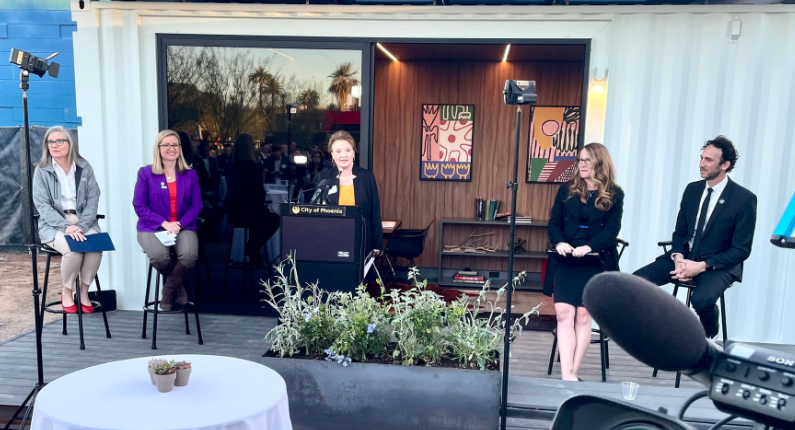
Last week, Gov. Katie Hobbs held “listening sessions” ahead of her third trip to the southern border in order to better understand the border crisis.
Hobbs met with groups that provide housing and transport for illegal immigrants seeking asylum to discuss the anticipated impact of Title 42’s end come May 11. These included Campesinos sin Fronteras, International Rescue Committee, Regional Center Border Health and representatives from Greyhound lines and Sky Harbor International Airport.
The governor claimed in a press release that her administration has “proactively” addressed the crisis.
“My administration is proactively addressing the myriad of issues with our southern border, and want to hear from organizations on the ground regarding how the administration can better support efforts to coordinate and collaborate on processing these individuals in the most humane and efficient manner,” said Hobbs.
There have been well over 4.9 million southwest border encounters since President Joe Biden took office. That’s an average of over 197,000 encounters a month. At this rate, there could be well over 9.4 million illegal immigrant encounters by the end of the president’s first term.
The encounter data doesn’t include gotaways: those illegal immigrants not apprehended but observed crossing into the country.
Hobbs plans to visit the border on Tuesday; her third since taking office in January, previously visiting Yuma, San Luis, and Somerton. Department of Homeland Security (DHS) Secretary Alejandro Mayorkas plans to join Hobbs for this latest border visit.
The governor has taken the opposite approach from her predecessor when it comes to border security. Almost immediately after taking office, Hobbs had the shipping containers removed and repurposed into houses for the homeless. Hobbs claimed that former Gov. Doug Ducey’s effort to close the border was a “publicity stunt,” and not a permanent solution.
The state spent about $95 million on construction and $75 million on removal of the shipping containers.
Following her election, Hobbs also pledged to dissolve Ducey’s Border Strike Force (BSF), established in 2015. Hobbs clarified during a press conference last month that the BSF would go away — but not its funding and resources.
“Right now, the Border Strike Force is not actually being utilized at the border, so we want to coordinate those resources where they can be most helpful with the law enforcement there,” said Hobbs. “It’s really important to listen to the folks working in the field that are experts on these and take our direction from them.”
Hobbs has also advocated for greater benefits to illegal immigrants, asking lawmakers for $40 million to finance illegal immigrants’ college tuition during her State of the State address in January.
Corinne Murdock is a reporter for AZ Free News. Follow her latest on Twitter, or email tips to corinne@azfreenews.com.
by Corinne Murdock | Mar 20, 2023 | News
By Corinne Murdock |
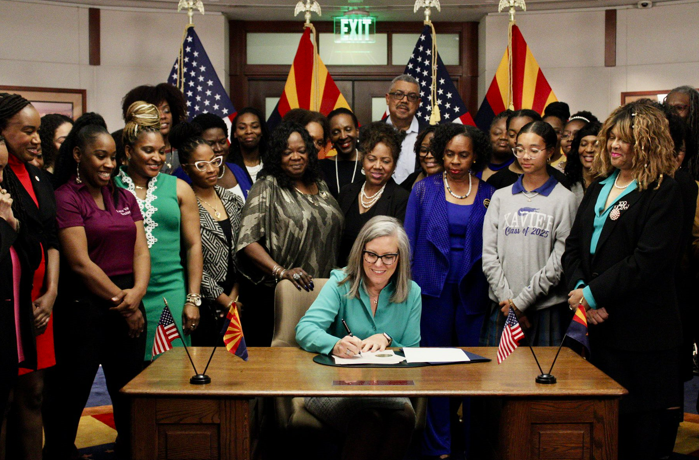
The “transracial” woman who stirred national controversy about eight years ago for falsely claiming to be Black attended Gov. Katie Hobbs’ signing of a ban on hair discrimination last Friday.
Rachel Dolezal, who now goes by Nkechi Amare Diallo, formerly served as the president of an NAACP chapter in Washington, as well as an Africana studies professor at Eastern Washington University. The truth of Dolezal’s race came to light after her parents came forward to disavow her claimed identity, following her Black rights activism and claims to police and media that she was the victim of racially-motivated hate crimes.
Hobbs signed the executive order — titled the “Create a Respectful and Open World for Natural Hair” Act, or “CROWN” Act — on Friday. The California-originating model legislation prohibits public schools and state employers or contractors from discriminating against employees’ hair texture and protective styles, such as braids, locs, twists, knots, and headwraps.
“Black women, men, and children should be able to wear their natural hair with pride and without the fear of discrimination,” tweeted Hobbs, echoing a line from the executive order.
Dolezal wasn’t included in the published version of the photo posted by the governor.
California lawmakers passed their version of the CROWN Act in 2019. New York, New Jersey, Washington, Maryland, Nevada, Virginia, Colorado, Massachusetts, and Illinois all followed suit in passage of their version of the model legislation.
The Arizona legislature last considered a version of the CROWN Act in 2021 under HB2593 from former Democratic State Rep. Aaron Lieberman. The legislation didn’t make it to committee.
Reactions to Hobbs’ executive order were mixed, mainly along party lines.
The Arizona Free Enterprise Club (AFEC) questioned Hobbs’ priorities: making time for an executive order declaring the professionalism of certain hairstyles while other issues such as the border crisis continue unsolved.
“We don’t have a budget or a secure border, inflation is raging, our elections are a laughingstock and our schools are a parent’s worst nightmare. But at least there’s this,” tweeted AFEC.
However, some criticism came from within Hobbs’ own party. Talonya Adams — the woman impacted by racial discrimination under Hobbs when the governor was Senate Minority Leader in the legislature — indicated that Hobbs’ executive order was an attempt to placate the Black community.
In a since-deleted tweet, Adams questioned Hobbs’ decision to prioritize a social issue like hair discrimination over other, more pressing issues like the homeless crisis or offering an explanation of the Oman trip.
Corinne Murdock is a reporter for AZ Free News. Follow her latest on Twitter, or email tips to corinne@azfreenews.com.
by Corinne Murdock | Mar 15, 2023 | News
By Corinne Murdock |
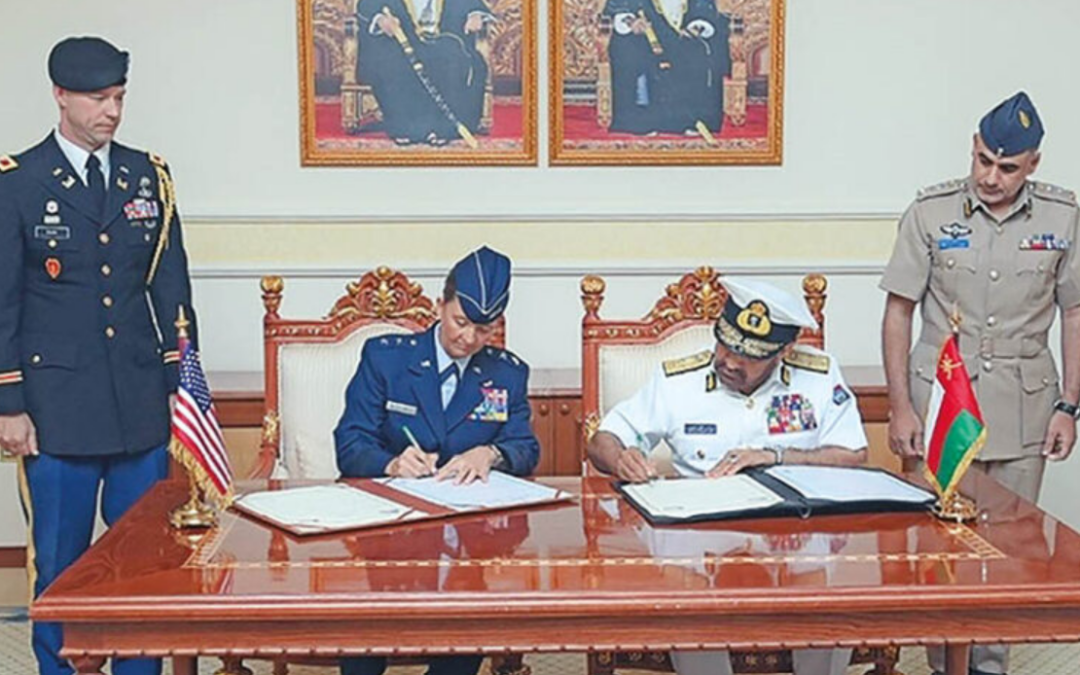
This week, Gov. Katie Hobbs departed for Oman to officiate a pact made under the former administration with the Middle Eastern country.
In a press release, Hobbs said that the partnership provided greater readiness for Arizonan forces. Oman has a population of nearly four million people, bordering Saudi Arabia, the United Arab Emirates, and Yemen. The partnership formed under former Gov. Doug Ducey last October.
“This partnership is grounded in our Arizona National Guard military relationship but expands to other sectors of the government bringing valuable interoperability opportunities for both countries,” said Hobbs.
Kerry Muehlenbeck, Arizona National Guard adjutant general and Department of Emergency and Military Affairs director, added that the partnership would strengthen both country’s forces.
The Arizona National Guard established the partnership last October through the Department of Defense National Guard Bureau State Partnership Program. The program partners states with nations in order to bridge international civil-military affairs; over 90 nations have a match in the states. This year marks the program’s 30th anniversary.
Arizona partners with one other country through the program, the Republic of Kazakhstan, a relationship it has held since 1993.
Daniel Hokanson, chief of the National Guard Bureau, said that the program also allows soldiers to visit other countries and understand problem-solving skills from foreign soldiers.
“To look at the environment that they operate in, and to really see, in many cases, the same problems — just approached from a different angle,” said Hokanson. “We learn a lot in those countries and in those interactions that we bring back to make our organizations better, and I like to think vice versa.”
Several days after announcing the partnership, the University of Arizona (UArizona) Eller Executive Education announced a partnership with the Royal Academy of Management in Oman for a program, “Developing Leaders and Future Foresight.” Although the press release was issued several days after the state announced the National Guard partnership, UArizona’s initial press release was dated for the same day as the state’s announcement.
UArizona’s partner program with Oman is designed to develop and equip national leaders to fulfill Oman’s “Vision 2040,” a plan to become a developed country by 2040.
Oman is one of the top oil exporters. They also export liquified natural gas.
Hobbs attended the formal signing ceremony on Monday, and is scheduled to depart from Oman on Wednesday. Oman leadership is scheduled to visit Arizona in May.
Corinne Murdock is a reporter for AZ Free News. Follow her latest on Twitter, or email tips to corinne@azfreenews.com.
by Daniel Stefanski | Mar 10, 2023 | News
By Daniel Stefanski |
Democrat Governor Katie Hobbs is giving her veto stamp a workout in the first two-plus months of the Arizona Legislative session, and Republicans are not pleased with her disdain for their policy proposals.
On Thursday, Governor Hobbs vetoed SB 1305, which was sponsored by Senator J.D. Mesnard. According to the purpose of the legislation provided by the State Senate, SB 1305 “prohibits a public school, school district or state agency that is involved with students or teachers of preschool or kindergarten programs of any of grades 1 through 12 (state agency), or an employee of a public school, school district or state agency, from providing instruction to students or employees that promotes or advocates for specified concepts relating to race and ethnicity.”
Senator Mesnard was not happy in the least about Hobbs’ veto of his legislation, issuing the following statement once her decision was official: “I’m deeply disheartened by Governor Hobbs’ choice to condone these discriminatory teachings our kids are being exposed to, by vetoing my bill. As lawmakers, we are called to protect the vulnerable, including impressionable and innocent kids. Her action today is a slap in the face to parents who came forward with serious concerns about the racism being taught in their children’s classrooms.”
The governor released a short explanation of her veto of SB 1305, writing, “It’s time to stop pushing students and teachers into culture wars rooted in fear mongering and evidence-free accusation. Bills like SB1305 serve only to divide and antagonize. I urge the Legislature to work with me on the real issues affecting Arizona schools: underfunded classrooms, a growing educator retention crisis, and school buildings in need of repair and replacement.”
The ACLU of Arizona agreed with Hobbs’ veto, tweeting, “Young people have a right to learn an inclusive and complete history in schools, free from partisan restrictions. We applaud @GovernorHobbs for vetoing #SB1305, the legislature’s latest attempt to censor Arizona classrooms and distract from real issues.”
Mesnard addressed Hobbs’ condemnation of Republican tactics and policies: “Contrary to Governor Hobbs’ accusation in her veto letter that we are not working on ‘real issues,’ Senate Republicans have so far passed a budget that would have provided assurance that schools, public safety, health services, child welfare services, transportation, and other government functions would not shutdown come July 1. We’ve passed a rental tax cut that would have provided much needed relief to our citizens struggling with housing affordability and crippling inflation. In fact, within the first two months of session, the Senate has passed more than 200 bills addressing a variety of issues important to the people of Arizona. We certainly have proven we know how to multitask, but unfortunately, we’re working with a Governor who is playing political games with lives and livelihoods.”
Hobbs’ veto of this bill risks the increased ire of a growing number of parents who are extremely concerned about what their children are being taught in district and charter schools. Over the past few years especially, educational curriculum and reading material has been under a massive amount of scrutiny and research, leading to heightened election contests and fiery confrontations at school board meetings around the country.
The veto of SB 1305 was Hobbs’ 16th of the legislative session. Many additional vetoes are expected as Republicans continue to pass bills out of the Arizona Legislature and transmit to the Ninth Floor of the Executive Tower.
Daniel Stefanski is a reporter for AZ Free News. You can send him news tips using this link.
by Daniel Stefanski | Mar 7, 2023 | News
By Daniel Stefanski |
The Arizona Legislature finished its work on an important piece of legislation to protect children from a leftist agenda in schools, but the bill faces a near-certain dismissal from Democrat Governor Katie Hobbs.
Last month, both the Arizona House and Senate voted to approve SB 1305, sponsored by Senator J.D. Mesnard, which deals with prohibited instruction in schools. According to the purpose of the legislation provided by the State Senate, SB 1305 “prohibits a public school, school district or state agency that is involved with students or teachers of preschool or kindergarten programs of any of grades 1 through 12 (state agency), or an employee of a public school, school district or state agency, from providing instruction to students or employees that promotes or advocates for specified concepts relating to race and ethnicity.”
Like many bills in the Arizona Legislature this session, SB 1305 attracted partisan votes throughout the committee process and on the floors of both chambers. The vote in the Senate was 16-12 in support, with two members (Senators Gabaldon and Miranda) not voting. The vote in the House was 31-29 in favor.
After voting in favor of the bill in February, Representative Austin Smith wrote, “We shouldn’t teach kids in Arizona to hate their fellow man or America.”
On Monday, SB 1305 was transmitted to the Governor’s Office on the Ninth Floor of the Arizona Executive Tower. The bill sponsor, Senator Mesnard, released the following statement to accompany his bill’s recent clearance from the state legislature: “Teaching about historical movements, ideologies or instances of racial hatred and discrimination, including slavery and Jim Crow, are absolutely legitimate and sensible topics of study in the classroom. However, pushing a destructive and racist ideology has no place in our schools. More and more parents are expressing concern over this issue, and we must ensure we nip this in the bud now before the damage is done on our impressionable youth. My colleagues and I in the Senate are calling on Governor Hobbs to sign this commonsense legislation.”
Mesnard’s bill also “outlines procedures for complaints, enforcement and the imposition of civil penalties up to $5,000.”
Arizona Superintendent of Public Instruction, Tom Horne, provided the following quote to AZ Free News on his support of the bill: “All of my life I have believed that we are all individuals, brothers and sisters under the skin, and that what matters is what we know and can do, and not what race we were born into.”
Representatives from Stand for Children, Arizona School Administrators Association, Arizona Education Association, American Civil Liberties Union of Arizona, Save Our Schools Arizona, Arizona School Boards Association, and the Children’s Action Alliance opposed this legislation during the legislative process.
Last month, Save Our Schools Arizona tweeted, “Today, the #AZLeg passed #SB1305, an anti-public school culture-war bill to ban teaching ‘controversial topics,’ drive further distrust of educators & impose $5,000 fines.”
After the bill was approved by the legislative bodies, Stand for Children Arizona tweeted, “If you support teachers and want AZ students to learn accurate history, SIGN OUR LETTER requesting a veto on this bill, and similar bills moving forward.”
The legislation now awaits its fate from Governor Hobbs, who is expected to veto the bill in the coming days.
Daniel Stefanski is a reporter for AZ Free News. You can send him news tips using this link.