As expected, Governor Katie Hobbs vetoed the budget sent to her by the Arizona Legislature, putting the state’s financial future into a potential situation of future limbo.
Instead of signing a budget very similar to one passed last session by a bipartisan majority of legislators, Governor Hobbs repeatedly attacked Republicans for doing their constitutional duties over the past month, characterizing the $15.8 Billion budget as “approved by a slim, partisan majority.” Her statement, released after her veto of the budget, framed the legislature’s offering as a “do-nothing budget” that “kicks the can down the road,” and that it was “an insult to Arizonans.”
After these sharp assertions by Arizona’s new Chief Executive, her office released a tweet from her @GovernorHobbs account that reiterated her oft-used claim that her “door is open” and that she welcomes “any sincere efforts to work on a budget that puts people, not politics, first.” Hobbs’ “open-door” claim has been refuted by Republicans throughout the first month of the legislative session, including one statement from Representative David Livingston on February 1, 2023, when he said, “It’s one thing to talk a big talk & use social media to say you have an open-door policy, but I can tell you from personal experience, her door is locked from the inside.”
🔥🔥🔥"It's one thing to talk a big talk & use social media to say you have an open-door policy, but I can tell you from personal experience, her door is locked from the inside."
Senate President Warren Petersen had also shared his concerns about the lack of communication from the Ninth Floor in the weeks leading up to this budget passage and gubernatorial veto. Also on February 1, Petersen told his chamber that “we have an open door policy to hear all budget requests and suggestions, and we haven’t heard a peep from Governor Hobbs!”
"We have an open door policy to hear all budget requests and suggestions, and we haven't heard a peep from Governor @GovernorHobbs!"
Republicans had no shortage of responses after seeing the news of the governor’s veto. Senate President Pro Tempore T.J. Shope tweeted, “How brave to veto a budget that just six months ago was awesome. Gonna be a long session and a long four years @GovernorHobbs but I’ll be here for all of it. Some of us have been working and others have been offering platitudes about open doors and such. Arizonans deserve better…”
How brave to veto a budget that just six months ago was awesome. Gonna be a long session and a long four years @GovernorHobbs but I’ll be here for all of it. Some of us have been working and others have been offering platitudes about open doors and such. Arizonans deserve better… https://t.co/D82U7A1Jsv
Representative Lupe Diaz wrote, “Katie Hobbs just vetoed a sensible strong budget that both Republicans and Democrats voted on last year. With this veto she shows that she is willing to put the citizens of Arizona in the path of a State shut down.”
Katie Hobbs just vetoed a sensible strong budget that both Republicans and Democrats voted on last year. With this veto she shows that she is willing to put the citizens of Arizona in the path of a State shut down. Let your friends know that she is irresponsible and reckless.
Representative Joseph Chaplik informed his followers that “Every single Dem in #azleg voted for this budget in 2022. Katie Hobbs’ veto shows she’d rather shut the state down than do the right thing for every citizen of this state.”
Every single Dem in #azleg voted for this budget in 2022. Katie Hobbs’ veto shows she’d rather shut the state down than do the right thing for every citizen of this state.
Hobbs’ veto proves once again that she cares more for illegals than Arizonans and is an unserious… https://t.co/94mWApjitl
Senator Anthony Kern said, “Katie Hobbs just vetoed $82 million for the School Safety Program that provides grant funding for both school counselors and school resource officers.”
Katie Hobbs just vetoed $82 million for the School Safety Program that provides grant funding for both school counselors and school resource officers. @AZSenateGOPpic.twitter.com/QrG9m47yEF
Legislative Democrats, however, were appreciative of Hobbs’ veto. House Democratic Leader Andrés Cano applauded the governor’s action, saying, “Republican lawmakers unilaterally introduced a sham budget that they knew would be vetoed. This was a colossal waste of time by the GOP that involved no opportunity for compromise or negotiation.” Senate Democratic Leader Raquel Terán tweeted, “.@GovernorHobbs did right by every Arizona with this veto. This ‘budget’ does nothing to move us forward, but would rather chain us to the past. It’s time to step into the future and craft a budget that addresses our shared reality.”
Arizona’s Fiscal Year 2024 begins July 1, and Governor Hobbs’ veto has now officially kickstarted the stare down over a possible lapse in state funding this summer. Hobbs is expected to veto many more Republican bills this session, and it remains to be seen if communication between the sides will improve as they approach the June 30 deadline to reach an accord on another budget compromise.
Daniel Stefanski is a reporter for AZ Free News. You can send him news tips using this link.
Katie Hobbs’ reign as governor of Arizona is off to a rough start. She was booed at the Phoenix Open this past weekend. She looked foolish in an interview before the Super Bowl with Fox News Sunday host Shannon Bream—who called out Hobbs for opposing school choice even though she attended a private school. And her pick to lead the Arizona Democratic Party, Maricopa County Supervisor Steve Gallardo, was rejected.
That’s not a good look for a governor who’s been in office just over a month. And it’s probably why, at this point, Hobbs has chosen to rule by executive action. But her latest failure may be her worst to date.
Earlier this week, Hobbs’ pick to lead the Department of Health Services (DHS), Dr. Theresa Cullen, failed miserably when the Senate rejected her nomination…
Governor Katie Hobbs’ nominee to head up Arizona’s health services department failed to earn the support of a majority of Senate members on Tuesday.
Last week, the Arizona Senate’s bipartisan Committee on Director Nominations held its first hearing to vet the nominations of two of Governor Katie Hobbs’ appointments to lead state agencies. One, Angie Rodgers, who was nominated to lead the Department of Economic Security, received unanimous support from all five committee members (three Republicans and two Democrats). The other, Dr. Theresa Cullen, who was nominated to run the Department of Health Services (DHS), received an unfavorable recommendation after lawmakers had ample time to review her record and statements.
This week, the full Arizona Senate took up the nominations and rejected the governor’s choice to lead DHS. This was not any ordinary vote, however. Senate Democrats – and Governor Hobbs – claimed that the nomination was withdrawn, and the vote was moot. President Warren Petersen informed Senators that he had not received the withdrawal notice, and so the vote proceeded as scheduled. AZ Free News was told that the Governor attempted to withdraw her nomination of Dr. Cullen, but nothing was received by the Senate’s Secretary.
The Senate’s course was expected after the committee hearing, in which Petersen served up a warning following perceived inconsistencies in Dr. Cullen’s answers, tweeting, “Any nominee who gets caught lying at a confirmation hearing is not fit to serve the state of Arizona.”
Any nominee who gets caught lying at a confirmation hearing is not fit to serve the state of Arizona. The 9th floor could learn from Napolitano. Napolitano did not appoint radical lefties as directors.
In an exclusive interview with AZ Free News, Senator Jake Hoffman, the chairman of the Director Nominations Committee, had the following to say after the floor action and the governor’s attempt to frame Dr. Cullen’s defeat as a Republican-forced withdrawal:
“Personnel is policy, and Katie Hobbs demonstrated with the nomination of Theresa Cullen that her policy agenda is an extreme, authoritarian one that will have no problems infringing the civil liberties of the people of Arizona. Cullen’s record is one of lockdowns, curfews, school closures, forced vaccinations, shaming Pima County citizens, and lying during her confirmation hearing. The people of Arizona deserve better.”
After the Senate’s vote, the Senate Republican Caucus released statements from its leadership team, reacting to the latest development with Governor Hobbs’ problematic nomination. Senate President Petersen said, “We now hope that the Governor takes a more pragmatic approach to this process and appoints individuals in the mainstream, without a political agenda, and who are ready to answer questions from the public.”
Senate President Pro Tempore T.J. Shope stated, “We heard some pretty damning testimony in last week’s committee hearing that was only made worse with lies from Dr. Cullen. Presenting us with this kind of nominee only highlights a failure from the Hobbs administration.”
Senate Majority Whip Sine Kerr responded, “If only Governor Hobbs would have taken the time to conduct the same thorough vetting process as my colleagues and I did at the Senate, we would not be here today, voting on – and ultimately rejecting – a nominee who clearly is not an appropriate fit for this position.”
Governor Hobbs, on the other hand, was furious about the Senate’s action in rejecting her nominee for DHS, writing, “As long as Republicans choose politics over the people of Arizona, some of the most talented and qualified candidates will choose not to enter state service, and it is the people of Arizona who will suffer most because of these political games.” She characterized the behavior of “some Republicans on the State Senate’s committee on director nominations” as “nothing short of harassment,” and she bemoaned the rejection of a nominee with a “mountain of expertise and an immense track record of public health success.”
The Arizona Senate Democratic Caucus claimed in a tweet that Hobbs’ letter was “hand delivered and sent via email to ensure (the Republicans’) symbolic nonsense vote wasn’t necessary.
According to Arizona Senate sources, Governor Hobbs has now transmitted nine total nominations to the legislature, including the failed nomination of Dr. Cullen. The governor is expected to name a replacement nominee for Dr. Cullen, though she blasted Senate Republicans for her current dilemma: “If the Senate’s Director Nominations Committee is unwilling to acknowledge the skill and expertise of Dr. Cullen, there may be no public health professional in the State they would endorse.”
Daniel Stefanski is a reporter for AZ Free News. You can send him news tips using this link.
Benjamin Franklin once famously said, “[I]n this world, nothing is certain except death and taxes” — true, unless you’re a leftist political nonprofit. For many of them, taxation isn’t certain, even if they run afoul of tax-exempt status requirements.
Funding sources, expenditure recipients, and even those operating these nonprofits may remain secretive under the current state of lax federal enforcement. These tax-free and opacity perks are possible through two interrelated federal tax classifications: 501(c)(3), or “C3,” and 501(c)(4), or “C4.” There are over 27,000 C3s and just over 1,200C4s registered in Arizona. The big difference between the two classifications is that donations to IRS-recognized C3 organizations are deductible under our income tax code. And the Left has learned how to exploit this tax status for their political benefit.
In Arizona, many liberal C3 and C4 nonprofits work in tandem, each executing symbiotic duties while coordinating their activities and sharing data and resources. Sometimes, these C3 and C4 duos are “sister” organizations — meaning, they’re affiliated rather than independent entities allied over common goals.
These arrangements are legal so long as clear distinctions are made between charitable and non-charitable activities. Over the last several months, AZ Free News has conducted an extensive review of over a dozen different liberal nonprofits in the state, examining their websites, tax documents, and social media accounts. Our research has found that many of these organizations have blurred the lines on their political activities via various C3 and C4 groups. In some cases, there appeared to be no distinction at all, with some C3 organizations providing completely different accounts of their tax-deductible program activities to the IRS compared to what they shared publicly.
How the IRS Intended for C3 and C4 Organizations to Operate
C3s have two major qualifiers: they’re supposed to be nonpartisan and apolitical—meaning, they can’t expend funds or use resources to coordinate with political activity being conducted by C4s.
C3s must organize and operate exclusively for purposes that are one or more of the following: charitable, religious, educational, scientific, literary, testing for public safety, fostering national or international amateur sports competition, and preventing cruelty to children or animals.
The IRS defines “charitable” as relief of the poor, the distressed, or the underprivileged; advancement of religion; advancement of education or science; erecting or maintaining public buildings, monuments, or works; lessening the burdens of government; lessening neighborhood tensions; eliminating prejudice and discrimination; defending human and civil rights; and combating community deterioration and juvenile delinquency.
The IRS expressly prohibits C3s from being an “action organization”: those engaging in political or legislative activities. Political activities include the direct or indirect participation or intervention in any political campaign on behalf of or in opposition to any political candidate. The IRS also prohibits political campaign fund contributions or public statements of positions, either verbal or written, on behalf of the organization in favor of or opposing any candidate.
The IRS does condone voter education activities, such as get-out-the-vote (GOTV) efforts like voter registration. However, any evidence of political bias is forbidden: favoritism of a candidate, opposing a candidate in any way, or “hav[ing] the effect of favoring a candidate or group of candidates.” Lobbying is also largely forbidden.
Comparatively, the IRS classifies C4 organizations into one of two categories: social welfare organizations or local association of employees. The former concerns civic leagues or organizations organized exclusively for social welfare promotion, not profit. The IRS clarifies that social welfare promotion doesn’t include direct or indirect participation or intervention in political campaigns on behalf of or in opposition to any candidate. Those that do must not render that activity as their primary activity, and risk being subjected to taxation. The latter concerns membership-based organizations with net earnings devoted exclusively to charitable, educational, or recreational purposes.
How Leftist C3 and C4s Operate in Arizona
Our review of leftist C3s in Arizona appears to indicate that their activities are overtly partisan and political. They coordinate with politically active C4s to achieve shared, partisan goals, and receive political action committee (PAC) funding while doing so. Often, these leftist C4s have either direct or indirect participation or intervention in political campaigns on behalf of or in opposition to one or more candidates.
Progressive activists leading these C3s have effectively mastered the art of exploiting the IRS code for partisan advantage, helping to maximize liberal donor partisan impact with their dollars while still hiding their identity. The C3s will claim that their allowable vote (GOTV) efforts, such as voter registration, are nonpartisan. They will claim they’re reaching out to certain, “marginalized” demographic groups; however, these groups turn out to be known Democratic voter bases.
One example of this is Mi Familia Vota Education Fund, the C3 sister organization of Mi Familia Vota, the C4. The former admitted on their 2020 tax filing to coordinating political activity with the latter. The executive director of Mi Familia Vota Education Fund, Hector Sanchez Barba, has publicly advocated for the losses of Republican candidates.
“We will keep working to keep extremism, Trump and MAGA out of our democracy,” wrote Sanchez Barba. “@MiFamiliaVota.”
In response to a Politico article documenting the GOP’s underperformance in last year’s midterm elections, Sanchez Barba thanked Latino voters for having Democrats win.
Meanwhile, their partner C4s pay for media and partisan activities like ad campaigns for candidates. It’s uncertain whether the funding for these activities comes from their C3 partners since those grant or cost-sharing agreements aren’t public. The IRS requires that C3 funds given to C4s be restricted to charitable uses — not electioneering activity.
The C3-C4 duo targets certain voter demographics to achieve a partisan outcome. They contact Democrat-leaning voters to get their vote cast, convince newly registered voters to vote Democratic through mailers and ads supportive of Democratic candidates and causes, and publicly support certain partisan ballot initiatives.
The C3-C4 sister organizations thinly veil their efforts that a division exists between them. For example, Mi Familia Vota spent tens of thousands on TV advertising that advocated for the election of Reginald Bolding ahead of last year’s primary. However, they listed a staffer for their C3 sister organization, Mi Familia Vota Education, as the point-of-contact on that campaign filing.
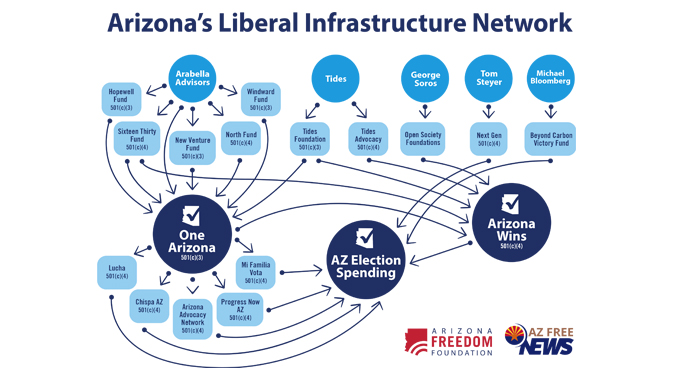
As AZ Free News reported in Part One of this series, Mi Familia Vota receives funding from One Arizona, a C3, which in turn receives its funding from the Tides Foundation, George Soros’ Open Societies Foundation, and several different organizations under Arabella Advisors.
.@RealMarkFinchem, a MAGAmigo, lies, & says that the 2020 election was fraudulent. If elected, he would use his position to help Trump. We are fighting for free and clear elections this cycle. Our democracy is at stake in Arizona, we must fight back. We say #BastaFinchempic.twitter.com/WPVSjflt2L
Ahead of the midterm election last June, One Arizona advertised a job opening for an independent expenditure (IE) campaign manager. The position appears to be one for a political staffer, which would constitute prohibited electioneering.
While not a complete pitcure, the above graphic illustrates some of the connections in the left’s secretive infrastructure and how they relate to Arizona elections.
Leftist C3s also hire for both the C3 and C4, resulting in shared jobs and salaries. One Arizona (C3) and Arizona Wins (C4) co-hired staff including a field director, field program coordinator, and finance and compliance director. That shared salary should not be used for political work. One recent example of this was a job listing by Arizona Coalition for Change (C3) and Our Voice Our Vote (C4) for a data manager that would work within the duo’s political and grassroots lobbying arms.
These blurred lines surrounding co-hires don’t just apply to staff. Arizona Center for Empowerment (ACE, a C3) and LUCHA (C4) share an executive director, Alejandra (Alex) Gomez, as well as staffers. This relationship is further complicated by the fact that ACE listed LUCHA as its “Employer of Record” on their latest tax return. Under Gomez, both organizations have expressed their partisanship.
Last year, LUCHA launched an initiative to get Democratic candidates elected: “LUCHA Blue.” The nonprofit pledged to prioritize certain races and voter bases in its GOTV efforts. On its hiring page for the initiative, LUCHA disclosed that it would staff between 70 and 105 people.
“We believe that not all candidates align with the mission of LUCHA, and this is why we created a campaign not only to flip Arizona Blue — but LUCHA Blue!” stated LUCHA. “Overall, the goal of the campaign is to win these targeted races, increase Latin/Hispanic voter turnout, and educate voters on the voting process.” (emphasis added)
In one post following Sen. Mark Kelly (D-AZ) winning re-election last November, LUCHA appeared to affirm that both it and ACE assisted in organizational efforts to assure Kelly’s victory.
Wealthy dark money donors have a greater financial incentive to back C3s. 75 percent of their donations can go to politics and qualify as tax deductible — effectively maximizing their gift-giving while affording them a tax break. C4 donations aren’t tax deductible.
The IRS has long been aware of the disparity between the lawful intent for C3 and C4 entities, and the current reality of C3-C4 relationships. As ProPublica revealed in 2019, the IRS essentially gave up on holding nonprofits accountable.
The following are some of Arizona’s liberal C3-C4 nonprofit duos: One Arizona and Arizona Wins, Arizona Center for Empowerment and Living United for Change in Arizona, Mi Familia Vota Education Fund and Mi Familia Vota Victory, Chispa AZ/League of Conservation Voters Education Fund and League of Conservation Voters, Arizona Coalition for Change and Our Voice Our Vote, Instituto Lab and Instituto Power, Rural Arizona Engagement and Rural Arizona Action, and Voto Latino Foundation and Voto Latino.
The relationships between these nonprofits and the awareness of their straining tax law will be further explained in the next installment of this series.
This is Part Two in a series on the Left’s secret infrastructure to turn Arizona blue. Be sure to sign up for our newsletter to be notified of Part Three in the series.
Corinne Murdock is a reporter for AZ Free News. Follow her latest on Twitter, or email tips to corinne@azfreenews.com.
Arizona Governor Katie Hobbs has made no secret of her desire to dismantle the state’s school choice benefits for tens of thousands of children and their families, and this weekend, she was challenged on her desires by Fox News Sunday host, Shannon Bream, during an exclusive interview leading up to the Super Bowl in Glendale.
During the interview, Bream asked the governor why all students shouldn’t have a chance to have the educational opportunities that she had growing up – a reference to Hobbs’ high school graduation from Seton Catholic Preparatory. Governor Hobbs appeared to embrace the rhetoric of school choice proponents as she searched for justification for her positions, responding that her parents “made that choice” and that they “sacrificed a lot” to give her the chance at a private education.
Hobbs went on to say that she wants every student in Arizona to have access to high-quality public education – access that she claimed would not happen under Arizona’s historic Educational Scholarship Account (ESA) program, which was passed last year by the Arizona Legislature. Bream followed up by asking the governor if students should not have a chance to go elsewhere if their school system was failing. Hobbs’ reply was that “the schools are failing because we are failing to invest in them.”
But Governor Hobbs’ rampant claims of the ESA program bankrupting and failing Arizona schools were met with facts from several individuals. Corey DeAngelis, one of the nation’s premier “evangelists” of school choice, tweeted thanks to Shannon Bream for citing his January Wall Street Journal article, showing that Arizona’s ESA program could actually save the state more than $100 million.
And Andrew Clark, Executive Director of Yes. Every Kid. Foundation, tweeted, “The average cost for a family to homeschool is year is about: $2k per kid. Micro-schools and pods are about $5k. Private schools average $10k, charters around $12k. Public schools clock in around $15k. But sure it’s a spending problem for public schools…let’s ignore the facts…”
The average cost for a family to homeschool is year is about: $2k per kid. Microschools and pods are about $5k. Private schools average $10k, charters around $12k. Public schools clock in around $15k. But sure it’s a spending problem for public schools…let’s ignore the facts… https://t.co/b0Rgjq4JAd
Governor Hobbs’ answers on school choice quickly went viral after the recorded interview went live Sunday morning, and Arizona Republicans, who are at the front lines of protecting the landmark ESA program, wasted no time in making their thoughts known.
The Arizona Senate Republicans Twitter account posted: “.@GovernorHobbs response makes absolutely zero sense, other than reinforcing why expansion of ESA school choice is so desperately needed.”
Senator Justine Wadsack tweeted, “So #HypocriteHobbs attended PRIVATE school, and her parents made “sacrifices” to put her there. Even found themselves on food stamps! Had #ESA/#SchoolChoice existed back then, her parents would have been given $7,000 to help with the cost of Katie’s education.”
So #HypocriteHobbs attended PRIVATE school, and her parents made "sacrifices" to put her there. Even found themselves on food stamps!
Representative Quang Nguyen stated, “So if your parents afforded you this great opportunity, shouldn’t you make it possible for other parents to give their children the same opportunity you received as a child? Asking for Arizonans.”
So if your parents afforded you this great opportunity, shouldn’t you make it possible for other parents to give their children the same opportunity you received as a child? Asking for Arizonans. https://t.co/ffMnjxSRMo
Representative Cory McGarr disagreed with Governor Hobbs’ characterizations of district school funding, saying: “Our government schools are failing because we are supposedly starving them of resources?? 73% increase in funding since 2016… Perhaps they are failing because they focus on woke sexualization, feelings and racism and have no accountability because of politicians like this.”
Our government schools are failing because we are supposedly starving them of resources??
73% increase in funding since 2016…
Perhaps they are failing because they focus on woke sexualization, feelings and racism and have no accountability because of politicians like this. https://t.co/xXGMqiFyUq
Representative Matt Gress underlined the foundation of the school choice argument, writing: “.@GovernorHobbs’ parents struggled to provide her with an education THEY thought best. It’s unfortunate she wants AZ families to choose between being on food stamps or sending their kids to the school they choose. Let’s help families. Give them a choice, not push them down.”
.@GovernorHobbs’ parents struggled to provide her with an education THEY thought best.
It’s unfortunate she wants AZ families to choose between being on food stamps or sending their kids to the school they choose.
Representative Austin Smith said, “Booed at the Phoenix Open, health nominee failed in the senate committee and called out for her hypocrisy on school choice on national Sunday show. Bad weekend for Hobbs. Is there anyone who thinks she’s actually an effective leader?”
Booed at the Phoenix Open, health nominee failed in the senate committee and called out for her hypocrisy on school choice on national Sunday show. Bad weekend for Hobbs.
Representative Justin Heap tweeted: “@katiehobbs is committed to ending Az’s ESA program which allows thousands of Arizona children to receive the same private school education she received. Katie Hobbs definitely believes in pulling the ladder up behind her.”
@katiehobbs is committed to ending Az's ESA program which allows thousands of Arizona children to receive the same private school education she received. Katie Hobbs definately believes in pulling the ladder up behind her. https://t.co/zI9tjtBJ53