by Corinne Murdock | Feb 12, 2023 | News
By Corinne Murdock |
The Phoenix Open crowd reportedly booed Gov. Katie Hobbs after her attendance was announced at the tournament on Wednesday.
Eyewitness accounts say the incident occurred at the Skybox stadium located on Hole 16 on Wednesday, a day before the opening day of the Waste Management Phoenix Open. Hobbs was brought onto the green to greet the crowds in the stadium. A video posted later that day allegedly captured the incident.
Twitter users who claimed they were at the open claimed that Hobbs looked “dejected” after walking off the course.
Another user said that Hobbs attempted to wave at the crowd, but received boos instead.
The campaign team for Hobbs’ GOP opponent, Kari Lake, claimed that Hobbs was also booed at a recent Phoenix Suns game.
Lake asked social media users to send in their videos of the booing, with promises that they would give them credit and “help them go viral.”
Apparent dissatisfaction with Hobbs’ first days in office may be considered bipartisan.
The governor stood opposed to the favored pick to take over the Arizona Democratic Party (ADP) chairmanship. Hobbs endorsed Maricopa County Supervisor Steve Gallardo; he also served on her transition team. However, top Democratic leaders and officials sponsored Yolanda Bejarano, ADP’s former vice chair. Bejarano won the election last month.
Hobbs didn’t congratulate Bejarano individually following the election; rather, the governor opted to congratulate the entirety of the new ADP board.
Prior to her swearing in, Hobbs stirred up controversy when she neglected to disclose the cost and funders behind her inauguration ceremony. It wasn’t until several days after her inauguration that the nonprofit accepting donations on her behalf for the event released the names of the donors and their amounts donated.
According to Hobbs, her “Katie Hobbs Inaugural Fund” accepted $1.9 million from about 235 donors. Arizona Corporation Commission (ACC) records disputed Hobbs’ initial claim that she raised about $1.5 million from 120 donors.
The inauguration costed $207,000 — about 11 percent of total donations. This inspired questions of the purpose for the remainder of the funds as government transparency watchdogs called for investigation of whether Hobbs’ inauguration team purposefully accepted more donations than they knew were necessary.
Attorney Tim La Sota told “The Conservative Circus” that Hobbs’ use of a state website to solicit inaugural funds presented a potential legal issue.
“That’s definitely a no-no,” said La Sota. “That’s no different, hardly, than just putting a link on the governor’s official state website to her campaign account and saying, ‘Hey, you know, do you want to support me politically? Go to my campaign.’”
The inaugural fund was established as a 501(c)(4) nonprofit by Hobbs’ campaign manager, Nicole DeMont. That classification enables the funds to be used for any promotion of “social welfare,” per IRS rules. Under this classification, the remaining $1.7 million could potentially be applied to certain political efforts that advance “social welfare,” like lobbying.
Corinne Murdock is a reporter for AZ Free News. Follow her latest on Twitter, or email tips to corinne@azfreenews.com.
by Daniel Stefanski | Feb 12, 2023 | News
By Daniel Stefanski |
Governor Katie Hobbs has been reticent to transmit her nominations for state agency heads to the state legislature, and the effort by the Arizona Senate to bring transparency to the process may not lend itself to greater cooperation by the Ninth Floor going forward.
On Thursday, the Arizona Senate Committee on Director Nominations met for its first meeting to consider two of the nominees that Governor Hobbs sent to the legislature. A.R.S. 38-211 prescribes that “the governor shall nominate and with the consent of the senate appoint such officer,” and that “the governor shall during each (legislative) session nominate a person who meets the requirements of law for such office and promptly transmit the nomination to the president of the senate.” The Senate’s constitutional responsibility to provide “consent” for Governor Hobbs’ nominees led to President Warren Petersen forming this committee to “recommend a course of action for the Senate to take on each individual.”
But Governor Hobbs has only fulfilled her constitutional responsibility to “promptly transmit” a select number of nominees – and two of them were before the Senate Committee Thursday. The first individual up for consideration was Angie Rodgers, the nominee to lead the Department of Economic Security. Rodgers has been the President and CEO for the Arizona Food Bank Network and previously served in the Napolitano administration as the governor’s Human Services Policy Advisor. Though Republicans on the committee did have concerns about how she would lead this agency, the vote to favorably recommend her to the full Senate was unanimous.
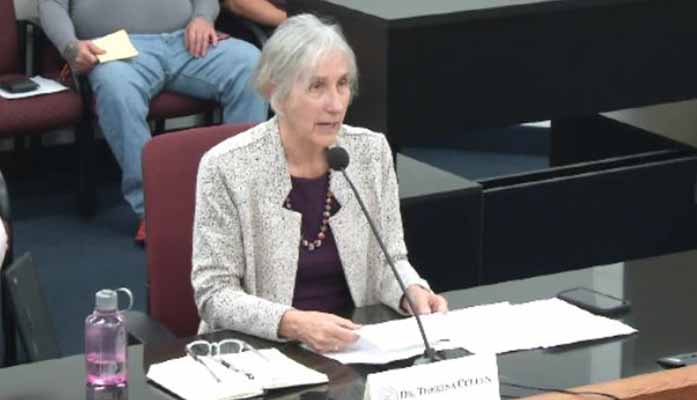
It was the second nominee considered by the committee who brought the most contention, however. Dr. Theresa Cullen, who Hobbs nominated to run the Department of Health Services, is currently the Director of the Pima County Public Health Department – a position she has held since June 1, 2020. Both Dr. Cullen and Rodgers were announced in the first round of future nominees on December 27, 2022, by then-Governor-elect Hobbs.
Arizona Republicans pointed out multiple inconsistencies in her answers throughout the afternoon. On two occasions, Senate President Petersen sharply chided her responses and served a warning about her future as a public servant, writing, “Any nominee who gets caught lying at a confirmation hearing is not fit to serve the state of Arizona. The 9th floor could learn from Napolitano. Napolitano did not appoint radical lefties as directors.”
After enough time was spent on vetting Dr. Cullen’s past (especially her leadership over the Pima County health response to the COVID-19 pandemic) and her ability to lead this Department in the future, members of the committee voted against recommending her nomination to the full Senate with a party line 3-2 vote.
Senate Republicans, who now have a decision to make about Dr. Cullen’s future employment at the Department of Health Services, had plenty to say after the hearing was complete. Senator John Kavanagh tweeted, “Her repressive covid policies when she led Pima County Health included an illegal 10pm-5am curfew.” Senator Sonny Borrelli wrote, “Why would @GovernorHobbs appoint Dr. Cullen to a critical position, such as state health director, when her testimony in committee clearly showed she makes decisions based on politics and not commonsense or data?” Senator Anthony Kern stated, “Dr. Cullen prided herself on locking down Pima County, ruining the livelihoods of her constituents while she raked in a comfortable $200,000/yr. salary.” Committee Member Janae Shamp said, “Dr. Cullen provided misleading responses and failed to accept responsibility for her record.” Senate President Pro Tempore T.J. Shope tweeted, “I respect Dr. Cullen’s experience, but her poor judgement in Pima County reflects poorly on her – and even more poorly on Hobbs.” And Senator Wendy Rogers left no doubt with her thoughts from the hearing: “True leaders never reply, ‘I don’t know’ to tough questions. Shame on @GovernorHobbs for nominating Pima county’s MEDICAL TYRANT Dr. Theresa Cullen for State Health Director.”
Governor Katie Hobbs was also not happy after the hearing – but for different reasons than legislative Republicans. She released a statement, saying, “What we witnessed today was an exercise in political theater, and it is a shame that Arizonans have to suffer for it. Dr. Admiral Cullen has a distinguished career in medicine and public health that spans decades, and I stand by her nomination. Her dedication and vision in making our state the healthiest it can be is exactly what Arizona needs right now.”
Daniel Scarpinato, a Chief of Staff to former Governor Doug Ducey, had some valuable insight about the committee process and genesis, tweeting, “All Governors must work with the Legislature. It’s part of our process and a system taught in basic civics. The Arizona Senate gets to determine how they want to conduct the process, and I think the one they have developed is a very good one.” He went on to say that “No one can accuse this AZ Senate Committee of being a partisan exercise. Their questions are fair and appropriate. Sen. Hoffman is doing an excellent job as Chairman.”
Both Dr. Cullen’s and Rodgers’ nominations now head to the full Senate chamber for a vote on their future in the Hobbs’ administration.
Daniel Stefanski is a reporter for AZ Free News. You can send him news tips using this link.
by AZ Free Enterprise Club | Feb 11, 2023 | Opinion
By the Arizona Free Enterprise Club |
Katie Hobbs certainly seems to like power. That’s probably why she was so giddy with laughter and excitement during her swearing-in ceremony last month. Now, she’s gotten to work. And despite her claims that Republicans and Democrats will have an open door to her office to get to work on bipartisan compromise, her preferred method appears to be executive action.
In just over a month since beginning her reign as governor, Hobbs has already signed seven executive orders. And there’s no sign that she’ll stop there. Her first executive order, prohibiting gender identity discrimination in state employment and contracts, was particularly eye-opening. Consider it a small taste of the woke agenda Hobbs is looking to implement over the next four years. And while it’s good to see that groups like the Arizona Freedom Caucus are planning to file a lawsuit challenging the constitutionality of such an order, it will take more than that to stop Hobbs from overstepping her authority…
>>> CONTINUE READING >>>
by Daniel Stefanski | Feb 8, 2023 | News
By Daniel Stefanski |
Arizona is one of the nation’s top Second Amendment states, and legislators are working to augment those constitutional protections – even though these new policies are highly likely to be vetoed by Democrat Governor Katie Hobbs should the bills clear both the House and Senate.
One of those pieces of legislation, HB2332, sponsored by freshman Representative Selina Bliss, deals with firearms safety training in Arizona schools. According to the House summary of the bill, HB2332 “requires school districts and charter schools to provide one or more firearms safety training sessions.”
The Arizona House also revealed that “statute currently states that the Arizona Game and Fish Department may provide training in the safe handling and use of bows or firearms for schools that request this instruction….In addition to voluntary training in the use of bows and firearms, statute allows any school district or charter school to offer a one semester, one credit elective course in firearm marksmanship designated as the Arizona Gun Safety Program Course.”
The legislation requires the district or charter school to inform the parents of the students two weeks prior to the training and provides an allowance for the students to be excused from the training should the parents request it.
HB2332 cleared the House Military Affairs & Public Safety Committee on Monday, February 6, with a party-line 8-7 vote. Republicans Payne (Chairman), Jones (Vice Chairman), Gillette, Harris, Hendrix, Marshall, Nguyen, and Wilmeth voted in favor of the bill. Democrats Blattman, Longdon, Peshlakai, Quiñonez, Sun, Travers, and Tsosie voted to table the bill.
In an exclusive interview with AZ Free News, Representative Bliss explained why she introduced this bill:
“I introduced this bill to empower our youth to gain respect for and to be safe around firearms. The problem this bill is trying to solve is firearm accident prevention through education, so that kids are safe from firearm injuries and death. Most children are harmed by firearms when visiting a friend’s house and become curious about an unattended firearm. This one-time education in grades 6 through 12 is a small start, but will open dialogue between teachers, parents, and children on the safe handling and storage of firearms. I also introduced this bill because of my personal experience as a Concealed Carry Weapons (CCW) instructor as well as my experience as the Safety and EMS Director of the Arizona State Rifle and Pistol Association. In these roles I have come to see first-hand the value of education when it comes to empowering our youth.”
House Democrats vehemently opposed this legislation before and during committee debate. The Arizona House Democrats’ Twitter account tweeted “It’s back! BAD BILL ALERT” and bemoaned the failed amendment from Rep. Longdon “to make the firearms training opt-in instead of requiring students and parents to opt out.” Rep. Travers also stated, “If you want your Second Amendment rights then you take ownership of it. Don’t put the burden on somebody else.”
Representative Bliss told AZ Free News that Arizonans should support this legislation because “this is a non-controversial safety subject that uses age-appropriate curriculum to teach middle and high school children what to do if they come across an unattended firearm…. firearm safety should be viewed as a life skills course important for all kids, similar to mechanics, wood shop, or cooking courses.”
During last year’s legislative session, a similar bill was introduced by Representative Bliss’s current seatmate, Representative Nguyen. HB 2448 was co-sponsored by Representatives Blackman, Bolick, Fillmore, Hoffman, and Senator Boyer. On February 24, 2022, this legislation passed the Arizona House by a vote of 31-28, with one member not voting. It passed the Senate Education Committee with a party-line vote of 5-3 before being held from final passage and transmission to then-Governor Doug Ducey’s desk.
Representative Bliss has confidence that “this bill will be considered, thoughtfully discussed, and passed through both chambers.” She hopes “both chambers can work together to keep our children safe!”
Daniel Stefanski is a reporter for AZ Free News. You can send him news tips using this link.
by Corinne Murdock | Feb 5, 2023 | News
By Corinne Murdock |
On Monday, the Arizona Senate Appropriations Committee approved reusing last year’s budget for the coming year, citing concerns over the current poor state of the economy.
The budget bill, SB1523, passed along partisan lines, 6-4. The Republican majority of the committee insisted that this budget structure was a fiscally wise move, while the Democratic minority claimed that Republicans were merely unwilling to negotiate with them.
Gov. Katie Hobbs criticized the budget as a “do-nothing” plan.
Republican legislators wondered whether Hobbs would close government-funded entities to obtain her ideal budget.
“[W]ill she veto the budget and threaten the possibility of closing our schools, law enforcement agencies, and health care services?” asked House Majority Leader Leo Biasiucci (R-LD30).
During Monday’s Senate Appropriations Committee meeting, Democrats alleged that Republicans weren’t concerned about the economy. Rather, they said that their budget reflected a refusal to work with either them or Hobbs.
Senate Minority Caucus Chair Lela Alston (D-LD05) called the budget a “phony bill,” a “power grab,” and a “Ducey budget” that avoided negotiations with Hobbs and Democrats. State Sen. Priya Sundareshan (D-LD18) claimed it was disrespectful to not give them more notice. The legislators received the bill on Monday evening. Sundareshan implied that last year’s Democratic legislators were only satisfied with the budget because they had several different Democrats in the legislature and didn’t have a Democratic governor in power.
“I understand that this budget may have been modeled after a bipartisan one last year, but that does not reflect the reality on the ground today. We have different legislators in the legislature today, we have a different governor, we have different circumstances on the ground,” said Sundareshan.
State Sen. John Kavanagh (R-LD03), the committee chairman, countered Democrats’ claims that the budget was sprung upon them suddenly Monday evening. Kavanagh said that they had plenty of notice of budget proceedings over the past month.
“It wouldn’t be a phony budget to the state employees, to those who rely on state monies come July when government shuts down. To them, this wouldn’t have been a phony budget, this would’ve been a lifesaver budget, including schools and teachers,” said Kavanagh.
READ THE PROPOSED BUDGET HERE
State Sen. Anthony Kern (R-LD27) said that the budget was “skinny” and “responsible” since the state and nation are living in times of economic uncertainty. State Sen. Jake Hoffman (R-LD15) concurred. He questioned why Hobbs would veto the budget when she knew how a Republican-led legislature would structure the budgets in response to their constituents.
“We are going into times of economic uncertainty, and this budget is going to keep the lights on,” said Hoffman.
Senate Democrats criticized the budget for being too similar to last year’s version. However, last year the caucus praised the budget as a “historic and rare opportunity” for schools.
In a press release following the Senate Appropriations Committee advancing their version of the budget, House Minority Leader Andrés Cano (D-LD20) claimed that Republicans were “afraid” of Hobbs, and needed to “grow up.” Similarly, Senate Minority Leader Raquel Terán (D-LD26) said that Republicans needed to “act their age” to improve the budget.
Following the Senate advancing its version of the budget, House Republicans introduced their version on Tuesday. State Rep. David Livingston (R-LD28) expressed confidence that all 13 of his introduced budget bills would pass during Wednesday’s House Appropriations Committee meeting, which he chairs.
In a press release, Livingston called Hobbs’ budget plan an “irresponsible,” “left-wing” wish list.
“In this time of political division and economic uncertainty, that won’t work for Arizonans, and it won’t pass at the legislature,” said Livingston.
The Joint Legislative Budget Committee (JLBC) report of the budget forecasted $17.6 billion in ongoing revenue for the upcoming fiscal year, nearly $15 billion in ongoing expenditures, and nearly $858,000 in one-time expenditures.
The budget includes $183 million in one-time funding for building renewal grants, $78 million from the state general fund for a one-time deposit in the new schools facility fund, and $200 million from the state general fund for the superintendent.
Corinne Murdock is a reporter for AZ Free News. Follow her latest on Twitter, or email tips to corinne@azfreenews.com.