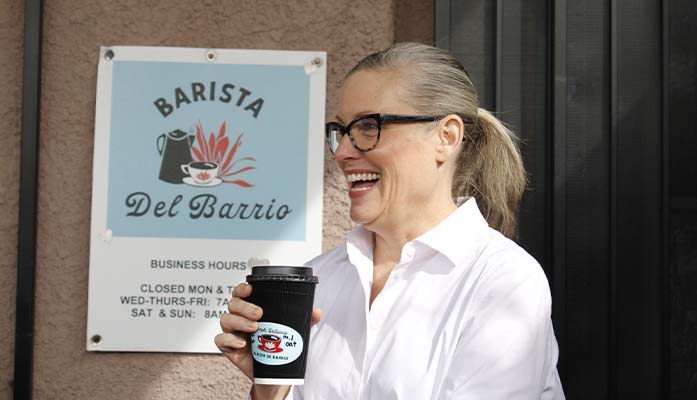
Gov. Katie Hobbs vetoed legislation that would have established financial transparency requirements tied to an alleged pay-to-play scandal involving her administration.
Hobbs called the legislation, SB 1186, a “political stunt” against her in a veto letter. The governor issued her veto last Friday as part of her office’s regular legislative action updates.
The governor also claimed that her proposed amendment to the financial disclosure reform bill — carried by Senate Minority Leader Priya Sundareshan (D-LD18) — was superior to what was vetoed by her.
“As I have made clear, this proposal is a political stunt that applies only to one elected official, when what we really need is real transparency and accountability for all elected officials, campaigns, and affiliated political committees,” said Hobbs. “Transparency and accountability are priorities I have acted on from day one.”
The Hobbs-Sundareshan amendment would have restricted lawmakers from receiving donations from state contract bidders.
Senate President Pro Tempore T.J. Shope (R-LD16), the bill sponsor, explained to Capitol Media Services that the governor’s office, not the legislature, handles procurement, and that the amendment would have weakened the legislation.
SB 1186 would have required companies holding or seeking state contracts and certain grants to disclose anything of value provided in the preceding five years to the governor or the governor’s campaign-related entities, inaugural funds, joint fundraising committees, and organizations supporting the governor or opposing the governor’s political opponents.
The bill also would have prohibited state agencies and employees from destroying contract proposal evaluation notes. Contracts tied to improperly destroyed records would be subject to resolicitation.
Multiple entities are investigating Hobbs for the alleged pay-to-play scheme, which involved $400,000 in campaign donations from group home operator Sunshine Residential Homes and a unique, multibillion-dollar rate increase contract nearly 40 percent above the average for other peer contractors, as awarded by the Arizona Health Care Cost Containment System (AHCCCS).
Hobbs was also the only Arizona candidate to receive contributions from Sunshine Residential Homes CEO Simon Kottoor and his wife, Elizabeth Kottoor, during the 2022 and 2024 election cycles.
Several investigations into this alleged scheme are occurring simultaneously: one by Attorney General Kris Mayes, one by Maricopa County Attorney Rachel Mitchell and Auditor General Lindsey Perry, and one by an advisory team within the Arizona House.
The agency told Capitol Media Services that the contract occurred because Sunshine Residential Homes threatened to increase intake of migrant children at the expense of the state’s foster children if it didn’t receive additional funding.
The Arizona Senate GOP stated in a press release that Hobbs had rejected essential safeguards to prevent government officials from rewarding financial supporters with taxpayer-funded contracts.
Shope accused Hobbs of denying Arizona taxpayers the right to transparency from their elected leaders.
“Arizona families work hard for every dollar they send to the government. They have every right to know whether companies seeking millions or even billions of taxpayer dollars have financial or political ties to the Governor’s inner circle before contracts are awarded, not after another scandal makes headlines,” said Shope. “If state contracting decisions are truly being made fairly and on merit alone, transparency should not be controversial.”
AZ Free News is your #1 source for Arizona news and politics. You can send us news tips using this link.
Gov. Katie Hobbs vetoed 88 bills in a single day last week, rejecting Republican-backed legislation dealing with gender-transition procedures for minors, immigration enforcement, election administration, medical mandates, civics instruction, religious instruction, photo radar penalties, parents’ rights, and local business regulations.
The Governor’s Office listed 72 bills signed and 88 bills vetoed in a June 19 legislative action update.
The vetoes were wide-ranging, from mundane measures to controversial ones: from refusing to lower Arizona’s learner’s permit age to 15 to refusing to prohibit the application of Sharia law in Arizona courts to prohibiting illegal immigrants from accessing banking services.
Among the highest-profile vetoes were the three measures dealing with gender-transition procedures. Hobbs vetoed SB 1015, dealing with provider liability for gender-transition procedures; SB 1094, dealing with civil liability for gender-reassignment surgery; and SB 1095, dealing with gender-transition procedures for minors.
In her veto letter, Hobbs wrote, “It is already unlawful to perform gender transition surgery on minors in Arizona; therefore, this legislation is unnecessary.”
Potentially one of the most politically significant vetoes was SB 1186, sponsored by Senate President Pro Tempore T.J. Shope (R-LD16), which would have required companies holding or seeking state contracts and certain state grants to disclose anything of value provided during the previous five years to the Governor, campaign-related entities, inaugural funds, joint fundraising committees, and organizations supporting the Governor or opposing the Governor’s political opponents.
Senate Republicans said the veto came as Hobbs remains under investigation over allegations involving donations connected to Sunshine Residential Homes and a subsequent rate increase approved by the Department of Child Safety. Hobbs dismissed the legislation as a “political stunt.”
🚨FOR IMMEDIATE RELEASE: Hobbs Blocks Transparency Reform for State Contracts Worth Billions While Facing Ongoing Investigation into Alleged Pay-to-Play Scheme
Hobbs also vetoed SB 1055, sponsored by Sen. Wendy Rogers (R-LD7), which would have required U.S. Immigration and Customs Enforcement or U.S. Customs and Border Protection to be immediately notified when an unlawfully present alien is arrested by a state or local law enforcement agency for a violation of state or local law.
In her veto letter, Hobbs said existing law already allows law enforcement officers to contact immigration enforcement when they have reasonable suspicion regarding a person’s immigration status. She said the bill could strain resources, increase workload, and divert law enforcement attention from public safety duties.
Another immigration-related measure, SB 1520, would have dealt with immigration data sharing by state agencies. Hobbs wrote in her veto letter that the bill was “unconstitutional” and risked violating federal and state privacy laws.
Rogers responded in a statement from the Arizona Senate GOP Caucus, saying:
“Governor Hobbs continues to show just how disconnected she is from the reality many Arizona families face every day. These bills were not extreme. They were practical steps to help enforce existing laws, improve cooperation with federal authorities, ensure taxpayer-funded benefits go to those legally entitled to receive them, and prevent Arizona from becoming a magnet for illegal immigration. Arizonans have already spoken.”
The veto list also included several election-related measures. Hobbs vetoed SB 1057, which dealt with fraud countermeasures for paper ballots. In her veto letter, Hobbs said she remained confident in Arizona election officials’ ability to administer free and fair elections “without added expense and complexity.”
Hobbs also rejected SB 1429, sponsored by Sen. J.D. Mesnard (R-LD13), which would have required ballot measure petition circulators to disclose whether they were paid circulators, volunteers, or out-of-state residents. In her veto letter, Hobbs wrote that the bill “would further narrow the pathway for citizens’ initiatives and referenda at the local level.”
Additional election-related vetoes listed by the Governor’s Office included SB 1037, dealing with voting equipment, internet access, and custody; SB 1038, dealing with cast vote records as public records; SB 1040, dealing with voter registration rolls and internet access; and SB 1060, dealing with voter registration and temporary absence.
Hobbs vetoed two measures dealing with vaccines, masks, and medical interventions. HB 2086 dealt with vaccination mandates and masks, while HB 2248, titled the “Arizona Medical Freedom Act,” would have barred businesses, schools, and state or local government entities from requiring certain medical interventions as a condition of services, entry, employment, government benefits, or transportation, with exceptions.
In her veto letter, Hobbs wrote, “Vaccines save lives,” and said Arizona law already provides robust exemptions to immunization requirements. She added that diseases once eliminated are “making a comeback in Arizona’s playgrounds and classrooms because of dangerous misinformation.”
Education-related vetoes included SB 1572, sponsored by Sen. Mark Finchem (R-LD1), which dealt with public school civics instruction requirements. Hobbs wrote in her veto letter that she was confident the curriculum outlined in the bill was already adequately covered during the school year, including through the Sandra Day O’Connor Civics Celebration Day and the Arizona Civics Test. “Changes to civics education should go through experts, not the legislature,” Hobbs wrote.
Hobbs also vetoed SB 1741, which dealt with released-time courses for public school students. The measure would have expanded access to off-campus religious instruction during the school day if a student’s parent provided written consent and the course provider met statutory requirements. In her veto letter, Hobbs wrote that Arizona has “a robust school choice system,” and said public school instructional time should be used for standards-aligned instruction.
Hobbs vetoed SB 1624, sponsored by Sen. David Gowan (R-LD19), which would have capped civil penalties for photo radar speeding violations at $75. The measure also would have barred the Motor Vehicle Division from reporting certain speed-camera violations to insurers and prevented those citations from being used as points for license suspension. Hobbs wrote in her veto letter that the bill undermined cities’ ability to make their own decisions about law enforcement policies.
Another vetoed bill, HB 2460, sponsored by Rep. Nick Kupper (R-LD25), would have barred municipalities and counties from imposing penalties on businesses for stolen or abandoned movable property, including shopping carts and hand-held baskets. In her veto letter, Hobbs wrote that the bill “delves into a truly local issue that is best resolved between businesses and their local elected leaders.”
The Governor’s Office also listed vetoes of HB 2249, a parents’ bill of rights remedy, and HB 2830, a bill on fetal and prenatal development instruction. Hobbs said in her HB 2249 veto letter that parents already have the right to direct their children’s education and upbringing, and that the bill would threaten schools and educators with “exorbitant financial penalties.” In her HB 2830 veto letter, Hobbs wrote that instructional requirements should be left to experts rather than “politicians trying to force mandates on our teachers.”
The 88-bill veto sweep drew criticism from Republicans, including gubernatorial candidate Andy Biggs. In a post to X, Biggs wrote, “The Katie Hobbs record: 541 vetoes, 45th in Affordability, 0 victories for Arizonans. We cannot afford four more years of the Veto Queen!”
The Biggs War Room account wrote, “Katie Hobbs just vetoed 88 bills in one day, bringing her near 150 vetoes this session.”
🚨THE HOBBS FILES JUST DROPPED🚨
Katie Hobbs just vetoed 88 bills in one day, bringing her near 150 vetoes this session.
But what exactly did she veto? Here are the highlights:
-She vetoed a bill banning gender-affirming care for minors. -She vetoed a bill to cap photo radar…
“This is not leadership,” the War Room added. “This is the Hobbs agenda in black and white. Arizona does not need another four years of common-sense reform dying under a veto pen. It needs a Governor’s Office that will sign real reform, protect families, defend taxpayers, and put Arizona voters first.”
The Governor’s Office also announced 72 signed bills on June 19, including measures dealing with candidate financial disclosures, worker death benefits, law enforcement reinstatement costs, health care licensing, missing and kidnapped children reporting requirements, assisted living facilities, and Department of Child Safety procedures.
After months of vetoes and walking away from the table, Hobbs has finally signed a budget. A budget that looks pretty much the same as the one Legislative Republicans sent up to her desk at the beginning of May. A budget she vetoed, and that she and her colleagues in the Legislature bashed repeatedly. So, what changed?
There were two budget priorities our organization laid out before the session began. First, anything less than full conformity tax relief from Trump’s Big Beautiful Bill would essentially be a tax hike on Arizonans. Second, an extension of Prop 123 (the increased distribution from the state land trust to K-12 schools to the tune of $330 million a year) must be a nonstarter in budget negotiations. Before getting into the details, both of these objectives were accomplished.
The biggest item in this budget fight was undoubtedly tax cuts from tax conformity. After President Trump signed the Big Beautiful Bill into law on 4th of July 2025, states faced a decision: do they pass on the tax relief Republicans in D.C. delivered, or do they effectively increase taxes on their residents. Core planks of conformity included no tax on tips, no tax on overtime, an increased standard deduction, a new deduction for seniors, among several provisions for small businesses and corporations of all sizes, most importantly allowing them to deduct expenses in the year they are made, rather than depreciating those expenses over several years. In other words, the bulk of the business provisions weren’t even a tax cut. The question is not whether businesses deduct those expenses, only when they deduct them.
This question needed to be resolved quickly, as the legislature begins session the second week of January and Tax Day is in April. In the first week of session, Republicans in the legislature sent a package to her desk that delivered full tax relief. All democrats voted no. Hobbs vetoed it.
Again, in February, to prevent confusion and chaos for taxpayers beginning to file, Republicans in the legislature sent up another bill. It received a veto. At the beginning of May, they sent up a budget that included full tax conformity relief for the third time. Again, it met a veto.
Based on all of the votetoes, relentless opposition and endless rhetoric about “tax breaks for billionaires,” you would think that the agreed upon budget must have included significant changes to the tax package. But if you are thinking that, you would be very wrong.
So What did Hobbs and Democrats actually fight for in this budget that necessitated six months of chaos and tax season confusion?
The Arizona Department of Child Safety (DCS) will implement a new child safety reform set to be codified until Gov. Katie Hobbs’ office intervened.
Sen. Carine Werner (R-LD4) had championed the legislation that prompted the new policy, SB 1175. It passed the legislature with bipartisan support earlier this month.
The legislation would have required DCS caseworkers to photograph children during abuse and neglect investigations, followed by a review of those images when evaluating the safety and well-being of those children. Specifically, the legislation would have required caseworkers to consider any decline in a child’s appearance or health.
DCS leadership announced it would voluntarily adopt the requirements as policy.
SB 1175 was part of a legislative package of bipartisan reform bills to improve DCS handling of reports of abuse. The reforms were prompted by high-profile child abuse cases in which prior DCS involvement failed to prevent deaths, including 10-year-old Rebekah Baptiste, 14-year-old Emily Pike, and 16-year-old Zariah Dodd.
At Werner’s urging early last year following Pike’s death in 2024, Arizona lawmakers launched an investigation into DCS for systemic failure. The subsequent deaths of Baptiste and Dodd further compelled lawmakers to take expedited action.
At the time, Werner said the failures of the state had too great of consequences to be ignored.
“These tragedies make it painfully clear that when our child protection systems — both state and tribal — fail, the consequences can be horrific,” said Werner.
Werner said in a press release issued last week that Hobbs’ office attempted to require SB 1175 to have legislative appropriation. Werner and legislative staff disagreed with the assessment from Hobbs’ office, citing an estimated implementation cost low enough to be absorbed within the existing DCS budget: $50,000. Hobbs’ office refused to relent on their request, and the House opted to recall the statutory route and instead relied on DCS to implement it through policy.
Summaries of SB 1175 noted that the new DCS requirements would have no anticipated fiscal impact to the state general fund.
DCS Director Kathryn Ptak said the legislation-turned-policy was a “commonsense solution” for keeping children safe while in DCS care.
“I will be issuing a directive to our staff to guarantee each child in our care has an updated photograph to help us maintain accurate records and respond quickly in any situation where a child’s safety or whereabouts need to be confirmed, while continuing conversations around this topic,” said Ptak. “We are grateful to Senator Werner for her partnership in advancing bills that help keep children safe, while also balancing the privacy needs of families.”
Werner said the legislation was a fulfillment of government responsibility to respond to those tragedies that occur despite oversight, especially when it comes to children entrusted to a state system.
“Children cannot afford for warning signs to be missed. If something as simple as maintaining and reviewing photographs helps a caseworker recognize a child is deteriorating and intervene sooner, then it is absolutely worth doing,” said Werner. “I’m grateful to Director Ptak and the Department for their partnership in moving these reforms forward right away through administrative action. This ensures Arizona’s most vulnerable children benefit from improved documentation and earlier recognition of warning signs without delay.”
AZ Free News is your #1 source for Arizona news and politics. You can send us news tips using this link.
Earlier this spring, a federal judge in Phoenix had to step in and protect law-abiding Americans from a prosecutor who had lost all sense of limits. He struck down Kris Mayes’s case against the prediction market Kalshi and, in doing so, exposed one of the more reckless abuses of government power our state has seen in recent memory.
The story should alarm every Arizonan, regardless of whether you have ever placed a trade. In March, Mayes made Arizona the first state in the nation to bring criminal charges against a federally regulated exchange—twenty counts against an American company operating under the direct supervision of the federal Commodity Futures Trading Commission. And she didn’t stop at the criminal docket, either; her allies in the state government pressed a parallel civil campaign to choke an American innovator out of existence.
It took a respected federal judge, appointed by President Trump, to end the spectacle. In finding that federal law leaves “no room for state regulation” of these markets, he warned against precisely the “inconsistent regulatory patchwork that Congress intended to avoid,” and that Mayes tried to foist on Arizonans. Mayes’s crusade was doomed from the start, and any honest lawyer in her office could have told her so. Instead, she torched your tax dollars and Arizona’s reputation, all to chase a headline.
This is what the weaponization of a prosecutor’s office looks like. We have watched the radical left turn the law into a club against the people they dislike: parents, police, people of faith, and President Trump himself. Mayes has now turned that club on the future. Prediction markets let ordinary citizens put their own judgment, and their own money, behind what they actually believe will happen in the economy and the world. They cut through the noise of the mainstream media and pundit class, and they are one piece of a sweeping wave of financial innovation that is remaking the global economy in real time.
President Trump understands this in his bones. While Mayes was busy criminalizing the future, the President was busy building it. His CFTC Chairman, Michael Selig, has led the charge, defending federal authority in courtrooms across the country, advancing clear and sensible national rules, and declaring that America’s financial markets are ready for a new Golden Age. The President has been emphatic that the CFTC must retain exclusive authority over these markets, and he is right. That is America First leadership: clear rules, room to grow, and the confidence that fifty different prosecutors won’t be allowed to strangle American innovation in its crib.
Arizona ought to be racing to the front of that parade. Instead, our Democratic officials keep stomping on the brakes. I led the fight to make Arizona the first state in the country with a Strategic Bitcoin Reserve, only for Governor Katie Hobbs to veto it. I pushed to let Arizonans pay their taxes in digital currency. Again and again, the message from this state’s Democrats has been the same: if you dare to build something new, we will tax it, ban it, or drag you into court. Innovators don’t flee to Texas and Florida by accident. They flee politicians who treat builders like criminals.
I have spent fourteen years at the Capitol doing the opposite—defending the Constitution, guarding taxpayers, and standing up for the right to build without first begging permission from the government. As your attorney general, I will never turn the power of that office into a weapon against a company for the crime of innovating. I will use it to defend Arizonans, to enforce the law as it is actually written, and to show Washington’s worst instincts, and our own state’s, exactly where the line is drawn.
This task is too important to leave to my opponent in the Republican primary. Rodney Glassman didn’t merely vote for Democrats, he ran for the U.S. Senate as a Democrat at the request of another liberal Democratic attorney general, Terry Goddard. So, ask yourself: when the radical left comes for innovation, for crypto, for free markets—and they will come—who do you want holding the line? A proven conservative who has already taken the arrows, or a man who spent the prime of his career carrying the other team’s banner and discovered his “convictions” only when trying to grab President Trump’s coattails?
The attorney general’s job is not to chase headlines by prosecuting the future. It is to be the wall that protects the rights, the savings, and the freedom of Arizonans. Kris Mayes tore that wall down. I intend to rebuild it.
President Trump is leading America into a Golden Age of growth, opportunity, and renewed confidence. Arizona belongs at the front of that charge, but is instead being dragged from behind, handing out indictments to the people who create our jobs. Give me the honor of serving as your attorney general, and I’ll make sure that our great state is exactly where it should be.