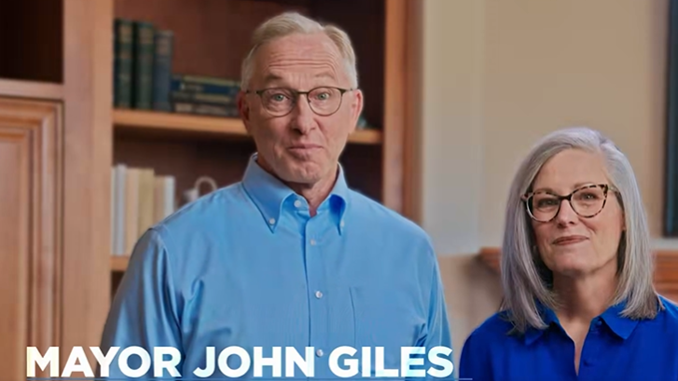
Gov. Katie Hobbs confirmed that the rumors of her lieutenant governor pick were true: John Giles is her running mate.
Hobbs went public with her decision the weekend following an initial deadline from the secretary of state’s office, reportedly established to ensure the state had adequate time for ballot printing.
Giles is the former mayor of Mesa and a recently registered independent who voted in the Democratic primary this year. Giles voted for Joe Biden in 2020, endorsed Sen. Mark Kelly in 2022, and Kamala Harris in 2024.
During the 2024 election, Giles led the Arizona Republicans for Harris organization and spoke at the Democratic National Convention. Giles said in Tuesday’s announcement that those with the Republican Party were “extremists” that prevented good governance.
“I was a lifelong Republican before becoming an independent because extremists shouldn’t stand in the way of getting things done,” said Giles.
Arizona deserves leaders who put our state ahead of partisan politics.
That’s why I’m proud to have former Mesa Mayor @johngiles4AZ by my side as my pick for Lieutenant Governor.
Together, we’ll put Arizona first, deliver real results, and keep moving our state forward. pic.twitter.com/TddoGok0Ve
Not long after going public as Hobbs’ running mate, Giles announced he would fall in line with Hobbs’ preferred non-engagement approach to campaigning and announced he would not be participating in any public debates.
Sine Kerr, Republican nominee Andy Biggs’ running mate, had stated shortly after Hobbs’ reveal that she was eager to debate Giles.
“We should discuss my Arizona Women’s Bill of Rights legislation and SB1583, which protected children from predators,” said Kerr. “Katie Hobbs vetoed both. Maybe John Giles can explain why.”
Kerr said Hobbs and Giles avoiding debates was unfair to voters.
“It’s really unfortunate that they don’t want to stand for a debate. They don’t want to answer tough questions,” Kerr said. “I think it’s very disrespectful to the people, to the voters of Arizona.”
The Arizona Clean Election Commission scheduled a debate between the lieutenant governor picks to occur on October 5.
Looking forward to the Lt. Governor’s Debate on October 5th with Democrat primary voter John Giles.
We should discuss my Arizona Women’s Bill of Rights legislation and SB1583, which protected children from predators.
Hobbs told Arizona’s Family that she selected Giles because he, too, has a history of governing beyond political party.
“I believe Arizonans deserve leadership that puts them ahead of the partisan politics. That’s how I’ve governed,” said Hobbs.
Hobbs dismissed the notion that issues facing Arizonans, including traditionally partisan ones like abortion, were not actually partisan.
“[P]rotecting reproductive freedom, which is not a partisan issue. It’s something that a vast majority of Arizonans support. We’re on the same page,” said Hobbs.
Giles said that the topic of abortion should be left to the voters, which is why he supported Proposition 139.
“I’m a Republican with standards,” said Giles. “In recent years, I felt like some of the folks at the top of the ticket and the Republican Party were just below the bar with regard to character and commitment to the Constitution and rule of law.”
Many of Giles’ most significant policies and initiatives as mayor of Mesa aligned with Democratic Party priorities. In some cases, Giles preempted Hobbs on progressive policy.
In 2021, Giles led the passage of an ordinance to add sexual orientation and gender identity to the protected classes in the city’s nondiscrimination laws. The ordinance was similar to those adopted by the cities of Phoenix, Flagstaff, Tempe, and, later, Chandler.
Residents opposed to the ordinance cited concerns of males entering spaces historically reserved for females, such as restrooms and locker rooms, and that businesses would face religious persecution. Giles dismissed those concerns as not based in reality and told those opponents that the city had considered the ordinance since he joined as a city council member in 2014. About two years later, Hobbs’ first executive order prohibited gender identity discrimination.
“We’re not breaking any ground here,” said Giles. “This ordinance is moderate and reflects the input from the community. This is a mainstream ordinance that hasn’t been dictated to us from any outside groups.”
AZ Free News is your #1 source for Arizona news and politics. You can send us news tips using this link.
Gov. Katie Hobbs has campaigned on claims of success in negotiating protections for Arizona’s Colorado River water rights — but recent developments have indicated otherwise.
In late June, the governor promised Arizonans that she had successfully advocated for Arizona’s water rights. Hobbs characterized those negotiations as the “one problem” she solved in her four years as governor in an interview with 12 News.
One month later, the federal government announced that Arizona would face the largest Colorado River water cuts.
In her interview with 12 News, Hobbs indicated that the federal government had been persuaded by her contributions to the Lower Basin negotiations.
“We took on a lot of tough challenges that have been years in the making,” said Hobbs. “We have made huge progress in prioritizing Arizona’s Colorado River at the federal level to ensure that we can continue our economic position.”
Hobbs walked into negotiations with arguments no other state could make: Arizona uses Colorado River water to produce more fresh vegetables, advanced missile systems, advanced chip technologies, and critical minerals than other states. Yet, it appears Hobbs failed to make a compelling case for the federal government to divide water cuts more equally.
“All critical to America’s economic future, our national security, we do that with Colorado River water, and no other state can say that, and we’ve been making that case,” said Hobbs.
The Bureau of Reclamation announced last week that Arizonans would be required to cut water usage by up to 77% in 2027 and 2028.
Hobbs responded to the mandate with a plea to the federal government to adopt the proposal she and the other Lower Basin states put forward. The governor said she would continue to try to convince the federal government of Arizona’s importance to the nation with its agricultural and national security contributions.
“As the federal government finalizes their operating plans for 2027 and 2028, my administration will be working around the clock advocating for an approach that protects the stability of the system, distributes water reductions equitably, and ensures water security for all Colorado River water users,” said Hobbs. “I will continue making that case to the federal government and fighting relentlessly to protect Arizona’s fair share of the Colorado River so our families can feel confident we will have the water we need to turn on the taps, nourish our crops, and grow our economy well into the future.”
The Department of the Interior mentioned in its release of the new Colorado River operational guidelines that it had been unsuccessful in reaching a consensus with the basin states over the past six years.
Biggs described the federal mandate as an “Arizona last” measure, and said that the Upper Basin states — Colorado, New Mexico, Utah, and Wyoming — were behind the years-long lack of consensus.
Even with the release of the Final Environmental Impact Statement for the Colorado River Basin, I will continue to take action to bring relief to our state and ensure that we can protect our citizens, agriculture industries, and everyone else relying on this life-giving resource. pic.twitter.com/97mD6XUhhh
In that same June interview, Hobbs said in her view that her historic veto record — more than 500 — didn’t cause Arizonans to lose out on any legislation that provided solutions.
“I am proud of the fact that I have signed over 800 bipartisan bills into law. I didn’t come here to veto bills,” said Hobbs.
AZ Free News is your #1 source for Arizona news and politics. You can send us news tips using this link.
Gov. Katie Hobbs is rumored to have picked the leader of the Republicans for Harris movement to serve as her lieutenant governor should she win in November.
Unnamed sources toldThe New York Times that Hobbs picked John Giles as her running mate, a former Republican and the mayor of Mesa from 2014 to 2025. Giles co-chaired Republicans for Harris, a campaign advisory committee for 2024 Democratic presidential candidate Kamala Harris.
Multiple media outlets reported that Giles was a “moderate Republican,” but voter records reflect that Giles changed his voter registration to be an independent back in May and voted in this year’s Democratic primary.
Giles was initially reported to be among a handful of candidates that had allegedly rejected Hobbs’ request, according to sources cited in earlier reporting by The New York Times.
Giles has been a consistent supporter of Hobbs leading up to and throughout her governorship.
Giles served on Hobbs’ transition team; as our reporting noted, Giles was one of several on the team with connections to a fellow transition team member running a nonprofit under investigation for pandemic loan fraud. Giles had backed a proposition put forth by that nonprofit granting in-state college tuition to illegal aliens.
Giles also issued a statement commending the governor on her first 100 days in office.
During the 2024 election, Giles was promoted as leading a coalition of Arizona Republicans campaigning for Harris via their communications director at the time, Delaney Corcoran, who is currently Attorney General Kris Mayes’ campaign manager and until recently, Mayes’ deputy communications director. Giles described President Donald Trump as the “path of political extremism.”
HAPPENING NOW: Arizona Republicans endorse Vice President Harris and slam Trump for his attacks on democracy. GOP leaders will form a new advisory committee to help the Harris for Arizona campaign reach Republicans who will reject MAGA from now until November 🗳️ pic.twitter.com/UKySKxC0LG
Giles’ public commitment to the Harris campaign occurred following a widely circulated guest column in the Arizona Republic in which he criticized pro-life and pro-gun policies as “far-right” threats to constitutional rights.
“Trump poses a serious threat to our nation. We can’t have a felon representing us on the national stage, let alone one who would threaten to abandon NATO and ruin our standing abroad,” wrote Giles in the column. “Kamala Harris is the competent, just and fair leader our country deserves. This year too much is at stake to vote Republican at the top of the ticket.”
While mayor of Mesa, Giles implemented the Off the Streets program, which provides 90-day transitional housing to the homeless using roughly $14 million in pandemic relief funds. Under Giles’ tenure and following the program’s launch in 2021, the homeless population increased by 31%. Giles structured the program using the Built for Zero approach promoted by the nonprofit Community Solutions.
Giles also ensured Mesa was the first in the state to have a Google data center.
Following Harris’s loss and his departure from the mayor’s office, it appears Giles’ involvement with Arizona Republicans for Harris concluded.
Arizona campaign finance records reflect just one expenditure mentioning Giles’ Arizona Republicans for Harris group: a $600 cash payment from the Democrats of Rim County to the organization in September 2024 for signs. The address for Giles’ group was listed as “Unknown, Phoenix, AZ, 85001.”
It appears Arizona Republicans for Harris was absorbed or combined with a political action committee (PAC) that helped Joe Biden win the presidency in 2020, Arizona Republicans Who Believe In Treating Others With Respect.
Daniel Barker, retired Arizona Court of Appeals judge and leader within the Maricopa County Mormon community, co-founded the PAC with his wife, Nan, in 2020.
No campaign finance records for the PAC were available as of this report on the Arizona secretary of state website. Federal Election Commission (FEC) records report the entity to be an active super PAC which reported raising more than $470,000 in 2024. Nearly half of those funds — $200,000 — came from the revocable trust belonging to Democratic Illinois Gov. J.B. Pritzker. $125,000 came from Justin Durand, a Mesa guest ranch owner.
Most of the funds raised went to supporting the Harris campaign.
— AZRepublicansWhoBelieve (@AZ_Reps_Believe) October 1, 2024
At the national scale, Republicans for Harris has since rebranded as “Maverick,” a group of “bold centrists fighting for America.” It is maintained by Reed Howard, who formerly ran Young Republicans for Harris and currently serves as chief strategy officer for the Future Caucus.
Attorney General Kris Mayes wouldn’t confirm whether Gov. Katie Hobbs will be questioned as part of the investigation into the governor’s alleged pay-to-play scandal, which has been ongoing for more than two years.
Mayes was asked during a press conference announcing her lawsuit against the Trump administration’s tariffs on Monday whether it was possible that Hobbs would never sit for questioning.
“I’m going to decline to answer that question right now,” said Mayes.
Mayes’ office has asked Hobbs publicly to sit for questioning for months.
Despite needing a sit-down interview to proceed with the investigation, Mayes did promise to release the results of the investigation sometime before the general election in November. Left unsaid was the possibility that voters may not have those results until their ballots have already been cast in the highly competitive governor’s race between incumbent Hobbs and Republican Andy Biggs.
Mayes disagreed that Hobbs was shirking questioning and denied that the prolonged lack of communication between her and the governor on the matter had to do with Hobbs leaning on her power and status as the state’s chief executive, and their shared party affiliation.
“You cannot blow off the attorney general’s office. Full stop. No one can, regardless of who they are,” said Mayes. “When we have a result in this investigation, we will make an announcement. And we are near the end of the investigation.”
The investigation concerns an allegation that Hobbs directed a unique rate increase of 30% for Sunshine Residential Homes, a group home operator, as thanks for the company’s sizable 2024 election cycle donations totaling more than $400,000 to Hobbs and the Arizona Democratic Party. Hobbs was the only candidate to receive contributions from Simon Kottoor, founder and CEO of Sunshine Residential Homes.
While Sunshine Residential Homes received a rate increase, the Arizona Department of Child Safety (DCS) denied rate increases for other home operators and dropped more than a dozen providers. DCS has since stated that the rate increase occurred because Sunshine Residential Homes threatened to prioritize intake of migrant children over Arizona’s foster children.
Mayes began her investigation more than two years ago, in the summer of 2024, after others began investigating following reporting by the Arizona Republic that broke the pay-to-play scandal.
Certain officials had begun to investigate the allegations, but Mayes stepped in to stop them. Mayes sent letters to Maricopa County Attorney Rachel Mitchell and Auditor General Lindsey Perry, ordering both officials to stop seeking answers.
“It would not be appropriate or in the best interest of the state to conduct parallel investigations into the same matter,” said Mayes in the letter to Mitchell. “[A] separate process conducted by the MCAO could jeopardize the integrity of the criminal investigation that my office will now proceed with.”
Mitchell’s response urged Mayes to reconsider her position on being the sole investigator into the allegations.
“I want to be clear: This is not an accusation against you or the many fine employees in your office,” said Mitchell. “We are in a time when people are increasingly distrustful of government. Your insistence on being the sole investigator in this matter will greatly contribute to people’s […] belief that nothing can change.”
Leadership within the Republican-led legislature announced their own investigatory efforts earlier this year. The House advisory team obtained outside counsel to investigate the alleged pay-to-play scandal. No findings have been made public as a result of that effort to date.
Earlier this summer, the governor vetoed legislation establishing financial transparency requirements tied to the alleged pay-to-play scandal.
Hobbs has denied any wrongdoing throughout the years-long investigation.
AZ Free News is your #1 source for Arizona news and politics. You can send us news tips using this link.
Arizona House Republicans are calling on Gov. Katie Hobbs to pursue a federal data-sharing agreement intended to help investigators identify Medicaid and other public-benefit fraud by finding connections between government benefit payments and complex business records.
House Majority Leader Michael Carbone (R-LD25) and House Health and Human Services Committee Chairman Selina Bliss (R-LD1) issued the request Monday following the Justice Department’s announcement of new cooperation agreements with several southeastern states.
✅House Republicans Call on Governor Hobbs to Join Federal Anti-Fraud Data-Sharing Partnership Six states have already agreed to help federal investigators uncover fraud
“Arizona families work hard and pay their taxes, and they have every right to expect that not one dollar of… pic.twitter.com/y0L8vKPchx
— Arizona House Republicans (@AZHouseGOP) August 3, 2026
The Justice Department’s National Fraud Enforcement Division announced the agreements July 30 as part of a wider federal-state initiative involving Alabama, Florida, Georgia, Louisiana, Mississippi, North Carolina, and South Carolina.
Secretaries of state from Alabama, Florida, Georgia, Louisiana, Mississippi, and South Carolina entered data-sharing agreements giving the division access to publicly available corporate-registration and public-benefit payment information held by their agencies. State treasurers from Florida, Mississippi, and South Carolina also joined the agreements.
Federal investigators plan to use the data to identify patterns connecting business entities with public-benefit payments and trace financial activity through shell companies, layered business structures, and related entities. The department encouraged other states to pursue similar partnerships.
“Arizona families work hard and pay their taxes, and they have every right to expect that not one dollar of their money ends up in the pocket of a fraudster,” Carbone said. “Six states have already signed up to help catch the criminals stealing from taxpayers and from the people these programs are supposed to serve. There is no good reason Arizona should not be next, and no good reason for Governor Hobbs to wait.”
“Arizona’s most vulnerable families should not pay the price for fraud and inaction,” he added. “Arizona taxpayers have already lost billions of dollars, and the Justice Department has given states a practical way to identify suspicious payments and business connections earlier. Governor Hobbs should begin the process today.”
Carbone proposed that Arizona begin with a two- or three-year memorandum of understanding that would preserve state control over the information and allow officials to evaluate the partnership’s results.
“Every dollar siphoned off by fraudsters is a dollar that does not reach an Arizona family who needs it,” Bliss said. “We have seen billions lost to sober living scams and phantom behavioral health clinics right here in our state, and Arizona has been named one of the riskiest states in the country for this kind of abuse.”
The Republican lawmakers did not specify which Arizona agencies would enter the agreement or which categories of public-benefit information would be shared.
Unlike the participating states, Arizona’s Secretary of State’s Office does not register corporations or limited liability companies. Those records are maintained by the independently elected Arizona Corporation Commission, while public-benefit payment information is held by executive agencies including AHCCCS and the Department of Economic Security.
The request comes as Hobbs remains under investigation over allegations involving Sunshine Residential Homes, a Department of Child Safety (DCS) contractor. Sunshine donated $300,000 to the Arizona Democratic Party and $100,000 to Hobbs’ inaugural fund before DCS approved a 30% rate increase, though no other group homes received rate increases and over a dozen contracts were terminated.
Attorney General Kris Mayes’ office has sought an interview with Hobbs as part of its ongoing criminal investigation, while the Arizona House has retained outside counsel to conduct a separate inquiry. Hobbs has denied wrongdoing and maintained that she did not influence the contracting decision. As of July 30, no date had been set for her interview with investigators. KJZZ reported that Mayes expects to make an announcement regarding the investigation before the November 3 election.
The Justice Department established a West Coast Health Care Fraud Strike Force in April covering Arizona, Nevada, and the Northern District of California. U.S. Attorney Timothy Courchaine said federal investigators and prosecutors had disrupted fraud schemes representing more than $1 billion in Arizona alone.
In announcing the strike force, the Justice Department cited the prosecution of two wound-graft company owners in a $1.2 billion Medicare and Medicaid fraud scheme and the indictment of Farrukh Jarar Ali, a Pakistani national accused of directing an approximately $650 million fraud operation involving at least 41 Arizona substance-abuse treatment clinics.
Federal prosecutors allege Ali’s company helped enroll clinics as providers with AHCCCS before submitting approximately $650 million in fraudulent claims for services that were unnecessary, substandard, or never provided. AHCCCS paid approximately $564 million on the claims, according to the Justice Department.
Hobbs’ administration has separately promoted Arizona’s existing efforts to prevent Medicaid fraud. In May, the governor’s office said the state’s enforcement campaign had targeted as much as $2.5 billion in suspected fraud, produced more than 364 payment suspensions based on credible allegations, and contributed to more than 100 indictments. AHCCCS also began deploying the Alivia 360 analytics platform this summer to identify potential improper claims before payment.
Carbone said the federal agreement could add another investigative tool by allowing authorities to identify suspicious connections between public payments and corporate records earlier.
“Arizona has already paid an enormous price for fraud,” Carbone said. “Governor Hobbs can act now to help prevent the next scandal. If she chooses to leave Arizona on the sidelines, she should explain why.”