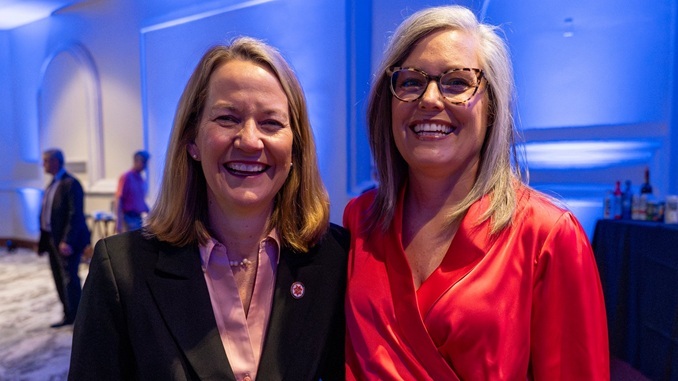
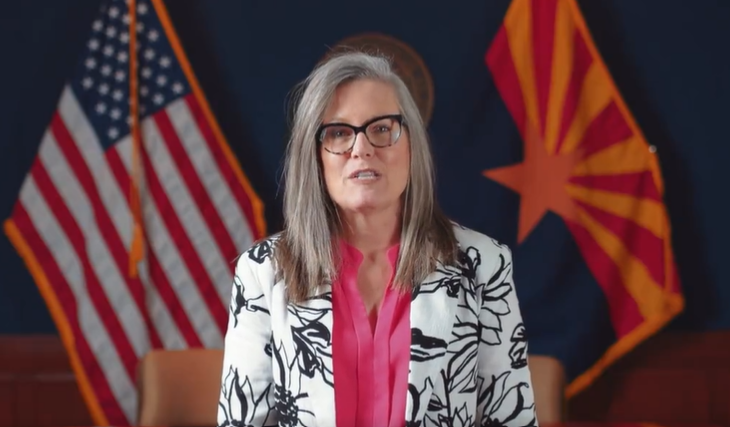
Arizona Attorney General Kris Mayes declined to prosecute Gov. Katie Hobbs on Friday over allegations of a pay-to-play arrangement involving Sunshine Residential Homes. The decision prompted Senate President Warren Petersen (R-LD14), Mayes’ Republican opponent in the November election, to accuse the attorney general of protecting a political ally.
Mayes announced that her office found no evidence establishing that political contributions from Sunshine were exchanged for rate increases granted by the Arizona Department of Child Safety (DCS).
“The investigation has not uncovered any evidence of the necessary quid pro quo to support a bribery charge,” Mayes said.
The decision followed a two-year criminal investigation that included 12 interviews and reviews of campaign-finance records, procurement records, bank documents, and state communications comprising more than one terabyte of data and more than 100,000 documents.
The investigation began in June 2024 after Republican Sen. T.J. Shope (R-LD16) requested reviews by both Mayes’ office and the Maricopa County Attorney’s Office following reporting about Sunshine’s political contributions and subsequent rate increases.
Sunshine gave $200,000 to the Arizona Democratic Party before Hobbs’ 2022 election, $100,000 to her inaugural fund, and another $100,000 to the party in August 2023. Sunshine founder Simon Kottoor and his wife, Elizabeth, also contributed to Hobbs’ gubernatorial campaigns. Arizona campaign-finance records showed Hobbs was the only Arizona candidate to receive contributions from either Kottoor during the 2022 and 2024 election cycles.
Sunshine received a mid-contract increase in May 2023 that raised its rate to $195 per bed, followed by an increase to $234 per bed during its April 2024 contract renewal. The Attorney General’s memorandum said the company’s rate increased 56% from 2019 to 2024, although two other providers received larger percentage increases over that period while maintaining lower daily rates.
Investigators found that DCS officials were aware of Sunshine’s political contributions while considering its request. According to the memorandum, then-DCS official Robert Navarro told agency officials during a February 2023 meeting that Sunshine was likely to request an increase and added that the company was a donor to the governor. Internal teams messages also included discussions of Sunshine’s contributions.
Navarro told investigators that the donations created perceived pressure, but the Attorney General’s Office concluded that the pressure resulted from his knowledge of the contributions and found no evidence that Hobbs or her office directed DCS to raise Sunshine’s rate.
The investigation instead concluded that Sunshine’s rate increases “appear as the result of its outsized leverage” over the state’s congregate-care system. The company has been one of Arizona’s largest group-home providers and accounted for approximately 20% to 25% of the state’s non-Division of Developmental Disabilities congregate-care beds, according to the AG memorandum.
DCS officials told investigators that Sunshine had indicated it could shift beds to the federal Office of Refugee Resettlement, which was paying substantially higher rates to house unaccompanied migrant children. Officials expressed concern that losing Sunshine’s capacity would make it more difficult to keep siblings in foster care together. Two other providers had already left state contracts in favor of federal work.
Mayes would not say whether Hobbs would ultimately sit for questioning, while saying the investigation was nearing completion. The memorandum released Friday says Hobbs declined to sit for an in-person interview with investigators but submitted two written statements through her attorneys on Aug. 17, one in her capacity as governor and another as a candidate.
Hobbs wrote that she “has never discussed DCS contract rates, Sunshine’s rates, or any DCS procurement decision” with Kottoor or anyone affiliated with Sunshine. She also denied directing anyone else to have such discussions and said neither Sunshine’s contributions nor other financial support influenced state decisions concerning the company.
Petersen criticized Mayes’ decision in a statement released through Arizona Senate Republicans Friday.
“Mayes’ decision was predictable in an election season,” Petersen said. He accused Mayes of having “shamefully shifted accountability and protected her political ally, turning a blind eye to Hobbs’ misconduct” and said she had placed politics ahead of law enforcement.
Petersen’s office said Sunshine made three $100,000 contributions to the Arizona Democratic Party during Mayes’ investigation. However, AZ Free News previously reported that Sunshine gave the party $200,000 in September and October 2022 and another $100,000 in August 2023, before Mayes opened her investigation in June 2024. The Attorney General’s findings released Friday do not identify any additional Sunshine contributions made during the investigation.
Petersen won the Republican nomination for attorney general in July and will face Mayes in the general election.
Mayes called for new state contracting transparency laws while announcing the decision, saying the absence of evidence sufficient for prosecution did not eliminate concerns about disclosure requirements surrounding state contractors and political donations.
The Legislature has previously sent Hobbs two bills sponsored by Shope addressing those issues. SB 1612 in 2025 would have required companies responding to state requests for proposals or seeking grants to disclose items of value provided during the previous five years to the governor, gubernatorial political committees, inaugural funds, and related entities. It also included procurement-record retention requirements and removed an Arizona Health Care Cost Containment System (AHCCCS) exemption from state procurement laws. Hobbs vetoed the measure.
Shope returned this year with SB 1186, which retained the political-contribution disclosures and record-retention provisions without the AHCCCS provision. Hobbs vetoed the bill in June after lawmakers sent it to her amid the continuing Sunshine investigation.
Hobbs separately proposed her own procurement and campaign-finance changes earlier this year, including limits on political giving while companies were bidding for state contracts and a searchable database of state contractors. The competing proposals did not produce legislation acceptable to both the governor and Legislature before lawmakers adjourned.
Mayes’ criminal division recommended closing its investigation into the alleged pay-to-play arrangement involving Hobbs and Sunshine. The memorandum said the office would keep its investigation open for the limited purpose of assisting the Arizona Auditor General if requested. A separate investigation involving Maricopa County Attorney Rachel Mitchell and the Arizona Auditor General also remains ongoing.
A new complaint filed this week alleges that Arizona’s governor, secretary of state, and attorney general may have participated in a straw donor scheme.
The complainant, San Tan Valley resident Gary DeBerge, has asked Arizona District Attorney Timothy Courchaine and Maricopa County Attorney Rachel Mitchell to look into what he says are “mysterious and unexplained” irregularities in the campaigns of Gov. Katie Hobbs, Secretary of State Adrian Fontes, and Attorney General Kris Mayes.
A copy of the complaint obtained by AZ Free News alleges that recent filings by one of the campaigns reflect “repeatedly altered reported receipts by millions of dollars” due to alleged eliminations of prior reported contributions.
Elect Katie Hobbs, the governor’s reelection campaign account, issued 10 amended reports for the 2026 Quarter 2 report, several of which varied by millions of dollars.
Exempt small contributions amounting to less than $100 totaled more than $1.4 million in the original filing and the first amended report, dropped to $0 in the second and third amended reports, then rose to nearly $400,000 in subsequent amended reports.
Total receipts amounted to more than $2.6 million in the original filing, but jumped to $3.1 million in the first amended report, then dropped below $1.7 million in the second amended report, then rose again to more than $2.2 million in the third amended report, and then rose again, back to more than $2.6 million in subsequent amended reports.
Donations under $100 are considered eligible for aggregate rather than individual reporting.
The complaint petitioned investigators to determine whether the millions moved around in amended filings reflected “a calculated attempt to obscure the true source and disposition” of the funds.
As noted by the complaint, Hobbs’ campaign reported much smaller totals of exempt small contributions throughout 2025 and the first quarter of 2026. Exempt small contributions across five quarters amounted to $600,000 in total. Then, in the second quarter of this year, the campaign reported a surge in exempt small contributions that amounted to more than double what the campaign pulled for an entire year and a quarter.
“Elect Katie Hobbs has reported approximately $1.4 million in exempt contributions and then later reported that those same contributions never existed,” stated the complaint. “This should immediately raise questions regarding the accuracy of one, if not all, of the recent filings made by this committee.”
The Trump administration and Republican leaders in Congress have initiated investigatory efforts into straw donor schemes by online fundraising platforms.
An example of this was illustrated prominently in the media earlier this year, when investigative reporters discovered that ActBlue, the primary fundraising platform for Democrats, allegedly misattributed around $100,000 in donations across thousands of individual political contributions over five years to one Elizabeth Waffle, an 88-year-old woman in Michigan living in a trailer with limited income. ActBlue allegedly misattributed more than 13,000 donations that occurred once or multiple times on a daily basis.
The complaint also questioned the number of contributors listed as “not employed” across the three campaigns’ 2026 filings to date.
Below are the total number of instances in which individual contributors were listed as “not employed” for the three report filings due so far this year and the four report filings made in 2025. These instances exclude retirees and may include individuals who contributed more than once.
Candidate
“Not Employed” or “Unemployed” in 2026 Filings
“Not Employed” or “Unemployed” in 2025 Filings
Katie Hobbs
46,335
26,643
Andy Biggs
26
21
Kris Mayes
17,530
13,162
Warren Petersen
0
0
Adrian Fontes
12,640
3,294
Alexander Kolodin
2
1
AZ Free News is your #1 source for Arizona news and politics. You can send us news tips using this link.
The state ceased imposing mandatory guardrails for parent caregiver payouts nearly a year ago.
The year of potentially runaway spending may have wasted nearly half a billion dollars, a new report from the auditor general revealed.
The audit found that the Arizona Health Care Cost Containment System (AHCCCS) and the Department of Economic Security (DES) had failed to implement cost-control requirements to the Arizona Long Term Care Services (ALTCS) program, within which is one of the biggest program costs: the Parents as Paid Caregivers (PPC) service delivery model.
PPC was established during COVID with substantial funding from the federal government, initially with the intent of being a temporary program. However, stakeholders desired permanence for the program when those pandemic dollars ran out. Gov. Katie Hobbs received approval from the Biden administration to make PPC permanent in 2024, which required Arizona to cover more than a third of the costs.
According to the audit, AHCCCS and DES leadership acted contrary to state law in order to implement laws how and when they saw fit, not how and when it was required of them.
One of the main cost-control requirements the agencies failed to implement was the standardized assessment tool.
AHCCCS suspended the tool in mid-October 2025, 16 days after initiating it according to state law. Those assessments made between Oct. 1 and 16, 2025, were reversed.
As a consequence, the auditor general estimated that the agency failed to realize between $133 million and $493 million in potential cost reduction “risking additional cost increases and shortfalls.”
DES was forced to request $83 million in supplemental appropriation from the state legislature for fiscal year 2026 as a consequence.
The threat of legal action reportedly prompted the agency to buck state law.
“AHCCCS reported that it halted implementation due to the threat of litigation and instead of implementing the policies it created it decided to engage in emergency rulemaking,” reported the audit.
The auditor general did assess that the tool lacked the ability to contain costs in the long term, and suggested legislative changes and federal approval.
The audit also reported that AHCCCS and DES failed to fully implement other cost-control measures, including executing processes to ensure parents reside in the state for at least six months prior to becoming paid caregivers, and prohibiting payments for parent-provided services between 10 p.m. and 6 a.m. and when the child isn’t home.
Further, AHCCCS and DES were found to have not enforced the 40-hour limit on parent-provided care until April of this year. The agencies were required to implement that limit back in July 2025. The audit found this delay caused DES to overpay some parents.
AHCCCS and DES ignored the law by delaying the limit for 10 months to avoid penalizing parents.
“[D]espite lacking the authority to do so, [the agencies] delayed enforcing the requirement because [they] sought to increase compliance through an educational and not punitive approach,” stated the audit.
The audit also found that DES was inconsistent about maintaining member records and ensuring the accuracy of member assessments. The auditor general warned that the former could result in unsupported service authorizations and impair payment oversight, and the latter could result in incorrect payments, waste, and mismatched service authorizations.
The auditor general issued 11 recommendations:
Implement the required standardized assessment tool
Continue developing a formally documented Extraordinary Care Review process
Develop and implement a procedure to seek legal counsel prior to programmatic changes
Develop and implement all required cost controls and oversight processes to ensure functionality
Update monitoring processes to ensure timely oversight of compliance with contractual and statutory obligations related to ALTCS and PPCG
Require provision of timely access to utilization and vendor payment records
Develop and implement regular assessments of the 40-hour limit
Establish corrective action requirements for lack of enforcement concerning 40-hour limit
Conduct an analysis to identify additional cost-control measures to improve ALTCS finances
Implement any additional cost controls for ALTCS as discovered with aid of governor’s office and CMS
Notify the legislature of analysis results and plan of action
Roberta Harrison, AHCCCS interim director, responded that she disagreed with the auditor general’s findings but promised to implement the 11 recommendations. Harrison cited federal Medicaid requirements, legal and procedural considerations, data limitations, and implementation timelines as hindering agency compliance.
DES agreed with one of the findings, that required cost-control measures weren’t fully implemented, and disagreed with the other three. DES agreed to implement all but five of the 20 recommendations.
The auditor general’s office plans to follow up with AHCCCS and DES in six months’ time.
AZ Free News is your #1 source for Arizona news and politics. You can send us news tips using this link.
Gov. Katie Hobbs says public education is woefully underfunded, but fiscal reporting indicates districts are flush with cash.
According to the latest Arizona Department of Education annual financial report, public school districts carried forward more than $8.3 billion in unspent funds from the 2024-25 fiscal year.
That is nearly equivalent to total appropriations that the state allocated for public education in the 2024-25 fiscal year: $8.9 billion, which goes beyond K-12 schools to include the Board of Regents, community colleges, and universities.
That $8.9 billion accounts for 55% of total appropriations out of the state’s general fund, which amounted to more than $16.2 billion in the 2024-25 fiscal year.
Within the $8.3 billion carried over from the 2024-25 fiscal year:
$1.6 billion for bond building
$1.3 billion for maintenance and operations
$1.2 billion for “other” funding
$941,000 for the Classroom Site Fund and Instructional Improvement Fund
$884,000 for unrestricted capital outlay
$708,000 for federal projects
$672,000 for bond principal deduction
$393,000 for debt service
$248,000 for food service
$150,000 for adjacent ways
$147,000 for school plant
$41,000 for state projects
The emergency deficiencies correction, building renewal, and new school facilities funds had negative balances of approximately $395,000, $19 million, and $33 million, respectively.
Last fall, the Common Sense Institute estimated that school districts hold more than $20 billion in combined cash reserves and underutilized real estate.
Public school district enrollment has declined steadily since 2008, more so in recent years after the state allowed universal enrollment for the ESA program in 2022.
Hobbs has advocated for lawmakers to revive Proposition 123, which would take around $300 million every year from the State Land Trust Permanent Fund and give it to education. $300 million is equivalent to a drop in the public education fund bucket: approximately 3% of what the state allocated from its general fund in the 2024-25 fiscal year.
Hobbs credited Prop 123 as providing “critical funding” for districts and educators in her State of the State address earlier this year. The governor said the funding provided by the proposition curbed the budget shortfall and would enable teacher pay raises and prevent future tax hikes.
The governor and lawmakers have failed to reach a consensus on renewing Prop 123. The proposition expired in June 2025.
Teresa Leyba Ruiz, the Democratic nominee for superintendent of public instruction, wants to claw back another 3% from a potential funding source. As reported earlier this week, Ruiz proposed reverting the $350 million set aside in Empowerment Scholarship Account (ESA) program funds back to public schools.
32% of educators reported having an external job and 21% of educators indicated additional paid responsibilities and a second job outside their school, according to a 2024 report by Hobbs’ Educator Retention Task Force issued in partnership with the Arizona State University Morrison Institute for Public Policy.
That same report identified inadequate salary, unpaid duties and hours, pay differences, and salary compression as issues impacting retention. The report estimated that only 16% of educators agreed that their salary was satisfactory and motivated them to stay in their professions.
A more recent poll of more than 9,300 educators during the 2025-26 school year by the Arizona Department of Education also found that teacher pay was one of the biggest sources of dissatisfaction for educators.
AZ Free News is your #1 source for Arizona news and politics. You can send us news tips using this link.
Friends of the Salt River Wild Horses is calling on Gov. Katie Hobbs to meet with advocates, saying more than 70 requests for a meeting have gone unanswered as the planned September removal of horses from the Salt River herd draws closer.
The organization issued the appeal Monday, one week after Hobbs formally launched her “Arizona Over Party” coalition, which her reelection campaign described as a group of Republican and Independent leaders, community members, and business leaders supporting her campaign.
“My focus has always been on delivering results for Arizona families,” Hobbs said when announcing the coalition. “That’s what Arizona Over Party is all about: putting the people of Arizona ahead of partisan politics.”
Friends of the Salt River Wild Horses cited the coalition in its Monday press release, saying its members span the political spectrum and have repeatedly sought an opportunity to speak with Hobbs before horses begin being permanently removed from the herd.
“We are not asking Governor Hobbs to agree with us,” a spokesperson for the group said. “We are simply asking her to listen before an irreversible decision is made.”
The organization said it has submitted more than 70 requests for a meeting with the governor through letters, emails, and other channels over the past several months.
During the group’s July 22 “Preserve the Herd — Follow the Science” rally at the Arizona State Capitol, advocates displayed more than 50 written requests seeking a meeting or assistance from the governor. Organizers said at the time that the requests had gone unanswered.
The dispute centers on a five-year herd management agreement awarded by the Arizona Department of Agriculture (AZDA) to the Salt River Wild Horse Management Group in February. The management group has said the plan calls for reducing the herd from approximately 274 horses to 120 through fertility control, natural attrition, and gradual relocation of horses to sanctuaries.
The Salt River Wild Horse Management Group said it plans to relocate approximately 25 horses annually to protected sanctuaries, with the first relocations planned for September. The group has opposed reducing the herd to 120 while saying it agreed to the plan as a compromise that would limit the number of horses removed each year and keep family bands together.
Friends of the Salt River Wild Horses said Monday that the herd currently numbers approximately 269 horses and reiterated its request that Hobbs pause permanent removals until an independent scientific review determines whether the population remaining along the Salt River would be genetically viable and self-sustaining.
“The burden should be on the state to show the science before taking an irreversible action,” the organization said. “The public should not have to accept assurances when the future of a protected herd is at stake. We are asking to see the independent scientific evidence supporting these reductions.”
The group has previously raised concerns over the proposed population level alongside wildlife ecologists and equine genetics specialists. In July, equine population geneticist and Texas A&M University professor emeritus Dr. E. Gus Cothran warned that a population of 120 could pose long-term genetic concerns, saying a population of approximately 150 to 200 animals is generally considered a minimum for maintaining genetic health over an extended period.
The Agriculture Department has defended the management process. When the contract was announced, AZDA said the proposal was evaluated by a panel that included veterinarians, a rangeland management scientist, and a federal wild horse manager, and said the gradual reduction was intended to balance available resources within the herd’s range while preserving its genetic integrity.
The department also told the Arizona Capitol Times in April that it had not independently established or mandated a 120-horse target. According to AZDA, the Salt River Wild Horse Management Group proposed reducing the herd to 120 over the five-year contract period. The department said sustainable management requires considering both the ecosystem’s capacity and the size and genetic diversity of the herd.
A spokesperson for Hobbs’ office said at the time that AZDA conducted a thorough procurement process and that the state was committed to sustainably managing the herd to protect the long-term health of the horses and their habitat.
The question of whether additional scientific review should precede removals also reached the Legislature earlier this year. A House-amended version of SB 1199 would have required AZDA to contract for an independent genetic assessment examining effective population size, allelic diversity, and inbreeding coefficients within the herd. It also would have temporarily prohibited population control removals while the herd maintained a negative growth rate, except when necessary to prevent or alleviate the suffering of an individually assessed horse and not for population control.
The House approved the amended legislation 43-10 on June 9 and returned it to the Senate, but senators did not take a final concurrence vote before the Legislature adjourned.
Current Arizona law prohibits harassing, shooting, injuring, killing, or slaughtering members of the Salt River herd and prohibits interfering with, taking, chasing, capturing, or euthanizing the horses without written authorization from the Department of Agriculture or Maricopa County sheriff, which may be granted only for humane purposes. The statute also authorizes the state to enter agreements with private entities concerning management of the herd.
Friends of the Salt River Wild Horses said its request to Hobbs remains open ahead of the September removals.
“Before the September removals, please meet with us,” the organization said. “And before another healthy horse is removed, please show Arizonans the independent science supporting that decision.”
AZ Free News requested comments from Gov. Hobbs’ Office and the Arizona Department of Agriculture; as of publication, no responses were received.