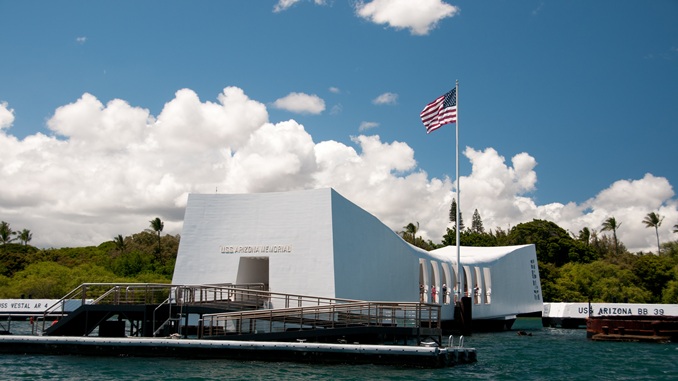
On the 85th anniversary of the attack on Pearl Harbor, federal officials will initiate the identification and return of remains belonging to World War II service members killed aboard the USS Arizona.
The Department of Defense (DOD) will begin exhuming 277 of the sailors and Marines who lost their lives during the attack on Pearl Harbor on Dec. 7, 1941. As part of the disinterment, the DOD will undertake forensic efforts to identify 86 of the service members whose identities remain unknown to this day.
The Defense POW/MIA Accounting Agency (DPAA) will use DNA analysis to match the remains to family members. DPAA will disinter eight caskets to start, then proceed at a pace of around eight caskets every two to three weeks until all the remains of the 86 unknown service members are disinterred.
More than 700 family members of the USS Arizona’s fallen are anticipated to be present for a ceremony at Joint Base Pearl Harbor-Hickam following the first disinterment on December 7 at the National Memorial Cemetery of the Pacific in Honolulu, Hawaii, per reporting from the Stars and Stripes.
The disinterment almost didn’t happen. A report by the Navy submitted to Congress in 2022 advised that it would take about a decade and $2.7 million to obtain familial DNA for identification efforts. The federal government determined such an undertaking would be too costly and require too much manpower.
DPAA needed a 60% threshold of DNA Family Reference Samples — family representation for 643 crew members — to proceed with the disinterment and identification process.
Kevin Kline, whose great-uncle Robert Edward Kline was among the service members killed aboard the USS Arizona, launched Operation 85 in 2023 to collect those samples. Kline reportedly spent nearly $150,000 of his own money to fund the costs to obtain them, and successfully made the organization an official partner of DPAA.
In April, DPAA announced that Kline and Operation 85 successfully reached the required 60% threshold, having obtained 653 DNA kits.
The 277 buried in Hawaii outside the ship represent nearly a quarter of the lives lost on the ship that day.
Just before 8 a.m. on Dec. 7, 1941, Japan attacked the Pearl Harbor naval base. More than 350 Japanese aircraft bombed U.S. vessels, the USS Arizona among them. The battleship exploded and sank, then burned for more than two days. The USS Arizona had 334 survivors: 319 from the Navy, and 15 from the Marines.
1,177 from the USS Arizona perished, representing nearly half of the 2,403 service members killed at Pearl Harbor. More than 900 of the 1,177 have the sunken battleship at the Pearl Harbor National Memorial as their final resting place.
DPAA recently reached a record milestone of 250 identifications of unaccounted-for service members. The 250th service member to be identified was U.S. Army Captain Albert Wilcox, a prisoner of war killed aboard a Japanese troop and prisoner transport ship that was sunk by Allied aircraft in the final months of World War II.
AZ Free News is your #1 source for Arizona news and politics. You can send us news tips using this link.
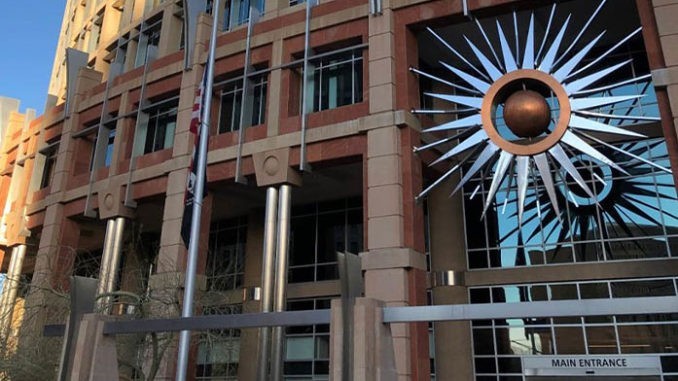
The city of Phoenix is operating a program to investigate federal agencies under President Donald Trump, according to public records.
The city publicly promotes its Community Transparency Initiative (CTI) as a complaint intake system and informational resource for the public on immigration matters.
However, records obtained by Judicial Watch reflect that the city of Phoenix tasks its employees and law enforcement with documenting, reporting, and investigating more than just federal immigration officials.
CTI, developed through the Office of Transparency and Accountability (OAT), was initially developed to take in reports and complaints concerning Immigration and Customs Enforcement (ICE) personnel.
The city’s employee training materials reveal that CTI has a much larger scope of oversight beyond ICE to include more federal agencies. City employees are trained to document and report all encounters involving federal law enforcement personnel. They are also trained to maintain records of time and resources devoted to work done concerning CTI.
Agencies under city of Phoenix employees’ purview were indicated to include the Federal Bureau of Investigation; United States Secret Service; Alcohol, Tobacco, Firearms, and Explosives; United States Postal Inspection Service; Border Patrol; Drug Enforcement Agency; United States Marshals Service; Federal Air Marshal Service; Federal Protective Service; Capitol Police; and the Transportation Security Administration.
Under CTI, the Phoenix Police Department uses its Special Investigations Division to review CTI complaints, investigate for criminal or civil rights violations, and pass along findings to Arizona Attorney General Kris Mayes. Both the police and fire departments have been involved in implementing CTI.
The initiative also connects residents with multiple progressive nonprofit organizations: the national and Arizona chapter of the ACLU, Immigrant Legal Resource Center, National Immigration Law Center, Informed Immigrant, Florence Project, International Rescue Committee, Phoenix Legal Action Network, and the Immigrant Advocacy Network.
CTI also refers residents to its Office of Refugee and Immigrant Support, established in March 2023 amid the height of the illegal immigration crisis under former President Joe Biden. The office provides refugees and asylum seekers with integration services, including access to healthcare, housing, childcare, education, and employment.
Around the same time in 2023, Gov. Katie Hobbs’ administration allocated $60 million to house, feed, and provide other resources to the homeless and illegal immigrants. $13 million went to the city of Phoenix.
In recent years, the city spent around $8 million of its $396 million in American Rescue Plan Act funds on refugee and immigrant services.
In early March of this year, the city authorized spending up to $500,000 through June 2028 for legal counsel through Coppersmith Brockelman PLC, a favorite law firm among top Democrats such as Gov. Katie Hobbs, though the CTI website and later reporting stated that the city spent $1 million to hire the firm. Sam Coppersmith, a managing partner to the firm, was formerly a Democratic congressman for the 1st Congressional District and a chairman of the Arizona Democratic Party.
Judicial Watch didn’t receive any records confirming that the city formally considered any other law firms to provide outside legal counsel for CTI.
Following this authorization for outside legal counsel, the city passed a policy banning ICE enforcement operations from city-owned property. Mayes later issued a defense of the city’s action.
AZ Free News is your #1 source for Arizona news and politics. You can send us news tips using this link.
Attorney General Kris Mayes is styling her campaign to show bipartisan support; her latest endorsement comes from a “lifelong Republican” former mayor who misused the 911 system.
Mayes opened her latest campaign ad with the endorsement of Sam Campana, the former mayor of Scottsdale from 1996 to 2000.
“I’m voting for Kris Mayes because Arizona deserves better than politics as usual,” said Campana.
Mayes has encouraged a public perception of nonpartisanship on the campaign trail and the debate stage.
During her debate against Republican nominee Warren Petersen last month, Mayes presented herself as apolitical. Petersen disagreed with that characterization and revisited actions by her office that he claimed were evidence of political lawfare, such as her refusal to defend a state law banning boys from girls sports.
“Whether it was a Republican president or a Democratic president, our criteria is the same: has the Constitution been violated? Has the state been harmed?” said Mayes. “And that has happened all too often over the past two years.”
“Kris Mayes is the most political and partisan AG that this state has ever had,” replied Petersen. “She’s got [more than] 50 lawsuits against her political opponents. She has weaponized the office.”
In furtherance of that goal to present herself as nonpartisan, Mayes this week featured an endorsement from Campana, Scottsdale’s first female mayor who previously identified as a Republican.
Some Arizona voters were quick to point out that the chief law enforcement officer had chosen an endorser who misused 911 on more than one occasion.
While mayor, Campana repeatedly called 911 for directions to city functions when she couldn’t get an answer in time from non-emergency lines.
Campana continued calling 911 despite being asked by local police leadership to cease calling the emergency line for driving directions.
Campana eventually relented from calling 911 for directions according to reports, but stated at the time that she continued to call police for navigational assistance.
“I only use it under duress,” said Campana.
The only "Republican" @KrisMayes could find to endorse her in her new ad?
A former mayor who abused police resources by repeatedly calling 911 "to get driving directions." The police chief had to send out a memo telling her to stop 🤡 pic.twitter.com/p9lBWG2BQj
The former mayor also told the Arizona Progress Gazette in a 2020 interview that she helped to ensure that women were hired over men during her tenure, giving the implication that she participated in sex-based hiring discrimination.
“It was an exciting time on the Mezzanine of City Hall when all the mayor and council staff were women! Mostly it was because we hired the most capable person for the job, but in a case or two it was a nudge to give a woman an opportunity who otherwise wouldn’t have gotten it,” said Campana.
Campana was among several self-identified lifelong Republicans in this latest campaign ad who said they viewed Mayes as one of their own, since the attorney general was a registered Republican until 2019.
Although Campana described herself as a lifelong Republican, she has endorsed Democratic candidates for years and was a member of Republicans for Harris.
Campana endorsed President Joe Biden in 2020, Gov. Katie Hobbs in 2022, and Kamala Harris in 2024.
This year, Campana supported Solange Whitehead and Raoul Zubia for Scottsdale City Council, and Marlene Galan-Woods for Congress — all Democrats.
“Principled, public policy-minded, cares about Arizona, steady at the wheel and a proven statewide candidate who has delivered every time,” said Campana of Hobbs in her 2022 endorsement.
AZ Free News is your #1 source for Arizona news and politics. You can send us news tips using this link.
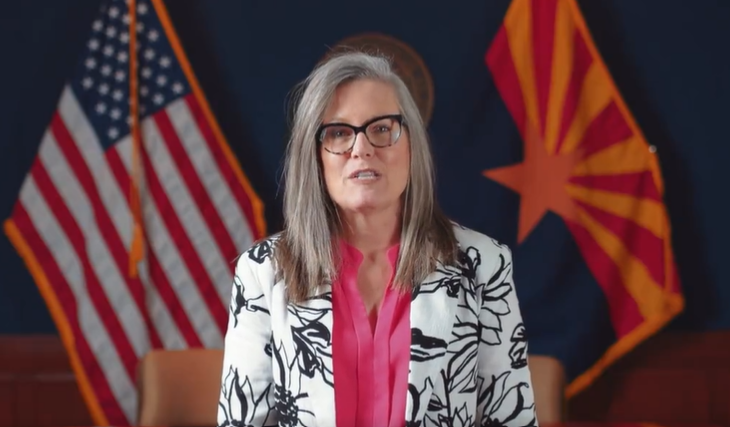
A law firm with close ties to Gov. Katie Hobbs has benefited from a series of government contracts within her administration totaling over $6 million.
Coppersmith Brockelman PLC has been awarded legal counsel contracts for multiple state agencies, according to initial reporting by FOIAzona.
The law firm, which has been a go-to for top Democrats, is also providing legal counsel to Hobbs’ secretive inaugural fund. The firm has disclosed its defense of Hobbs’ inaugural fund as one in a list of conflict-of-interest matters considered adverse to state interests.
Two of the firm’s partners have been appointed to high court positions in recent years. In 2022, Roopali Desai was appointed to the Ninth Circuit Court of Appeals; she administered Hobbs’ oath of office months later in January 2023. Earlier this year, Hobbs appointed Andy Gaona to the Arizona Court of Appeals.
Last year, one of Hobbs’ general counsel members, Bo Dul, joined Coppersmith Brockelman. Prior to joining the Hobbs administration, Dul had been senior counsel at States United Democracy Center, where she represented Hobbs pro bono.
Coppersmith Brockelman has contracts to provide counsel to the Department of Health Services (DHS), Arizona Department of Administration (ADOA), Arizona Department of Water Resources (ADWR), and the Arizona Health Care Cost Containment System (AHCCCS).
For all of the agencies, contracts were listed as “competition impracticable” — meaning the state didn’t undergo the competitive bidding process to award those contracts. For example, ADOA designated Coppersmith Brockelman in a 2024 competition impracticable procurement authorization form as having “specialized expertise” with DHS contracts.
The law firm received two contracts in 2024, two contracts in 2025, and one so far this year.
The two contracts in 2024 were for DHS and ADOA.
One of the 2024 contracts was for DHS litigation claims related to Sober Living Assisted Facilities at the request of Hobbs’ office; that contract has an initial estimated cost of up to $3 million, with listed counsel rated at anywhere from $350 to $500 per hour, paralegals listed at $150 per hour, and a legal assistant listed at $50 per hour.
The other 2024 contract was for civil claims against ADOA following a disqualification notice filed by Attorney General Kris Mayes. The contract had an initial estimated cost of up to $2 million, with listed counsel rated from $350 to $400 per hour, a paralegal for $150 per hour, and a legal assistant for $50 per hour.
The two contracts in 2025 were for ADWR and AHCCCS.
One of the 2025 contracts was for ADWR related to two separate actions filed in Maricopa County Superior Court pertaining to groundwater rules and regulations. Counsel rates were $400 and $425 per hour, with an estimated cost of up to $120,000 per year.
The other 2025 contract was to provide miscellaneous legal counsel for AHCCCS, with an initial estimated cost of $100,000 that was extended earlier this year to $200,000. Counsel rates were listed as $350 to $475 per hour, and an associate for $275 per hour.
The contract this year concerned ADWR’s involvement in an appeal and special action lawsuit on the assured water supply program: Home Builders Association of Central Arizona v. Arizona Department of Water Resources. The contract listed an initial estimated cost of up to $600,000. The state justified competition in this contract as impracticable because ADWR’s in-house attorneys were handling other litigation as well as Hobbs’ policy priorities.
AZ Free News is your #1 source for Arizona news and politics. You can send us news tips using this link.
Democratic congressional candidate Bernadette Greene-Placentia recently went public with a claim that she was raped by two men while cleaning up campaign signs.
Democratic elected officials were quick to voice their support for Greene-Placentia, but some voters and others online have expressed skepticism about her claims.
The Maricopa County Sheriff’s Office (MCSO) confirmed that it is investigating a sexual assault report filed August 31 by Greene-Placentia, who first went public with the alleged attack in a Phoenix New Timesarticle published October 7.
Greene-Placentia’s campaign toldPeople that the attack occurred August 14 at approximately 2 a.m. while she was repairing a campaign sign. Greene-Placentia is challenging Republican Rep. Abe Hamadeh in Arizona’s 8th Congressional District.
An MCSO spokesperson stated that the report, number IR26022432, won’t be available until their investigation is complete. The agency has not disclosed suspects, investigative findings, or a possible motive.
“I talked with the Detectives, they advised it is still an ongoing investigation and we cannot comment on the investigation at this time,” stated the spokesperson.
According to the Phoenix New Times report, Greene-Placentia claimed to have been struck in the head and lost consciousness after entering a parking lot to repair a sign. She alleged she regained consciousness as one man was raping her and then recalled a second man approaching. Greene-Placentia’s account varies between reports on whether the second man raped her or ceased his attempt to rape her when she put up a fight.
Greene-Placentia told the outlet that she interpreted one of her attackers as saying “Democratic bitch,” though she also expressed uncertainty about the words she heard. MCSO has not attributed any motive to the attack, political or otherwise.
Greene-Placentia described gaps in her memory following the incident, including her drive home, and expressed uncertainty about the precise location of the attack, which she said was likely near 99th Avenue and Bell Road in Sun City.
Once home, Greene-Placentia didn’t contact the police. Instead, she waited two weeks and three days to file a report.
Greene-Placentia continued her campaign activities between the attack and the day she filed the police report — including middle-of-the-night excursions to put up campaign signs.
On August 22 at about 3 a.m., about a week after the alleged rape, Greene-Placentia posted on Facebook that she was once again putting up signs at 2 a.m.
“Because whether it’s 2pm and 115 degrees while we canvass, coming off a 36 hour day to speak alongside Adrian Fontes for Arizona Secretary of State or put[ting] up signs at 2am when it’s still 105 degrees, Trucker Tough means the work never stops!” stated Greene-Placentia.
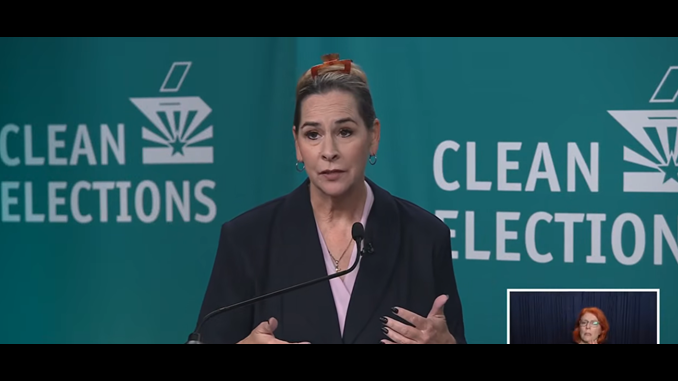
Four days before filing a police report, Greene-Placentia participated in a televised congressional candidate forum organized by Arizona’s Citizens Clean Elections Commission.
After filing the police report, Greene-Placentia waited five weeks to go public about the alleged attack.
Greene-Placentia’s rape claim — namely her decision to wait more than two weeks to contact police — has amassed skepticism online.
Hundreds of users across multiple platforms have expressed doubts about Greene-Placentia’s story, with many comparing Greene-Placentia’s allegation to Jussie Smollett’s fabricated 2019 attack.
Smollett was charged with felony filing of a false police report in February 2019 for staging a hate crime in which he falsely claimed masked men had insulted his homosexuality and told him it was “MAGA country.” Prosecutors decided to drop the charges about a month later.
just so i understand, she was in Surprise, at 2-3am, repairing her political signs, was recognized by two men who happened to be out and about and ready to rape her, and they did, and all this right before an election?
AZ Free News has compiled a timeline from the night of the attack to the first media report on Greene-Placentia’s allegations.
Timeline from Alleged Attack to Present:
Aug. 14, approximately 2 a.m.:Greene-Placentia says she was assaulted and raped by two men while repairing a campaign sign. She identified the general Sun City area while expressing uncertainty about the precise location.
Aug. 15:Greene-PlacentiajoinsEva Osuna, Peoria City Council candidate, and Melissa Ewing, Peoria Unified School District Governing Board candidate, for a canvassing launch in south Peoria.
Aug. 15–16 (approximate):Greene-Placentia’s husband described speaking with her by telephone but not seeing her for roughly two days. Her landlord described seeing her appear unsteady.
Aug. 16:A volunteer drove Greene-Placentia to a Chandler canvass launch, where she disclosed the alleged assault to campaign staff. Greene-Placentiapostson her Facebook page about her frustration with the Maricopa County Democratic Party for not investing $20,000 in her campaign: “Still pissed off..”
Aug. 17:Greene-Placentia told her husband about the alleged rape and contacted Greg Freeman, secretary of the Arizona Democratic Party.
Aug. 18:Greene-Placentiaattendedthe LD28 general meeting alongside Secretary of State Adrian Fontes in Peoria from 5:30 to 8 p.m.
Aug. 22:Greene-Placentiapostedon Facebook that she was putting up signs at 2 a.m. Later that day, Greene-Placentiaparticipatedin a South Peoria canvass with Raquel Terán, Melissa Ewing, Deborah Howard and Kyle Clayton, associated with Eva Osuna’s campaign.
Aug. 27:Greene-Placentia participated in the Clean Elections CD8 forum.
Aug. 30:Greene-Placentiaparticipatedin a canvass with LD29 Democrats, Melissa Ewing, and Eva Osuna.
Aug. 31:Greene-Placentia files a report of rape with MCSO; initial contact with the agency wasreportedlyby telephone.
Early September:Greene-Placentia reportedlytoldstate Rep. Stephanie Simacek about the alleged assault during a coffee meeting. No exact meeting date was established.
Sept. 1:Two sergeantsvisitedGreene-Placentia’s apartment the day after she filed her report.
Sept. 3:Greene-Placentiascheduledto appear at Grand Dems Meeting in Surprise from 5:30 to 7:30 p.m.
Sept. 8:Greene-Placentiahosteda live TikTok town hall with Friends with Political Benefits starting at 6 p.m.
Sept. 26:Greene-Placentiaappearedat LD3 Democrats canvass, LD3 Candidate Expo in Anthem, a house party, and the Arizona Democratic Party Hall of Fame dinner.
Oct. 7:Phoenix New TimespublishedBernadette-Greene’s rape allegation.
AZ Free News is your #1 source for Arizona news and politics. You can send us news tips using this link.