by Corinne Murdock | Apr 17, 2023 | News
By Daniel Stefanski |
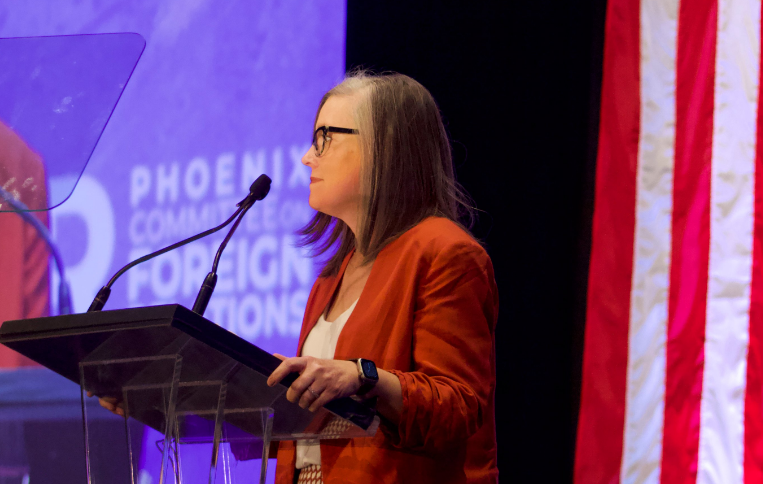
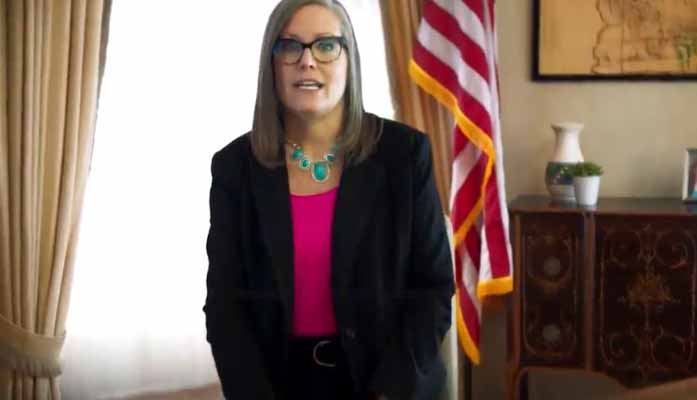
Democrat Governor Katie Hobbs marked her 100th day in office last week; and while she hasn’t accomplished much in her short tenure so far, she nonetheless celebrated this milestone.
Hobbs wrote an opinion piece for the Arizona Republic to kick off her day, stating that her “administration has hit the ground running to follow through on the promises I made during the campaign.” She championed the 22 bills that she signed into law and her work on the border and budget negotiations.
The governor didn’t just laud her own accomplishments, but pointed fingers at legislators, in large part, due to the “highly politicized confirmation process” for her nominees to lead state agencies. Hobbs argued that this perceived obstruction “has led agencies to slow walk critical initiatives that could save lives or support vulnerable populations for fear that any move, no matter how innocuous, will be interpreted negatively by certain lawmakers.”
Arizona legislators have been extremely frustrated over the Governor’s Office slow walking of nominees to the Senate for confirmation in the early going of her administration as is her legal responsibility. Though the Hobbs’ administration has appeared to have picked up the pace of transmitting her selections to the Legislature, a Senate source did tell AZ Free News that there are still a few outstanding from the Ninth Floor.
Unsurprisingly, the governor did not include any of her administration’s missteps and unfavorable headlines, including her decision to pull the nomination of her first appointee to serve as the Director of the Arizona Department of Child Safety, the lack of transparency over aspects of her Inaugural Fund, or the sudden resignation of her press secretary – among others.
Hobbs also tweeted that “We’ve accomplished so much these last 100 days and laid the groundwork for what’s to come.” She shared two graphics that highlighted what her administration has done “to move Arizona forward.”
On public safety and the border, the governor selected her Executive Order to establish the Independent Prison Oversight Commission and her roundtable discussion with U.S. Homeland Security Secretary Alejandro Mayorkas on migrant policy. On infrastructure, her speech at Lighting Up the Future, a benefit dinner for broadband expansion and digital equity. On Water and the environment, her establishment of the Office of Resiliency. On education, her Executive Order to create the Educator Retention Task Force. On health, her veto of Representative Matt Gress’s bill to enhance protections for pregnant victims. On housing, her Executive Order to reinstate the Arizona Governor’s Commission on Homelessness and Housing under new title. And on the economy, her International State of the State Address.
Mesa Mayor John Giles cheered on the governor’s first 100 days in office, writing, “In a divided government, Governor Hobbs has been forced to be a great defensive player. I appreciate that she’s also gone on the offensive for our shared priorities. She’s off to a great start, setting the right pace to tackle the issues impacting all Arizonans.”
But many legislative Republicans disagreed with Hobbs’ (and others’) characterizations of her early time in office. House Speaker Pro-Tempore Travis Grantham told AZ Free News that “There’s not much for her to celebrate. It’s clear she wasn’t prepared to govern, and her administration has been a mishandled from the start. But we can celebrate that because of the work by Republicans at the legislature in recent years, the State of Arizona is in a pretty good position. Consider that we now have universal school choice for families, a 2.5 percent flat income tax for everyone, and a balanced budget with billions of dollars in the bank in a rainy-day fund, all because of Republicans. And we are going to protect and defend those things.”
Arizona Senate President Pro Tempore T.J. Shope tweeted out a preview of an interview he participated in outside of the chamber, saying, “Special thanks to @Telemundo for having me on to discuss the lack of promised bipartisanship from @GovernorHobbs over her first 100 Days. From vetoing food/rental tax cuts, standing with murderers on Death Row instead of crime victims, standing with sex offenders instead of parents, to vetoes on bills that had over 2/3s support in both House & Senate to expand access to health care options, the partisan actions haven’t lived up to the bipartisan hype.”
Daniel Stefanski is a reporter for AZ Free News. You can send him news tips using this link.
by Daniel Stefanski | Apr 15, 2023 | News
By Daniel Stefanski |
Earlier this week, Democrat Governor Katie Hobbs continued her effort to break Arizona governors’ veto record, vetoing five bills sent to her from the state legislature.
The bills that Hobbs vetoed were HB 2552, HB 2675, HB 2754, SB 1236, and SB 1251.
Former Gov. Janet Napolitano set the record with 58 vetoes.
HB 2552, sponsored by Representative Austin Smith, would have prohibited “certain entities from using a voting method or nomination process that includes the ranking of candidates or allows candidates to be eliminated through multiple rounds of tabulation.” It also would have required “the person who receives the highest number of legal votes in an election to be declared elected.” Hobbs explained that “ranked choice voting is an election process that is used successfully elsewhere in the country.”
HB 2675, sponsored by Representative Steve Montenegro, would have declared “that drug cartels are terrorist organizations and required the Arizona Department of Homeland Security to do everything within its authority to address the threat that drug cartels pose.” Governor Hobbs justified her veto of this bill by saying, “Labeling drug cartels as terrorist organizations to deploy state resources is not a real solution and is not a state function.”
HB 2754, sponsored by Representative Rachel Jones, would have included “nongovernmental organizations in the definition of an enterprise for purposes of criminal liability and subjected an enterprise to criminal liability for the offense of participating in a human smuggling organization.” In announcing her veto of this proposal, Hobbs said, “This bill has unintended consequences for organizations that support immigrants.”
SB 1236, sponsored by Senator Wendy Rogers, would have declared “the regulation of the imposition of a tax or fee on a person or entity running a node on block chain technology to be a matter of statewide concern and preempted further regulation by a city, town or county.” The Governor stated that “this bill broadly defines ‘blockchain technology’ and prevents local policymaking concerning an emergent and potentially energy-intensive economic activity.”
After Hobbs’ action, Senator Rogers tweeted: “Of course Hobbs blocked my bill…anything that encourages the free markets gets torpedoed.”
SB 1251, sponsored by Senator Janae Shamp, would have prohibited “a city, town or county from enacting any ordinance, resolution or policy that prohibits or restricts a person from using a working animal in lawful commerce or for an animal enterprise.” Hobbs wrote that “SB 1251 is a solution in search of a problem. As the bill sponsor stated, no Arizona city, town, or county restricts rodeos or the use of working animals for agricultural or ranching operations. There are also no pending policy proposals to do so anywhere in Arizona.”
Daniel Stefanski is a reporter for AZ Free News. You can send him news tips using this link.
by Daniel Stefanski | Apr 12, 2023 | News
By Daniel Stefanski |
It’s a tale as old as January 2023: Arizona’s Democrat Governor and Republican-led Legislature aren’t agreeing on much in this session; and they certainly aren’t coming together on issues of election integrity.
Governor Katie Hobbs recently vetoed SB 1074, sponsored by Senator Sonny Borrelli, which would have prohibited “the use of electronic voting equipment as the primary method for tabulating votes in any city, town, county, state or federal election unless the outlined requirements are met.” The legislation would also prescribe “requirements relating to the source codes for electronic voting equipment.”
The governor didn’t provide much information in her veto letter to Arizona Senate President Warren Petersen, writing, “The election equipment required by the bill, as well as the problem it purports to solve, does not exist. This bill neither strengthens our democracy, nor ensures that Arizonans can better exercise their fundamental right to vote. I stand ready to receive bills that do.”
The bill sponsor, Borrelli, was outraged at the governor’s decision, issuing a press release to “call out Governor Hobbs for her continued blatant political games after she vetoed a bill that would have established oversight, security and transparency on electronic voting systems.”
Senator Borrelli stated: “In her veto letter, Governor Hobbs stated the election equipment required by the bill does not exist. This is in fact a lie. The equipment exists, but the components are made in the People’s Republic of China and other non-friendly countries. She’s pushing the idea that the United States of America could not onshore the manufacturing of tabulation equipment, which is absolutely absurd. There is nothing the American workforce cannot do given the right opportunities.”
He continued, saying, “Furthermore, Governor Hobbs falsely stated that this bill purports to solve a problem that does not exist. I beg to differ. Any electronic device can be manipulated to have a certain outcome. You need source codes to determine this, but they’re not being provided with the current system. You would think the former Secretary of State would know that in 2013, the U.S. Department of Homeland Security designated elections systems as critical infrastructure. This means these systems should be subjected to the same national security standards that the U.S. Department of Defense would apply to any critical infrastructure. Having a third-party vendor with total autonomy is not good for security, voter confidence, nor democracy. This bill would have taken the politics out of the voting process and created a neutral party that works for the Legislature. Fair and honest elections are a bi-partisan concern, albeit only when Democrats are the ones to benefit. Hobbs’ obstructive and cavalier attitude has been part of the destruction of transparency and oversight within our elections.”
SB 1074 originated in the Senate and was considered by the Elections Committee in February, where it passed by a vote of 5-3. The full Senate then approved of the measure in March, 16-13, with one member (Senator Gonzales) not voting. Borrelli’s proposal was then transmitted to the House and heard in the Municipal Oversight & Elections Committee, where it received six Republican votes compared to four Democrat votes (with Representative Jacqueline Parker absent for that vote). The full House then gave the bill the green light with a 31-27 tally, with two Democrat members not voting, making it possible for the legislation to be sent to the Governor’s Office.
Daniel Stefanski is a reporter for AZ Free News. You can send him news tips using this link.
by Daniel Stefanski | Apr 11, 2023 | News
By Daniel Stefanski |
A bill to protect children on the internet is nearing the finish line in the Arizona Legislature, though some partisan opposition puts its fate in jeopardy with Democrat Governor Katie Hobbs should it reach her desk.
SB 1503, sponsored by Senator Wendy Rogers, “directs a commercial entity to verify that any person attempting to access an internet website containing a substantial portion of material harmful to minors is at least 18 years old.” The bill “authorizes the age verification to be made through a commercially available database that is regularly used by businesses or governmental entities for the purposes of age and identity verification; or any other commercially reasonable method of age and identity verification.” It “subjects a commercial entity that violates the verification requirement to civil liability for damages, including attorney fees and costs, resulting from the minor’s access to the material.”
Rogers was joined on her bill by co-sponsors (and fellow Senators) Ken Bennett, Sonny Borrelli, Frank Carroll, David Farnsworth, Jake Hoffman, Steve Kaiser, John Kavanagh, Janae Shamp, T.J. Shope, and Justine Wadsack.
The bill first cleared the Arizona Senate Transportation and Technology Committee in February with a bipartisan vote of 5-2. Democrat Senator Christine Marsh joined four other Republicans to advance the legislation out of committee. After a Rogers’ amendment was adopted on the floor, the full chamber approved the bill with a bipartisan 19-11 vote, though Marsh did not vote in favor.
Senator Rogers cheered the passage of her proposal after the Senate vote, tweeting, “Need to be age 18 to view ‘content harmful to minors’ (pornography) on the internet. My SB 1503 passed the Arizona Senate. #ProtectChildInnocence”
SB 1503 was then transmitted to the Arizona House of Representatives where it was assigned to the Regulatory Committee. In March, the Committee took up and considered this bill, passing it with a party-line 4-3 vote. It awaits the green light from the House before it travels to the Governor’s Office for her final decision.
During the House Regulatory Committee hearing, Representative Nancy Gutierrez explained that she thought this legislation was “an infringement on our First Amendment rights,” and she found it “ridiculous” that anyone would suggest that a company would be at fault for a child looking at inappropriate websites. Gutierrez was baffled that anyone would also suggest that “there is a mechanism that would even be able to verify age.”
Her Democrat colleague, Representative Alma Hernandez, agreed with these sentiments. Before Hernandez voted against SB 1503, she first stated that she didn’t want children looking at pornography on the internet, but that this was “almost impossible to actually enforce.” She argued that the United States is “not North Korea, China, or Iran, where those countries have internet censorship,” and she challenged her Republican colleagues to return to their freedom-loving roots when coming up for solutions of problems that are perpetrated on the internet. Hernandez stated that she believes “it should be up to the parents to decide if they want to put screening mechanisms on their children’s phones.”
Daniel Stefanski is a reporter for AZ Free News. You can send him news tips using this link.
by Daniel Stefanski | Apr 10, 2023 | News
By Daniel Stefanski |
Democrat Governor Katie Hobbs and Arizona Legislative Republicans may not see eye to eye on much this session, but there’s one issue that has united Republicans with the state’s chief executive.
Last week, Governor Hobbs signed an executive order, dated April 4, to force “all State Agencies to remove TikTok from State-owned and State-leased information technology and personal devices used for State work.”
Hobbs justified her decision, writing that “TikTok has been found to have security vulnerabilities that, if unresolved, could expose State-owned or State-leased devices to malicious actors creating potential security and privacy risks to State agencies and the systems and data the State is charged with protecting.”
As Hobbs’ order concedes, the Arizona action was not the first in the nation: “TikTok has been banned on government devices by the federal government, several other states, countries, and organizations due to security concerns and concerns about the application’s potential to spread misinformation and propaganda.”
Freshman Representative Matt Gress, the sponsor of the “No TikTok on Arizona Government Devices Act” (HB 2416), cheered on the governor’s action, stating, “I applaud the Governor for taking action to address the security and data collection threats posed by TikTok and similar apps.”
Gress, though, urged the governor and his colleagues in the Legislature to pass and sign his bill, saying, “The Legislature still needs to act, and the Governor should sign HB 2416, a comprehensive plan to keep the state’s critical information secure and strengthen public safety. It would expand on the Governor’s order, codifying it permanently into state law, and apply to all government entities, employees, and contractors.”
HB 2416 passed the Arizona House at the end of February with a 31-28 vote – with one Democrat Representative not voting. It recently cleared the Senate Government Committee, and it awaits final action from the full chamber.
Arizona Attorney General Kris Mayes also chimed in on the TikTok news with an announcement, dated April 5, that the use of TikTok was banned on “all computers, mobile phones, and tablets owned by the (Attorney General’s) office.” Mayes explained that “Data security is paramount, especially for government agencies that handle sensitive information. We cannot risk the potential exposure of our data to foreign entities. Banning TikTok on state-owned devices is a necessary measure to protect our operations.”
Mayes revealed that “she was not reassured by recent testimony given by the CEO of Tik Tok to a Congressional panel,” adding, “Given the inability of TikTok’s CEO to definitiely state that the Chinese government cannot access data collected from U.S. users, I remain unconvinced that the app’s security risks have been adequately addressed.”
The action out of Mayes’ Office appears to have taken place earlier in the week. In the release from her office, it was stated that “Attorney General Mayes announced the ban in an email to Arizona Attorney General Office employees earlier this week.”
Daniel Stefanski is a reporter for AZ Free News. You can send him news tips using this link.