A Goldwater Institute-backed measure to constitutionally protect Empowerment Scholarship Account (ESA) funds for children of military families will go before Arizona voters in November after receiving legislative approval.
House Concurrent Resolution 2048, sponsored by Rep. Michael Way (R-LD15), asks voters to amend Article XI of the Arizona Constitution by adding a new section prohibiting the state from confiscating money from certain scholarship accounts of students who are children of military families.
Under the resolution text, the prohibition would apply if the scholarship account is established and maintained by the state under a program that designates children of military families as eligible to receive scholarship money, and if the student may use the money for tuition or fees at eligible postsecondary educational institutions. The resolution states that the provision is not limited to scholarship account programs established and maintained by the state only for children of military families.
The measure defines a “child of a military family” as a student whose parent is serving on active duty in the U.S. Armed Forces, was serving on active duty when the student’s eligibility was initially determined, or was killed in the line of duty. The measure defines “confiscate” as seizing, transferring, or otherwise taking money from a scholarship account.
The resolution includes exceptions for closures of accounts tied to individualized findings of illegal activity or wrongdoing after due process. It also accounts for routine account closures, including voluntary closure or failure to renew an account, graduation from an eligible postsecondary institution, or loss of eligibility after a student fails to enroll in an eligible postsecondary institution for at least four consecutive years after graduating from high school.
HCR 2048 also states that if a bill enacted into law or a voter-approved measure on or after Nov. 1, 2026, violates the proposed constitutional provision, the entire bill or measure is void and a court may not sever any portion of it. The resolution directs the Secretary of State to submit the proposition to voters at the next general election.
The measure passed the Senate on June 12 by a 16-13-1 vote and passed the House on final reading June 13 by a 31-22-7 vote.
The Goldwater Institute described the measure as its “Military Family Protection Act” and said it is intended to protect military families participating in Arizona’s ESA program from future efforts to redirect or reclaim scholarship funds.
The Arizona Department of Education (AZED) currently lists 100,713 students enrolled in the ESA program this school year. The department’s Fiscal Year 2026 Quarter 1 report, covering July 1 through Sept. 30, 2025, counted 93,993 ESA students, including 975 students in the category for students whose parent is active-duty military or was killed in the line of duty.
Goldwater’s Director of Education Policy, Matt Beienburg, told lawmakers that military families should not lose scholarship funds through a separate ballot proposal aimed at the ESA program.
“There is a current ballot measure being proposed to attack the scholarship funds and confiscate the scholarship funds of children, including military families,” Beienburg said. “These families should not be treated as a piggy bank to raid. These are families who have protected this nation.”
Rep. Way said the measure is intended to prevent Arizona from reclaiming scholarship money after families were promised access to the program.
“This measure asks a very simple question: should Arizona be allowed to take scholarship money from military families after we promised them? My answer is no,” Way said.
The referral comes as opponents of the ESA program are circulating the Protect Education Act, a proposed ballot initiative that would impose new restrictions on the ESA program. The campaign says the measure would require background checks and safety standards for voucher-funded schools, add spending transparency rules, prohibit non-educational and luxury purchases, cap family income for ESA eligibility at $150,000 with annual inflation adjustments, require unused ESA funds to be returned, and require voucher-funded schools to be accredited or administer approved assessments. The campaign says students with disabilities would be exempt from the income cap and assessment provisions.
In an op-ed for AZ Free News, Matthew Ladner and Jason Bedrick of the Heritage Foundation wrote that AZED published the results of a random audit of the ESA program in March 2026, “finding very low rates of misspending relative to other publicly funded programs and even lower rates of fraud. Less than 2% of ESA funds were spent on unallowed items, and 0.3% of the funds were spent on items considered ‘egregious’ or fraudulent.”
AZED disputed claims that the ESA program had a 20% fraud rate in a March release, saying about 2.0% of dollars spent by ESA account holders were for items deemed unallowable under program rules and that actual fraud or egregious purchases accounted for 0.3%.
“The submission of a purchase that is deemed unallowable does not constitute fraud,” AZED said. “Most are innocent mistakes, such as an error in a form that must be resubmitted, or educational items that are not on the allowable list but that the user could have in good faith believed were permitted. Some examples would be backpacks, lunch boxes and water bottles.”
AZED said the 20% figure represented program participants selected for risk-based auditing and “had nothing to do with fraud.” The department said action is taken to recover or collect funds or refer matters to law enforcement when necessary, and that more than $1.2 million had been recovered through that process.
Opponents of HCR 2048 have argued that its voidability provision could invalidate ESA reform proposals if voters approve conflicting measures. ABC15 reported that critics said the measure is aimed at blocking the Protect Education Act, while supporters said it is intended to protect scholarship funds promised to military families.
HCR 2048 was one of three education-related ballot referrals approved before the Legislature adjourned. Senate Republicans said the measures were intended to protect military families, direct more education dollars into classrooms, and restrict the use of taxpayer-funded school resources for labor organization activities.
“These scholarship funds were created for helping the children of military families pursue higher education,” Senate Appropriations Committee Chairman David Farnsworth said. “When government faces budget pressures, dedicated funds can become tempting targets. Arizona should never balance its books on the backs of military families or treat money set aside for their children’s futures as a piggy bank.
“This referral permanently protects those funds and ensures they remain available for the students they were intended to serve.”
For months, we have documented the pattern of errors, distortions, and outright fabrications that characterize the coverage of Arizona’s Empowerment Scholarship Account program by Channel 12’s political reporter Craig Harris. Each new episode—the fabricated 20% fraud claim, the defiance in the face of correction by the Arizona Department of Education itself, the constant shifting of goalposts as each of his claims is debunked—seemed like it might result in Channel 12 taking appropriate corrective action.
But they never did.
Last week, at the Arizona Legislature’s final stretch of its 2026 session, the mask came off entirely.
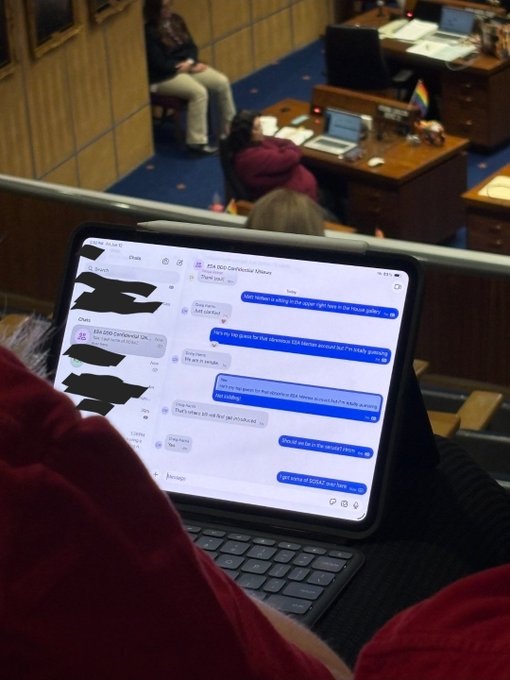
While lawmakers debated a series of consequential ESA-related bills and resolutions on Thursday and Friday—including a constitutional amendment to protect military family scholarships—Harris was captured on camera doing something that no journalist who takes the job title seriously can explain away: coordinating, via text message, with members of Save Our Schools Arizona, the anti-school-choice advocacy group that is a principal sponsor of the Protect Education Now ballot initiative, about where they should position themselves inside the Capitol building for maximum political impact.
Text message conversation between Channel 12’s Craig Harris and anti-school choice activists.
Let that sink in. A reporter on the education beat, covering legislation in real time, was not observing the advocacy groups in the building. He was directing them.
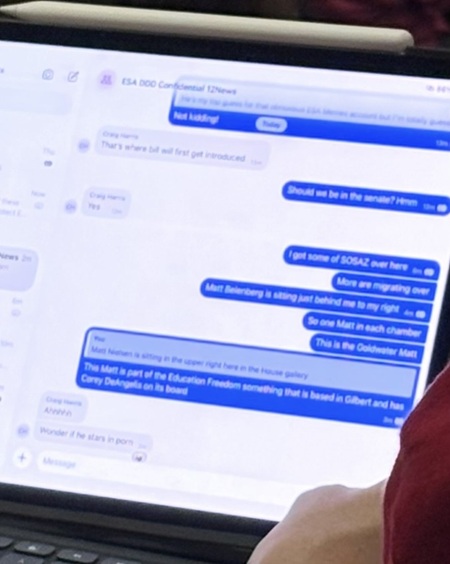
The text exchange was visible on the screen of a Save Our Schools activist—readable thanks to a conspicuously large font and no privacy screen—and was flagged by our Heritage Foundation colleague Corey DeAngelis, who shared images of the messages on social media after receiving them from a local activist. Harris subsequently confirmed on X that the images of the group chat, named “ESA DDD Confidential 12News,” were real.
After Harris told the activist that he was in the state senate chamber as that is “where [the] bill will first get introduced,” Save Our Schools board member Kathy Boltz asked Harris for advice regarding where their team of activists should place themselves in the capitol building. “Should we be in the senate? Hmm,” she asked. Within a minute, Harris answered in the affirmative.
This is not ambiguous. This is not a misunderstanding. This is a journalist using his knowledge of the Arizona Legislature’s political process to provide tactical advice to an advocacy group that has a direct political stake in the legislation he is supposed to be covering neutrally.
Harris was no longer covering the news. He was helping to manufacture it.
But that wasn’t the worst of it.
The same captured text conversation revealed Harris mocking a local school choice supporter, asking whether the individual “stars in porn.”
This derision was not just a lapse in professionalism. This was contempt—contempt for the families, advocates, and ordinary citizens who show up at the Capitol to make the case for educational freedom, expressed in a private conversation with advocates on the other side of the issue.
Text message conversation between Channel 12’s Craig Harris and anti-school choice activists.
Multiple Arizona politicos were quick to call out the behavior publicly. State Senator Jake Hoffman called for Channel 12 to fire Harris and called on the station to “open an investigation into every story he was involved in and retract any instance of undisclosed coordination.” Hoffman observed that this coordination with activists is “precisely the kind of unethical behavior that has caused the majority of Americans to deeply distrust the media.”
Arizona Republic columnist and former State Senator Paul Boyer called it “a really bad look” for Channel 12 to have their reporter, “who is also reporting on these same groups” to be discovered “coordinating with them at the legislature to defeat the same type of legislation he’s myopically focused on.” Similarly, J.P. Twist, executive director of Citizens for Free Enterprise, called out Harris for “literally strategizing with a partisan union to undermine parents’ rights.”
The parent company of Channel 12 publishes a “Principles of Ethical Journalism” statement committing its journalists to the values of truth, independence, public interest, fair play, and integrity. It’s hard to see how coordinating with one group of political activists and crudely mocking the other side comports with those standards.
Sadly, Harris’s breach of journalistic ethics does not end there.
Later that night, in a hearing on legislation to protect military family scholarships, Harris took to social media to characterize two of the three supporting witnesses who testified as people “making money off ESAs,” implying their support was financially motivated rather than principled.
One of those witnesses was Kevin Biesty, spokesperson for the Arizona Christian Education Coalition. As Biesty detailed on X, he reached out to Harris privately and asked him to correct or remove the post. Harris declined. As Biesty observed, the logic Harris applied to him — that representing clients who are affected by ESA policy makes one a financially conflicted advocate — is never applied to the other side. The staff and lobbyists of Save Our Schools Arizona and the teachers unions, who are paid to oppose the ESA program, are never characterized by Harris as people “making money off” the issue.
Harris also claimed that no military family spoke at the hearing. That too was false. Biesty had personally presented a written statement from a military mother who could not remain for the late-night session, and referenced letters from other military families — all of this while Harris was in the room. At no point did Harris ask Biesty for that mother’s contact information or seek to include her perspective in his coverage. He was, however, apparently attentive enough to the gallery to communicate with his Save Our Schools contact — the same ESA mother and SOS board member who, Biesty observed, is never identified as such in Harris’s stories — while sitting at the press desk on the floor.
Indeed, when ESA students and their families share their stories, Harris is quick to dismiss them. Recently, a young ESA student with disabilities named Jordan Visser shared on video about the ways the Protect Education Now initiative would harm students like himself. Harris went on social media to dispute his account, claiming that the initiative would not affect students with special needs—effectively accusing a student with disabilities of lying about the impact of a ballot measure on his own situation.
He was wrong. As the student’s mother, Kathy Visser, and others documented, the text of the initiative itself bore out what the student had said—the ESA funds that the family had saved to continue providing him with services would be seized by the state if the Save Our Schools ballot initiative were adopted.
The irony of Harris’s posture—aggressively checking the credibility of a disabled student while coordinating inside the Capitol with the very advocacy group sponsoring the initiative in question—encapsulates the problem. It is not that Harris is a journalist who occasionally makes mistakes. It is that the mistakes run in one direction, consistently, and that when corrected, he doubles down rather than acknowledging any error. And it is now documented, on camera, that he was coordinating tactics with one side of the debate he was purportedly covering.
Arizona families with children in the ESA program deserve better than a reporter who coordinates with the opposition at the very hearings he is assigned to cover. Arizona viewers deserve better than a news organization that has allowed this pattern to continue unchecked. And the thousands of children—including those with disabilities—who rely on these scholarships deserve a press corps willing to represent their stories honestly.
Channel 12 has not issued a correction or a retraction of the false fraud statistics. It has not yet acknowledged Harris’s coordination with activists or the mockery of a school choice supporter.
Channel 12’s parent company should answer a simple question: Is the behavior documented at the Capitol last week consistent with its Principles of Ethical Journalism? If not, what will it do about it?
Jason Bedrick is a Senior Research Fellow and Matthew Ladner is aSenior Advisor for education policy implementation at The Heritage Foundation’s Center for Education Policy.
The group seeking to end Arizona’s universal school choice program declared that it doesn’t have to disclose the percentage of out-of-state funds.
A complaint filed in April alleged the Protect Education, Accountability Now Committee (PEANC) falsely advertised that only 9% of contributions came from out of state.
PEANC’s ballot initiative, the Protect Education Act, would impose an income cap limiting enrollment in Arizona’s school choice program, Empowerment Scholarship Accounts, and eliminate funding rollover.
PEANC claimed in a response submitted on Friday and obtained by AZ Free News that Arizona law only requires the percentage of out-of-state contributors, not out-of-state contributions.
The section of Arizona law at issue (A.R.S. § 16-925) states the following:
“In addition to the disclosure required by subsection A of this section, a political action committee that makes an expenditure for an advertisement shall include a disclosure stating: […] The aggregate percentage of out-of-state contributors as calculated at the time the advertisement was produced for publication, display, delivery or broadcast. The disclosure shall state ‘paid for by _____’ as prescribed by subsection A of this section, followed by ‘with _____% from out-of-state contributors’ with the blank to be filled by the aggregate percentage prescribed by this paragraph.”
Counsel for PEANC argued in its response letter that, while nearly $4.5 million of its $4.6 million in net contributions did come from Washington, D.C. labor organizations, only 9% of all contributors to PEANC were from out of state.
“This text requires disclosure of the aggregate percentage of out-of-state contributors — i.e., based on contributor counts — not dollar amounts or ‘aggregate funding,’ and that percentage is calculated ‘at the time the advertisement was produced,’” stated PEANC’s counsel, Barton Mendez Soto. “The word ‘contributors’ refers to the people or entities making contributions, not the dollar amounts of their contributions.”
PEANC’s counsel said their interpretation accurately reflected what they dubbed the “contributors-percentage metric” represented by the statute.
The complainant, Jack Pannell, filed his complaint with the secretary of state after he observed a disclaimer on the bottom of PEANC’s website claiming that out-of-state contributors accounted only for 9% of total funding.
An archived version of the site captured in early February reflected an out-of-state contributions disclosure that totaled 50%.
Major Arizona-native donors to the PEANC came nowhere near the millions posted to PEANC’s finance reports; these donors include Arizonans For Quality Education (AFQE), $50,000; Nita and Phil Francis, $25,000; and the Arizona Education Association, $10,000.
Approximately 99% of AFQE’s funding has been tied to “shadow sponsors,” meaning unnamed corporations and LLCs. The remaining funds, less than half of a percent, came from an individual named Christopher “Chris” Kotterman on behalf of the Friends of ASBA, an affiliate of the Arizona School Boards Association.
Kotterman has served as Gov. Katie Hobbs’ senior policy advisor since late 2024.
The Protect Education Act would need about 256,000 signatures to make the ballot. The petition-filing deadline is July 2.
AZ Free News is your #1 source for Arizona news and politics. You can send us news tips using this link.
An Arizona mother says the state’s universal school choice program ensured the successes of her nine children.
Andrea attested that the Empowerment Scholarship Account (ESA) program allowed her family to have choice in the education of their nine children after she and her husband lost their jobs.
“It was a hard time to be able to pay for homeschool; we would have had to put our kids in a public school, and it was really stressing us out,” said Andrea.
ESAs empower kids with scholarships for the best fit education.
Listen to this AZ homeschool mom share how ESAs empower her kids.
— AZ Women of Action (@AZWomenofAction) May 19, 2026
Andrea told America’s Women that the job her husband acquired following his job loss didn’t provide enough income to cover the costs of homeschooling. The prospect of forcing her children to enter “a one-size-fits-all system” worried her; Andrea said the ESA program allowed her to provide her children with unique opportunities and freedoms not available within public education.
“Homeschooling with ESA has opened doors beyond traditional education. Our children have the opportunity to learn through real-life experiences — hiking in nature, visiting museums, and engaging in hands-on learning that brings lessons to life,” said Andrea. “They can move at their own pace, receive one-on-one attention, and explore interests that will shape their future paths and careers.”
As of Monday, the ESA program reported surpassing 101,500 students. The program also reported the enrollment of 3,300 new students for the next school year.
The ESA program may undergo reforms from two propositions gathering signatures to make it onto the November ballot: the Protect Education Act and the Reform and Accountability Act. Each would need 256,000 signatures to make it onto the ballot.
The Protect Education Act would impose an income cap on enrollment in the ESA program, in addition to eliminating the rollover of funding. This proposition is backed by two big critics of school choice: the state’s main teachers union, Arizona Education Association, and the nonprofit Save Our Schools Arizona.
Under the reforms on this proposal, qualified schools and tutors would have to pay fees and register annually with the Arizona Department of Education (ADE). Qualified schools must be accredited or administer state assessments, and the state would have greater oversight of nonpublic schools receiving ESA funds.
The Reform and Accountability Act would mandate the ADE to establish an online marketplace payments system starting July 2027. The proposed system would limit ESA purchases to approved vendors. This would eliminate the current system, in which parents rely on reimbursements and debit cards.
The program would need to issue quarterly reports to the attorney general detailing vendor payments, family disqualifications, and recovered funds. As part of that crackdown on misspending, this ballot measure would permanently disqualify parents from the program who intentionally misuse school choice funding.
Students not enrolled full-time at a qualified school would need to participate in an approved examination to gain entry to the ESA program. Then, the ADE would need to maintain lists of approved examinations and curricula.
The American Federation for Children has backed this proposition.
AZ Free News is your #1 source for Arizona news and politics. You can send us news tips using this link.
A new round of videos confirms that the spread of misinformation is extensive on both campaigns.
The entire Arizona school choice coalition opposes both measures because they would curtail the ESA program, which enables the families of more than 102,000 Arizona students to choose the learning environments that work best for them.
The initiatives would greatly disrupt their education by imposing new restrictions on how families can spend their funds, layering on bureaucratic red tape, and—in the case of the union-backed measure—kicking tens of thousands of children out of the program entirely.
In the latest clips, signature gatherers working for Protect Education Now, a joint project of Save Our Schools Arizona and the Arizona Education Association, and Fortify AZ, backed by the American Federation for Children, misrepresent the basics of the initiative and the ESA program itself.
Surprisingly, the talking points used by the supposedly pro-school choice campaign frequently mirror those used by ESA opponents.
Both Campaigns Grossly Exaggerate Misspending
In video after video, signature gatherers working for both initiatives wildly exaggerate the prevalence of fraud in the ESA program and hype the supposed purchase of “luxury” items such as jewelry, lingerie, trips to Disneyland, and other tabloid-ready spending that are forbidden under the ESA regulations.
One signature gatherer wearing a badge for Petition Partners, the group hired by the American Federation for Children-backed campaign, claimed that the ESA funds were used for jet skis and vacation rentals.
Another signature gatherer wearing a Petition Partners badge claimed there was $10.3 million in misspending in 2025. She failed to note that that accounts for barely 1% of total ESA spending, and that the vast majority of unallowed expenses were innocent mistakes, such as backpacks, lunch boxes, and water bottles.
Although there is room for improvement, Arizona’s ESA program is among the most accountable of any Arizona government program.
The Arizona Department of Education has confirmed that only 0.3% of ESA spending has been flagged as fraudulent or egregious—and nearly all of that occurred in the ClassWallet Marketplace channel that the American Federation for Children-backed initiative would preserve, while eliminating the debit card and reimbursement options that have almost no fraud at all.
Both Campaigns Spread Misinformation
Some gatherers from both campaigns have gone further still, telling voters verifiably false information in order to induce them to sign their petitions.
One Petition Partners signature gatherer told a voter that ESA parents were not required to submit receipts and that they could “buy a puppy” with their ESA and “say it’s for science class.” In fact, parents are required to provide receipts and other documentation. Moreover, the Arizona Department of Education confirmed that no ESA funds have been spent on puppies.
Another Petition Partners signature gatherer told a voter that parents were using ESA funds on cruises and home remodeling, while yet another claimed they were buying “cars and houses” with ESA funds. The Arizona Department of Education confirmed that no ESA funds have been spent on cruises, cars, houses, or home remodeling.
In some cases, the signature gatherers misrepresent the ballot initiatives to make them appear to be providing more education options for students.
In one video, a signature gatherer wearing a badge for FieldWorks, the group hired by the union-backed campaign, falsely tells voters that signing the petition would “help low-income students go to college.” The ballot initiative does no such thing.
In another video, a signature gatherer wearing a Petition Partners badge claims that the ballot initiative was “for everybody to be able to qualify for the [ESA] program.”
When the voter pushed back, noting that all students already qualify now, he replied (incoherently), “Because there’s something that’s against it already, so we [are] trying to get it on the ballot to be voted on instead of it just being changed.”
Ballot initiative workers have even spoken falsely to voters about the nature of their employment. In one video, a signature gatherer wearing a FieldWorks badge falsely tells a voter that he works for the Secretary of State’s office.
FieldWorks, the Arizona Education Association, and Save Our Schools Arizona did not respond to a request for comment.
It is unsurprising, if dishonest, when a teachers’ union and an avowedly anti-choice group resort to these tropes. It is genuinely appalling when a campaign backed by a self-described school choice organization spreads misinformation about a popular school choice program.
The American Federation for Children did not respond to a request for comment.
Previous videos have shown workers from the two campaigns colluding to gather signatures. In a new video, a signature gatherer with a FieldWorks badge that identifies her as a “team leader” introduces a voter to her fiancé, whom she claims is working for the “other education petition,” seemingly referring to the American Federation for Children-backed campaign.
The FieldWorks worker claims to be the “top signature gatherer in the state.” Her fiancé does not appear to be wearing a badge identifying the campaign for which he works, but he is holding a clipboard for the Fortify AZ petition.
When asked for comment, the owner of Petition Partners, Drew Chavez, deferred to their spokesperson David Liebowitz, who runs a self-described “public relations, political and crisis communication firm.”
The spokesperson declined to answer questions about the involvement of the American Federation for Children in crafting the messaging provided to the Petition Partners signature gatherers, instead providing the following statement: “Petition Partners has hands down the most thorough training program in the industry. Each of the more than 800 circulators hired for this effort has spent hours training on how to comply with state law and the facts of the measure itself.” The Petition Partners spokesperson said that they “have had reports of people pretending to be [Petition Partners] team members in an effort to discredit our work.” When asked to confirm or deny the employment of individuals who appeared in the videos, the Petition Partners spokesperson declined to answer.
Jack Reany, an ESA parent from Tucson, says that he has spoken with more than a dozen signature gatherers. He expressed shock at how little they tend to know about the ballot initiatives they’re asking people to sign.
“The public is being dangerously misled,” says Reany. “The fraud-and-accountability narrative is a smokescreen obscuring a deeply consequential piece of legislation: one that would strip legal protections from private schools, remove children from educational environments where they are thriving, and raid savings set aside by disabled students for their future.”
Arizona law is clear. Under A.R.S. § 19-116, knowingly misrepresenting an initiative’s subject matter to induce a signature is a Class 1 misdemeanor.
The videos keep accumulating. Whether Arizona’s anti-ESA attorney general acts on them is another question.
In the meantime, the advice from Arizona’s school choice advocates remains unchanged: If a gatherer approaches you with either petition, decline to sign.
Jason Bedrick is a Senior Research Fellow at the Heritage Foundation’s Center for Education Policy.