by Corinne Murdock | Jun 22, 2022 | Education, News
By Corinne Murdock |
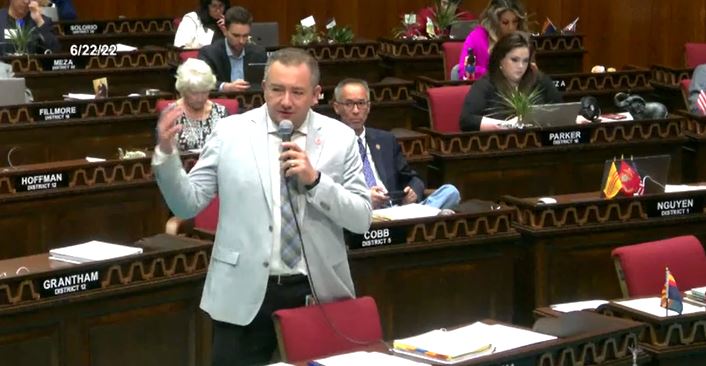
The Arizona House approved a universal expansion of the state’s school choice program on Wednesday afternoon. It now heads to the Senate for review.
The legislation, HB2853 by State Representative Ben Toma (R-Peoria), prompted protracted arguments that delayed the vote for about an hour. House Republicans managed to overcome Tuesday’s budget disputes to rally the majority to pass the bill, 31-26 along party lines. Anti-school choice activists in the gallery shouted “Shame!” repeatedly as the vote totals were read, adding to their general disruption and commentary presented throughout the hour-long debate on HB2853.
Democrats asserted that public schools weren’t fully funded, insinuating that was why they fell short in the eyes of Republicans and what they claimed was a minority of Arizona parents. They insisted that universal school choice through the state’s Empowerment Scholarship Account (ESA) Program contradicted the will of a majority of Arizona voters.
Republicans argued that school choice should be the option for all students, regardless of income or zip code. They repeated the idea that parents were the ultimate accountability for student success and outcomes, not government.
As the final vote and argument presented, Toma argued that Democrats’ logic meant that voters couldn’t ever possibly change their mind on the subject of school choice, which he insisted wasn’t true. Toma insisted that dollars should follow the students and not be the ownership of individual systems.
Toma wondered why private schools should be the exclusive domain of the wealthy, citing back to committee testimony from Drew Anderson — a South Phoenix pastor, Democrat, and beneficiary of school choice, which lifted him out of the squalor of public schools and onto a path resulting in his becoming an NFL player and consequently enabling him to lift his entire family out of poverty.
“This is giving everyone the opportunity to make full use of all their choices,” said Toma.
AZ Free News summarized the highlights of the partisan floor arguments for and against HB2853.
Democrat Arguments Against Universal School Choice:
State Representative Kelli Butler (D-Paradise Valley) characterized the bill repeatedly as “disrespecting the will of voters,” which earned reprimanding from Speaker Pro Tempore Travis Grantham (R-Gilbert). Butler doubted that beneficiaries of the ESA Program were using their funds to “learn anything,” claiming that there wasn’t proper oversight of beneficiary schools’ curriculum.
“They could be learning the most basic things and using our tax dollars,” said Butler.
State Representative Lorenzo Sierra (D-Avondale) said that public schools provided a far superior education, pointing out that 19 out of 20 Flinn Scholars went to public schools.
Sierra also predicted there would be regulations on this bill, speculating that a group of liberals would launch a school built around the 1619 Project, and that the legislature would then attempt to regulate private schools if that happened.
State Representative Judy Schwiebert (D-Phoenix) said that a vast majority of families choose a public district for their children because of their accountability and presence of school boards, calling public school curriculum “well-rounded, publicly vetted, [and] diverse.”
Ultimately, Schwiebert insisted that not all children deserved school choice.
“Technically I know we’re giving it to parents, but let’s be real about it, we’re funneling it to private schools,” said Schwiebert.
State Representative Mitzi Epstein (D-Chandler) said that school choice expansion at this scale would greatly increase cost of administration, and called parents’ access to taxpayer dollars to individualize their children’s education “inefficient.”
State Representative Andrés Cano (D-Tucson) asked his Republican colleagues to submit personal financial disclosures about their benefit to school choice.
State Representative Sarah Liguori complained that the ESA Program was corrupted because some of her wealthier “mom friends” used program funds toward their children’s education. Ligouri said that those individuals should pay for private schooling themselves.
House Minority Leader Reginald Bolding (D-Laveen) claimed that “millionaires and billionaires” would receive a check to subsidize their child’s private schooling. He claimed that private schools wouldn’t return ESA program money even if the family couldn’t cover the rest of the tuition, and that public schools would have to “pick up the slack.”
State Representative Melody Hernandez (D-Tempe) said that expanding the ESA Program would actually trap low-income families in failing schools, many of whom she said were minorities. She called the bill “immoral,” and claimed that Republicans were targeting people like her by expanding a system of oppression.
Republican Arguments For Universal School Choice:
State Representative Lupe Diaz (R-Hereford) insisted that Democrats’ arguments about the harm of school choice couldn’t be true based on the longevity and successes of school choice in Arizona’s history.
“If this program causes so much heartache and blows up public schools, then it wouldn’t have the longevity it has now,” asserted Diaz.
State Representative Shawnna Bolick (R-Phoenix) said she would’ve loved to have school choice options like this growing up, and asserted that it was a good thing that children could use ESA dollars for college education as well.
“Why should we wait until higher education to allow taxpayers to utilize these public dollars for their [children’s] education?” said Bolick.
State Representative John Fillmore (R-Apache Junction) reminded the floor that K-12 spending eats up almost half of general fund money, yet Democrats argued it wasn’t enough. Fillmore also read Arizona Department of Education (ADE) data revealing the low passage rates for children in standardized testing.
“The fact of the matter is, the schools have failed us. Parents are taking their kids out because they see this failure,” said Fillmore.
State Representative Joanne Osborne (R-Goodyear) said that every generation of her family dating back to the late 1890s graduated from Arizona’s public school systems, and that her daughter is a current public school teacher, but that those factors didn’t outweigh her care for children’s needs.
Osborne characterized HB2853 as a win for all Arizona schoolchildren, and asserted that a majority of Arizona parents want school choice. Her remark prompted commentary from the gallery.
Corinne Murdock is a reporter for AZ Free News. Follow her latest on Twitter, or email tips to corinne@azfreenews.com.
by Corinne Murdock | Aug 31, 2021 | Education, News
By Corinne Murdock |
Another data breach in two years has Empowerment Scholarship Account (ESA) holders wondering if their information is secure with the Arizona Department of Education (ADE). This past week, it was discovered that the state’s contracted payment platform for ESA funds, ClassWallet, had allowed users to search for other ESA account holders and view their names and email addresses.
In a letter sent to ESA holders, ESA Program Director of Communications and Engagement Sarah Raybon explained that they became aware of the data breach last Friday. Raybon assured ESA holders that ClassWallet would resolve that feature over the weekend.
“Today, our team became aware of an issue in ClassWallet portal’s search feature that allowed account holders to view the names and email addresses of other account holders,” wrote Raybon. “Upon discovery, we immediately contacted the Treasurer’s Office (who holds the ClassWallet contract) and we spoke to ClassWallet directly. We have been advised that ClassWallet engineers will be working over the weekend to get this fixed.”
During the Arizona State Board of Education’s meeting last week, parents questioned why a violation of federal law was happening again. They pleaded with the members to remedy these issues sooner rather than later. One ESA parent, Kelly Pichitino, admonished ADE for not cleaning up their act and ensuring any contract holders follow federal law after last year’s data breach.
“I would like to know why, for a second time, my child’s name is available for a stranger to view along with my personal information?” asked Pichitino. “[I] would think that the department would invest a little more thought and care, time and accountability into their actions.”
Further public commentary at the meeting also focused on other issues with the ESA system, such as inappropriate or incompetent staff behavior, apparently arbitrary denial of funds for educational needs, little to no communication and transparency, and relentless rule or policy changes.
These issues were also detailed in written comments, which are available here.
This isn’t the first time that ADE has compromised ESA members’ information unintentionally. As Arizona Capitol Times discovered and reported last January, the ADE failed to properly redact the personally-identifying information of all ESA account holders when fulfilling a public records request to three requestors, one of which was a group that actively campaigns against ESAs: Save Our Schools Arizona (SOSAZ).
Exposed information included parents’ first and last names, email addresses, the grade of their student(s), and any disabilities if a particular student had special needs.
The Arizona Department of Education (ADE) downplayed the data breach, saying that only “some” personal information was shared inadvertently.
“In the course of fulfilling a public records request to three individuals, the Arizona Department of Education (ADE) inadvertently disclosed some personally identifiable information belonging to Empowerment Scholarship Account holders,” stated ADE. “ADE redacted the document subject to the public records request but failed to secure the integrity of the redaction prior to sending the data, and the document was able to be manipulated to reveal private information.”
Corinne Murdock is a reporter for AZ Free News. Follow her latest on Twitter, or email tips to corinne@azfreenews.com.
by AZ Free News | Jun 28, 2021 | Education, News
Republican Arizona State Reps. Michelle Udall, Joanne Osbourne, and Joel John are coming under fire for their decision to deny over 700,000 kids school choice opportunities. The trio voted with all House Democrats to reject a proposal to expand the Empowerment Scholarship Account program.
Specifically, Udall, Osbourne, and John voted against an amendment offered by Rep. Shawnna Bolick that would have expanded the Empowerment Scholarship Account (ESA) program to low-income students (about 80% of whom are minorities) and kids of Veterans.
ESAs allow families to utilize their education tax dollars and spend those funds on education choices that they deem best for their children. These dollars can be used to attend micro/pod schools, private schools, hiring tutors, purchasing online curriculum, and other options that may work best for each unique student.
Critics say that by voting no on the Bolick amendment, Udall, Osborne, and John became the only three Republicans to vote against this measure and sided with the teachers’ union and anti-school choice groups like Save Our Schools.
Additionally, a poll conducted by the #1 pollster in the country according to the NY Times showed that 75% of Arizonan’s support school choice and that 73% of Arizonans support this specific effort of helping low-income children. This means that the vast majority of Republican, Democrat, and Independent voters all support school choice.
Supporters of ESAs say students in Arizona needed this expansion especially in light of the drastic learning loss from Covid due to the sub-standard “virtual” education provided due to the refusal of teachers to return to in-class learning.
RELATED ARTICLE: This Pastor And Former NFL Player Believes All Students Deserve School Choice
by Terri Jo Neff | Jun 24, 2021 | Education, News
By Terri Jo Neff |
The State Senate worked into the early hours Wednesday to pass an 11-bill budget packet, and now all eyes turn to the 60 members of the House which is slated to take up the bills Thursday.
But questions remain as to whether House Speaker Rusty Bowers can ensure 31 votes on the budget bill involving K-12 Education funding.
The Senate pushed its bills through a marathon of 16 to 14 party line votes which started Tuesday and did not end until 2:30 a.m. Wednesday. Many of those bills included amendments, including SB1826, the Senate’s K-12 budget bill, which as passed includes a major expansion of eligibility for Arizona’s Empowerment Scholarship Accounts (ESAs).
An ESA allows an eligible child to receive credit for most of the government education funding that would have been paid to the student’s public or charter school. Those funds can then be used toward private school expenses, including tuition, counseling, tuition, and other necessary costs.
The Senate’s K-12 bill jumps the number of students eligible for an ESA from 256,000 to nearly 726,000. However, the House K-12 budget bill, HB2898, does not currently expand ESA eligibility. And two Republicans whose votes are needed to pass any budget bill have been staunchly opposed an ESA expansion.
Those Republicans are Rep. Joel John (R-LD4) and Rep. Michelle Udall (R-LD25). Both have worked as educators, and it was their opposition earlier in the session that killed an ESA expansion bill introduced by Sen. Paul Boyer.
How strong the opposition of John and Udall is to expanding ESA criteria will be tested Thursday due to the fact Senate President Karen Fann included one of Udall’s own education-related bills in the same Senate’s K-12 budget amendment. There are also items in the amendment that John is known to support.
Less than 10,000 of the students in K-12 who are currently eligible for an ESA utilize the program. Assuming the same percent of eligible students enroll under the new criteria as under the current criteria, then nearly 2,000 new students would benefit in Fiscal Year 2022. That number of new students could grow to nearly 6,000 in Fiscal year 2024, according to the Joint Legislative Budget Committee.
Boyer, an educator for a charter school, introduced his bill back in February and was able to get it through the Senate on a 16 to 14 party line vote. It then stalled in the House when it became clear Bowers did not have the necessary 31 votes for passage due to John and Udall’s opposition.
For the last few weeks Boyer had withheld support for the Senate’s 11-bill budget package, which he believed needed to provide more funding for education and paying down Arizona’s debt. With ESA and other expenditures added as amendments his vote turned to a yes. Whether Bowers can find a way to bring John and Udall on board for Thursday’s vote remains to be seen.
Those who support the ESA expansion include the Center for Arizona Policy, the Barry Goldwater Institute for Public Policy Research, and the Republican Liberty Caucus- Arizona.
by AZ Free News | Feb 3, 2021 | News
UPDATE: Senate Bill 1452 passed out of the Senate Education Committee along party lines on a 5-3 vote on Tuesday.
PHOENIX – Prominent leaders from the valley’s Black Community gathered at the state capitol today in a call-for-action to support minority children when it comes to education in the wake of the pandemic.
They’re supporting Senate Bill 1452, introduced by Senator Paul Boyer, which would expand the state’s Empowerment Scholarship Account program to include low-income students.
“The time for equal opportunity in education is now,” Boyer said before today’s committee hearing on the issue.
A recent study shows that low-income and minority students nationwide are up to 5 months behind their peers and could be as far as 16 months behind academically by the end of the school year.
Pastor Drew Anderson, from the Legacy Christian Center in South Phoenix, led today’s group of SB 1452 supporters. Anderson, a former NFL player, says his success in life would never have come about had it not been for the educational opportunities he was given growing up in Chicago.
Anderson is attempting to unite party lines, saying, “We are in a battle not of Republicans, not of Democrats, but we are in a battle for young souls. As a registered democrat I support this bill, as a registered democrat I support anybody who supports making sure all minority children are given an opportunity to be properly educated.”
Since the pandemic began and schools across America were closed, one report puts the number of missing children, students who have not been getting any type of schooling, mostly from low-income families, at three million children. The challenges to low income families are many including poor to no internet access for virtual learning. Anderson tells of seeing families in McDonalds restaurants so their children could have access to their school work.
In addition, a survey from the Urban Institute found that 75 percent of low-income parents were unable to work from home. Which in many families means no one is available to help these students with distance-learning. Aggravating that statistic is Arizona’s ranking of 14th in the nation for single parent households.
In an effort off-set these disadvantages, Black Leaders believe lawmakers need to take action through the expansion of the existing ESA program. The proposal introduced today would help low income parents overcome disadvantages from the digital divide to unsupervised distance learning.
The measure under consideration would make funding available for a parent to pay for tutoring, educational materials, homeschool and micro-schools or money for private schools.
Janelle Wood, with the Black Mothers Forums in Arizona says she’s fought the battle for supportive and safe learning environments for “our sons and daughters”. Speaking out today, she said, “Our children deserve and opportunity, their parents, their mothers, deserve an opportunity to find a place where those children are safe and supported.”
The group contends letting minority students fall behind will create issues for the state for years to come. Right now, by expanding the established ESA program, the state’s Black Leaders say Arizona’s legislature has the option to change the course of what could be an educational disaster. Hoping to offset what is known as the prison pipeline because of a lack of education, Reginald Steele, a Pastor from Kingdom in the Valley said a better use of our monies would be investing in education, especially the school choice option.
“I would rather see us building more Penn States then Penitentiaries,” Steele said.
Senate Bill 1452 would give parents up to $7000 in ESA funds to spend on their children’s education, and cut the approval and waiting time for parents to 30 days instead of 100.
“School Choice is no longer something that can be on the back-burner,” Drew says, “but it’s actually the Civil Rights Movement of this era.”