• About
  • News
  • Opinion
  • Economy
  • Education
  • Contact
  • About
AZ FREE NEWS
New Scottsdale Private School Offers Christian, Parent-Involved Alternative

New Scottsdale Private School Offers Christian, Parent-Involved Alternative

by Corinne Murdock | Jul 28, 2022 | Education, News

By Corinne Murdock |

In a few short weeks, around 200 children will commit to an education that tends to stand out in this day and age: a “Christian, constitutional, classical” one. 

These students of the new private school, Tipping Point Academy (TPA), are just a fraction of the thousands upended or seeking alternatives following public schools’ response to the COVID-19 pandemic: a demographic projected to increase due to the state’s recent and historic universalization of its school choice program, Empowerment Scholarship Accounts (ESAs). 

TPA was launched last March by Great State Alliance (GSA), a nonprofit advocating for constitutional liberty since the summer of 2020 when that organization launched in response to the COVID-19 pandemic.

AZ Free News interviewed TPA Founder Jeremy Wood. He was unabashed about God being the core of TPA’s foundations and vision. 

“We are working from the presupposition that the word of God is the roadmap for life and living,” he explained. “The Bible is God’s word and truth. It offers knowledge and wisdom and everything you need to be successful in life. Our classes are all taught from a Biblical worldview. Everything we teach is taught from that perspective. We believe that God created the world. He created science, math, astronomy, and the stars, and He made the world to work as a perfect mechanism.”

Wood clarified that core academics and God aren’t mutually exclusive. He explained that TPA operates from Christian premises rather than a secular one. Meaning: TPA offers a classical education that encompasses the likes of Socratic dialogue and natural law and excludes modern, controversial approaches like Critical Race Theory (CRT), Culturally Responsive Education (CRE), Social-Emotional Learning (SEL), and Comprehensive Sexuality Education (CSE). Their version of education includes approaches like “The Noah Plan,” which incorporates the Bible in every subject. 

“That’s the difference: the word of God is the foundation of our instruction. That’s not separate from our academics. We’re teaching the kids all the same academics they’re learning in public schools,” said Wood. “Our curriculum isn’t vastly different. It’s more of a philosophical approach for how we apply the methodology of teaching. We apply the principled approach which is based on teaching kids on how to become learners and critical thinkers.”

Wood said that TPA initially started as a desire to provide a better education for his own children. Then, he said that he recognized that education was a frontline in defending liberty, and his desire expanded to offering a better education to his community.

 “The government was forcing these shutdowns and mandates, so we decided to stand up and create a solution that was faith-based and protective of our rights to assemble, to meet without fear of needing to shut down, or implement mask policies, or some other weird draconian measures to create barriers between us,” said Wood.

According to Wood, TPA uses a mastery learning model for teaching. Students must master content in each subject, which are “set up like mini dissertations” that require students to compile their research and writing to complete a notebook, or “mini thesis.” Additionally, TPA prioritizes hands-on, project-based learning. Wood cited an example of TPA students learning to apply for a job, use functional math, develop business plans, manage a business, run sales, and market products and services through the campus cafe. 

“TPA is about creating critical thinkers,” stated Wood.

Another unique aspect about TPA: they expect parental involvement, almost to the point of a requirement. Wood emphasized that fathers were the key figures that TPA prioritizes for incorporation, but noted that anyone is open to serve through work like administrative support or classroom management. Parents are required to undergo a background check, just like all TPA staff. 

“We’re not going to allow you to be a non-present parent. We expect volunteering,” said Wood. “We believe it’s our duty to partner with the parents. If you’re not going to be involved in volunteering, we’ll just tell you right now we don’t think you’re a fit for our school. If we were in it for the money, we’d be telling people everything they wanted to hear to get them in the door. We’re pretty clear on our methodology to keep like-minded people in our community.”

In just over a year of its existence, TPA has already experienced pushback from the establishment educational community.

Save Our Schools Arizona (SOSAZ) has been one of the first to target TPA. The anti-school choice organization’s director, Beth Lewis, characterized the private school as a money-grabbing scheme developed in response to the universalization of ESAs.

It’s no coincidence that schools like Tipping Point Academy are popping up all over AZ, ready to scoop up millions in taxpayer 💰 if universal voucher expansion isn’t stopped 😡 Their mission is to “develop tomorrow’s godly titans” pic.twitter.com/9BAiRleFlh

— Beth Lewis 🆘 🏜🎓 (@AZBethLewis) July 24, 2022

At $8,500 annually, TPA’s tuition falls below the average private school cost. Average tuition for private schooling in Arizona is nearly $10,300. 

TPA’s enrollment ranges between 180 to 200 students, totaling between $1.5 and $1.7 million accrued from tuition. If every parent utilized the $7,000 maximum from the state’s ESA Program, that reduces tuition to $1,500 — which may be paid down for just over $100 on a monthly basis. Interested parents may also qualify for a TPA scholarship.

Wood responded that taxpayer dollars for education should be accessible to all taxpayers — regardless of their beliefs.

“Those are our taxpayer dollars as well. People are welcome to have their opinion. They don’t have to send their kids to our school,” said Wood. “We shouldn’t be discriminated against just because we want our kids to learn about our heritage, our values, our God, as well as the academics.”

Wood added that he hasn’t drawn “one penny” from his nonprofit for compensation. Rather, he said that he sacrificed his own business to launch TPA. The Wood family now lives well within their means, he says, to allow TPA to flourish. 

“I think there’s the perception that we don’t want taxpayer dollars going to religion. Well, we’re taxpayers as well, so if this is what we believe we should have a right to allocate our dollars to the education of our choice,” said Wood. “I’m not doing this for a platform. I’m not doing this for fame or money. We’re just trying to create a solution for our families and families that think like us.”

From the very beginning, Wood said that the TPA team relied on God to provide. He shared that they prayed without ceasing for their ideal location where the school sits currently: the site of a former church. By the time Wood discovered the site, it was already under contract to become a multifamily residence. Yet he said they prayed, and three weeks later the property fell out of escrow. Wood then sent a letter to the property owners, explaining his reason for buying. The owners agreed, selling the property at a generous price that Wood described as “essentially the cost of the dirt.” They closed within 30 days on the deal, enabling the TPA team to prepare the location for this past school year. 

“We came across a campus in the Northeast Valley, and we believed God was going to deliver this property for us. We didn’t know how,” said Wood. “It was a small, humble beginning.”

TPA’s enrollment is filling up this year but, according to Wood, the main reason that some parents say they can’t enroll their student is due to finances. He expressed hope that increasing awareness of the ESA Program expansion will remedy that issue. 

Wood shared that some parents also prefer the frugality of charter schools. He touched on an issue reported by AZ Free News: since charter schools exist within the realm of public schools, they’re under stricter government regulation and susceptible to incidents that occur in public education.

“There’s a perception that they could jump to the charter school path, that there’s a little more autonomy there. People don’t understand a charter school is still a public school,” said Wood. “They’re still under the regulatory thumb of the state government in terms of health requirements. If the government starts pushing for mask or vaccine mandates, or hindering any medical freedoms, the charter schools are still going to have to comply with that.”

TPA will teach all grades, K-12, but enrollment is only open up to the 9th grade at present. The school plans to integrate its current students into high school before opening up its high school classrooms for enrollment. 

TPA also launched a feeder school, or “K-prep,” enrolling under 20 children. Wood said their goal is to launch 100 schools over the next decade. 

Corinne Murdock is a reporter for AZ Free News. Follow her latest on Twitter, or email tips to corinne@azfreenews.com.

Arizona Codifies Universal School Choice, Makes History as Most Expansive in Nation

Arizona Codifies Universal School Choice, Makes History as Most Expansive in Nation

by Corinne Murdock | Jul 8, 2022 | News

By Corinne Murdock |

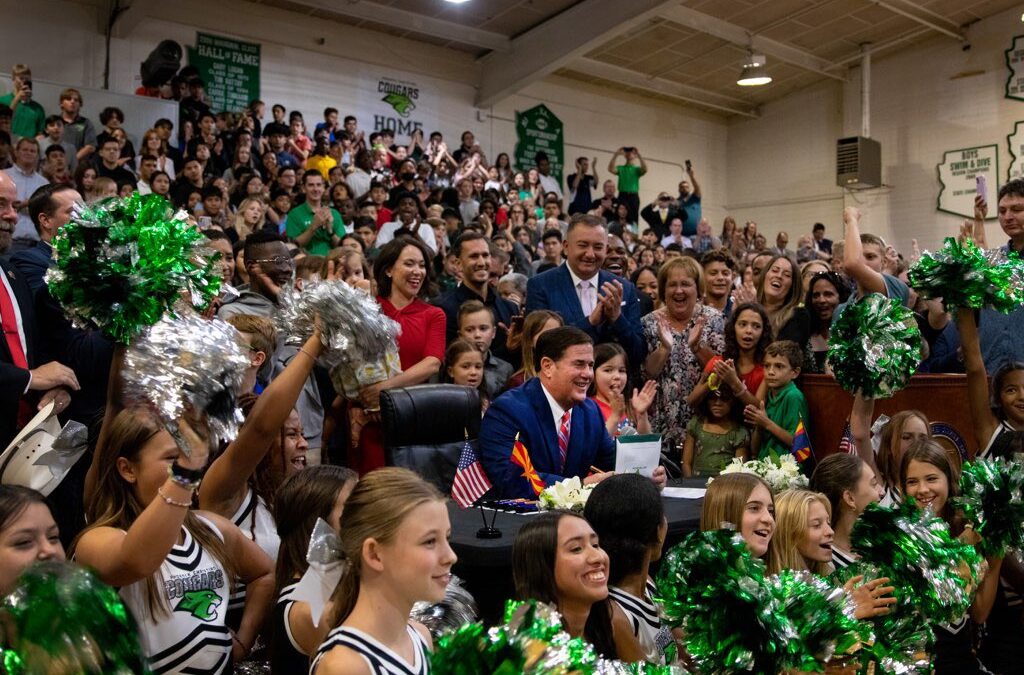
On Thursday afternoon, Arizona made history by becoming the first state to implement universal school choice in modern-day education. The state’s school choice system, the Empowerment Scholarship Account (ESA) Program, ensures that all of Arizona’s students receive up to $7,000 annually to receive the education they desire. Students may apply the scholarship account funds to public school alternatives or supplements like private schools, homeschooling, educational therapies, or tutoring. 

For the past month, Governor Doug Ducey has celebrated the historic legislation in a flurry of tweets and press releases. Ducey declared Arizona’s universal school choice program the “gold standard for education freedom.”

📚SIGNED: THE MOST EXPANSIVE SCHOOL CHOICE LEGISLATION IN THE NATION📚

This is a monumental moment for all of Arizona’s students. Our kids will no longer be locked in under-performing schools. 1/ https://t.co/CEz1Vk43E0

— Doug Ducey (@DougDucey) July 7, 2022

The legislation marks a fulfillment of Ducey’s promise during his state of the state address in January to expand school choice.

Promise made: Let’s expand school choice any way we can this session.

Promise kept: All Arizona K-12 students now have access to Empowerment Scholarship Accounts.https://t.co/alfvXxkaBA pic.twitter.com/GhTIkmtsJX

— Doug Ducey (@DougDucey) July 7, 2022

Arizona House Majority Leader Ben Toma, the sponsor behind the bill to universalize school choice, emphasized in a press release that the GOP overcame divided opinion within its “razor thin” majority to universalize ESAs. 

“In Arizona, we fund students, not systems, because we know one size does not fit all students,” said Toma. “I couldn’t be prouder that House Republicans stood united to pass the first truly universal ESA program in the nation and deliver educational freedom to more than 1.1 million students.”

House Majority Leader @RepBenToma Hails Enactment of Universal ESA Program, Expanding School Choice for All K-12 Families.

Read more on the law he sponsored to deliver educational freedom throughout Arizona 👇https://t.co/QtPbEpCUhV #AZleg pic.twitter.com/aP1wTSdgRk

— Arizona House Republicans (@AZHouseGOP) July 7, 2022

In the wake of the Arizona legislation’s approval of Toma’s bill, school choice opponents invoked rhetoric to reiterate their longstanding claim that school choice leads to segregation. Proponents of school choice refute that claim, including one prominent Black pastor from South Phoenix — a Democrat who benefitted from school choice. 

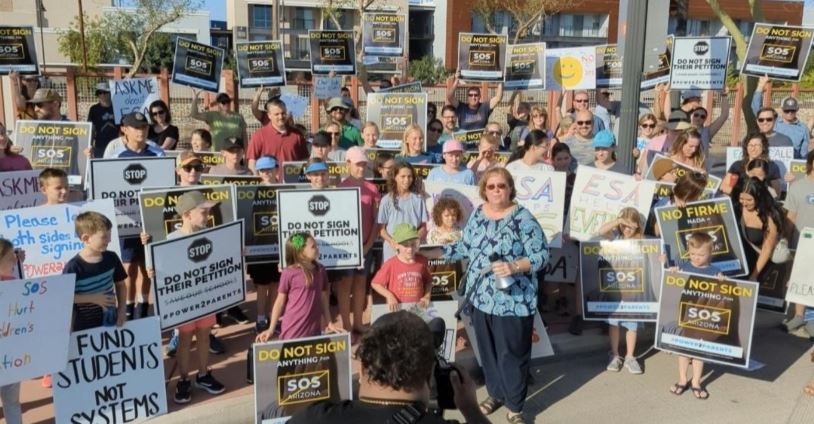
Anti-school choice activists with Save Our Schools Arizona (SOSAZ) launched a campaign to subvert the new law, “Stop Voucher Expansion” — a mischaracterization of the school choice funds as “vouchers.” If successful, SOSAZ would put the fate of universal school choice on the 2024 ballot.

Today, we are proud to announce the launch of #StopVoucherExpansion, an all-volunteer petition drive to refer universal ESA voucher expansion to the 2024 ballot. Join our movement to protect public education & keep $1B in AZ’s public schools TODAY: https://t.co/Se3tAgpXWz pic.twitter.com/ODf9Z1CFxo

— Save Our Schools AZ (@arizona_sos) July 7, 2022

The ESA Program is not a voucher program. It is an education scholarship account. Vouchers are education funds awarded for use at private schools only. The ESA Program allows parents to apply their funds to a variety of education options including, but not limited to, private schooling. Prior to its universalization, the ESA Program was open to a select few classes of students, mainly utilized by those with disabilities that relied on the funds to obtain niche educational therapies. 

Parents who benefited from ESAs pleaded with their community to oppose the SOSAZ activists.

Please DECLINE TO SIGN anything from Save Our Schools Arizona. ALL Arizona children deserve access to an education that meets their individual needs. Signing their petition does not allow families to make the best educational choice for their children. #DeclineToSign pic.twitter.com/nNDGDth1iO

— Christine Emanuel (@AzESASpEdMom) July 7, 2022

Corinne Murdock is a reporter for AZ Free News. Follow her latest on Twitter, or email tips to corinne@azfreenews.com.

Ducey To Sign Toma Bill Which Expands ESAs To All K-12 Students

Ducey To Sign Toma Bill Which Expands ESAs To All K-12 Students

by Terri Jo Neff | Jun 26, 2022 | News

By Terri Jo Neff |

An expansion of Arizona’s Empowerment Scholarship Account (ESA) program has long been a cornerstone platform issue for Conservative lawmakers. And on Saturday, Gov. Doug Ducey made comments which have supporters believing he will sign into law what he called “the most expansive school choice legislation in the nation.”

House Bill 2853 creates a roughly $7,000 education credit for each of the 1.1 million K-12 student in Arizona to attend any school of their choice, whether it be a public, private or charter school, or even homeschooling. Ducey has called passage of the bill sponsored by House Majority Leader Ben Toma (R-Peoria) a “monumental moment for Arizona’s kids and families.”

Our kids will no longer be locked in under-performing schools. Today, their future success is unlocked. With this legislation, Arizona will now be the first state in the nation to offer all families the option to choose the school setting that works best for them. 2/

— Doug Ducey (@DougDucey) June 25, 2022

I commend Senate President @Fannkfann, House @speakerbowers, @RepBenToma and all the lawmakers who voted for this important legislation for helping to cement Arizona’s position as the top state for school choice. 3/3

— Doug Ducey (@DougDucey) June 25, 2022

That sentiment was shared by the Goldwater Institute, which noted Arizona’s new universal ESA expansion provides school choice for all students and “empowers families to choose the best schooling option for their children regardless of their zip code.”

HB2853 will take effect on behalf of the state’s more than 1.1 million students a mere 90 days after signed by the governor. The credit, which is paid out as scholarships, can be used for expenses such as tuition and tutoring, transportation, education tools (i.e. textbooks and computers), and other costs directly related to supporting a student’s educational needs.

And they said it couldn’t be done! The most expansive school choice program in the nation has passed the legislature and is on its way to the Governor’s desk! #HB2853 pic.twitter.com/4CxLoUKsGm

— Ben Toma (@RepBenToma) June 25, 2022

Among those across the country recognizing the legislative victory in Arizona is former Florida Gov. Jeb Bush, a longtime advocate of ESA programs.

Thank you Governor Ducey! Lawmakers Pass Universal Expansion of Arizona Empowerment Scholarship Account Program: https://t.co/xKRhXC4SMS

— Jeb Bush (@JebBush) June 25, 2022

In addition, Corey A. DeAngelis of the Washington DC-based American Federation for Children tweeted about the bill which now allows all Arizona families to direct their student’s ESA dollars to the educational institution that can best serve the student.

BREAKING: Arizona Senate just passed a bill to fund students instead of systems.

This will be the most expansive school choice initiative in the nation.

All families will be able to take their children's education dollars to the education providers of their choosing.

— Corey A. DeAngelis (@DeAngelisCorey) June 25, 2022

However, organizations such as Save Our Schools have threatened to push back on the new legislation if Ducey signs it. The group advocates for funding the needs of public school systems instead of the needs of individual students, even when a family has determined a private, charter, or home school situation is better for the student than a public school setting.

EDITOR NOTE: The original article has been updated to reflect that Gov. Ducey has not yet signed HB2853 despite his public comments in support of the legislation.

Universal School Choice Passes Arizona House

Universal School Choice Passes Arizona House

by Corinne Murdock | Jun 22, 2022 | Education, News

By Corinne Murdock |

The Arizona House approved a universal expansion of the state’s school choice program on Wednesday afternoon. It now heads to the Senate for review.

The legislation, HB2853 by State Representative Ben Toma (R-Peoria), prompted protracted arguments that delayed the vote for about an hour. House Republicans managed to overcome Tuesday’s budget disputes to rally the majority to pass the bill, 31-26 along party lines. Anti-school choice activists in the gallery shouted “Shame!” repeatedly as the vote totals were read, adding to their general disruption and commentary presented throughout the hour-long debate on HB2853.

NOW: Arizona House passes universal school choice expansion.@DeAngelisCorey pic.twitter.com/fmqoTrIjqe

— Corinne Murdock (@CorinneMurdock) June 22, 2022

Democrats asserted that public schools weren’t fully funded, insinuating that was why they fell short in the eyes of Republicans and what they claimed was a minority of Arizona parents. They insisted that universal school choice through the state’s Empowerment Scholarship Account (ESA) Program contradicted the will of a majority of Arizona voters.

Republicans argued that school choice should be the option for all students, regardless of income or zip code. They repeated the idea that parents were the ultimate accountability for student success and outcomes, not government. 

As the final vote and argument presented, Toma argued that Democrats’ logic meant that voters couldn’t ever possibly change their mind on the subject of school choice, which he insisted wasn’t true. Toma insisted that dollars should follow the students and not be the ownership of individual systems.

Toma wondered why private schools should be the exclusive domain of the wealthy, citing back to committee testimony from Drew Anderson — a South Phoenix pastor, Democrat, and beneficiary of school choice, which lifted him out of the squalor of public schools and onto a path resulting in his becoming an NFL player and consequently enabling him to lift his entire family out of poverty.

“This is giving everyone the opportunity to make full use of all their choices,” said Toma.

AZ Free News summarized the highlights of the partisan floor arguments for and against HB2853.

Democrat Arguments Against Universal School Choice:

State Representative Kelli Butler (D-Paradise Valley) characterized the bill repeatedly as “disrespecting the will of voters,” which earned reprimanding from Speaker Pro Tempore Travis Grantham (R-Gilbert). Butler doubted that beneficiaries of the ESA Program were using their funds to “learn anything,” claiming that there wasn’t proper oversight of beneficiary schools’ curriculum.

“They could be learning the most basic things and using our tax dollars,” said Butler.

State Representative Lorenzo Sierra (D-Avondale) said that public schools provided a far superior education, pointing out that 19 out of 20 Flinn Scholars went to public schools.

Sierra also predicted there would be regulations on this bill, speculating that a group of liberals would launch a school built around the 1619 Project, and that the legislature would then attempt to regulate private schools if that happened.

State Representative Judy Schwiebert (D-Phoenix) said that a vast majority of families choose a public district for their children because of their accountability and presence of school boards, calling public school curriculum “well-rounded, publicly vetted, [and] diverse.” 

Ultimately, Schwiebert insisted that not all children deserved school choice.

“Technically I know we’re giving it to parents, but let’s be real about it, we’re funneling it to private schools,” said Schwiebert. 

State Representative Mitzi Epstein (D-Chandler) said that school choice expansion at this scale would greatly increase cost of administration, and called parents’ access to taxpayer dollars to individualize their children’s education “inefficient.”

State Representative Andrés Cano (D-Tucson) asked his Republican colleagues to submit personal financial disclosures about their benefit to school choice.

State Representative Sarah Liguori complained that the ESA Program was corrupted because some of her wealthier “mom friends” used program funds toward their children’s education. Ligouri said that those individuals should pay for private schooling themselves.

House Minority Leader Reginald Bolding (D-Laveen) claimed that “millionaires and billionaires” would receive a check to subsidize their child’s private schooling. He claimed that private schools wouldn’t return ESA program money even if the family couldn’t cover the rest of the tuition, and that public schools would have to “pick up the slack.”

State Representative Melody Hernandez (D-Tempe) said that expanding the ESA Program would actually trap low-income families in failing schools, many of whom she said were minorities. She called the bill “immoral,” and claimed that Republicans were targeting people like her by expanding a system of oppression.

Republican Arguments For Universal School Choice:

State Representative Lupe Diaz (R-Hereford) insisted that Democrats’ arguments about the harm of school choice couldn’t be true based on the longevity and successes of school choice in Arizona’s history.

“If this program causes so much heartache and blows up public schools, then it wouldn’t have the longevity it has now,” asserted Diaz.

State Representative Shawnna Bolick (R-Phoenix) said she would’ve loved to have school choice options like this growing up, and asserted that it was a good thing that children could use ESA dollars for college education as well.

“Why should we wait until higher education to allow taxpayers to utilize these public dollars for their [children’s] education?” said Bolick.

State Representative John Fillmore (R-Apache Junction) reminded the floor that K-12 spending eats up almost half of general fund money, yet Democrats argued it wasn’t enough. Fillmore also read Arizona Department of Education (ADE) data revealing the low passage rates for children in standardized testing.

“The fact of the matter is, the schools have failed us. Parents are taking their kids out because they see this failure,” said Fillmore. 

State Representative Joanne Osborne (R-Goodyear) said that every generation of her family dating back to the late 1890s graduated from Arizona’s public school systems, and that her daughter is a current public school teacher, but that those factors didn’t outweigh her care for children’s needs. 

Osborne characterized HB2853 as a win for all Arizona schoolchildren, and asserted that a majority of Arizona parents want school choice. Her remark prompted commentary from the gallery.

Hopefully this time you can control yourselves and not yell in committee hearings and make a spectacle of yourselves. Such behavior is an embarrassment to my profession as a teacher. https://t.co/fQfhq0bFcv

— Paul "nothing but trouble" Boyer (@PaulDBoyer) June 22, 2022

Corinne Murdock is a reporter for AZ Free News. Follow her latest on Twitter, or email tips to corinne@azfreenews.com.

ESA Users’ Personal Information Compromised Again

ESA Users’ Personal Information Compromised Again

by Corinne Murdock | Aug 31, 2021 | Education, News

By Corinne Murdock |

Another data breach in two years has Empowerment Scholarship Account (ESA) holders wondering if their information is secure with the Arizona Department of Education (ADE). This past week, it was discovered that the state’s contracted payment platform for ESA funds, ClassWallet, had allowed users to search for other ESA account holders and view their names and email addresses.

In a letter sent to ESA holders, ESA Program Director of Communications and Engagement Sarah Raybon explained that they became aware of the data breach last Friday. Raybon assured ESA holders that ClassWallet would resolve that feature over the weekend.

“Today, our team became aware of an issue in ClassWallet portal’s search feature that allowed account holders to view the names and email addresses of other account holders,” wrote Raybon. “Upon discovery, we immediately contacted the Treasurer’s Office (who holds the ClassWallet contract) and we spoke to ClassWallet directly. We have been advised that ClassWallet engineers will be working over the weekend to get this fixed.”

During the Arizona State Board of Education’s meeting last week, parents questioned why a violation of federal law was happening again. They pleaded with the members to remedy these issues sooner rather than later. One ESA parent, Kelly Pichitino, admonished ADE for not cleaning up their act and ensuring any contract holders follow federal law after last year’s data breach.

“I would like to know why, for a second time, my child’s name is available for a stranger to view along with my personal information?” asked Pichitino. “[I] would think that the department would invest a little more thought and care, time and accountability into their actions.”

Further public commentary at the meeting also focused on other issues with the ESA system, such as inappropriate or incompetent staff behavior, apparently arbitrary denial of funds for educational needs, little to no communication and transparency, and relentless rule or policy changes.

These issues were also detailed in written comments, which are available here.

This isn’t the first time that ADE has compromised ESA members’ information unintentionally. As Arizona Capitol Times discovered and reported last January, the ADE failed to properly redact the personally-identifying information of all ESA account holders when fulfilling a public records request to three requestors, one of which was a group that actively campaigns against ESAs: Save Our Schools Arizona (SOSAZ).

Exposed information included parents’ first and last names, email addresses, the grade of their student(s), and any disabilities if a particular student had special needs.

The Arizona Department of Education (ADE) downplayed the data breach, saying that only “some” personal information was shared inadvertently.

“In the course of fulfilling a public records request to three individuals, the Arizona Department of Education (ADE) inadvertently disclosed some personally identifiable information belonging to Empowerment Scholarship Account holders,” stated ADE. “ADE redacted the document subject to the public records request but failed to secure the integrity of the redaction prior to sending the data, and the document was able to be manipulated to reveal private information.”

Corinne Murdock is a reporter for AZ Free News. Follow her latest on Twitter, or email tips to corinne@azfreenews.com.


Page 24 of 25« First«...10...16171819202122232425»

Recent Posts

  • ABE HAMADEH: Public Safety Is The First Responsibility Of Government
  • Election Reform Package Blocked After Hobbs Vetoes Key Bills
  • GOP Child Welfare Reform Package Signed Into Law
  • Arizona Strengthens Protections For Public Shooting Ranges
  • WARREN PETERSEN: Arizona Senate Republicans Protecting Women’s Sports

Recent Comments

No comments to show.

Categories

  • Economy
  • Education
  • Home Page Top Story
  • Must Read
  • National News
  • News
  • Opinion
  • Politics