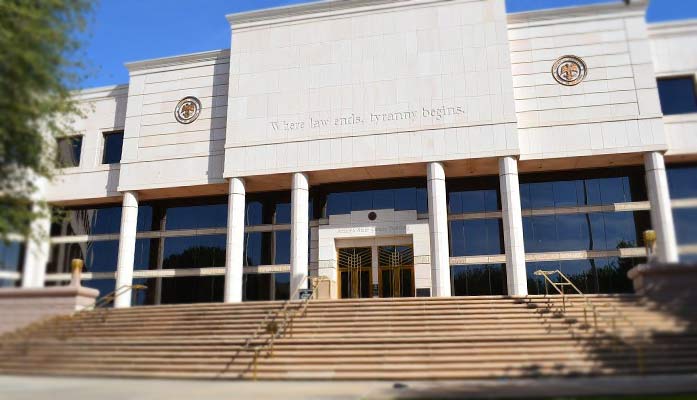
Teachers’ union activists were once again dealt a serious blow after the Arizona Supreme Court issued an order effectively removing an initiative from the ballot that aimed to undo the state’s universal school choice program.
Nearly four years ago to date, a similar initiative was removed from the ballot for failing to have the required number of signatures. Katie Hobbs, secretary of the state at the time and now the governor, held out on invalidating the ballot initiative.
The court’s order to recalculate the signature totals using the trial court’s formula, issued on Tuesday, is projected to have brought Proposition 212, the Protect Education Act, below the required signature total following a legal challenge filed by the Goldwater Institute in Clark v. Fontes.
Protect Education Accountability Now, the political action committee (PAC) behind the Protect Education Act, confirmed that the Arizona Supreme Court order meant their initiative would not qualify for the ballot.
The PAC blamed “big money in partnership with Republican lawmakers and the anti-public education lobby” for the initiative’s demise.
A spokesperson for the PAC stated that the initiative should have been included on the ballot regardless of the invalid signatures.
“This does not reflect what Arizona voters want. It does not reflect the overwhelming support of educators, parents and public school advocates across the state who volunteered their time and demanded a voice in reforming a program that abused taxpayer money and pulled funding from their neighborhood public schools,” said the spokesperson. “Instead, the hard-earned resources educators raised to fund this were buried under a mountain of big money, political power, and a system that consistently sides with special interests.”
— Protect Education Ballot Initiative (@ProtectEdAct) August 18, 2026
Activists submitted around 420,000 signatures to qualify for the ballot. Pending a review incited by the Goldwater Institute’s court challenge, the number of valid signatures will fall to a projected total of approximately 245,000. The initiative needed approximately 256,000 to qualify for the ballot.
Nearly 70,000 signatures were invalidated due to their discovery as duplicates or having been collected by legally ineligible circulators, like felons. The court also upheld the trial court ruling which invalidated entire sheets of signatures due to the petition circulator providing an address at which they weren’t living.
The ballot measure would have rolled back the universality of the Empowerment Scholarship Account (ESA) program by imposing an income cap.
The union-backed Protect Education Act appears to have fallen short of the valid signatures needed to make the November ballot.
In this special Keep Arizona Free Update with @Darla4freedom:
➡️ The campaign submitted roughly between 416,000-421,000 signatures, but after trial… pic.twitter.com/l7886cgtT9
The court also agreed with a lower court ruling that the ballot language drafted by Secretary of State Adrian Fontes was false and misleading because it used the term “voucher” to describe the ESA program. Vouchers must be spent immediately and only at certain approved schools, whereas ESA program funds may be rolled over and applied to various schooling types and educational resources.
The PAC behind this second failed initiative to end universal school choice raised more than $7.5 million and spent more than $7.2 million.
More than $6.5 million, or 87%, came from the National Education Association. $810,000, or nearly 11%, came from the Arizona Education Association.
Other major donors included $50,000 from the United Food and Commercial Workers Active Ballot Club, the PAC of a D.C.-based union; and $50,000 from Arizonans for Quality Education, a corporation or LLC based in Phoenix.
The latter entity was formerly known as Friends of ASBA, with ASBA standing for the Arizona School Boards Association, and was registered as a domestic nonprofit corporation, according to Arizona Corporation Commission (ACC) records.
AZ Free News is your #1 source for Arizona news and politics. You can send us news tips using this link.
The Protect Education Act is projected to fall more than 10,000 valid signatures short of the number required to qualify for Arizona’s November ballot after a court challenge removed thousands of petition signatures and county recorders completed their validity reviews.
The Arizona Free Enterprise Club (AFEC) announced Monday that applying the trial court’s rulings and county signature-validity rates leaves the initiative with approximately 245,000 valid signatures. Arizona law required the campaign to produce 255,949 valid signatures.
The calculation follows an expedited ruling Thursday from Maricopa County Superior Court Judge David McDowell in Clark v. Fontes, the lawsuit challenging the petitions submitted by Protect Education, Accountability Now, the political committee behind the initiative.
At the time of McDowell’s ruling, the final outcome remained unresolved because Maricopa and Apache counties had not yet completed their reviews. The Arizona Capitol Timesreported that the Secretary of State’s initial review had reduced the campaign’s submitted total to 389,376 signatures before the court considered challenges to individual circulators, petition sheets, and duplicate signatures.
🚨 BREAKING: “PROTECT EDUCATION ACT” FALLS SHORT
Based on the trial court’s ruling in Clark (@ClarkRimsza) v Fontes and county signature validity rates, the union-backed anti-ESA initiative does not have enough valid signatures to qualify for the November ballot.
McDowell’s ruling left 348,269 signatures presumptively valid before application of the counties’ random-sample validity rates. The court also addressed 24,369 duplicate signatures and challenges involving more than 110 petition circulators.
“The court agrees that it is conceivable that a double count could occur, but the court cannot make a decision based upon a hypothetical double counting of duplicate signatures,” McDowell wrote.
The initiative’s supporters submitted 421,451 signatures on July 2. Save Our Schools Arizona and the Arizona Education Association were among the organizations backing the campaign.
The Goldwater Institute filed its challenge July 20, alleging that tens of thousands of the submitted signatures should be rejected because of duplicate entries, defects in circulator registrations, and petitions collected by people who were legally ineligible to circulate them.
The amended complaint raised more than 73,300 objections. Those included allegations involving unregistered paid circulators, signatures collected before circulator registration, inaccurate addresses or contact information, identification problems, and circulators whose felony convictions or other legal circumstances allegedly made them ineligible.
McDowell ultimately invalidated signatures collected by several circulators. Four circulators were disqualified because of criminal histories. The judge also invalidated several thousand signatures collected by circulator Tyrone Crispell after finding his denial that he misrepresented the initiative to prospective signers was not credible.
AFEC said Monday that nearly 70,000 signatures were disqualified through the challenge, including duplicates and signatures gathered by legally ineligible circulators.
“This is a major victory for Arizona parents, students, and the integrity of our elections,” AFEC President Scot Mussi said. “This anti-school choice initiative and its union backers spent more than $7 million dollars trying to dismantle school choice in our state, but they still could not collect enough lawful, valid signatures to qualify for the ballot.”
Campaign-finance figures compiled by Transparency USA from Arizona disclosure records show the Protect Education, Accountability Now committee had reported more than $7.5 million in total expenditures through July 30. The National Education Association accounted for approximately $6.57 million in cash and in-kind contributions, while the Arizona Education Association contributed another $810,000.
The Protect Education Act, designated Proposition 212 during the ballot-review process, would make several changes to Arizona’s Empowerment Scholarship Account (ESA) program. The measure would generally limit eligibility to families earning $150,000 or less, with exceptions including students with disabilities, certain military families, and students assigned to poorly performing public schools.
The proposal would also establish additional requirements for participating private schools and tutors, restrict certain ESA expenditures, and generally require unused annual ESA funds to be returned to the state.
The signature dispute is separate from litigation over how Proposition 212 would be described to voters. Last week, Maricopa County Superior Court Judge Julie Ann Mata ordered Secretary of State Adrian Fontes to rewrite portions of the proposition’s descriptive title and “yes” and “no” statements after finding that the existing language omitted significant provisions of the measure. Judge Daniel Martin separately ordered revisions to the Arizona Legislative Council’s publicity-pamphlet analysis.
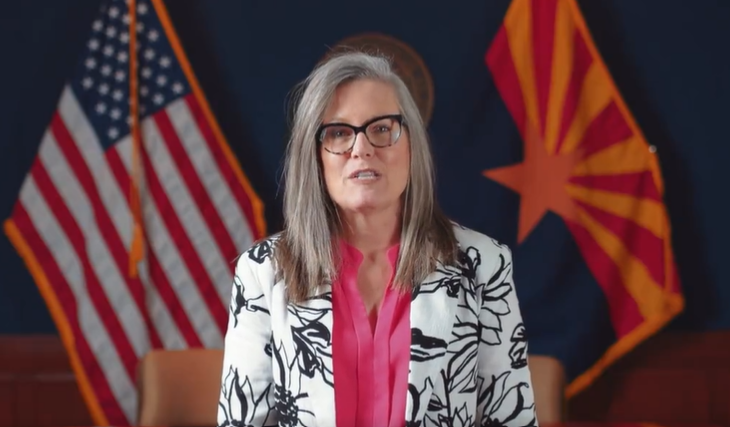
Gov. Katie Hobbs says public education is woefully underfunded, but fiscal reporting indicates districts are flush with cash.
According to the latest Arizona Department of Education annual financial report, public school districts carried forward more than $8.3 billion in unspent funds from the 2024-25 fiscal year.
That is nearly equivalent to total appropriations that the state allocated for public education in the 2024-25 fiscal year: $8.9 billion, which goes beyond K-12 schools to include the Board of Regents, community colleges, and universities.
That $8.9 billion accounts for 55% of total appropriations out of the state’s general fund, which amounted to more than $16.2 billion in the 2024-25 fiscal year.
Within the $8.3 billion carried over from the 2024-25 fiscal year:
$1.6 billion for bond building
$1.3 billion for maintenance and operations
$1.2 billion for “other” funding
$941,000 for the Classroom Site Fund and Instructional Improvement Fund
$884,000 for unrestricted capital outlay
$708,000 for federal projects
$672,000 for bond principal deduction
$393,000 for debt service
$248,000 for food service
$150,000 for adjacent ways
$147,000 for school plant
$41,000 for state projects
The emergency deficiencies correction, building renewal, and new school facilities funds had negative balances of approximately $395,000, $19 million, and $33 million, respectively.
Last fall, the Common Sense Institute estimated that school districts hold more than $20 billion in combined cash reserves and underutilized real estate.
Public school district enrollment has declined steadily since 2008, more so in recent years after the state allowed universal enrollment for the ESA program in 2022.
Hobbs has advocated for lawmakers to revive Proposition 123, which would take around $300 million every year from the State Land Trust Permanent Fund and give it to education. $300 million is equivalent to a drop in the public education fund bucket: approximately 3% of what the state allocated from its general fund in the 2024-25 fiscal year.
Hobbs credited Prop 123 as providing “critical funding” for districts and educators in her State of the State address earlier this year. The governor said the funding provided by the proposition curbed the budget shortfall and would enable teacher pay raises and prevent future tax hikes.
The governor and lawmakers have failed to reach a consensus on renewing Prop 123. The proposition expired in June 2025.
Teresa Leyba Ruiz, the Democratic nominee for superintendent of public instruction, wants to claw back another 3% from a potential funding source. As reported earlier this week, Ruiz proposed reverting the $350 million set aside in Empowerment Scholarship Account (ESA) program funds back to public schools.
32% of educators reported having an external job and 21% of educators indicated additional paid responsibilities and a second job outside their school, according to a 2024 report by Hobbs’ Educator Retention Task Force issued in partnership with the Arizona State University Morrison Institute for Public Policy.
That same report identified inadequate salary, unpaid duties and hours, pay differences, and salary compression as issues impacting retention. The report estimated that only 16% of educators agreed that their salary was satisfactory and motivated them to stay in their professions.
A more recent poll of more than 9,300 educators during the 2025-26 school year by the Arizona Department of Education also found that teacher pay was one of the biggest sources of dissatisfaction for educators.
AZ Free News is your #1 source for Arizona news and politics. You can send us news tips using this link.
A Maricopa County Superior Court judge ordered Arizona election officials Tuesday to rewrite the descriptive title and “yes” and “no” statements for Proposition 212. The judge found that the current version omits substantial changes to enforcement and government oversight and misleadingly describes Arizona’s Empowerment Scholarship Account (ESA) program as a “school voucher program.”
Judge Julie Ann Mata enjoined Secretary of State Adrian Fontes from using the current language on the official ballot or in the publicity pamphlet. She also issued a writ directing Fontes and Attorney General Kris Mayes to revise the language in accordance with state law and her ruling.
The court left the exact wording to Fontes and Mayes under their statutory drafting and approval authority. Mata declined to order the state to adopt replacement language proposed by the plaintiffs and denied their request for attorneys’ fees and costs.
Daryl Groves and the Arizona Free Enterprise Club (AFEC) filed the case against Mayes and Fontes on July 28. Protect Education, Accountability Now, the political committee sponsoring Proposition 212, participated as a friend of the court in support of the challenged language. The defendants argued that the wording fairly summarized the measure and complied with A.R.S. § 19-125(D).
AFEC called the order a “major victory for Arizona school choice” and said, “Arizona voters deserve the truth.”
BREAKING NEWS: MAJOR VICTORY FOR ARIZONA SCHOOL CHOICE
The Arizona Free Enterprise Club has won at the trial court in our lawsuit challenging the misleading ballot language drafted for Proposition 212: the union-backed initiative targeting Arizona’s ESA program.
Mata wrote that the court’s review addressed the accuracy of the ballot language and left the policy merits of Proposition 212 to voters.
The version posted by the Secretary of State before the ruling states that Proposition 212 would limit ESA eligibility to families earning $150,000 or less per year, with specified exceptions; prohibit spending on noneducational and luxury items; impose qualifications on tutors; require accreditation or testing for participating schools; and generally return unspent annual ESA allocations to the state.
The full initiative also gives the sponsoring committee or its designee standing to initiate or intervene in litigation to enforce or defend the measure. Mata found that authority to be a substantial change that the ballot title or description must disclose. She found that the existing phrase “other rules and restrictions” failed to adequately inform voters about it.
Mata also found that the “yes” statement omitted a substantial change to two existing statutory limits on government control or supervision of nonpublic schools and homeschools. Proposition 212 would amend those provisions to permit control or supervision provided elsewhere in the ESA chapter for schools and homeschools receiving ESA funds. The court did not rule on the constitutionality of that proposed change.
The judge separately found the phrase “school voucher program” misleading. She cited Arizona decisions that invalidated two voucher programs and later upheld the ESA program under a different legal structure. Mata wrote that using the phrase could lead voters to treat the legally distinct programs as equivalent.
The court rejected one of AFEC’s arguments. The group argued that describing the $150,000 income limit as “adjusted for inflation” could mislead voters because the initiative caps the annual adjustment at the lower of 2% or the change in the gross domestic product price deflator. Mata found the existing wording provided appropriate information and held that omitting the precise formula was not misleading.
In a separate decision, Maricopa County Superior Court Judge Daniel Martin also ordered changes Tuesday to a separate piece of voter information concerning Proposition 212. The judge directed the Arizona Legislative Council to revise its analysis for the publicity pamphlet by Aug. 21.
Martin found the Council’s statement that the initiative committee would have “the power to sue the families and private schools that participate in the program for any violations of the proposition” sufficiently partisan to violate state law. He ordered the Council to strike or revise the language by Aug. 21. The Council’s adopted three-page analysis is governed by a separate law requiring an impartial explanation for the publicity pamphlet.
Mata’s case concerned the shorter ballot title and “yes” and “no” statements prepared by the Secretary of State and approved by the Attorney General.
Proposition 212’s ballot qualification remains the subject of separate litigation over petition circulators and signatures. That case, Clark v. Fontes, is a Goldwater Institute and AFEC-backed challenge to the initiative’s petition circulators and signatures. Maricopa County Superior Court Judge David McDowell is expected to rule on the matter by the end of the week. The amended complaint seeks to prevent the initiative from appearing on the November ballot.
The Democratic nominee for Superintendent of Public Instruction, Teresa Leyba Ruiz, says Arizona’s school choice funds should be reverted back to the public schools.
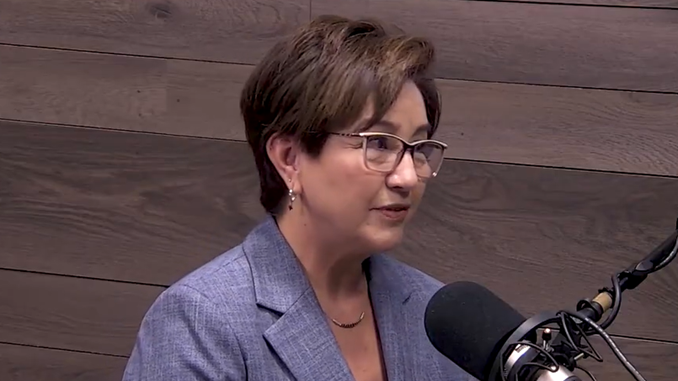
Ruiz, the former president of Glendale Community College, told “The Mike Broomhead Show” on KTAR that Empowerment Scholarship Account (ESA) funds should be converted to public school funding under her administration of the Arizona Department of Education (ADE).
Ruiz said that she would like to use ESA funds to pay for a literacy coach in every single classroom. Ruiz said if Arizona spent more on its schools, parents would be “fighting” to stay in public schools instead of leaving.
“Right now, in Arizona, there’s over $350 million dollars being stockpiled for future use, for college perhaps. Wouldn’t it be amazing if we took that money and invested it in our schools?” said Ruiz. “If we just invested in our schools — remember this is 50 years of underfunding and not prioritizing our public schools.”
The state spent more than $13.4 billion on public schools in the past fiscal year, an increase of $300 million from the prior fiscal year. Per-pupil spending was more than $12,000, and the average teacher salary was more than $65,600.
Instructional spending declined for the third consecutive year to 52%, the lowest rate since state monitoring began in 2001.
Ruiz also told KTAR on the “AZ Political” podcast that ADE would save money by creating an automated denial system for ESA funds.
“Over $650 million of our taxpayer dollars have flown out the door, unchecked and unchallenged. No oversight on the front end, and that’s something we would put an end to,” said Ruiz. “We’re talking about having a modern, automated system that can quickly process transactions that are appropriate and flag and stop inappropriate transactions.”
According to the current superintendent, Tom Horne, ADE automatically approved expenditures under $2,000 due to lack of staffing. Problematic expenditures under that cap would be subject to review post-approval.
Ruiz said it was for a lack of leadership that Horne had that problem. She claimed that ADE could have shifted resources from one aspect of the department to another to make up for understaffing within the ESA expenditure approval team.
Ruiz served on President Joe Biden’s Advisory Commission on Advancing Educational Equity, Excellence, and Economic Opportunity for Hispanics, specifically the committee for Advancing Higher Education and Hispanic Serving Institutions. The commission was part of the Biden administration’s reestablishment of the Hispanic-Serving Institution programming, which used federal funding to incentivize higher education institutions to intentionally prioritize Hispanic students within admissions.
Ruiz’s commission resulted in the July 2024 creation of the White House Initiative on Advancing Educational Equity, Excellence and Economic Opportunity Through Hispanic-Serving Institutions, which formally prioritized Hispanic-serving institutions through federal recruitment, federal resources, and federal funding.
The commission also successfully convinced the Biden administration to expand federal TRIO programming to illegal alien students classified as Dreamers; TRIO programming has historically provided low-income American citizens with support services such as college campus visits, tutoring, and assistance with college and financial aid applications.
Ruiz also served in the Aspen Institute’s 2018-2019 Presidential Fellows Program; as reported previously, the Aspen Institute played a major role in covering up the Hunter Biden laptop scandal ahead of the 2020 election.
AZ Free News is your #1 source for Arizona news and politics. You can send us news tips using this link.