by Tiffany Benson | Mar 10, 2026 | Opinion
By Tiffany Benson |
When asked, “What was the original purpose of public education?” A.I. gave this response:
The original purpose of public education in the U.S. focused on fostering a literate, cohesive, and obedient citizenry to support a new democracy, ensure social order, and provide basic religious instruction.
Since at least 1962, public education has been heavily influenced by secularists. As a result, students are not literate or cohesive, and their obedience has been co-opted into secrecy and rebellion against parents. Of course, democracy means mob rule.
How did we get here?
One obvious answer lies in the worldview of secular humanism. The ideologies of this religion threatens to turn innocent children into a godless, genderless, enraged monolith. Secularism is a parasite that causes symptoms of mental illness, moral confusion, and self-induced hysteria. Parasitic infestations have three phases: growth, reproduction, and transmission.
The growth of secularism in K-12 education manifests as:
- Social emotional learning (SEL)
- Evolutionary theory
- Ethnic studies (CRT)
- Diversity, Inclusion, and Equity (DIE)
- Rainbow flags and gay celebrations on campus
- The acknowledgement and acceptance of every religion but Christianity
The reproduction of secularism in K-12 education manifests as:
- Law enforcement protests during educational hours
- Counselors secretly transitioning students’ gender
- Sex education for kindergarteners
- Children judging their peers by skin color
- School officials referring minors to abortion clinics
- Boys invading girls’ sports and private spaces
The transmission of secularism from K-12 education to society manifests as:
- High school graduates with little to no reading, writing, or math skills
- Increased sexual activity, STDs, and unwed pregnancies among youth
- High abortion rates among women in their 20s
- Low IQ citizens who predominantly vote for radical policies
- Emotional immaturity, violence, and lack of personal responsibility
- Suicide and premature death
The average American child, from age 4 to 17, will spend about 14,000 hours in school. Most of these students will undergo secular brainwashing in the form of “academic standards,” “core competencies,” and state testing. Parents have been lulled into a false sense of trust, abdicating their rights and responsibilities to government workers. Even “good” educators (the conservative ones who remain fearfully silent) shouldn’t have unchecked influence over a child’s mental, emotional, or moral development.
The pervasive ignorance of secularism explains why people interpret “separation of church and state” to mean Christians can’t pray, read Scripture, or invoke the name of God publicly. Secularism is also why Americans call the United States a “democracy.” The secularist worldview is so morally inferior that it can only be defended by calling opponents racists, white supremacists, fascists, and homophobes.
The demonization of Christianity, prayer, and Bible reading has only escalated as Arizona lawmakers attempt to pass legislation that fortifies First Amendment rights and parental rights in K-12 education.
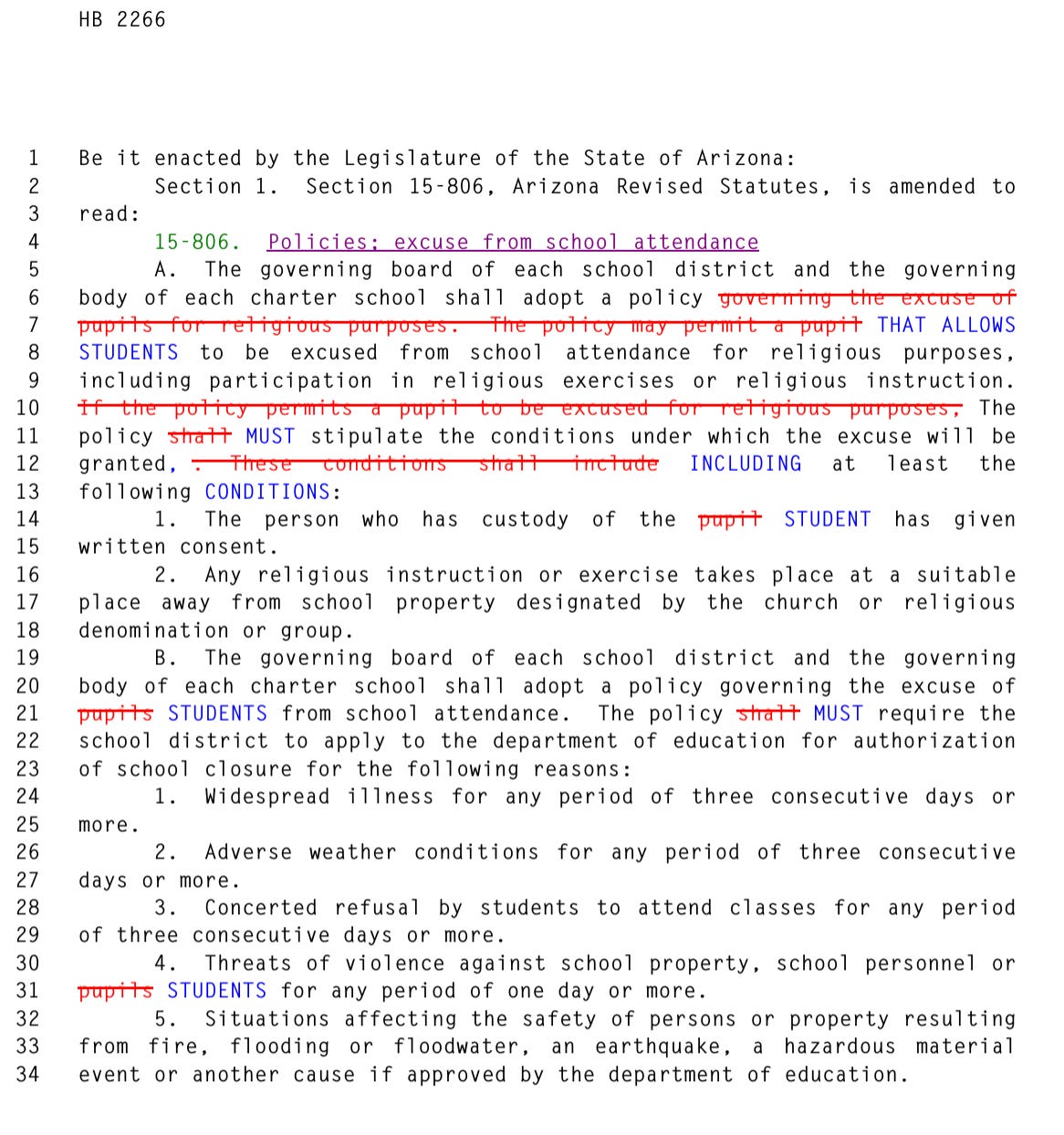
Secularists linked LifeWise Academy—an organization with a mission to offer Bible education to public school students during school hours—to Arizona House Bill 2266. Secularists claim bussing children to nearby churches for Bible studies during the school day is harmful to academic communities. But encouraging kids to walk off campus with “F— ICE” t-shirts during educational hours is okay? Only in the mind of a secularist.
Deer Valley board member and AZ legislator, Stephanie Simacek (D-LD2), called Lifewise “a controversial, far-right, religious instruction program.” Regarding HB 2266, the secularist told her constituents she would “continue to oppose bills that do nothing to serve public education.” Essentially, high moral standards, respecting authority, and taking responsibility for one’s actions have no place in taxpayer-funded, government schools.
The life’s purpose of a secularist boils down to persecuting Christians, opposing common sense legislation, and infiltrating public school systems to spread anti-Christ propaganda through immoral policies and curricula on all grade levels. Secularism is a spiritual, intellectual, and emotional drain on every generation. No child should be entrusted to an institution that’s predominantly run by godless people.
Parents must continue to seek alternative learning methods and regain control over their kids’ education. Don’t let secularism destroy their innocence and corrupt their moral character. Furthermore, taxpayers should keep rejecting bonds and overrides. Don’t incentivize sleazy administrators and weak board members to advance a secular agenda. Let the schools close and the buildings be repurposed. The kids will be fine if more parents and silent educators step up.
Public education—especially in Arizona—is a colossal failure. The lie of “separation of church and state” must be exposed. Steering children back to God is the only way to defeat secularism and defend our Constitutional Republic. Support constitutional legislation like AZ House Bill 2266 and the Empowerment Scholarship Account (ESA). Support Christian organizations like LifeWise Academy. Most importantly, support parental rights in K-12 education for all American families.
Tiffany Benson is the founder of Restore Parental Rights in Education and host of The Myth of Education Podcast. Her commentaries on public education and Christian faith can be viewed at Parentspayattention.com and Bigviewsmallwindow.com. All views and opinions expressed by Tiffany are her own.
by Jason Bedrick | Feb 19, 2026 | Opinion
By Matthew Ladner & Jason Bedrick |
Emerson famously noted that “a foolish consistency is the hobgoblin of little minds.” Opponents of Arizona’s school choice program seem determined to field legions of such monsters.
Exhibit A: the reporting of Craig Harris. Harris has over the years repeatedly filed anti-school choice stories which were riddled with errors. His latest salvo against Arizona’s popular Empowerment Scholarship Accounts (ESA) program is no exception.
In 2018 and 2019, Harris published articles in the Arizona Republic claiming charter schools underperformed district schools and faced mass closures, but both stories relied on flawed research—including counting schools that only went through 9th grade or had already closed as having 0% graduation rates and relying on “research” by anti-charter school activists that misunderstood basic accounting concepts.
More than six years later, the predicted mass closures have never materialized, and National Assessment of Educational Progress data actually showed Arizona charter students outscoring district peers by roughly two grade levels.
But Harris, unlike the students, doesn’t seem to have learned his lesson. These days he has fixated his efforts against Arizona’s ESA program—and the results are just as edifying.
With an ESA, parents can purchase a wide variety of educational goods and services using 90% of the state money that their child would have received at their local district school. The parent-managed accounts have state oversight to keep transactions focused on allowable education expenses. The program is wildly popular with Arizona families, with over 100,000 students participating.
However, the ESA program is not so popular with special interest groups tied to school districts and their allies in the press.
Now at Channel 12, Harris has produced misleading stories about Arizona’s ESA program, including claims that parents use accounts for “babysitting“—based on a since-corrected error by the Treasurer’s Office—and that families are “subsidizing vacations,” when in reality they’re purchasing tickets to museums, zoos, and aquariums, which are allowable educational expenses also used by public schools. The program uses risk-based auditing to detect fraud, the same widely accepted method used by the IRS and recommended by Arizona’s Auditor General.
In his latest salvo against ESAs, Harris has produced a so-called “analysis” claiming that 20% of ESA purchases constituted a misuse of funds—a huge jump from the less than 1% rate of misuse previously detected by the Arizona Auditor General.
Misuse of funds in publicly funded programs is a serious problem which the Arizona Department of Education has taken great pains to minimize in the ESA program. Harris, however, is once again playing games and tricks with the data.
First, Harris’s claim of that 20% misuse is based upon an examination only of a small portion of total ESA purchases—384,478 of the 1.8 million total ESA transactions since December 2024, or about 20% of the total. This smaller group of purchases had been selected by the Arizona Department of Education for additional scrutiny via risk-based auditing, so it’s not a random sample that one could use to extrapolate about rates of misuse in the ESA program generally.
In other words, among the 20% of ESA purchases flagged for additional scrutiny, 20% were found to be misspending. But 20% of 20% amounts to only 4% of total purchases. Harris’s claim that 20% of ESA purchases were misspending is a gross exaggeration.
In fact, even the supposed 4% misuse rate itself is an exaggeration, as it is 4% of total transactions, not 4% of total spending. The most recent data from the Arizona Department of Education show more than half of ESA funds are spent on private school tuition, so the rate of misspending is likely less than 2% of total spending—a rate of improper payments that is well below a variety of programs found in programs which ESA opponents support, such as Medicaid (7.4%), food stamps (9.3%), and unemployment insurance (14.4%).
Tears for Fears’s hit song “Everybody Wants to Rule the World” includes the line, “One headline—why believe it?” If the headline is followed by a Craig Harris byline, be very careful before you believe it as you are not getting the whole story—maybe even a false story.
Matthew Ladner is a Senior Advisor for education policy implementation and Jason Bedrick is a Research Fellow at the Heritage Foundation’s Center for Education Policy.
by AZ Free Enterprise Club | Feb 9, 2026 | Opinion
By the Arizona Free Enterprise Club |
Governor Katie Hobbs rolled out her budget last month and, unsurprisingly, it doesn’t add up.
Not only because her “solutions” don’t match the problems she claims to be solving, like suggesting we can make goods and services more affordable by piling on new taxes and fees, but because her budget quite literally just doesn’t add up.
While it’s become common for governors to release budgets built on rosier revenue assumptions than the Legislature’s more conservative Joint Legislative Budget Committee (JLBC), Hobbs’ proposal relies on projections so fanciful it resembles a fairy tale more than a fiscal plan.
Counting Chickens Before They Hatch
Hobbs’ budget is a $17.7B spending plan ($100M more than last year) that leaves a meager $37.8M balance at the end of FY27. That means her revenue projections leave very little room for error. Yet one of the more obvious facts about her budget is just how likely error-prone these projections are, a fact that Republicans during a joint appropriations hearing were sure to point out.
One of the most speculative assumptions Hobbs is making in her budget proposal is relying on $760 million of “reimbursements” from the federal government for expenditures the state has made for border security since 2021. That is a good chunk of change, and her budget is unworkable without it.
The problem is it is actually way more likely than not that even if the state receives something in the way of reimbursement, it will not be the full amount, and who knows on what timeline. Regardless, it is irresponsible to commit money out the front door that may never come in.
This is nothing new for Hobbs. Just last year she continued a COVID-era program that neither had legislative authorization to continue nor the ongoing financial allocations to support it. That wound up blowing a $122M fiscal hole in the previous year’s budget mid-session that Republicans had to mop up.
The Governor’s budget also depends on tapping the State Land trust for another $1.5 Billion. Setting aside whether its a good idea to raid the land trust set up for various beneficiaries (K-12, Universities, deaf and blind, etc), changing the formula for trust land distributions requires a constitutional amendment that would need to be approved by voters in November.
Hobbs’ “Affordability” Plan is Really a Chaotic Tax-And-Spend Plan
Hobbs wants to brand her budget as improving affordability, but it does just the opposite. Every idea in her plan is built around $1B in new taxes and fees and the hope that the bureaucracy can “manage” the cost of living while literally contributing to its inflation…
>>> CONTINUE READING >>>
by Staff Reporter | Jan 30, 2026 | Education, News
By Staff Reporter |
The Arizona’s Empowerment Scholarship Account (ESA) program grew to over 100,000 enrollments this week.
As of Monday, the Arizona Department of Education (AZED) reported the ESA program had nearly 100,500 enrollees.
Superintendent Tom Horne said in a statement on Tuesday that the milestone represented “a remarkable endorsement” of school choice by Arizona parents. Horne offered an example of a typical scenario in which a family enrolls in the ESA program.
“Consider a family with three children. Two of the children are doing just fine in district schools. The third child’s needs are not being met. Now, the parents can find another school that meets the child’s needs,” said Horne. “I do not understand how anyone can say parents do not have a right to find a school that meets their child’s needs, unless people are so immersed in ideology that they lose sight of what is best for students.”
When Horne took office in 2023, the ESA program had about 11,000 students. That represents an average annual growth of nearly 30,000 students in the program for the past three years.
The latest enrollment data from AZED (2024-2025) reported nearly 1.1 million students across K-12. That’s about nine percent of the total student population.
AZED also reported the recovery of nearly $1.2 million in unallowable expenses through collections, repayments, or legal authority referrals. The program requires parents to document all purchases made, and any impermissible purchases result in a freeze on their accounts.
Parents do have recourse if they believe a mistake was made in the rejection of their expenditures. Horne reminded parents in his Tuesday statement that they are free to appeal rulings; to date, AZED has not lost an appeal.
“Some people have questioned my authority to insist that expenditures only be for valid educational purposes. I am not the final word. Parents have a right to appeal denial to an administrative law judge,” said Horne. “There have been 20 such appeals, and my authority to deny the expenditure was involved in everyone. We have 20 wins and zero losses. Administrative law judges have held unanimously that I do have that authority.”
Horne’s fellow executive branch leaders have expressed dissatisfaction with the continued growth of the ESA program.
In her State of the State Address earlier this month, Gov. Katie Hobbs accused the program of widespread waste, fraud, and abuse — a money pit funding many things other than “true educational purposes.” Hobbs recently proposed an income cap on ESA enrollment: anyone making over $250,000 a year would not qualify.
Horne’s response was a defense of the ESA program as a clear desire of Arizona voters. The ESA program was universalized through legislation passed in 2022 under Hobbs’ Republican predecessor, Gov. Doug Ducey.
“Arizona parents have made it clear they believe in being able to choose the best education for their children, whether districts, charters or Empowerment Scholarship Accounts,” said Horne. “By their loud display today, Democrats proved they want to take that power away from mothers and fathers who know their children’s needs best and return education to a government monopoly that parents do not want.”
AZ Free News is your #1 source for Arizona news and politics. You can send us news tips using this link.
by Staff Reporter | Jan 21, 2026 | Education, News
By Staff Reporter |
Governor Katie Hobbs claimed the state’s school choice program lacks oversight.
The Arizona Department of Education (ADE) and experts dispute Hobbs’ claim.
The governor targeted the Empowerment Scholarship Account (ESA) Program during her state of the state speech last week. Hobbs advocated for the school choice program to be rolled back from universalization to its previous form that only accepted certain families with disability or military backgrounds.
“While other government entitlements have strict requirements and oversight, the ESA program continues to operate unchecked, squandering taxpayer dollars with no accountability,” said Hobbs. “It seems like every day, we learn about new shopping sprees happening at the expense of taxpayers…diamond jewelry, high-end clothing and furniture…who knows what taxpayers will be footing the bill for tomorrow?”
ADE publishes notice of its internal audits and has attempted to refer cases over to the attorney general’s office for prosecution — though Attorney General Kris Mayes has reportedly been unwilling to pursue prosecution of alleged fraud or abuse.
ADE bases its claims on existing requirements within the ESA Program: documenting all purchases made, and freezing accounts that make unauthorized expenditures. Parents must repay the program for unauthorized purchases.
In August, ADE reported it marked over $600,000 for collections “due to possible fraud or misuse.”
That’s less than one-tenth of one percent of total ESA spending, as noted by the Heritage Foundation in a report last August.
Comparatively, the estimated total fraud within average federal government obligations ranges from three to seven percent, according to a 2024 report by the Government Accountability Office.
Other examples of improper payment rates within government programs in Arizona have been issued recently. (The latest data aligns with the 2024 fiscal year in most cases).
The Department of Labor announced an estimated seven percent improper payment rate from July 2021 to July 2024.
For the 2024 fiscal year, the USDA reported that Arizona had a payment error rate of nearly nine percent.
The federal government even factors in improper payment rates to mitigate losses.
The Center for Medicaid projected an improper payment rate of over six percent for Arizona in 2024.
This indicates that fraud is an inevitable occurrence within any government program.
Unlike the reporting efforts of ADE regarding the ESA Program, the Arizona Auditor General presently finds that nearly 30 school districts are noncompliant based on financially related internal control deficiencies.
This slate of presently noncompliant districts represents over $1 billion in state spending. The entire ESA program spent under $900 million in the 2025 fiscal year and costs about $1 billion for the 2026 fiscal year.
Arizona school districts have accumulated nearly $8 billion in cash reserves, per the Heritage Foundation’s assessment of Arizona Superintendent Tom Horne’s annual report covering the 2023-2024 fiscal year.
Horne responded to Hobbs’ state of the state address with criticism over the governor’s open opposition to a program supported by a majority of voters. Arizona voters approved universalization of school choice back in 2022.
“Arizona parents have made it clear they believe in being able to choose the best education for their children, whether districts, charters or Empowerment Scholarship Accounts,” said Horne. “By their loud display today, Democrats proved they want to take that power away from mothers and fathers who know their children’s needs best and return education to a government monopoly that parents do not want.”
AZ Free News is your #1 source for Arizona news and politics. You can send us news tips using this link.