School bureaucrats who have mismanaged their finances are hoping that voters will blame a convenient scapegoat: families using Empowerment Scholarship Accounts (ESAs) to educate their children. As usual, their allies in the legacy media are trying hard to help them shift the blame—but the numbers don’t lie.
Channel 12 recently ran a story titled “Deer Valley teachers self-fund or rely on classroom wish lists for basics, while ESA parents buy luxury items with state tax dollars.” Most of the article reads like a press release from Deer Valley Unified School District Superintendent Curtis Finch, who claims that the ESA program has “zero accountability,” “no oversight,” and is “out of control.” Meanwhile, the article quotes teachers in Deer Valley who are spending hundreds of dollars from their own pockets to cover school supplies for their students.
The implication is clear: district schools are financially starved while ESA families waste money on frivolous luxuries. But the reality is exactly the opposite.
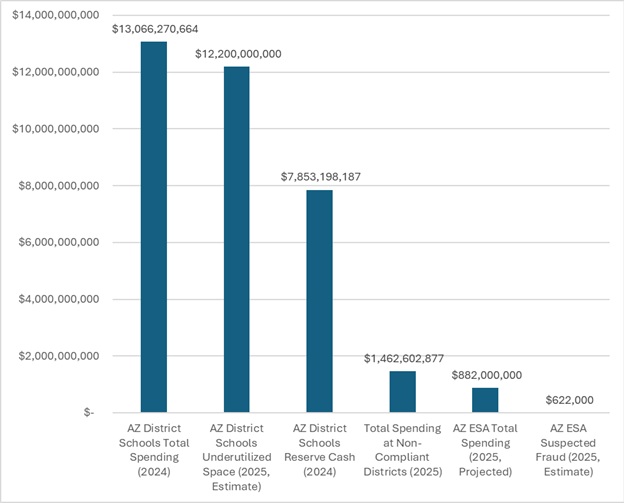
Misuse of the ESA program is vanishingly small. The Arizona Department of Education’s internal audit had turned up $622,000 in ESA funds that are “possible fraud or misuse.” That’s approximately 0.05% of total ESA spending over the past two years.
Misuse of funds in the ESA or any other public program must be detected, deterred, and punished. This is in fact happening in the ESA program, as the Arizona Department of Education had already found the misuse, suspended accounts of those responsible, and reports that it is “in the process of collecting more than $600,000” in improper spending. All of this makes the ESA program far more transparent and accountable than Arizona school districts, which do not post their purchases.
And while Deer Valley teachers may indeed purchase their own school supplies, it has nothing to do with the ESA program and everything to do with misplaced district priorities.
One of the oldest tricks in the school district advocate playbook involves pretending that teachers must buy their own classroom supplies because of a lack of funding. The Channel 12 story cites a Deer Valley biology teacher who said she “spends at least $500 of her own money every summer for her classroom.”
Days after the report aired, former Deer Valley school board candidate Tiffany Hawkins revealed that Deer Valley Unified had spent $560,407 to send students and staff on trips to Disneyland, Knott’s Berry Farm, Sea World, Universal Studios, and other destinations in Arizona, California, Hawaii, Indiana, and Texas. Apparently, the district leadership decided that these trips took precedence over classroom supplies for Deer Valley teachers.
Don’t hold your breath waiting for Channel 12 to cover that. Deer Valley Superintendent Finch—who recently faced charges of stonewalling public records requests and illegal electioneering on school grounds—attacked the ESA program for “out of control” spending with “zero accountability.” But his critiques of the ESA program much more accurately describe spending in his own district.
The Arizona Auditor General reports that Deer Valley spends $13,717 per pupil, meaning that a classroom of 25 students thus generates over $340,000 in total revenue. Where did this money go? Mainly not to teachers.
The Auditor General reports that Deer Valley average teacher pay is $2,163 below the state average. If Deer Valley is not prioritizing teachers, what is it prioritizing instead? The Auditor General report helpfully provides an answer: “high” and “very high” spending on administration and transportation, respectively, compared to a group of peer school districts.
The Goldwater Institute recently published a study of Arizona school superintendent compensation. Goldwater needed to use the open-records law to obtain this information, as districts compensate their superintendents in a variety of creative ways outside of their base salary, including providing either vehicles or “car allowances,” extra retirement benefits, and other perks.
The Goldwater Institute found that Deer Valley provides a total compensation package for their Superintendent of $290,505, including a car allowance of $10,000. This car allowance alone could have provided 20 teachers with $500 each for classroom supplies.
Even if one were to take the highly perverse view that students were the indentured servants of the school districts in which they reside, it would still be absurd for Deer Valley Unified officials to blame their problems on the ESA program. Arizona Department of Education reports show that 10,966 students lived within the boundaries of Deer Valley Unified but attended other public schools in 2024.
Deer Valley Unified meanwhile “drained” almost 3,000 students and their funding from other public schools. At the end of 2024, only 709 students had left a Deer Valley school to participate in the ESA program. Four different public schools outside Deer Valley Unified each have enrolled more students who reside in the district than the ESA program. Moreover 217 total public schools outside the district enroll Deer Valley Unified resident students.
Luckily, Arizona policymakers have decided that Arizona children are not merely funding units for their local school districts. Arizona families can use ESAs to choose the schools that are the best fit for the interests and aspirations of their children.
Arizona school districts have never had as much money as they have now, enough apparently to prioritize trips to California and perks for superintendents. If Deer Valley Unified officials hope to gain the enrollment of the thousands of resident students who have chosen to pursue their education elsewhere, a clear path forward would be to prioritize their funding.
Purchasing classroom supplies for teachers would be a great first step.
Matthew Ladner is a Senior Advisor for education policy implementation and Jason Bedrick is a Research Fellow at the Heritage Foundation’s Center for Education Policy.
Arizona AG Kris Mayes’ Communications Director Richie Taylor deleted his X, Bluesky, and LinkedIn accounts after screenshots of his alleged posts surfaced on “groypers” and “violence on the right.”
Corey A. DeAngelis, a Senior Advisor with Americans For Fair Treatment, shared a screenshot allegedly taken from Taylor’s X account, which read, “Lots of people learning about groyper’s tonight because of violence on the right in this country.”
The post appeared to advance the unsubstantiated theory that Charlie Kirk’s assassin, Tyler Robinson, is a member of online commentator Nick Fuentes’ fan base, known as “groypers,” who have rhetorically feuded with Kirk and Turning Point USA over the years.
— Corey A. DeAngelis, school choice evangelist (@DeAngelisCorey) September 17, 2025
As reported by the Associated Press, Utah County Attorney Jeff Gray revealed Tuesday that evidence, including a text confession and a note, shows the suspect targeted Charlie Kirk, stating, “I had enough of his hatred. Some hate can’t be negotiated out,” and “I had the opportunity to take out Charlie Kirk and I’m going to take it.”
The comments would seem to preclude the assassin from views that could be “on the right,” as Taylor’s alleged post suggested. Gray declined to address whether Kirk was targeted due to his views on transgenderism on Tuesday, telling reporters, “That is for a jury to decide.”
Last month, Taylor came under public scrutiny for “vicious ad hominem attacks” against Jenny Clark, founder of Love Your School, a nonprofit that advocates for parental rights, school choice, and resources for Empowerment Scholarship Accounts (ESA) and special education students.
🚨Update: the Head of Communications for @AZAGMayes , @richietaylor – has deleted posts against me which were extremely aggressive, untrue, unprovoked and vicious ad hominem attacks.
I make policy arguments supported by available facts, they prefer to personally attack people. pic.twitter.com/qkeXlqG9KU
Following the incident, Clark posted an update saying, “Update: the Head of Communications for @AZAGMayes, @richietaylor – has deleted posts against me which were extremely aggressive, untrue, unprovoked and vicious ad hominem attacks. I make policy arguments supported by available facts, they prefer to personally attack people.”
Arizona is one of the nation’s leading states in offering families education choice—and families are loving it.
Three out of four parents support the state’s Empowerment Scholarship Accounts program, which enables families to choose the learning environments that work best for their children. Parents can use these funds to pay for private school tuition, tutoring, textbooks, homeschool curricula, online courses, special needs therapy, and more.
The typical student in this program receives about $7,500 per year, less than half the $15,300 per pupil at Arizona’s district schools.
But Democrat Attorney General Kris Mayes wants to put a stop to even that.
Yet again, Mayes is waging lawfare against the more than 90,000 students using the state’s education choice program.
Earlier this year, Mayes ordered the Arizona Department of Education to adopt an extra-statutory regulation—one she invented from thin air—that undermined the ability of the department to approve education savings account expense requests in a timely manner. Now, she’s using exaggerated concerns over misspending to achieve the same end: throwing sand in the program’s gears.
Late last month, Mayes sent a letter to Arizona Superintendent of Public Instruction Tom Horne ordering him to cease automatically approving account purchases under $2,000, a practice Mayes argued “has led to ESA [Empowerment Scholarship Account] holders purchasing prohibited items […] with taxpayer funds.”
Horne, a former attorney general, responded that Mayes’s issue lies not with him but with the state Legislature, which modified the program’s statute last year to require the education department to adopt “risk-based auditing procedures” for the program. The revision was signed into law by Gov. Katie Hobbs, a Democrat.
The risk-based auditing provision seems like a boring, in-the-weeds detail. But such details can make or break a program like the Empowerment Scholarship Accounts—and Mayes knows it.
Before the Legislature revised the statute, the Arizona Department of Education was manually approving every single account purchase or reimbursement request. This “review every penny” approach was causing massive backlogs and delays.
There were nearly 11,000 transactions in Quarter 3 of this year alone. It’s impossible for the department’s small staff to review each transaction in a timely manner. Instead, families were forced to wait over two months to purchase things like books or curricular materials.
But families can’t wait months just to buy a textbook or pay their child’s tutor or school. Those who couldn’t wait had to pay out of pocket—and it took nearly five months to be reimbursed.
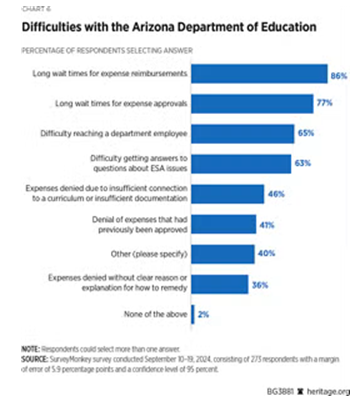
The delays caused families considerable frustration. A survey of families using the accounts found that two-thirds were dissatisfied with how the program was being administered, and about 8 in 10 were frustrated by long wait times for expense approvals and reimbursements.
It wasn’t supposed to be this way. ClassWallet, the vendor that operates the program, promised in its 2023 contract with the state “to automate the approval of platform transactions and reduce the [department’s] reliance on manual reviews of platform purchases,” claiming that the artificial intelligence it was developing “provides the State a path to a zero-approval queue, minimizing staffing and costs.”
Unfortunately, ClassWallet has thus far failed to deliver on that promise. And while artificial intelligence might one day allow parents to instantly access their funds while reducing fraud to zero, it’s not there yet.
In the meantime, the department needed a practical solution that simultaneously maximized user-friendliness while minimizing fraud.
That’s where risk-based auditing comes in. In response to parental frustration with the manual review process, the legislature modified the statute, ordering the Arizona Department of Education to adopt a risk-based auditing approach.
To comply with legislative intent, the department decided to automatically approve spending requests below $2,000, then audit accounts on the back end.
The new approach has been a stunning success. Parents can get most items immediately, and wait times for purchase requests above $2,000 dropped from two months to just three or four days. And the risk-based auditing system produced a high degree of financial accountability.
Unfortunately, though, the media seized upon the tiny percentage of ESA holders who are taking advantage of the looser rules. Sensationalist “journalists” with a long history of factually challenged attacks on school choice programs breathlessly reported that account holders purchased a variety of ineligible expenses, including diamond rings and necklaces, flights and hotel stays, and even lingerie.
What they neglected to report was the scale of the misspending.
Last month, the Arizona Department of Education revealed that its internal audit of two years’ worth of ESA spending had turned up $622,000 in ESA funds that are “possible fraud or misuse.” That’s less than 0.05% of total ESA spending from 0.4% of account holders.
More than that, anyone engaged in misspending will be forced to pay the money back and could face prosecution. The department reports that it is “in the process of collecting more than $600,000” in improper spending, and it’s already suspended 400 accounts. Some have been referred some to the attorney general for further investigation and prosecution.
One would think that the attorney general would be impressed by this high level of accountability. But instead, she’s demanding that the Education Department abandon risk-based auditing in favor of the failed manual-review process that produced months-long wait times.
Clearly, accountability is not the goal here. Arizona’s attorney general is using misspending as a pretext. If accountability were her real concern, she’d be raising alarms about all the waste, fraud, and abuse in the district school system—such as the $12 billion worth of unused and underutilized buildings that Arizona school districts are sitting on, or the record $7.8 billion they’re holding in cash reserves.
Mayes says she is concerned with stopping the 0.4% of account holders committing fraud. But her demands would make the program unworkable for the over 99% of families who are just trying to do right by their children.
Punishing fraud is necessary. Every government program has some amount of fraud and abuse, and public officials have a duty to implement rules that keep fraud to a bare minimum. But undermining a program’s effectiveness does not serve the public interest, especially when that program is helping kids get access to a better education and a brighter future.
The attorney general’s demands are unreasonable and pretextual. Acceding to her demands would not fix the state’s education choice program—it would break it. Horne was right to tell the attorney general to go pound sand.
Jason Bedrick is a Research Fellow at The Heritage Foundation’s Center for Education Policy.
Richie Taylor, Communications Director for Arizona Attorney General Kris Mayes, was called out on social media earlier this week. The Democrat staffer allegedly launched “vicious ad hominem attacks” against Jenny Clark, founder of Love Your School, a nonprofit that advocates for parental rights, school choice, and resources for Empowerment Scholarship Accounts (ESA) and special education students.
Clark sat on the State Board of Education, appointed by former Gov. Doug Ducey in 2022, as a public member known for her advocacy for ESAs and School Tuition Organizations (STOs), and for vocally opposing Governor Katie Hobbs on both topics. She was ousted from the role by Hobbs in March after her term expired.
Following an August 27th segment on KTAR’s Outspoken, which featured Clark, AZGOP Chairwoman Gina Swoboda, and KTAR Legal Analyst Barry Markson, a terse exchange between Taylor and Clark began.
More from ESA Debate on @OutspokenKTAR:@ClarkRimsza provides important context that more than 99.9% of ESA purchases are proper educational spending.@BarryMarkson1: I think 99% of the parents using the program probably are using it right. I absolutely agree with you! pic.twitter.com/zfpLMTfDlO
The disagreement appeared to arise when Taylor referred to Clark as a “grifter” and put her name in quotation marks, which led Clark to point out Taylor’s collaboration with her during his time as Communications Director for the Arizona Department of Education. She wrote, “Why is my name in quotes, Richie! How weird! Remember when you were at the AZ Dept. of Ed. and we partnered to get flyers out about the ESA program in 2021? Here’s a screenshot for reference! Feel free to keep attacking the Arizona ESA program – right into 2026, please!”
Why is my name in quotes, Richie! How weird! Remember when you were at the AZ Dept. of Ed. and we partnered to get flyers out about the ESA program in 2021?
The exchange escalated with Taylor posting, “lol indeed. You caught me acting in good faith. Wow impressive. Again, you had a dem superintendent wanting to work with you and you f***ed it over at every turn because it would have ruined your grift.”
Why is the Head of Communications for @AZAGMayes posting in my X account, totally unprovoked, and cussing me out?
We have had cordial exchanges before when he was at ADE and I worked to get flyers out for them on ESAs (which I shared in screenshots).
In response, Clark shared the post and asked: “Why is the Head of Communications for @AZAGMayes posting in my X account, totally unprovoked, and cussing me out? We have had cordial exchanges before when he was at ADE and I worked to get flyers out for them on ESAs (which I shared in screenshots). Inappropriate and odd.”
Responding to another now-deleted post, she asked, “Why is the Head of Communications for an elected Attorney General @AZAGMayes personally attacking a working mom, who started a non-profit on school choice, and is helping families? I mean, is this the type of class and leadership we have come to expect from democrats? Odd!”
She replied to the post, writing, “It’s such an abrupt and unprofessional personal attack. I’m not sure what prompted it! I’ve never had issues with @richietaylor before, all of a sudden today they’re attacking me personally on my X threads. It’s actually very concerning, on a few different privacy levels, too.”
Taylor then doubled down replying “Cry more and get used to it.”
In the most recent post in the social media clash, Clark shared a screenshot of the now-deleted post in which Taylor allegedly wrote to her, “lol. You make so much money off the program and you know it[.] Why don’t you tell people how much? And you also know you torpedoed any real reform because you were trying to get your preferred vendor the contract to manage it.”
According to ProPublica, citing public tax records, Clark drew a salary of $102,000 in her role as Executive Director of Love Your School. No public record of her applying for “preferred vendor status” was found in the State Board of Education’s available online records.
In her post, Clark wrote, “Update: the Head of Communications for @AZAGMayes, @richietaylor- has deleted posts against me which were extremely aggressive, untrue, unprovoked and vicious ad hominem attacks. I make policy arguments supported by available facts, they prefer to personally attack people.”
Responding to a letter issued by Arizona Democrat Attorney General Kris Mayes, Arizona Superintendent of Public Instruction Tom Horne issued a statement that Mayes is “misleading the public with claims she has leveled at the management of the Empowerment Scholarship Account (ESA) program.” In an 8-page letter with 12 pages of testimony from the Arizona Department of Education’s John Ward in the case of Velia Aguirre v. State of Arizona, Mayes outlined an investigation from her office, making allegations regarding the Department of Education’s use of a risk-based audit approach, which echoes a similar exchange between Horne and Governor Katie Hobbs in December 2024.
Mayes directly critiqued Horne and the ADE writing in part:
“Your failure to appropriately monitor ESA spending has created an untenable situation. Again, I do not want to disrupt the process for ESA holders who are following the law, but this cannot continue. Accordingly, you must act immediately to develop and implement appropriately rigorous purchase review standards and risk-based audit procedures so that ESA families may access their funds in a timely manner and public funds are not spent illegally. The Department’s purchase review and audit standards should employ appropriate controls to safeguard public funds. These controls, and any automatic payment thresholds, should consider the level of risk associated with different categories of expenses, vendors, methods of payment, and individual ESA holders.”
Mayes went on to cite a 12 News report that “the Department has automatically approved [$]1.2 million ESA purchases since the automatic approval policy took effect in December 2024.”
As Matt Beienburg wrote in an op-ed for AZ Free News, the Arizona Capitol Times issued a retraction of its initial report that “Education department under fire for approving $124M in improper ESA [education savings account] purchases,” clarifying with a formal correction that “an inaccurate dollar amount,” was reported. However, no similar retraction has been issued by 12 News as of this report.
"Facts don't lie, even if the media does."
Here are two MAJOR lies 12News "reported" in its bogus ESA attack 👇
❌ Dollar amounts were exaggerated up to 100 times!
Beienburg notes that blatantly inappropriate purchases such as iPhones, televisions, and other non-educational items “haven’t been approved, as the State Board of Education’s ESA Handbook—ratified by members appointed by both former Gov. Doug Ducey and Gov. Katie Hobbs—makes clear. The document expressly states that while families’ ESA purchases under $2,000 are promptly reimbursed by the state, these items ‘are not deemed ‘approved’ by the Department, until they are audited OR the timeframe to audit the orders has passed [2 fiscal years].’ Just like their tax returns filed with the IRS, these families’ ESA purchases are processed up front and subject to enforcement afterwards.”
For immediate release: August 29, 2025 Horne calls out AG Mayes for misleading attack on ESA program AG sent letter to Superintendent today Link: : https://t.co/ul3JSKLudp Contact: Communications@azed.gov pic.twitter.com/xGEPdsrHqB
— Arizona Department of Education (@azedschools) August 29, 2025
In a lengthy statement, Horne addressed the allegations raised by Mayes and accused the AG of making false statements:
“In your letter today, and in a recent television interview, you misled the public by stating that improper ESA purchases had been approved, without any reference to the fact that under risk-based auditing dictated by the legislature the money has been recovered or is in the process of being recovered. We have collected or are in the process of collecting more than $600,000 that was paid out for improper purchases. You also criticize risk-based auditing. Risk-based auditing is a very common and appropriate practice used by auditors, and the ESA Director has more than 16 years’ experience as an auditor. The risk-based approach involves not approving purchases prior to review, but paying amounts under $2,000 subject to later review, which is how we were able to collect or be in the process of collecting more than $600,000.”
He went on to chide Mayes writing, “You state that this is not partisan. That is disproved by all the false statements you made on the television interview.”
Horne continued, “Your argument is not with me but with the legislature. The legislature recently passed ARS section 15–2403B. It provides in part: ‘The department, in consultation with the office of the auditor general, shall develop risk-based auditing procedures for audits conducted pursuing to this subsection.’
“The statute was passed because the department is operating with the same number of people to check purchases as had been given by the legislature when the program was 1/7th as large. The most recent House budget included an appropriation for more people to check purchases, but it had to drop that provision when the governor said that if it did not do so, she would veto the entire budget. The limit on personnel had meant delays for reimbursement or more than two months, which was an unbearable burden for parents who had already paid the money and needed reimbursement. This explains why the legislature wanted to add more staff to serve parents.
“Again, you misled the public in your interview by stating that these improper items have been approved. They were not approved, and as to all the items you mentioned, the accounts have already been frozen. This is as egregious as ignoring the recovery of over $600,000, not to mention your failure to state that this procedure was dictated to us by the legislature and the ESA parent committee that you referred to set the limit at $2,000 pursuant to the legislative command to adopt risk-based auditing. It has been made clear to ESA users in multiple communications that payments of under $2,000 do not imply approval, which can be obtained only after the risk-based auditing dictated by the legislature.
“You referred to a July 21 meeting of the legislative audit committee. Within four days we consulted with the auditor general. Some have erroneously interpreted the word ‘consultation’ to mean that the auditor general has the right to dictate terms to us. That is incorrect. The normal English language use of the word consultation is that we have a discussion, which we have done, and then proceed. However, we have agreed to have further consultations with the auditor general and will do so.
“We will provide at a later date further responses to your long-winded letter of seven pages single space. We are responding now to the main points so you will have no further excuse to mislead the public.”