Craig Harris of Channel 12 is out with another story cunningly designed to make Arizona’s Empowerment Scholarship Account (ESA) program look like a runaway subsidy for private schools. Regular readers will recognize the pattern: take real numbers, arrange them to imply a conclusion the numbers don’t support, and omit every fact that would undercut that conclusion.
We’ve documented this pattern before. For example, Harris’s fabricated 20% fraud claim that the Arizona Department of Education directly refuted, or the misread auditor general sample Harris falsely presented as a program-wide “34% misspending,” despite the auditor general specifically saying it was not a random sample and hence “not intended to be projected to the entire population.”
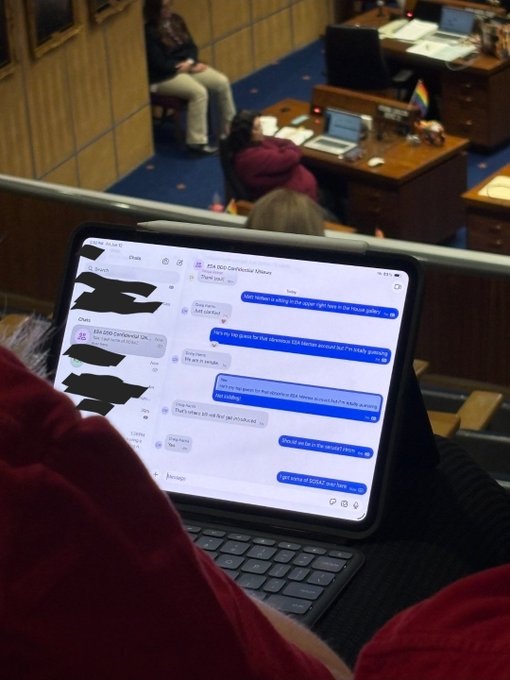
Most damning, Harris was caught coordinating by text message with anti-school choice activists at the Capitol — advising them where to position themselves for “maximum political impact” on the very legislation he was supposedly covering neutrally.
Channel 12 has never corrected the record on any of it.
Harris’s latest piece continues the tradition. Among numerous falsehoods in the piece, three stand out.
1. Big Numbers With No Denominator
Harris tells readers that $719 million in ESA funds flowed to “just” 190 private schools since 2022, and that Gilbert Christian Schools alone received $34 million – letting the insinuation behind the word “just” do a lot of work.
What Harris doesn’t tell readers is what any of that means in context.
Arizona’s public school system — district and charter combined — spends roughly $14,673 per pupil, a record high, according to the nonpartisan Joint Legislative Budget Committee. The ESA program, by contrast, reports that three-quarters of scholarships fall between $7,000 and $9,000 a year — roughly half what a district or charter school spends on the same child.
Total annualized ESA spending as of the most recent quarterly report is about $1.1 billion — against total Arizona K-12 public school spending of roughly $15.9 billion. ESAs represent about 7% of what Arizona spends educating children, despite educating 9% of Arizona’s K–12 students. That’s not the runaway spending Harris implies.
The Gilbert Christian figure is even more telling once you run it against the alternative. Gilbert Christian’s enrollment grew from roughly 1,377 students in 2022 to 2,300 in 2026. Had those same students attended a district school instead, at Arizona’s average per-pupil cost, taxpayers would have spent well over $100 million educating them over that period — versus the $34 million ESAs actually paid out.
Harris presents the $34 million as an alarming number. He never mentions the number it’s replacing. Again: the context that undercuts his narrative is conspicuously absent.
2. Omitting ESA Data on Special-Needs Students
For his next two attacks on the ESA program, Craig Harris quotes Tulane economist Douglas Harris (no relation) of Tulane University. For those unfamiliar with the latter’s work, Douglas Harris is the Craig Harris of school-choice research.
For example, in a brazen attempt to smear school-choice philanthropist Betsy DeVos during her confirmation hearings for U.S. Secretary of Education, Douglas Harris wrote an op-ed in the New York Times claiming that that charter-school sector in Detroit (which DeVos supported) was a “disaster.” As proof, he relied on a study by Stanford University’s Center for Research on Education Outcomes (CREDO). The only problem was that the study showed that Detroit’s charter schools consistently outperformed Detroit’s traditional public schools, and CREDO called Detroit’s charter school sector a “model to other communities.”
In the latest Channel 12 salvo against ESAs, Douglas Harris is cited claiming that school choice programs nationwide serve students who “typically have fewer needs” than public school students.
Arizona’s own data say the opposite.
The most recent Arizona Department of Education (ADE) quarterly report shows 21% of ESA students have a disability, compared to 15% in Arizona’s district schools. That’s not a program skimming the easiest kids to serve. It’s a program serving a higher share of students with disabilities than the district school system.
Of course, those data don’t appear in the Channel 12 story. That would undercut Harris’s crooked narrative.
3. Omitting ESA Data on Sector Switchers
Douglas Harris also claims choice programs nationally serve students who were “already attending” private schools before receiving public support. That’s not true nationwide, and it certainly isn’t true in Arizona today.
ADE’s most recent quarterly report shows 58.6% of new ESA students newly enrolling this year came directly from a public school the year before — up from 57.3% last year and 47.6% the year before. Moreover, these figures undercount the number of switchers because they don’t factor in students moving from out of state or students who would have attended a public school in the absence of an ESA program.
Those figures are harder to calculate, but at the very least, an objective reporter would give readers ADE’s published data on this very question.
But yet again, Craig Harris chose to omit any data that would undermine his anti-ESA narrative.
A Pattern of Omissions and Distortions
None of these are subtle errors a careful reporter might miss once. They are the same style of omissions and distortions that have become the hallmark of Craig Harris’s career—anti-school choice advocacy wearing a press badge.
Arizona families deserve real reporting that provides the context necessary to understand what the numbers actually mean. Until Channel 12 starts doing that, Arizonans should get their news elsewhere.
Jason Bedrick is a Senior Research Fellow at The Heritage Foundation’s Center for Education Policy.
Arizona lawmakers may soon be summoned back to the Capitol for a special session to consider a “grand bargain” on Empowerment Scholarship Accounts (ESAs). If so, they should put the interests of ESA families first.
Under one version of the deal, the Arizona Education Association (AEA) and its allies would drop their ballot initiative restricting ESAs. In exchange, the legislature would abandon three measures it referred to the ballot this session — protections for military families’ scholarships, payroll reform for teachers’ unions, and a mandate that districts spend 60 percent of their budgets on instruction — and would enact most of the ESA provisions debated this session in House Bill 2142. (There’s one important exception: the unnecessary testing mandate would be dropped.)
A much better deal, proposed by Republican gubernatorial candidate Andy Biggs, would offer “one for one,” with the legislature dropping the payroll ballot measure in return for the AEA dropping its ballot measure. The legislative GOP caucus is behind the Biggs deal—the question is just how desperate the AEA is to avoid going to the ballot. But if the “grand bargain” requires some reforms to the ESA program, legislators should hold out for a better deal than the original proposal.
The AEA-backed initiative is not a modest accountability measure; it is a serious threat to the ESA program, imposing a host of harmful regulations, including a restrictive income cap that would kick tens of thousands of students off the program, blocking parents from buying basic school supplies, and confiscating funds that families had saved for their children’s education. If Democrats balk at the Biggs proposal, trading away three referred measures and a handful of program restrictions to make that threat disappear is a defensible trade.
But as Arizona’s ESA defenders take yes for an answer, they should be honest about what they’re doing and minimize harm to ESA families. The HB2142-based “grand bargain” is not, as the American Federation for Children (AFC) has suggested, a set of “commonsense reforms” that simply tidy up the program. It is a series of concessions — real costs imposed on real families — that ESA supporters are accepting because the alternative is worse. Calling it “commonsense” or a “fix” obscures this. It allows the organization to claim credit for “saving” the ESA program without ever having to explain to the families of more than 100,000 students who rely on it what its own proposed changes will actually do to their accounts.
In the wake of the HB2142-based proposal, I solicited feedback about it on a social network page for ESA families. I received nearly 400 comments from ESA parents who overwhelmingly opposed the proposed regulations. They explained in detail how the supposedly “commonsense” restrictions would hamper their ability to provide their children with an education that works best for them.
Here is what the three central provisions of the HB2142-based proposal would actually do — and why each of them, even if ultimately worth swallowing in some form, makes the program worse for the families it serves.
Capping Rollover Funds
A key feature of ESAs that distinguishes them from a traditional voucher is that families can save unspent funds from year to year rather than being forced to spend a lump sum on a single school by a single deadline. This matters because families spend their own money more efficiently than bureaucrats spend other people’s money. The ability to save and re-deploy funds gives families both the incentive to economize and the flexibility to plan for expenses that don’t arrive on a tidy nine-month school-year schedule. A voucher must be spent now, at one school, or it will be lost. ESA funds can be banked for next year’s therapy bill, a multi-year curriculum purchase, or a future tuition increase.
The deal under discussion would cap how much families can carry forward — $50,000 for students with disabilities, $24,000 for everyone else — with the excess confiscated and deposited into the state general fund each year. That won’t matter for most families who spend close to their full allotment annually. But for the families who most need the flexibility ESAs were designed to provide, particularly families of students with special needs, it will be a bitter pill to swallow.
Families saving toward a multi-year placement at a specialized school, parents stockpiling funds for a major piece of assistive technology, or families anticipating a more expensive placement as a child with a disability ages into more intensive services — these are exactly the families a cap punishes.
The rollover cap is a “solution” in search of a problem. The rollover cap creates a perverse “use it or lose it” incentive that won’t save money; it will only encourage wasteful spending. If lawmakers proceed with a cap, the least they should do is exempt students with disabilities entirely. The case for forced spend-down is weakest exactly where the case for flexibility is strongest: students whose educational and therapeutic needs are least predictable and most expensive over time.
Fingerprinting Mandate
The deal would require fingerprint clearance cards — the same background-check credential used for school district and charter school employees — for individuals providing tutoring or teaching services paid for with ESA funds, as well as for staff at qualified private schools. For an institution — a school, a learning center, a tutoring company with a storefront and rotating staff — this is a reasonable extension of an existing framework, as schools are already required to fingerprint their teachers.
But the bill does not stop at institutions. As drafted, it would also sweep in independent tutors — the retired teacher down the street who tutors a handful of children at a family’s kitchen table, the local college student who helps with algebra twice a week. This is a fundamentally different relationship from a teacher supervising a classroom of other people’s children at an institution. A tutor working in a family’s own home, under that family’s direct supervision and invited in by that family’s own judgment, is not analogous to a stranger left alone with a building full of students.
Parents already vet who comes into their homes; that is what parental choice means. Mandating a state-administered background-check bureaucracy on top of that judgment does not make children safer — it makes it harder and more expensive to find a tutor at all, particularly in the specialized subjects and therapeutic disciplines where the pool of qualified providers is already thin.
The fix here is narrow and obvious: limit the fingerprinting requirement to qualified schools and institutional tutoring providers, and exempt individual tutors providing services in a student’s own home. That preserves the child-safety rationale where it actually applies — institutional settings with unsupervised access to multiple children — without taxing the much more common, much more easily supervised arrangement of one family hiring one tutor.
Spending Restrictions
The deal under consideration also adds a long, explicit list of disallowed expenses. Most of this list is theater. Jewelry, lingerie, hot tubs, bounce houses, and gift cards were never allowable ESA expenses in the first place. Codifying their prohibition changes nothing about what families can actually buy. It exists to give legislators something to point to — a list that sounds tough — rather than to solve an actual problem in the program. That is itself a tell about how this provision came to be.
But a few items on the list are genuinely new restrictions, and those deserve scrutiny on the merits. Barring out-of-state and international museums and excursions, for instance, would forbid spending ESA funds on precisely the kind of experiential, field-based learning that homeschooling and hybrid-schooling families have used for years — a trip to a Civil War battlefield, a national museum in Washington, D.C., a language-immersion excursion across the border. These are not luxuries dressed up as education — for many families building a curriculum outside a traditional classroom, they are the curriculum. Banning them doesn’t close a loophole. It closes off a category of legitimate, well-documented educational practice that happens to be easy to caricature in a press release.
Hotel stays, meals, plane tickets and other travel expenses are already properly forbidden, but there’s no good reason to prevent families from purchasing tickets to a museum outside Arizona that would be allowed if it were in Arizona. Any grand bargain should restore legitimate educational purchases to the allowable-uses list.
Why AFC Is Getting This Wrong
None of these three provisions emerged from a serious conversation with ESA families about what they need. They emerged from a desire to manage headlines. Rather than designing ESA policy in the best interests of ESA families, AFC’s strategy would let school-choice opponents dictate the policy agenda. Chief among them is school-choice opponent Craig Harris at Channel 12, who has spent the better part of a year manufacturing alarm about ESA account balances and fraud rates that bear little resemblance to reality. The Arizona Department of Education has confirmed that flagged fraudulent or egregious spending amounts to roughly 0.3 percent of total ESA spending — a rate that would be the envy of nearly any government program. Harris has claimed fraud rates many times higher, and signature gatherers for the AEA-backed and AFC-backed ballot campaigns alike have been caught on camera spreading those falsehoods to voters.
The right response to false claims is to correct them. Instead, AFC has chosen to give ESA opponents a say in how to regulate the program — an approach that has repeatedly proven disastrous for ESA families. Instead of proposing rollover caps because Harris made an issue of high account balances, school-choice proponents should explain to Arizona voters why families save those balances in the first place — often precisely because they have a child with disabilities whose needs are expensive and unpredictable.
AFC’s approach sets a dangerous precedent: when an activist-journalist manufactures a talking point, AFC’s policy response is to regulate around it rather than to defend the program based on the facts.
Arizona’s ESA families were not asked whether they would trade their ability to save for a child’s future needs, or their ability to hire a trusted neighbor as a tutor, for a quieter news cycle. They deserve a coalition that designs policy around what actually serves them — not one that lets their loudest opponents write the rules by proxy, then dresses up the result as “commonsense.”
The next time AFC or any other organization in this space asks Arizona families to accept a “commonsense reform,” someone should ask the obvious question: commonsense according to whom, and at whose expense? If the goal is just to keep Craig Harris’s headlines at bay, it’s a fool’s errand — he and his ilk will continue manufacturing anti-ESA headlines so long as there’s an ESA program.
“Avoiding bad headlines” is not a serious approach to policymaking and certainly not in the interests of ESA families. Arizona’s ESA families deserve better.
Consider the Deal — With Open Eyes
None of this is an argument against the special-session deal. The AEA-backed initiative would do far more damage to far more families than a rollover cap or a fingerprinting mandate ever could, and trading three referred ballot measures plus some unnecessary or even harmful ESA restrictions to take that threat off the table is a trade worth considering. Dropping the testing mandate from the deal is itself a meaningful win, preserving the central insight of school choice: families, not state-mandated exams, are the accountability mechanism.
Taking the HB2142-based deal might be a necessary evil, but it’s certainly not a victory. At best, it would be a retreat to a more politically defensible position, not a “commonsense” fix or policy advance. If there is a special session, lawmakers who support the ESA should do everything in their power to minimize the harm to ESA families. That would entail supporting the Biggs proposal or, at the very least, holding out for revisions to HB2142 that seriously consider the impact on ESA families.
Jason Bedrick is a Senior Research Fellow at The Heritage Foundation’s Center for Education Policy.
For months, we have documented the pattern of errors, distortions, and outright fabrications that characterize the coverage of Arizona’s Empowerment Scholarship Account program by Channel 12’s political reporter Craig Harris. Each new episode—the fabricated 20% fraud claim, the defiance in the face of correction by the Arizona Department of Education itself, the constant shifting of goalposts as each of his claims is debunked—seemed like it might result in Channel 12 taking appropriate corrective action.
But they never did.
Last week, at the Arizona Legislature’s final stretch of its 2026 session, the mask came off entirely.
While lawmakers debated a series of consequential ESA-related bills and resolutions on Thursday and Friday—including a constitutional amendment to protect military family scholarships—Harris was captured on camera doing something that no journalist who takes the job title seriously can explain away: coordinating, via text message, with members of Save Our Schools Arizona, the anti-school-choice advocacy group that is a principal sponsor of the Protect Education Now ballot initiative, about where they should position themselves inside the Capitol building for maximum political impact.
Text message conversation between Channel 12’s Craig Harris and anti-school choice activists.
Let that sink in. A reporter on the education beat, covering legislation in real time, was not observing the advocacy groups in the building. He was directing them.
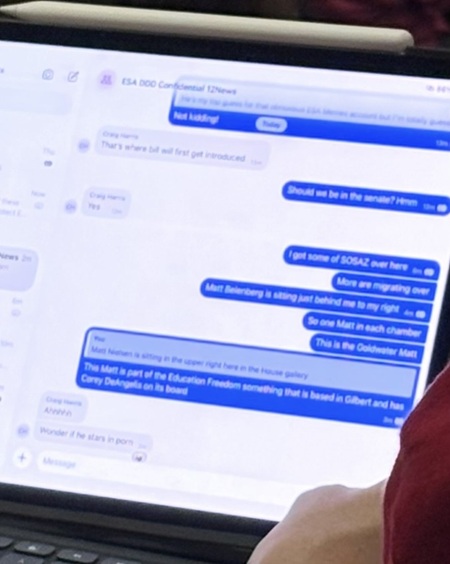
The text exchange was visible on the screen of a Save Our Schools activist—readable thanks to a conspicuously large font and no privacy screen—and was flagged by our Heritage Foundation colleague Corey DeAngelis, who shared images of the messages on social media after receiving them from a local activist. Harris subsequently confirmed on X that the images of the group chat, named “ESA DDD Confidential 12News,” were real.
After Harris told the activist that he was in the state senate chamber as that is “where [the] bill will first get introduced,” Save Our Schools board member Kathy Boltz asked Harris for advice regarding where their team of activists should place themselves in the capitol building. “Should we be in the senate? Hmm,” she asked. Within a minute, Harris answered in the affirmative.
This is not ambiguous. This is not a misunderstanding. This is a journalist using his knowledge of the Arizona Legislature’s political process to provide tactical advice to an advocacy group that has a direct political stake in the legislation he is supposed to be covering neutrally.
Harris was no longer covering the news. He was helping to manufacture it.
But that wasn’t the worst of it.
The same captured text conversation revealed Harris mocking a local school choice supporter, asking whether the individual “stars in porn.”
This derision was not just a lapse in professionalism. This was contempt—contempt for the families, advocates, and ordinary citizens who show up at the Capitol to make the case for educational freedom, expressed in a private conversation with advocates on the other side of the issue.
Text message conversation between Channel 12’s Craig Harris and anti-school choice activists.
Multiple Arizona politicos were quick to call out the behavior publicly. State Senator Jake Hoffman called for Channel 12 to fire Harris and called on the station to “open an investigation into every story he was involved in and retract any instance of undisclosed coordination.” Hoffman observed that this coordination with activists is “precisely the kind of unethical behavior that has caused the majority of Americans to deeply distrust the media.”
Arizona Republic columnist and former State Senator Paul Boyer called it “a really bad look” for Channel 12 to have their reporter, “who is also reporting on these same groups” to be discovered “coordinating with them at the legislature to defeat the same type of legislation he’s myopically focused on.” Similarly, J.P. Twist, executive director of Citizens for Free Enterprise, called out Harris for “literally strategizing with a partisan union to undermine parents’ rights.”
The parent company of Channel 12 publishes a “Principles of Ethical Journalism” statement committing its journalists to the values of truth, independence, public interest, fair play, and integrity. It’s hard to see how coordinating with one group of political activists and crudely mocking the other side comports with those standards.
Sadly, Harris’s breach of journalistic ethics does not end there.
Later that night, in a hearing on legislation to protect military family scholarships, Harris took to social media to characterize two of the three supporting witnesses who testified as people “making money off ESAs,” implying their support was financially motivated rather than principled.
One of those witnesses was Kevin Biesty, spokesperson for the Arizona Christian Education Coalition. As Biesty detailed on X, he reached out to Harris privately and asked him to correct or remove the post. Harris declined. As Biesty observed, the logic Harris applied to him — that representing clients who are affected by ESA policy makes one a financially conflicted advocate — is never applied to the other side. The staff and lobbyists of Save Our Schools Arizona and the teachers unions, who are paid to oppose the ESA program, are never characterized by Harris as people “making money off” the issue.
Harris also claimed that no military family spoke at the hearing. That too was false. Biesty had personally presented a written statement from a military mother who could not remain for the late-night session, and referenced letters from other military families — all of this while Harris was in the room. At no point did Harris ask Biesty for that mother’s contact information or seek to include her perspective in his coverage. He was, however, apparently attentive enough to the gallery to communicate with his Save Our Schools contact — the same ESA mother and SOS board member who, Biesty observed, is never identified as such in Harris’s stories — while sitting at the press desk on the floor.
Indeed, when ESA students and their families share their stories, Harris is quick to dismiss them. Recently, a young ESA student with disabilities named Jordan Visser shared on video about the ways the Protect Education Now initiative would harm students like himself. Harris went on social media to dispute his account, claiming that the initiative would not affect students with special needs—effectively accusing a student with disabilities of lying about the impact of a ballot measure on his own situation.
He was wrong. As the student’s mother, Kathy Visser, and others documented, the text of the initiative itself bore out what the student had said—the ESA funds that the family had saved to continue providing him with services would be seized by the state if the Save Our Schools ballot initiative were adopted.
The irony of Harris’s posture—aggressively checking the credibility of a disabled student while coordinating inside the Capitol with the very advocacy group sponsoring the initiative in question—encapsulates the problem. It is not that Harris is a journalist who occasionally makes mistakes. It is that the mistakes run in one direction, consistently, and that when corrected, he doubles down rather than acknowledging any error. And it is now documented, on camera, that he was coordinating tactics with one side of the debate he was purportedly covering.
Arizona families with children in the ESA program deserve better than a reporter who coordinates with the opposition at the very hearings he is assigned to cover. Arizona viewers deserve better than a news organization that has allowed this pattern to continue unchecked. And the thousands of children—including those with disabilities—who rely on these scholarships deserve a press corps willing to represent their stories honestly.
Channel 12 has not issued a correction or a retraction of the false fraud statistics. It has not yet acknowledged Harris’s coordination with activists or the mockery of a school choice supporter.
Channel 12’s parent company should answer a simple question: Is the behavior documented at the Capitol last week consistent with its Principles of Ethical Journalism? If not, what will it do about it?
Jason Bedrick is a Senior Research Fellow and Matthew Ladner is aSenior Advisor for education policy implementation at The Heritage Foundation’s Center for Education Policy.
A new round of videos confirms that the spread of misinformation is extensive on both campaigns.
The entire Arizona school choice coalition opposes both measures because they would curtail the ESA program, which enables the families of more than 102,000 Arizona students to choose the learning environments that work best for them.
The initiatives would greatly disrupt their education by imposing new restrictions on how families can spend their funds, layering on bureaucratic red tape, and—in the case of the union-backed measure—kicking tens of thousands of children out of the program entirely.
In the latest clips, signature gatherers working for Protect Education Now, a joint project of Save Our Schools Arizona and the Arizona Education Association, and Fortify AZ, backed by the American Federation for Children, misrepresent the basics of the initiative and the ESA program itself.
Surprisingly, the talking points used by the supposedly pro-school choice campaign frequently mirror those used by ESA opponents.
Both Campaigns Grossly Exaggerate Misspending
In video after video, signature gatherers working for both initiatives wildly exaggerate the prevalence of fraud in the ESA program and hype the supposed purchase of “luxury” items such as jewelry, lingerie, trips to Disneyland, and other tabloid-ready spending that are forbidden under the ESA regulations.
One signature gatherer wearing a badge for Petition Partners, the group hired by the American Federation for Children-backed campaign, claimed that the ESA funds were used for jet skis and vacation rentals.
Another signature gatherer wearing a Petition Partners badge claimed there was $10.3 million in misspending in 2025. She failed to note that that accounts for barely 1% of total ESA spending, and that the vast majority of unallowed expenses were innocent mistakes, such as backpacks, lunch boxes, and water bottles.
Although there is room for improvement, Arizona’s ESA program is among the most accountable of any Arizona government program.
The Arizona Department of Education has confirmed that only 0.3% of ESA spending has been flagged as fraudulent or egregious—and nearly all of that occurred in the ClassWallet Marketplace channel that the American Federation for Children-backed initiative would preserve, while eliminating the debit card and reimbursement options that have almost no fraud at all.
Both Campaigns Spread Misinformation
Some gatherers from both campaigns have gone further still, telling voters verifiably false information in order to induce them to sign their petitions.
One Petition Partners signature gatherer told a voter that ESA parents were not required to submit receipts and that they could “buy a puppy” with their ESA and “say it’s for science class.” In fact, parents are required to provide receipts and other documentation. Moreover, the Arizona Department of Education confirmed that no ESA funds have been spent on puppies.
Another Petition Partners signature gatherer told a voter that parents were using ESA funds on cruises and home remodeling, while yet another claimed they were buying “cars and houses” with ESA funds. The Arizona Department of Education confirmed that no ESA funds have been spent on cruises, cars, houses, or home remodeling.
In some cases, the signature gatherers misrepresent the ballot initiatives to make them appear to be providing more education options for students.
In one video, a signature gatherer wearing a badge for FieldWorks, the group hired by the union-backed campaign, falsely tells voters that signing the petition would “help low-income students go to college.” The ballot initiative does no such thing.
In another video, a signature gatherer wearing a Petition Partners badge claims that the ballot initiative was “for everybody to be able to qualify for the [ESA] program.”
When the voter pushed back, noting that all students already qualify now, he replied (incoherently), “Because there’s something that’s against it already, so we [are] trying to get it on the ballot to be voted on instead of it just being changed.”
Ballot initiative workers have even spoken falsely to voters about the nature of their employment. In one video, a signature gatherer wearing a FieldWorks badge falsely tells a voter that he works for the Secretary of State’s office.
FieldWorks, the Arizona Education Association, and Save Our Schools Arizona did not respond to a request for comment.
It is unsurprising, if dishonest, when a teachers’ union and an avowedly anti-choice group resort to these tropes. It is genuinely appalling when a campaign backed by a self-described school choice organization spreads misinformation about a popular school choice program.
The American Federation for Children did not respond to a request for comment.
Previous videos have shown workers from the two campaigns colluding to gather signatures. In a new video, a signature gatherer with a FieldWorks badge that identifies her as a “team leader” introduces a voter to her fiancé, whom she claims is working for the “other education petition,” seemingly referring to the American Federation for Children-backed campaign.
The FieldWorks worker claims to be the “top signature gatherer in the state.” Her fiancé does not appear to be wearing a badge identifying the campaign for which he works, but he is holding a clipboard for the Fortify AZ petition.
When asked for comment, the owner of Petition Partners, Drew Chavez, deferred to their spokesperson David Liebowitz, who runs a self-described “public relations, political and crisis communication firm.”
The spokesperson declined to answer questions about the involvement of the American Federation for Children in crafting the messaging provided to the Petition Partners signature gatherers, instead providing the following statement: “Petition Partners has hands down the most thorough training program in the industry. Each of the more than 800 circulators hired for this effort has spent hours training on how to comply with state law and the facts of the measure itself.” The Petition Partners spokesperson said that they “have had reports of people pretending to be [Petition Partners] team members in an effort to discredit our work.” When asked to confirm or deny the employment of individuals who appeared in the videos, the Petition Partners spokesperson declined to answer.
Jack Reany, an ESA parent from Tucson, says that he has spoken with more than a dozen signature gatherers. He expressed shock at how little they tend to know about the ballot initiatives they’re asking people to sign.
“The public is being dangerously misled,” says Reany. “The fraud-and-accountability narrative is a smokescreen obscuring a deeply consequential piece of legislation: one that would strip legal protections from private schools, remove children from educational environments where they are thriving, and raid savings set aside by disabled students for their future.”
Arizona law is clear. Under A.R.S. § 19-116, knowingly misrepresenting an initiative’s subject matter to induce a signature is a Class 1 misdemeanor.
The videos keep accumulating. Whether Arizona’s anti-ESA attorney general acts on them is another question.
In the meantime, the advice from Arizona’s school choice advocates remains unchanged: If a gatherer approaches you with either petition, decline to sign.
Jason Bedrick is a Senior Research Fellow at the Heritage Foundation’s Center for Education Policy.
This week’s erroneous attack on Arizona’s popular Empowerment Scholarship Accounts (ESAs) is another example of how biased reporting is misleading lawmakers and the public.
When the Arizona Auditor General last week released its Single Audit Report on the state for fiscal year 2024, Craig Harris of Channel 12 News had another fairy tale ready for viewers and readers. The ESA program, he claimed, is “plagued by weak controls, questionable spending, and internal management failures.”
No mention was made of the Arizona Department of Education’s recent finding that only 2% of ESA funds were spent on unallowed items (mostly innocent errors like backpacks and lunch boxes), and only 0.3% of ESA funds were spent fraudulently.
A new Arizona Auditor General report finds the the percentage of misspending in the state's Empowerment Scholarship program was a stunning 34 percent, based on a sample of transactions from July 23-October 25.
The report also is highly critical of @RealTomHorne management….
Both halves of that claim are false. And the falsehoods are not minor.
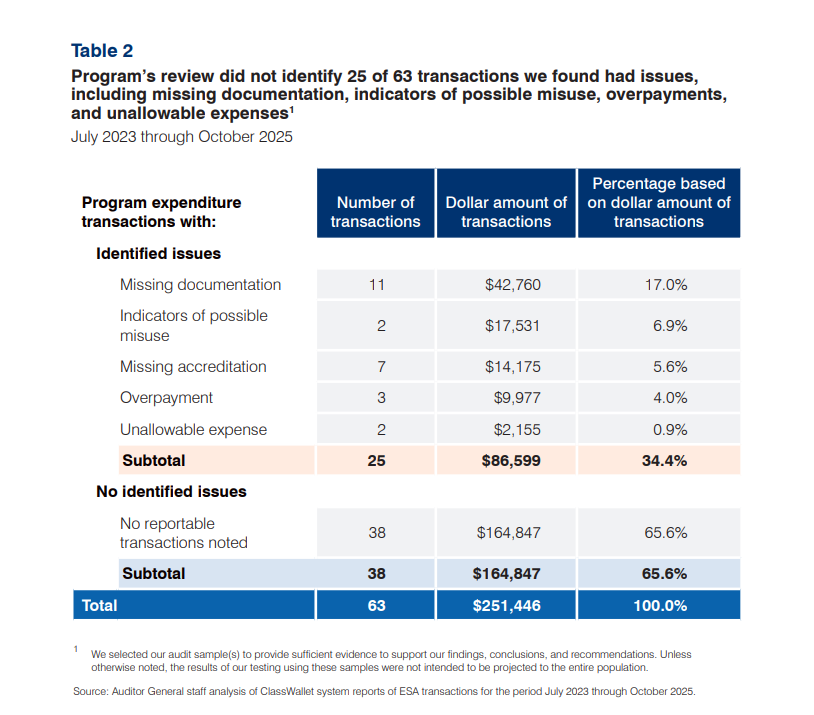
Start with “random.” The Auditor General’s report describes the relevant sample in unambiguous language: “we judgmentally selected 63 expenditure transactions for review occurring between July 2023 and October 2025 totaling $251,446.” [Emphasis added.]
A footnote on the same page adds, for the benefit of any reader who might be tempted to make the mistake that Harris did: “We selected our audit sample(s) to provide sufficient evidence to support our findings, conclusions, and recommendations. Unless otherwise noted, the results of our testing using these samples were not intended to be projected to the entire population.” [Emphasis added.]
Judgmental sampling and random sampling are not synonyms. They are distinct methodologies with distinct inferential properties. A random sample can be projected to a population; that is its entire purpose. A judgmental sample cannot, which is why auditors use it to probe suspected weaknesses rather than measure their prevalence.
In this case, the auditor general was testing the robustness of the Arizona Department of Education’s review process, not trying to determine the prevalence of misspending in the ESA program.
More responsible journalists, such as Garrett Archer of ABC 15, made sure to clarify that the auditor general’s findings were not generalizable to the entire program.
Note: This is not a program transaction error rate. The Auditor General's focus was on the review process itself.
— The AZ – abc15 – Data Guru (@Garrett_Archer) May 12, 2026
In other words, Harris completely misrepresented the auditor general’s methods and findings. That is sloppy at best, dishonest at worst.
Not only is the “34% misspending” figure not generalizable, it’s also not all misspending.
The 34.4% figure comes from dividing $86,599 in flagged transactions by the $251,446 sample. But Table 2 of Finding 2024-04 breaks those flagged transactions into five categories, and only two of them — “unallowable expense” ($2,155) and “overpayment” ($9,977) — involve money the program should not have disbursed.
The other three — missing documentation ($42,760), missing accreditation ($14,175), and “indicators of possible misuse” ($17,531) — are paperwork and compliance gaps. A tutor’s accreditation certificate that wasn’t uploaded is not the same thing as a misspent dollar. The actual confirmed misspending share within the sample (combining 0.9% unallowable expenses plus 4% overpayments) is about 4.9%, not 34%. Moreover, as the report concedes, even the 4.9% figure cannot be projected to the entire program.
In short, Harris conflates paperwork issues with misspending and treats a non-generalizable sample as generalizable, even though the auditor general warned readers not to do exactly that. Then Harris’s manufactured anti-ESA talking points are repeated ad nauseum by politicians and political activists.
Harris built an entire investigative series on a Department of Education internal review that supposedly reported a 20% misuse rate — except the internal review, like the auditors’ sample, was not designed to be projected. Harris projected it anyway.
When the same Department then produced a separate analysis suggesting misuse was minimal, Harris turned around and faulted that study for over-generalizing from its sample. For Harris, non-generalizable findings become generalizable when they damage ESA. Generalizable findings become non-generalizable when they don’t.
The convenient feature of this method is that the error always points the same direction. A reporter who genuinely struggled with the statistics of audit sampling would make mistakes in both directions over time. Harris’s don’t. They cluster.
And they remain uncorrected. Harris’s original 20% claim has never been retracted. The “random sample” language and the 34% framing are now circulating through campaign statements, legislative press releases, and social media posts, citing Harris’s distorted reading of the Auditor General report.
One cannot help but notice that Harris’s manufactured anti-ESA talking points come at a moment when anti-ESA groups are gathering signatures for two ballot initiatives to curb and regulate the ESA program. One also cannot help but wonder whether the downstream political effect is more than incidental to the reporting.
The Auditor General’s findings on ESA are real and worth engaging on their own terms. The program’s risk-based audit methodology is likely better than any other program in the state, but it could still be improved. The auditor has some substantive criticisms, and ADE will have to answer them.
Arizonans deserve honest reporting on those findings, not statistical fictions dressed up as “journalism.”
Jason Bedrick is a Senior Research Fellow and Corey DeAngelis is a Research Fellow at The Heritage Foundation’s Center for Education Policy.