The Arizona State Board of Education (ASBE) declined to approve the new handbook for the Empowerment Scholarship Account (ESA) Program.
ASBE discussed the proposed 2025-2026 ESA Handbook during its meeting on Monday. Though it had the opportunity to approve the handbook during the meeting, a majority of the board indicated a desire to abstain from voting on the handbook until their upcoming April meeting.
Arizona Department of Education (ADE) Superintendent Tom Horne motioned for ASBE to take a vote on the handbook, but no other board member seconded his motion.
The ESA executive director, John Ward, said the new handbook was more user friendly, with information clarified and organized, redundancies reduced, hyperlinked statutes and rules, a clarified list of spending limits on items associated with risks of abuse, and a new chapter on enrollments.
A point of concern for ASBE board members related to ESA Program approvals of expenditures, namely of the sort opposed by Attorney General Kris Mayes.
Mayes’ Government Accountability Unit launched an investigation into the ESA Program over its expense authorizations last July. Mayes accused the ESA Program of approving supplementary materials without documentation of a curriculum nexus, approving certain curriculum materials without curriculum documentation, and approving textbook expenses without documentation demonstrating a qualified school or eligible postsecondary institution requires it.
During Monday’s meeting, Ward clarified there were certain “common” educational items for which the ESA Program didn’t require curriculum in order to not burden families, such as pencils and paper. Ward said the attorney general’s letter prompted them to split the supplemental materials listings into two: those that will always require a curriculum nexus and those that are general educational items which, pending the ongoing court case’s outcome on the matter, may never require a curriculum nexus.
There were over 87,600 students reported within the ESA program as of Tuesday.
The ESA Program continues to be a source of conflict between statewide officials.
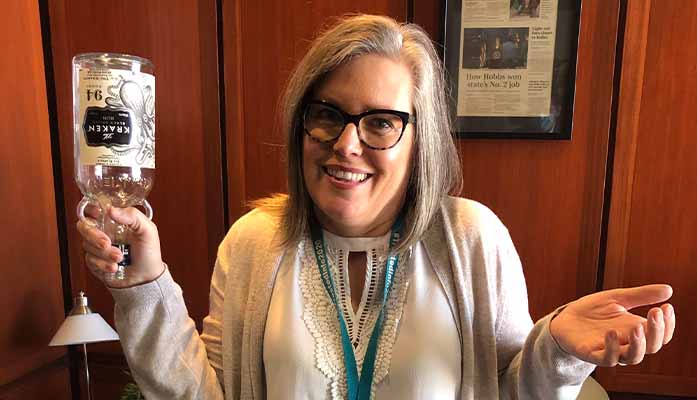
Governor Katie Hobbs targeted the ESA Program during her State of the State address in January. Hobbs’ criticisms prompted a rebuttal from Horne; he said the governor was ignorant to the administration of the program.
In his explanation of the new ESA Program Handbook earlier this month, Horne dismissed one major opposing claim: that the program needs to reimburse parents without question of the expenses.
Horne said the ADE’s oversight of expenditures successfully prevented abusive charges, such as a $5,000 Rolex watch and a $24,000 golf simulator.
“[These are] abuse of things that are not really for the educational benefit of the child. It’s obvious there has to be some limitations,” said Horne.
Unlike his predecessor, Horne has repeatedly stepped up to defend the ESA Program.
“Parents should have the choice to be sure their child is in a school that meets the needs of that child,” said Horne. “The ESAs are really not really a challenge to the public schools; they supplement them and make sure that all students are in an environment where needs are being met.”
AZ Free News is your #1 source for Arizona news and politics. You can send us news tips using this link.
Arizona Governor Katie Hobbs and the Radical Left have made it clear that they want to dismantle school choice in our state. Despite getting trounced in November’s election where teachers’ unions and other anti-school choice groups made it a referendum on educational freedom, Hobbs has doubled down on her same tired and out-of-touch efforts since the start of this year.
Once again, it hasn’t worked. Arizona’s Empowerment Scholarship Account (ESA) program continues to grow—with enrollment now over 87,000 students. So, Hobbs and her buddies in the teachers’ unions have resorted to employing one of their favorite tricks: relying on activist reporters in the corporate media to give their anti-school choice messaging an extra boost.
In early March, a coordinated attack was launched against Primavera, an online charter school serving thousands of K-12 students across the state. It began with a story from Craig Harris, a Red4ED activist that calls himself a reporter, who claimed that Primavera received a ‘D’ letter grade from the Arizona Department of Education for the past three years. According to the report, the school failed to meet the minimum academic requirements for a traditional charter school. Harris’ column then went on to complain about the owner of Primavera and how much money he has made while operating the school.
After the story was published, the Arizona Charter School Board convened a hearing to review the allegations against Primavera. In a span of just a few hours, the board imposed the most severe punishment at their disposal, revoking the schools’ charter and setting them up for eventual closure. In effect, Primavera was given the charter school death penalty after one meeting.
On the surface, this might make sense. After all, if a school is failing its students, it deserves proper accountability. But as so often happens with today’s corporate media, an important fact was omitted from this manufactured takedown…
Phoenix Mayor Kate Gallego attacked Arizona’s school choice programming in an attempt to sway Governor Katie Hobbs against an Arizona Diamondbacks funding bill.
In a letter submitted to Hobbs on Tuesday, Gallego expressed opposition over the bill to fund the Arizona Diamondbacks facility renovation, HB2704. The legislation dedicates Chase Field sales and employee income taxes to the renovation.
HB2704 has passed the House with bipartisan support and awaits Senate approval.
Gallego argued the legislation was a “boondoggle” for failing to accurately capture the fiscal impact. Gallego said the Joint Legislative Budget Committee (JLBC) model underestimated the predicted cost to taxpayers derived from the city’s actual tax collection data by nearly half, equating the underestimation to the Empowerment Scholarship Account (ESA) Program.
“Just like the state’s Empowerment Scholarship Account Program or the infamous Alt-Fuels bill, there is not a high-end cap on this bill to act as a safeguard for taxpayers,” said Gallego. “I urge that you work with the Legislature to demand responsible and enforceable parameters for the amount of taxpayer dollars spent on an annual and aggregate basis.”
The JLBC model estimated a $471 million cost over 30 years, sans fiscal impact data input from the Department of Revenue. Per Gallego, the city of Phoenix estimated an $825 million cost over 30 years.
“After accounting for lost construction sales tax revenue, additional revenues that can follow a significant renovation to a major league sports facility, and inflation over 30 years, the bill in its current form will certainly cost more than $1 billion in public funds,” said Gallego.
Last month, Gallego also spoke out against HB2704 publicly. Gallego expressed opposition to the diversion of millions of funds that would have gone to the city otherwise.
“Two-thirds of Phoenix’s general fund supports public safety. Phoenix’s tax dollars are best spent supporting our firefighters who respond to emergencies, helping police fight crime, and combating homelessness — not used to pay for subsidies for those at the very top,” said Gallego.
Recently ousted Arizona State Board of Education (ASBE) member and ESA Program advocate Jenny Clark advised Gallego to dedicate her efforts to improving the city’s budget rather than criticizing the budgeting of another program.
“Maybe Mayor Gallego should focus on her own MASSIVE failures with the city of Phoenix budget, instead of taking cheap shots at Arizona families using the widely popular ESA program,” said Clark.
Clark questioned why Gallego’s critique of increased funding for school choice, given the mayor attended an out-of-state private school in her youth.
The city of Phoenix narrowly avoided a reported $39 million budget deficit by the 2026 fiscal year by passing on the cost to taxpayers. The city previously announced an $85 million annual loss following the state legislature’s elimination of the residential rental tax and the implementation of the flat income tax.
On Tuesday, Gallego and the Phoenix City Council voted to increase the sales tax rate from 2.3 percent to 2.8 percent to avoid making cuts to city programs and services. The increase takes effect on July 1. Only Councilman Jim Waring voted against the sales tax increase.
The Goldwater Institute sued the city over the proposed tax increase earlier this month.
In a letter submitted to Gallego and the council, the public policy institute alleged this latest tax increase to be unconstitutional.
The Goldwater Institute also sued the city last year over allegedly illegal tax breaks for developers.
AZ Free News is your #1 source for Arizona news and politics. You can send us news tips using this link.
A majority of the Arizona State Board of Education (ASBE) members are serving on expired terms. Governor Katie Hobbs’ office has yet to replace them, but now she’s targeting one member in particular with an historically strong advocacy for school choice.
Board members serve a four-year term under gubernatorial appointment with State Senate consent.
Six of the 11 members on the board are serving on expired terms. The board also has one vacancy, making it six of 10 existing members to be serving on expired terms.
The terms for Jason Catanese and Vice President Dr. Scott Hagerman expired last January. The terms for President Katherine Haley, Jenny Clark, Dr. Daniel Corr, and Julia Meyerson expired last month.
It appears that Clark and her expired term came on Hobbs’ radar with the signing of the Phoenix Declaration: An American Vision for Education from the conservative think tank, Heritage Foundation, last week during its Conservative Vision of Education Conference in Phoenix. The declaration advocates for school choice, curriculum transparency, ideology-free classrooms, Western and Judeo-Christian education, character-based learning models, merit-based academic standards, and a greater emphasis on civics education.
10 educational and public interest groups, along with over 50 scholars and education policy experts, signed onto the declaration. Clark signed on with the organization she founded, Love Your School.
Following this development, Hobbs’ office called on Clark to resign last Wednesday. When Clark refused, Hobbs’ staff allegedly advised of a letter to arrive last Friday confirming Clark’s term ending. Clark claimed she had received no such letter as of Monday.
“Honestly, I’m surprised @GovernorHobbs didn’t remove me when she took office (which was fully within her abilities as Governor). Clearly, the 9th floor has been struggling the last couple of years!” said Clark. “I’ve enjoyed advocating for all students (including Arizona ESA families) while on the board, and I know the current board has a significant task ahead with the absolute CRISIS in math and reading AZ public schools are facing with the latest NAEP scores. I look forward to seeing the timely, aggressive, and student-centered approach they will take regarding this crisis.”
On Wednesday I received a call from @GovernorHobbs office asking me to submit a resignation from the Arizona State Board of Education since my term was up in Jan. Knowing several other board members are still serving in expired terms, I declined. I was called back and told a…
One of Hobbs’ main campaign promises was to eradicate the universality of the school choice program implemented by her predecessor, Republican Doug Ducey, in 2022.
Over the course of her two-year-long fight with the Republican-controlled legislature, Hobbs scaled back her original goal of undoing the universality of the state’s school choice model.
This year, Hobbs is vying for a budget proposal slashing funds to the states Empowerment Scholarship Accounts (ESA) Program. Hobbs proposed graduated income limits, with a restriction to household incomes at or above $200,000.
House Speaker Steve Montenegro indicated in statements to the press that this budget was a nonstarter for Republicans.
“While we share a commitment to improving the lives of Arizonans, the Governor’s budget proposal as presented raises concerns about parental choice, fiscal responsibility, public safety, economic growth, and the undue burdens it places on the backs of taxpayers,” said Montenegro.
Nearly 86,500 students have entered the ESA Program as of Monday.
AZ Free News is your #1 source for Arizona news and politics. You can send us news tips using this link.
In a recent report, the Common Sense Institute of Arizona (CSI) addressed the gradual slowing of enrollment in Arizona’s Empowerment Scholarship Account (ESA) program and traditional public school classrooms. The report shows that despite narratives for one or the other, the decline in both can be explained quite directly as a matter of demographics and parental choice.
In a press release issued Monday, CSI explained, “Headlines about declining enrollment and the subsequent financial struggles this creates in Arizona’s public schools have caught the state’s attention. However, CSI’s data shows this shift was inevitable, driven by dramatic demographic changes and a shift in enrollment preferences during the pandemic.”
Among CSI’s findings, it found that the school-age population of Arizona peaked in 2021 and is projected to decrease by 40,000 by 2028, heavily impacting an educational system which was structurally predicated on the assumption of a continually growing population.
CSI added, “The 2012 kindergarten cohort—the state’s largest ever—is now preparing to graduate. Future K-12 enrollment is not expected to grow in the foreseeable future.”
Arizona’s Public School Enrollment Decline: No Surprise
CSI research shows Arizona’s K-12 demographic shift has been years in the making: 📉 School-aged population peaked in 2021 🎓 The largest kindergarten class (2012) is now preparing to graduate 👶 By 2028, the school-aged… pic.twitter.com/u5rbGnVLFp
— Common Sense Institute Arizona (@CSInstituteAZ) January 28, 2025
CSI observed further that during the COVID-19 lockdowns, Arizona’s public schools lost 50,000 enrolled students from 2020-2021. Only 18,000 of those students re-enrolled in charter schools with the remaining approximate 32,000 otherwise unaccounted for. It is likely that this number presents a combination of expanded home schooling, relocation out of Arizona, and even enrollment in private schools. Indeed, the report indicates that private school enrollment spiked by 33% over that period with homeschooling experiencing a surge from 2% of the total student population to 11%, and settling back to 6% as of today.
Glenn Farley, CSI Arizona’s Director of Policy and Research summarized, “Arizona’s classrooms are entering a new era. The numbers have been clear for years: the system built for growth has reached its peak. Moving forward, policymakers must adapt to a smaller, more diverse student population and rethink how we allocate resources.”
Arizona’s Public School Enrollment Decline is No Surprise According to the Common Sense Institute Arizona–
— Common Sense Institute Arizona (@CSInstituteAZ) January 28, 2025
The CSI report noted the effect on budgetary considerations has been extreme. “Declining public school enrollments since 2020 reduced public K-12 funding formula costs by an estimated $450 million/year, and growing, compared to pre-pandemic trends. Since last year, the universal ESA program has returned these ‘missing kids’ to the public K-12 rolls – reinvesting prior ‘savings’ into education.”
The ESA, a subject of controversy in the state legislature, has reached a “steady state” according to CSI, with the recent period of rapid growth unlikely to be repeated and future increases owing almost exclusively to parental and student choice.
CSI concluded, “Demographic changes likely mean fewer school-aged children and lower overall enrollment across Arizona’s publicly funded K-12 options over the next ten years. And ultimately it is this demographic change, and pandemic-era changes in parental behavior that are changing K-12 in Arizona – and not-so-much universal ESA itself.”
As previously reported by AZ Free News, Governor Katie Hobbs’ repeated attacks on ESAs have centered primarily on the narrative of the program alternately being “rife with waste, fraud and abuse,” being costly to the state budget, and calling for a repeal of the popular program.