by Kevin Gemeroy | Nov 16, 2022 | Opinion
By Kevin Gemeroy |
I was born and raised in Seattle, Washington. I went to high school, and college, and started my business there. We were the fourth generation of our family to live in West Seattle where we founded and operated local businesses. Over the last 80 years, my family has founded four companies, employed hundreds of people, and created opportunities for many others to grow and succeed.
On August 5, 2020, we made the gut-wrenching decision to leave. That was the day that Washington’s Governor, Jay Inslee, proclaimed that it was “unsafe” for children to attend school in the state, extending our school closures indefinitely. Our school reopening guidelines were the among the strictest in the nation, and even most private schools (including our son’s) remained closed until further notice. Our boys were three and six at the time, and we expected another lockdown through the winter would do far more damage to our collective mental and physical health than COVID ever would.
Shortly after Governor Inslee’s press conference ended, we started packing. A few days later, we put 14 suitcases and duffle bags on an airplane and headed out to spend a year in the Sonoran Desert. As our son started in Scottsdale Public Schools, the battle between the districts, unions, and Governor Ducey were in full swing. After yet another week of “iPad school,” we began frantically looking for a private school that would guarantee an in-person education to our first grader.
We found an opening at a nearby for-profit private school and enrolled our boys on the spot. Within a few weeks, we heard from our older son’s teachers that he wasn’t learning normally. Initially, we dismissed their concerns, assuming they were caused by the impacts of Seattle’s hard lockdown and our extended school closures.
They gently pressed, and we agreed to seek a reading evaluation through a local clinic. The results were all over the place, so we were referred to a local neuropsychologist. Our son underwent two days of intensive testing which finally led us to the answer: he is gifted, has mixed dyslexia, and an ADHD (inattentive type) diagnosis would likely follow after he turned seven.
The number one recommendation was that our son would need to be in a private school long-term. The neuropsychologist described the challenges involved in getting an Individualized Education Program (IEP) and 504 plan, especially with a twice-exceptional child, where the giftedness often hides the disability. Our son would need small class sizes and individualized attention, as he would likely struggle in a public school classroom.
Our for-profit private school bent over backwards to accommodate his needs. They allowed him to continue to attend school through his eight-week, half-day intensive dyslexia treatment program so he could maintain the relationships in his class and participate in Spanish, PE, and STEM. His teacher taught his classmates about learning differences, so they’d approach our son with acceptance and curiosity instead of judgment. They approved his providers’ recommended accommodations without hesitation. They welcomed, loved, and supported our child, regardless of his learning differences.
One year later, our son is reading a grade level above his age thanks in part to the three weekly sessions with a reading specialist provided by his school. Three months into third grade, he no longer needs specialized support and is able to operate independently in an accelerated classroom environment.
Our journey was a privileged one. We had school choice, albeit across state lines. We had access to top private clinics and specialists. We used a combination of health insurance, HSA funds, and savings to cover the over $50,000 cost to remediate our son’s dyslexia and provide him with a private school education that met his unique needs. Very few families can afford this on their own.
Washington State has the exact education system that the teachers’ unions advocate for: strong and well-funded public schools. Seattle spends over $23,000 per child per year on school and teachers make around $100,000 on average. Every bond measure placed on the ballot gets approved overwhelmingly.
But choices are strictly limited – well-funded public school or very-expensive private school. Teachers’ unions have unfettered power to lobby the politicians for whatever they want. In response, over 30 percent of parents have pulled their kids out of Seattle Public Schools in neighborhoods where their families can afford to in just the past three years.
My family came to Arizona because of school choice. We stayed because our kids’ needs were met here. We’ve seen a union-first school system firsthand, and COVID revealed its shortcomings. In Arizona, we are leading the nation in building a child-first system, founded on universal ESAs.
As we hear Governor-Elect Katie Hobbs repeat her union supporters’ lines about Arizona’s school system and her criticism of the ESA program, please remember my family’s story of how a great Arizona private school and our school choice programs changed our son’s life and story for the better.
Every family should be able to choose the school that meets their kids’ unique needs, just like we did.
Kevin Gemeroy was recognized as Washington State’s Mr. Future Business Leader in 1998 and as a Puget Sound Business Journal’s 40 under 40 honoree in 2018. He and his wife reside in Scottsdale during the school year with their two twice-exceptional boys. You can follow Kevin on Twitter here.
by Corinne Murdock | Oct 28, 2022 | Education, News
By Corinne Murdock |
Parents attempting to call the Arizona Department of Education (ADE) helpline for the school choice program are met with an automated voice that rejects their call due to “excessive call volume” and promptly hangs up.
No indication of wait times, and no promise of a call back.
It’s just another day of Empowerment Scholarship Account (ESA) Program administration under ADE Superintendent Kathy Hoffman, who hasn’t exactly been shy about her disdain for school choice programs. Hoffman proclaims loudly and often that the ESA Program lacks accountability and remains dysfunctional, even well over three years into her administration.
AZ Free News asked ADE about the ESA Program helpline. They didn’t respond by press time.
Christine Accurso, one of the ESA parents on the frontlines advocating for universal school choice, criticized the ADE for taking in an additional $2.2 million to hire 26 new workers this summer, yet still can’t manage the universal school choice program.
Last month on her reelection campaign trail, Hoffman insisted that universal school choice doesn’t help children with unique learning needs. She declared that it was a “taxpayer-funded coupon for the wealthy.” She then advocated for voters to sign an initiative to refer universal school choice to the 2024 ballot.
Hoffman has fought consistently to eradicate the ESA Program.
Corinne Murdock is a reporter for AZ Free News. Follow her latest on Twitter, or email tips to corinne@azfreenews.com.
by Terri Jo Neff | Oct 1, 2022 | Education, News
By Terri Jo Neff |
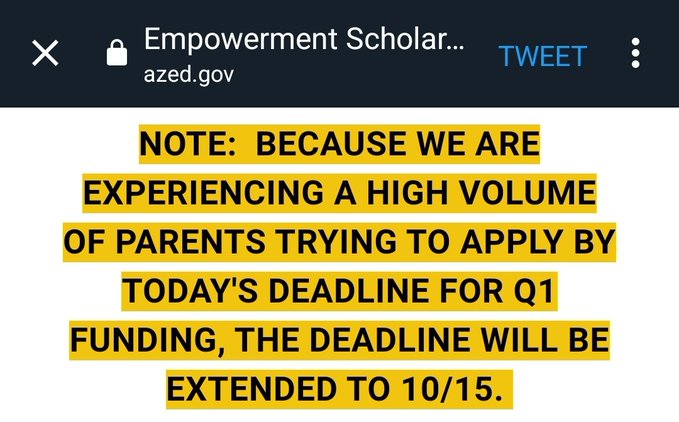
So many parents were trying to apply for Arizona’s expanded Empowerment Scholarship Accounts (ESAs) by Friday’s first quarter deadline that the department of education’s website was overwhelmed, leading to a decision to extend the application period.
“Because we are experiencing a high volume of parents trying to apply by today’s deadline for Q1 funding, @azedschools is extending the deadline to remain eligible for retroactive Q1 funding to 10/15/22,” the department announced midday Friday.
Gov. Doug Ducey helped spread word of the extension while commenting on the tremendous popularity of the new law which now makes all 1.1 million of Arizona’s K-12 students eligible to apply for an ESA which provides about $7,000 per student, per year to assist families in tailoring a student’s education experience to best meet their needs.
The funds can be used for a variety of purposes, including private school tuition, homeschooling expenses, educational therapies, tutoring, and other expenses in exchange for not attending a public school or receiving a tuition tax credit.
More than 12,000 applications have been received by the Arizona Department of Education since the governor signed ESA expansion legislation in June. That outpaces the number of students who were utilizing the ESA program under the old law.
The new expanded eligibility was to take effect Sept. 24 with a Sept. 30 deadline to qualify for first quarter funding. The rush by families to apply this week was bolstered by publicity involving a political action committee’s failed referendum effort to waylay the ESA expansion until voters could decide in 2024 whether it should go into effect or not.
Arizona Secretary of State Katie Hobbs put the law on hold Sept. 23 based on claims by Save Our Schools Arizona that more than 141,000 referendum petition signatures had been submitted to Hobbs’ office. Of those, at least 118,823 signatures needed to be validated to keep the ESA expansion sidelined.
But in a letter dated Thursday, Hobbs’ staff officially confirmed what has been known for days – that the referendum effort failed to come anywhere close to the constitutional minimum number of signatures.
One parent said Friday’s announcement by Hobbs’ office ensures parents are now “rightly in control of their children’s future.”
Christine Accurso of Gilbert is among pro-ESA parents who questioned whether the glaringly insufficient referendum filing was simply a calculated ploy by anti-school choice politicians to freeze funding for children right in the midst of the school year.
“As a longtime ESA parent, I could not be more thrilled to see thousands of new parents benefiting from this program,” Accurso said. “It is my hope that the rest of the country can follow our lead and bring this legislation to their state, so that we can one day see all American children in the school of their parent’s choice.”
Save Our Schools Arizona issued a statement Friday putting the blame for the group’s referendum effort failure on the governor, who is one of ESA’s staunchest supporters.
“We are confident we would have succeeded had Governor Ducey not waited 10 days to sign the bill, robbing Arizona voters of crucial time to sign the petition,” according to the statement.
The group even criticized pro-ESA organizations like the Goldwater Institute for using “sophisticated software” to review the petitions, resulting in Monday’s revelation that Save Our Schools Arizona submitted only about 90,000 signatures.
For school choice advocates like Accurso, the important fact is that the ESA expansion is now in effect. The priority now is to ensure families that still want to apply become aware of the extended Oct. 15 deadline.
by Michele Hamer | Sep 30, 2022 | Opinion
By Michele Hamer |
If you’re confused about the Arizona Empowerment Scholarship Account (ESA) program expansion to all Arizona K-12 students, you’re not alone. The recent passing of HB 2853, gives parents and guardians who opt out of the public-school option, a portion of taxpayer funds to use for tutoring, private school tuition, home schooling, and special-needs therapies. Much of the confusion comes from advocates for and against this expansion by complicating the issue with opposing scenarios.
I believe both sides of the debate must begin under the auspices of Arizona law. Specifically, the Parents’ Bill of Rights, which states: “All parental rights are reserved to a parent of a minor child without obstruction or interference from this state, including the right to direct the education, upbringing, moral or religious training and make all health care decisions for their minor child.”
Opponents to Arizona’s ESA program expansion, like Save Our Schools and teachers’ unions, who have tried and failed to get enough signatures to stop HB 2853, feel parents are unqualified and can’t be trusted with these taxpayer funds to direct the education of their children. The Democrats of Greater Tucson take that mistrust of parents to a heinous level in a recent post. They write “With no accountability protocols, this creates an opportunity for extremist-xenophobic-homophobic-white nationalist-MAGA groups to develop their own little Hitler Youth Academies to indoctrinate impressionable minors.” The four false cheering points of the anti-ESA crowd can be easily debunked with facts:
- ESAs don’t siphon funds away from public schools: The inconvenient truth as explained by the Goldwater Institute is the “ESA program now gives back nearly $1,000 per child to the public school system each time a student switches to an ESA from a public school. This is because ESA students forfeit their funding from several pots of state taxpayer funded money (such as the ‘Classroom Site Fund’ and ‘Prop 123’ add-on revenues) when they leave their district or charter school, and all of that money gets redistributed back to the public school system instead. (For instance, for the 2022-2023 school year alone, the Classroom Site Fund raised $945 million dollars, with every one of Arizona’s 1.1 million public school students getting almost $900 each from it. ESA students, on the other hand, completely give up their claim to those dollars and instead send them back to their public-school peers, who end up with more money per pupil than they had before.” Read more here.
- ESAs do have monetary accountability and transparency: According to the Arizona Department of Education’s 2022/2023 ESA Handbook, when an Account Holder enters into an ESA contract with the Department, the Account Holder is required to report all expenses made with ESA funds. To maintain ESA program eligibility, debit card receipts must be submitted in the quarter that the transaction occurred. Complete invoices or receipts must be included when submitting expenses or making payments in the “Class Wallet” platform. All required credentials must be included when submitting debit card receipts or reimbursements.
- Parents can’t spend the ESA money on anything they want: The Arizona Department of Education’s 2022/2023 ESA Handbook is quite clear on their “Spending and Program Requirements” in Chapter 2. There are twenty-one out of seventy pages in this handbook explaining what is approved and unapproved spending. For instance, if your child needs a computer for online classes, you would think that is an approved expenditure, but it’s not.
- ESAs have academic accountability and transparency: I find the teachers’ union claim to the contrary laughable after the Arizona Department of Education’s recent release of the state’s assessment data. Overall, only 41% of students passed the English component, and a mere 33% passed the math portion. Where is the accountability for this disaster?
The biggest inconvenient truth is that home-schooled and private school students outperform public school students on state standardized tests and college entrance exams. As the number of homeschooled children in the United States grows, the statistics of student outcome cannot be ignored. According to Think Impact, homeschooled students score between 80% and 90% regardless of their parents’ level of education. On average, homeschooling one child costs the parent(s) between $700 and $1,800.
Business Wire, a Berkshire Hathaway company, reports a Back to School Survey shows 47% of parents are considering dropping school and going to homeschooling. Results from the EdChoice survey in 2020 showed that the top reasons parents had considered homeschooling before the COVID-19 shut down included freedom in exploring their child’s interests; safety concerns about schools; schools did not meet the needs of the children; and parents wanted to mold their children as per their own practices and beliefs.
Private schools have a long history of superior academic outcomes to public schools according to the National Center of Educational Assessment, but here’s another inconvenient truth the opponents of school choice via ESAs aren’t telling you; private schools deliver better family life outcomes than students who attend public schools. (See Figure 1)
Our education system has become a bloated, bureaucratic mess that is desperately trying to hang on to power over our children that is not legally theirs to have. Schools have one job, and that is to give our children a great academic education and they are failing. Compared to other nations, the United States fell to 24th in high school literacy in 2012 and continues to decline.
Parents, guardians, and concerned citizens are on the front lines, exposing the inconvenient truths regarding problems in our schools. We need to give them our support. I don’t believe the teachers’ unions, Save Our Schools, and their media cohorts are going to give up after their first defeat to stop ESA expansion.
Please contact your state representatives and tell them to uphold Arizona law which gives our parents the right to direct the education of their children.
Michele Hamer is a candidate for the Prescott Unified School District Governing Board. You can find out more about her campaign here.
by AZ Free Enterprise Club | Sep 28, 2022 | Opinion
By the Arizona Free Enterprise Club |
What’s the difference between 141,714 and 88,866? Take a few seconds to do the math, and feel free to use a calculator if you’d like.
If you answered 52,848, you’re correct! Congratulations and give yourself a pat on the back because your math skills are far superior to those of Save Our Schools (SOS) and the rest of Arizona’s teachers’ unions.
On Friday, SOS Executive Director Beth Lewis boldly proclaimed—with all the confidence in the world—that the wall of boxes she was standing in front of contained the signatures of 141,714 Arizona voters who supported a ballot initiative aimed at overturning universal Empowerment Scholarship Accounts (ESA) in Arizona. She was giddy. Her supporters cheered. SOS declared blocking universal school choice for all a “historic victory.” And corporate media jumped on the opportunity to push their narrative, accepting everything SOS said at face value.
But there was a problem. And that’s where simple math comes into play…
>>> CONTINUE READING >>>