By Jason Bedrick & Matthew Ladner |
For months, we have documented the pattern of errors, distortions, and outright fabrications that characterize the coverage of Arizona’s Empowerment Scholarship Account program by Channel 12’s political reporter Craig Harris. Each new episode—the fabricated 20% fraud claim, the defiance in the face of correction by the Arizona Department of Education itself, the constant shifting of goalposts as each of his claims is debunked—seemed like it might result in Channel 12 taking appropriate corrective action.
But they never did.
Last week, at the Arizona Legislature’s final stretch of its 2026 session, the mask came off entirely.
While lawmakers debated a series of consequential ESA-related bills and resolutions on Thursday and Friday—including a constitutional amendment to protect military family scholarships—Harris was captured on camera doing something that no journalist who takes the job title seriously can explain away: coordinating, via text message, with members of Save Our Schools Arizona, the anti-school-choice advocacy group that is a principal sponsor of the Protect Education Now ballot initiative, about where they should position themselves inside the Capitol building for maximum political impact.
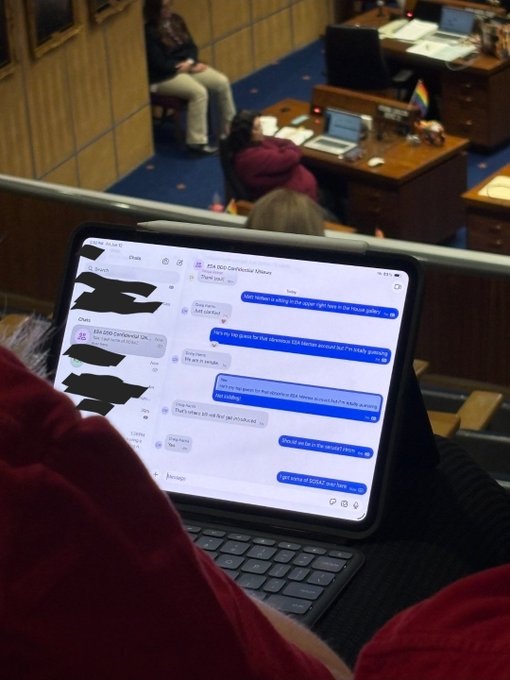
Let that sink in. A reporter on the education beat, covering legislation in real time, was not observing the advocacy groups in the building. He was directing them.
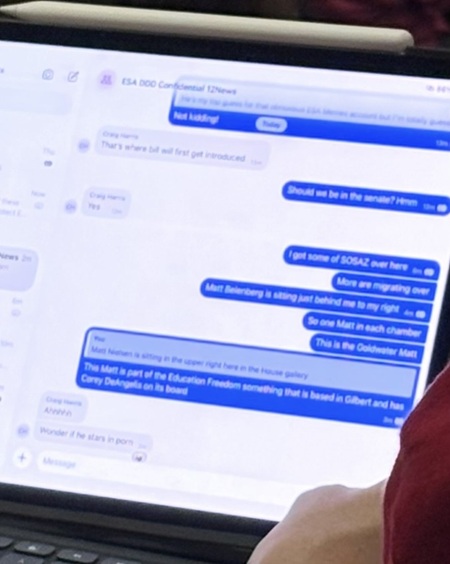
The text exchange was visible on the screen of a Save Our Schools activist—readable thanks to a conspicuously large font and no privacy screen—and was flagged by our Heritage Foundation colleague Corey DeAngelis, who shared images of the messages on social media after receiving them from a local activist. Harris subsequently confirmed on X that the images of the group chat, named “ESA DDD Confidential 12News,” were real.
After Harris told the activist that he was in the state senate chamber as that is “where [the] bill will first get introduced,” Save Our Schools board member Kathy Boltz asked Harris for advice regarding where their team of activists should place themselves in the capitol building. “Should we be in the senate? Hmm,” she asked. Within a minute, Harris answered in the affirmative.
This is not ambiguous. This is not a misunderstanding. This is a journalist using his knowledge of the Arizona Legislature’s political process to provide tactical advice to an advocacy group that has a direct political stake in the legislation he is supposed to be covering neutrally.
Harris was no longer covering the news. He was helping to manufacture it.
But that wasn’t the worst of it.
The same captured text conversation revealed Harris mocking a local school choice supporter, asking whether the individual “stars in porn.”
This derision was not just a lapse in professionalism. This was contempt—contempt for the families, advocates, and ordinary citizens who show up at the Capitol to make the case for educational freedom, expressed in a private conversation with advocates on the other side of the issue.
Multiple Arizona politicos were quick to call out the behavior publicly. State Senator Jake Hoffman called for Channel 12 to fire Harris and called on the station to “open an investigation into every story he was involved in and retract any instance of undisclosed coordination.” Hoffman observed that this coordination with activists is “precisely the kind of unethical behavior that has caused the majority of Americans to deeply distrust the media.”
Arizona Republic columnist and former State Senator Paul Boyer called it “a really bad look” for Channel 12 to have their reporter, “who is also reporting on these same groups” to be discovered “coordinating with them at the legislature to defeat the same type of legislation he’s myopically focused on.” Similarly, J.P. Twist, executive director of Citizens for Free Enterprise, called out Harris for “literally strategizing with a partisan union to undermine parents’ rights.”
The parent company of Channel 12 publishes a “Principles of Ethical Journalism” statement committing its journalists to the values of truth, independence, public interest, fair play, and integrity. It’s hard to see how coordinating with one group of political activists and crudely mocking the other side comports with those standards.
Sadly, Harris’s breach of journalistic ethics does not end there.
Later that night, in a hearing on legislation to protect military family scholarships, Harris took to social media to characterize two of the three supporting witnesses who testified as people “making money off ESAs,” implying their support was financially motivated rather than principled.
One of those witnesses was Kevin Biesty, spokesperson for the Arizona Christian Education Coalition. As Biesty detailed on X, he reached out to Harris privately and asked him to correct or remove the post. Harris declined. As Biesty observed, the logic Harris applied to him — that representing clients who are affected by ESA policy makes one a financially conflicted advocate — is never applied to the other side. The staff and lobbyists of Save Our Schools Arizona and the teachers unions, who are paid to oppose the ESA program, are never characterized by Harris as people “making money off” the issue.
Harris also claimed that no military family spoke at the hearing. That too was false. Biesty had personally presented a written statement from a military mother who could not remain for the late-night session, and referenced letters from other military families — all of this while Harris was in the room. At no point did Harris ask Biesty for that mother’s contact information or seek to include her perspective in his coverage. He was, however, apparently attentive enough to the gallery to communicate with his Save Our Schools contact — the same ESA mother and SOS board member who, Biesty observed, is never identified as such in Harris’s stories — while sitting at the press desk on the floor.
Indeed, when ESA students and their families share their stories, Harris is quick to dismiss them. Recently, a young ESA student with disabilities named Jordan Visser shared on video about the ways the Protect Education Now initiative would harm students like himself. Harris went on social media to dispute his account, claiming that the initiative would not affect students with special needs—effectively accusing a student with disabilities of lying about the impact of a ballot measure on his own situation.
He was wrong. As the student’s mother, Kathy Visser, and others documented, the text of the initiative itself bore out what the student had said—the ESA funds that the family had saved to continue providing him with services would be seized by the state if the Save Our Schools ballot initiative were adopted.
The irony of Harris’s posture—aggressively checking the credibility of a disabled student while coordinating inside the Capitol with the very advocacy group sponsoring the initiative in question—encapsulates the problem. It is not that Harris is a journalist who occasionally makes mistakes. It is that the mistakes run in one direction, consistently, and that when corrected, he doubles down rather than acknowledging any error. And it is now documented, on camera, that he was coordinating tactics with one side of the debate he was purportedly covering.
Arizona families with children in the ESA program deserve better than a reporter who coordinates with the opposition at the very hearings he is assigned to cover. Arizona viewers deserve better than a news organization that has allowed this pattern to continue unchecked. And the thousands of children—including those with disabilities—who rely on these scholarships deserve a press corps willing to represent their stories honestly.
Channel 12 has not issued a correction or a retraction of the false fraud statistics. It has not yet acknowledged Harris’s coordination with activists or the mockery of a school choice supporter.
Channel 12’s parent company should answer a simple question: Is the behavior documented at the Capitol last week consistent with its Principles of Ethical Journalism? If not, what will it do about it?
Jason Bedrick is a Senior Research Fellow and Matthew Ladner is a Senior Advisor for education policy implementation at The Heritage Foundation’s Center for Education Policy.