by Matthew Holloway | Nov 24, 2025 | News
By Matthew Holloway |
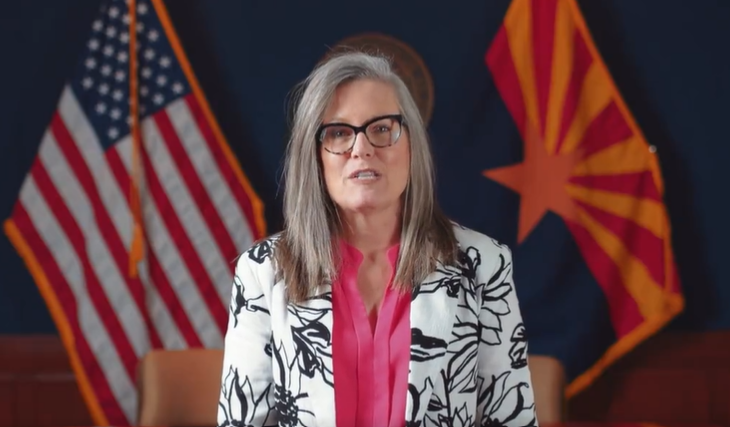
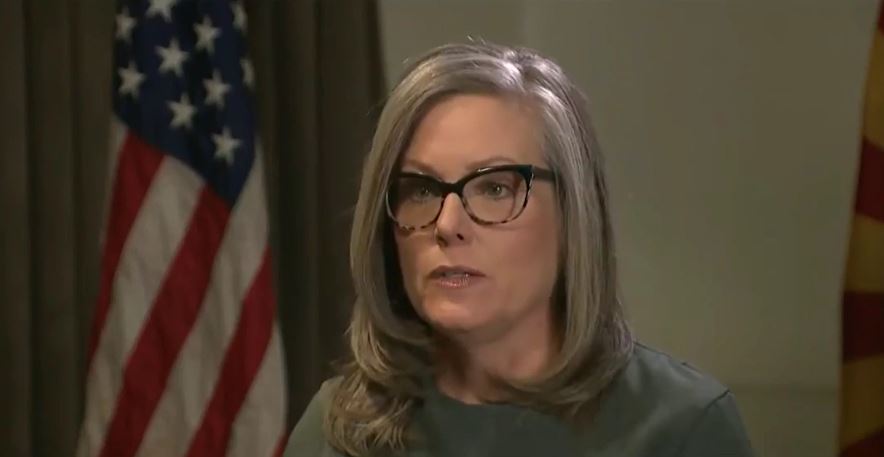
Congressman Andy Biggs has called out Arizona Gov. Katie Hobbs for “blatant hypocrisy” after she publicly pitched the benefits of the federal Working Families Tax Cut, a policy she previously denounced as a “betrayal.”
In a statement released Thursday, Biggs said Hobbs is “shamelessly” attempting to attach herself to a Republican-driven tax package that she vocally opposed earlier this year.
“After calling the Working Families Tax Cut a ‘betrayal,’ Katie Hobbs now shamelessly wants to take credit for the tax cuts passed by President Trump and Congressional Republicans,” Biggs said. The congressman provided links to her July comments to Fox10 in which the Governor stated:
“This bill is a betrayal of working families, children, and seniors in Arizona who will lose their healthcare, their ability to put food on the table, and good-paying jobs, all to give tax cuts to the people who are already billionaires while ballooning our national debt by $3.4 trillion.”
Biggs argued that despite Hobbs’ prior opposition, Republicans “successfully delivered tax relief to working-class Arizonans and seniors who are being hurt by the rising energy costs of Hobbs’ progressive, green energy agenda.”
On X, Biggs highlighted Hobbs’ recent promotion of her own “Middle Class Tax Cuts Package,” which includes bigger deductions, tax relief for seniors, and exemptions on taxes for tips, overtime, and new car loan interest.
Hobbs, who recently launched her 2026 reelection bid, has highlighted the tax cut in campaign messaging and controversially billed her events as “Arizona First” rallies, as noted by Capitol Media. Biggs asserted that the move reflects political weakness within her own party.
“Even her fellow Democrats are calling her ‘weak’ because they know the truth just like Arizonans do: Katie Hobbs has failed our state, and now she’s trying to cover it up by taking credit for Republican victories,” he said citing an op-ed from AZ Mirror.
The Working Families Tax Cut, a component of the “One Big Beautiful Bill” championed by President Donald Trump, Biggs, and other House Republicans, expanded credits for lower- and middle-income households and included relief provisions for seniors. Hobbs criticized the measure during negotiations, calling it fiscally irresponsible and siding with Democrats who argued it favored Republican priorities.
Matthew Holloway is a senior reporter for AZ Free News. Follow him on X for his latest stories, or email tips to Matthew@azfreenews.com.
by Jonathan Eberle | Nov 23, 2025 | News
By Jonathan Eberle |
A new dispute erupted at the Arizona State Capitol on Thursday after Senator J.D. Mesnard (R-LD13), chair of the Senate Committee on Finance, accused Governor Katie Hobbs of misleading the public with an executive order tied to federal tax changes enacted earlier this year.
In a press release, Mesnard said Hobbs’ order directing the Arizona Department of Revenue to update state tax forms “blatantly misleads the public” by implying that her administration was delivering new tax relief. According to Mesnard, the changes she referenced were already established under H.R. 1, a federal tax reform package advanced by former President Donald Trump and congressional Republicans.
Hobbs’ order, he argued, does not create any new state-level reductions. “Middle-class families deserve honesty, not last-minute attempts to steal credit for others’ hard work,” Mesnard said, asserting that Hobbs was attempting to claim political ownership of reforms she opposed. He noted that Democrats in Congress uniformly voted against the federal tax package and that—despite the governor’s framing—the adjustments she cited are already federal law.
Mesnard also criticized the order on procedural grounds, calling it inappropriate for a governor to “direct” the Department of Revenue’s handling of state tax policy. He said such authority rests with the Legislature.
The senator added that Republicans plan to advance legislation next session to formally align Arizona’s tax code with the federal reforms and expand on them where possible. But he warned that Hobbs’ order could create “uncertainty and chaos” for taxpayers in the meantime.
Jonathan Eberle is a reporter for AZ Free News. You can send him news tips using this link.
by Matthew Holloway | Nov 19, 2025 | News
By Matthew Holloway |
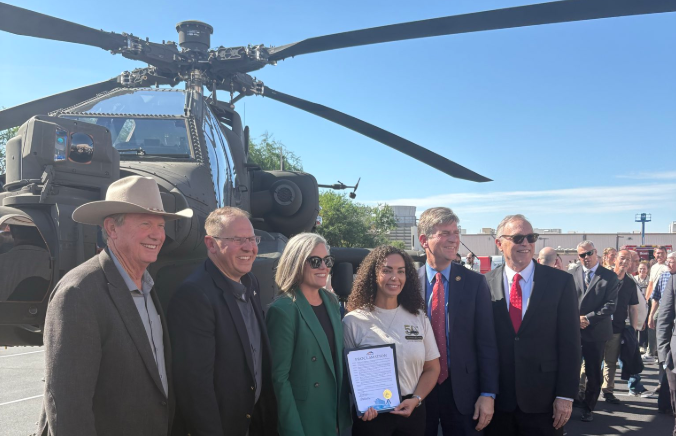
Arizona political figures gathered under the canopy of two Apache helicopters on display Thursday at Boeing’s manufacturing complex in northeast Mesa, near Falcon Field Airport. The event commemorated the 50th anniversary of the attack helicopter’s first flight, which occurred on September 30, 1975.
It drew current and former Boeing employees in matching beige t-shirts emblazoned with the Apache hovering and key statistics on the back—an homage to what Boeing employees and leaders described as the “best damn attack helicopter in the world,” according to Cronkite News.
In a statement issued by the Arizona Senate Republican Caucus, Senate Majority Whip Frank Carroll marked the anniversary by praising the program and its workforce.
“It’s an honor to stand with the dedicated Arizonans and military personnel who have helped make the Apache a global symbol of excellence,” Carroll remarked. “For 50 years, this aircraft has protected American lives and advanced our national security, and I’m proud to support the men and women who ensure it remains the best in the world.”
Arizona Gov. Katie Hobbs addressed the gathering as well, saying: “The fact that there are so many elected officials here from both sides of the aisle demonstrates our commitment to the future of the Apache program here in Arizona.”
Among the public figures present were Congressmen Greg Stanton (D-AZ-04) and Andy Biggs (R-AZ-05), as well as Mesa Mayor Mark Freeman. Stanton told the gathered crowd, “The Apache didn’t just fly, it soared and it took Mesa with it. The city is a hub for aerospace and defense manufacturing, anchored by great companies like Boeing,” per Chamber Business News.
Boeing Attack Helicopter Programs Vice President and Mesa Site Executive Christina Upah reported that nearly 3,000 Apache aircraft have been produced in Mesa, with more than 1,300 in operation around the world. Over the past five years, Hobbs noted, more than 60 expansions in Arizona’s aerospace and defense sector have generated more than $2.8 billion in investment and more than 12,000 jobs.
US Army Lt. Col. John Holcomb, commander at the Defense Contract Management Agency (DCMA) Vertical Lift Mesa, who manages production of the Apache alongside the AH-6i Light Attack and Reconnaissance Helicopter, and the MD-530 Cayuse Warrior helicopter, said: “Looking around this facility, I’m reminded that while the name on the buildings may have changed, the mission has remained constant. To deliver the best damn attack helicopter in the world.”
While the event was celebratory, it came against a backdrop of broader pressures facing Arizona’s aerospace and manufacturing sectors—and renewed bipartisan interest in preserving the state’s five-decade role in Apache production. The helicopter’s global impact also loomed large, with its widespread adoption by the U.S. Army and by 16 allied nations, including the U.K., Israel, Japan, and South Korea, per KJZZ.
During the event, Stanton even threw a proverbial nod to Biggs, quipping: “We don’t always agree, Andy, but on this one, we’re together,” citing the Congressmen’s past cooperation on legislation to support Apache production.
Matthew Holloway is a senior reporter for AZ Free News. Follow him on X for his latest stories, or email tips to Matthew@azfreenews.com.
by Jonathan Eberle | Nov 18, 2025 | News
By Jonathan Eberle |
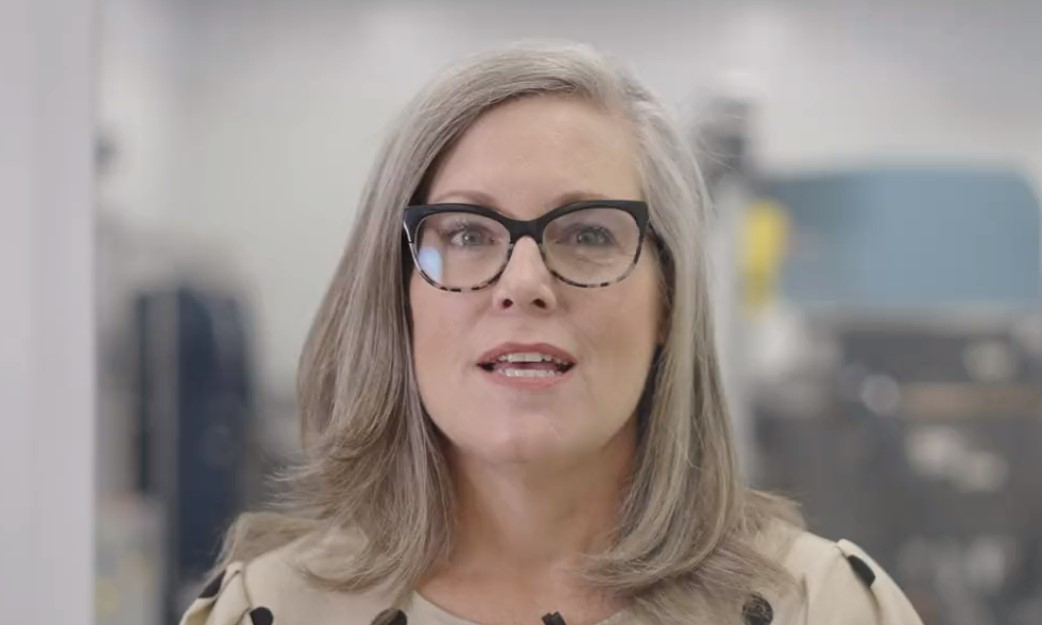
Arizona House Speaker Steve Montenegro has formed a new advisory team to investigate allegations that Governor Katie Hobbs’ administration awarded a lucrative contract increase to a politically connected group home provider, raising fresh questions about influence and accountability inside the Department of Child Safety (DCS).
The move follows reporting by The Arizona Republic that Sunshine Residential Homes received a 30% rate increase after contributing more than $400,000 to Hobbs and Democratic political committees. According to documents cited in the reporting, other group home providers seeking similar adjustments were denied. Internal communications reportedly show DCS staff discussing the provider’s political connections to the governor and suggesting the increase be kept quiet from competing organizations.
The revelations come as DCS faces a budget shortfall and has been under pressure to reduce reliance on group home placements, making the agency’s decision to grant a significant rate hike particularly notable. Speaker Montenegro said the advisory team will conduct a legislative investigation to assemble facts, coordinate with law-enforcement agencies, and evaluate possible actions the House may take to prevent preferential treatment in state contracting.
“The facts reported raise serious questions the House cannot ignore,” Montenegro said in a statement. “Arizona’s children, families, and taxpayers deserve a system that is clean, fair, and focused on care, not political access or donations.”
The speaker also directed state agencies and contractors to preserve all relevant records and to cooperate fully with the Legislature. The advisory panel includes several senior lawmakers including Rep. Selina Bliss, Chair of the House Health and Human Services Committee; Rep. David Livingston, Chair of House Appropriations; Rep. Matt Gress, Chair of the Joint Legislative Audit Committee; Rep. Quang Nguyen, Chair of House Judiciary; and Speaker Pro Tempore Neal Carter.
The investigation builds on earlier legislative efforts to probe the relationship between Sunshine Residential Homes and the Hobbs administration. In 2024, Rep. Matt Gress requested investigations by the Maricopa County Attorney and the Auditor General following the first reports linking the provider to political contributions and favorable treatment. Rep. David Livingston separately urged Attorney General Kris Mayes to recuse herself, citing concerns about conflicts of interest involving the governor and the Democratic Party.
The House advisory team is expected to begin its work immediately and will coordinate with any parallel investigations by the Auditor General, the Maricopa County Attorney’s Office, or the Attorney General. Montenegro said lawmakers will “secure the records, ask the hard questions, and, if necessary, change the law to ensure it never happens again.”
Jonathan Eberle is a reporter for AZ Free News. You can send him news tips using this link.
by Jonathan Eberle | Nov 17, 2025 | News
By Jonathan Eberle |
Newly surfaced documents and internal communications are raising new questions about political influence inside the Arizona Department of Child Safety (DCS), prompting calls for accountability from legislative leaders. Senate President Pro Tempore T.J. Shope is urging state and county prosecutors to provide an immediate update on whether investigations into the matter remain active.
The controversy centers on Sunshine Residential Homes, a group home provider that recently received a 30% rate increase from DCS. The company has been a significant donor to Governor Katie Hobbs and multiple Democratic political groups—connections that agency employees reportedly flagged as a source of concern.
According to internal messages and financial records reviewed by lawmakers, DCS staff expressed discomfort with the approval process for the rate hike. Employees referenced Sunshine Residential’s political ties to the Governor and suggested the situation placed agency leaders in an “uncomfortable position,” particularly after the provider allegedly pressured the state by threatening to shift services to the federal system unless the increase was approved.
Despite warnings that the higher rate would deepen an already-projected $13 million budget shortfall, DCS moved forward with the decision. Documents also show Sunshine Residential cited a substantial financial deficit to justify its request. However, financial records reportedly indicate the provider had $440,000 in operating income—figures that independent accounting experts said appeared inconsistent with the claimed shortfall.
These discrepancies have intensified questions about whether political considerations influenced decisions affecting vulnerable children in state care. In a letter sent Thursday to Attorney General Kris Mayes and Maricopa County Attorney Rachel Mitchell, Shope requested confirmation that any investigations into the potential “pay-to-play” conduct are ongoing. He also asked prosecutors to update the Legislature on the status of their reviews.
“These revelations are deeply disturbing,” Shope said. “If a provider donating hundreds of thousands of dollars to the Governor then pressures the state for a massive rate increase—and receives it—Arizonans deserve to know whether political influence played a role.”
Shope emphasized that the issue extends beyond partisan lines. “This is not a partisan issue—it’s a public trust issue,” he said. “If political donations influenced decisions inside DCS, especially decisions involving vulnerable children, that is unacceptable. We intend to get to the bottom of this.”
Jonathan Eberle is a reporter for AZ Free News. You can send him news tips using this link.