by Staff Reporter | Jan 24, 2026 | News
By Staff Reporter |
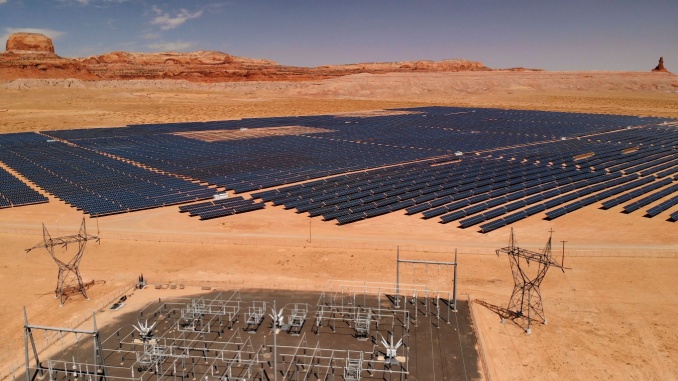
The Arizona State Land Department (ASLD) may be prioritizing the construction of solar panels over new home construction.
The agency maintains a unique map for “best” locations to put solar — but they don’t maintain similar maps for ideal locations for other industries, like housing, mining, and grazing for agriculture.
ASLD’s Land Parcel Viewer has a unique dataset for mapping existing and ideal spots for solar, complete with ratings: 0.0 to 0.9 for the best in green, all the way to 5.0 to 10.0 for the worst in red.
The map shows where parcels are for mineral and oil and gas, and whether those are unleased or permitted; the locations of rights of way and their perpetuity; and where grazing allotments exist. However, it does not offer any compatibility measure for the available land for each industry.
These industries would require knowledge to include resources, depth, size, and proximity to development for mining; animal unit month (the forage amount required for one animal per month), slope, and grass type and quality for grazing; soil conditions, water supply, and slope for agriculture; and path of development and slope for housing.
Spencer Kamps, vice president of the Home Builders Association of Central Arizona, said in a statement that the unique treatment of mapping land by ASLD may give the solar industry an unfair competitive edge in arguing for priority land use.
“In the absence of a similar map for other industries, some might say the solar map is serving functionally as a ‘presumptive highest and best use map,’ which gives solar a ‘rebuttable presumption’ of highest and best use in each parcel indicated in green,” said Kamps.
Last September, Gov. Katie Hobbs issued an executive order directing ASLD to outline proposals to streamline and expedite energy infrastructure projects on state land, as well as accelerate those energy-related projects already underway.
ASLD should have delivered the requested report last October.
The governor’s order also established a task force to come up with a strategic plan to “cut red tape related to the lease, sale, or other use of state lands in a way that advances the streamlined deployment of necessary generation and transmission projects.
That plan is part of three reports due by March 1 of this year. That task force, announced last November, includes ASLD Commissioner Robyn Sahid.
The two other reports include a policy framework for large energy users — data centers — to balance state interests in expansion with ratepayer costs, and an energy strategy plan to capitalize on technologies such as geothermal and advanced nuclear power.
Hobbs also directed her Office of Resiliency to use State Energy Program funding to fund one full-time staffer for ASLD to complete work on energy infrastructure projects.
ASLD doesn’t just have criticisms coming from the industries that sustained the state economy long before solar came on the scene. The state legislature believes the agency is in need of serious reform.
The House and Senate Joint Legislative Committee convened earlier this week to discuss ASLD’s scheduled sunset later this year.
In a significant departure from the standard renewal period of eight years for a state agency, the committee instead opted for a four-year continuation with conditions attached.
Official recommendations from the committee attributed their decision to “deep, longstanding issues” within the agency, describing its operations as an opaque, “unaccountable ‘black box’” per a press release issued on Wednesday.
Several of the committee recommendations outlined in the press release concerned solar leases and sales.
The committee advised the agency open additional investigations into intentionally vacant land, commissioner-initiated sales with only one bidder, solar leases and sales with only one bidder, reclamation of lands after solar leases, vacant land located within municipalities, vacant land location within five miles of urban areas, and vacant land located within 10 miles of urban areas.
Rep. Gail Griffin, committee co-chair, said in that press release the agency’s longstanding issues have worsened under Gov. Hobbs’ administration.
“Licensing timeframes, five-year disposition plans, and written policies and procedures are essential to upholding the best interests of the trust. These were the top issues,” said Griffin. “The Commissioner acknowledged these issues during her confirmation hearing and committed to fixing them, but they haven’t been fixed. The captain isn’t steering the ship.”
AZ Free News is your #1 source for Arizona news and politics. You can send us news tips using this link.
by Staff Reporter | Jan 22, 2026 | News
By Staff Reporter |
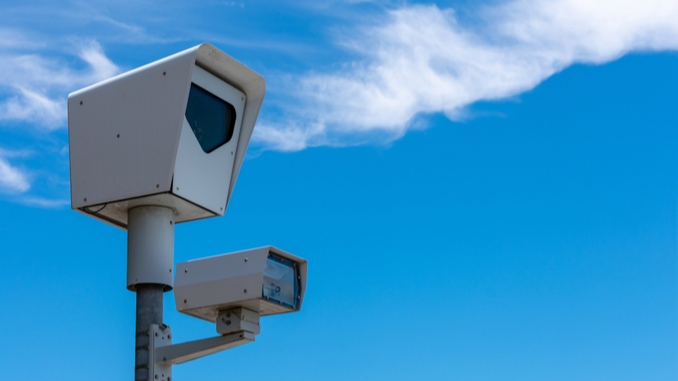
Voters may soon get to decide whether or not photo radar will continue to be used in the state.
A committee in the State Senate approved the bill on Tuesday.
SCR 1004 would ban photo enforcement systems used to identify violators of speed restrictions or traffic control devices from the entire state.
If approved by the state legislature, the measure could appear on the ballot as early as this November. Lawmakers opted for a resolution as a more viable pathway to bypass the requirement for Governor Katie Hobbs’ approval.
The governor didn’t support attempts to ban photo radar in the past.
Last year, the governor vetoed the same legislative language (outlined in a bill rather than a resolution) after its party-line approval in the legislature. No Democrats in either the House or Senate voted for the bill. Hobbs’ veto letter argued that the removal of photo radar would make the roads more dangerous, not safer.
“This bill attempts to remove the ability of local law enforcement to keep our streets safe by eliminating a tool used to enhance roadway safety,” stated Hobbs.
This sentiment was shared by Democratic lawmakers. State Sen. Lauren Kuby argued that certain studies supported the effectiveness of photo enforcement systems to reduce and deter traffic violations.
During voting on the bill last year, some Republicans — Reps. Teresa Martinez, Justin Wilmeth, Alexander Kolodin — did express doubts about the strategy of advancing a bill with SB 1019 rather than a resolution. An identical measure existed in SCR 1002.
Wilmeth said they were “wasting” their time by voting on the bill version of the legislation rather than the resolution.
“I want my Republican caucus members to understand: this bill will pass, and it will get vetoed,” said Wilmeth. “This is what majorities are about, and in this issue we are wasting our opportunity.”
Kolodin said Democrats were defending photo radar under false pretenses of public safety concerns, and that their true intentions had to do with ticket revenues’ ties to clean election campaign funds.
“The photo radar scam is the way that our friends across the aisle fund their war machine. They run candidates in noncompetitive districts and funnel taxpayer money over to competitive districts, all on the backs of hardworking Arizona drivers who are denied due process when they receive their traffic tickets,” said Kolodin. “It’s almost as if we’re more interested in making a show of solving the problem than actually solving the problem.”
State Sen. Wendy Rogers authored both pieces of legislation last year and was the lawmaker to reintroduce it again this year.
Rogers disputed Hobbs’ veto claim in a press release published on Tuesday. The state senator stressed the unreliability of automated enforcement, which is what photo radars operate under. Rogers said it should be law enforcement, not technology, to make the judgment call on violations of traffic law.
“Automated enforcement removes discretion, undermines due process, and turns routine driving into a revenue stream,” said Senator Rogers. “That’s not how law enforcement should work in Arizona. The resolution does not excuse dangerous driving or eliminate traffic enforcement. It ensures that enforcement decisions are made by trained law enforcement officers, not algorithms and contractors.”
AZ Free News is your #1 source for Arizona news and politics. You can send us news tips using this link.
by AZ Free Enterprise Club | Jan 21, 2026 | Opinion
By the Arizona Free Enterprise Club |
At a time when Arizonans are still struggling to recover from years of Biden-era inflation, Republican lawmakers acted swiftly to deliver on their Affordable Arizona agenda. On just the fourth day of the legislative session, they passed SB1106, a tax conformity package that delivered the full benefits of the One Big Beautiful Bill (OBBB) to Arizona taxpayers, families, and businesses. The legislation provided $1.1 billion in tax relief and, just as importantly, immediate certainty for millions of Arizonans heading into tax season.
The very next day, Governor Katie Hobbs vetoed it.
That veto leaves taxpayers facing a potential $1.1 billion tax hike and widespread chaos as filing season begins. This isn’t simply the typical tax policy fight between Democrat and Republican ideologies. But a full display of Katie Hobbs’ failure to lead.
From the outset, she has mishandled this critical issue of federal tax conformity with conflicting messages, unauthorized executive actions, and zero coordination with the Legislature or even apparently her own agencies. The result has been a self-inflicted mess, and Arizona taxpayers will be the ones to suffer the price.
>>> CONTINUE READING >>>
by Staff Reporter | Jan 21, 2026 | Education, News
By Staff Reporter |
Governor Katie Hobbs claimed the state’s school choice program lacks oversight.
The Arizona Department of Education (ADE) and experts dispute Hobbs’ claim.
The governor targeted the Empowerment Scholarship Account (ESA) Program during her state of the state speech last week. Hobbs advocated for the school choice program to be rolled back from universalization to its previous form that only accepted certain families with disability or military backgrounds.
“While other government entitlements have strict requirements and oversight, the ESA program continues to operate unchecked, squandering taxpayer dollars with no accountability,” said Hobbs. “It seems like every day, we learn about new shopping sprees happening at the expense of taxpayers…diamond jewelry, high-end clothing and furniture…who knows what taxpayers will be footing the bill for tomorrow?”
ADE publishes notice of its internal audits and has attempted to refer cases over to the attorney general’s office for prosecution — though Attorney General Kris Mayes has reportedly been unwilling to pursue prosecution of alleged fraud or abuse.
ADE bases its claims on existing requirements within the ESA Program: documenting all purchases made, and freezing accounts that make unauthorized expenditures. Parents must repay the program for unauthorized purchases.
In August, ADE reported it marked over $600,000 for collections “due to possible fraud or misuse.”
That’s less than one-tenth of one percent of total ESA spending, as noted by the Heritage Foundation in a report last August.
Comparatively, the estimated total fraud within average federal government obligations ranges from three to seven percent, according to a 2024 report by the Government Accountability Office.
Other examples of improper payment rates within government programs in Arizona have been issued recently. (The latest data aligns with the 2024 fiscal year in most cases).
The Department of Labor announced an estimated seven percent improper payment rate from July 2021 to July 2024.
For the 2024 fiscal year, the USDA reported that Arizona had a payment error rate of nearly nine percent.
The federal government even factors in improper payment rates to mitigate losses.
The Center for Medicaid projected an improper payment rate of over six percent for Arizona in 2024.
This indicates that fraud is an inevitable occurrence within any government program.
Unlike the reporting efforts of ADE regarding the ESA Program, the Arizona Auditor General presently finds that nearly 30 school districts are noncompliant based on financially related internal control deficiencies.
This slate of presently noncompliant districts represents over $1 billion in state spending. The entire ESA program spent under $900 million in the 2025 fiscal year and costs about $1 billion for the 2026 fiscal year.
Arizona school districts have accumulated nearly $8 billion in cash reserves, per the Heritage Foundation’s assessment of Arizona Superintendent Tom Horne’s annual report covering the 2023-2024 fiscal year.
Horne responded to Hobbs’ state of the state address with criticism over the governor’s open opposition to a program supported by a majority of voters. Arizona voters approved universalization of school choice back in 2022.
“Arizona parents have made it clear they believe in being able to choose the best education for their children, whether districts, charters or Empowerment Scholarship Accounts,” said Horne. “By their loud display today, Democrats proved they want to take that power away from mothers and fathers who know their children’s needs best and return education to a government monopoly that parents do not want.”
AZ Free News is your #1 source for Arizona news and politics. You can send us news tips using this link.
by Matthew Holloway | Jan 18, 2026 | News
By Matthew Holloway |
Gov. Katie Hobbs has vetoed Republican-backed tax conformity legislation approved Thursday by the Arizona Legislature.
The bill, SB 1106, would have provided $1.1 billion in tax relief over three years while maintaining a balanced state budget.
The legislation would have aligned Arizona’s tax code with recent federal changes and included provisions eliminating state income tax on tips and overtime pay, increasing the standard deduction, expanding the child tax credit, creating a deduction for childcare expenses, and providing additional tax relief for seniors.
Hobbs vetoed the bill without releasing a formal veto message as of the time of publication.
In response, House Speaker Steve Montenegro (R-LD29) issued a statement criticizing the governor’s decision and warning of potential impacts on taxpayers as the filing season approaches.
“Governor Hobbs’ veto of our tax relief act is a failure of leadership that will create unnecessary confusion and disruption for millions of Arizona taxpayers,” Montenegro said in a statement released Thursday.
Montenegro said House and Senate Republicans passed the legislation early to provide clarity and certainty for families, seniors, small businesses, employers, and tax preparers. He added that the bill conformed Arizona law to federal tax changes and removed provisions the governor had previously opposed.
“The Governor admitted swift action was needed. She asked for a bill to be sent quickly. We did exactly that,” Montenegro said. “What she did not do was offer a plan of her own. No bill. No alternative. No solution.”
Montenegro also listed several provisions included in the legislation that were rejected through the veto, including increases to the standard deduction, a childcare expense deduction, an expanded child tax credit, elimination of state taxes on tips and overtime, and additional tax relief for seniors.
Montenegro said the veto would lead to confusion for taxpayers, adding, “The chaos ahead is not accidental. It is the direct result of Governor Hobbs’ decision to veto a responsible tax conformity bill with no replacement plan.”
The veto also prompted reaction from other Republican lawmakers. State Rep. Nick Kupper (R-LD25) criticized the decision in a post on X. Kupper wrote, “Of course @GovernorHobbs vetoed the tax cuts we sent her because she doesn’t give a crap about working families. If she can’t give more handouts to non-working people then she won’t like whatever we send her.”
Arizona Congressman and 2026 gubernatorial candidate Andy Biggs, said, “Katie Hobbs vetoed a $1.1 BILLION tax cut for Arizona seniors, families, and workers. She is a weak and ineffective governor keeping Arizona from its full potential. She has no vision for the state. She has no ability to lead.”
Republicans do not hold the votes necessary to override the governor’s veto, leaving tax conformity unresolved unless lawmakers and the governor reach an agreement later in the legislative session.
Matthew Holloway is a senior reporter for AZ Free News. Follow him on X for his latest stories, or email tips to Matthew@azfreenews.com.