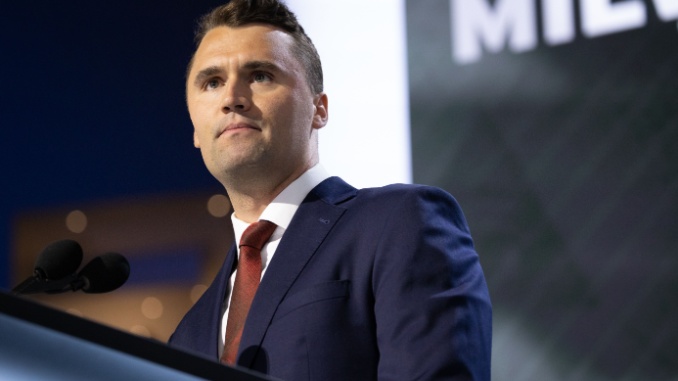
Charlie Kirk, a conservative activist leader and co-founder of Turning Point USA and Turning Point Action, was silenced by an assassin’s bullet at Utah Valley University (UVU) on Wednesday.
As Kirk took questions in his well-known debate format, seated beneath a tent as part of The American Comeback Tour, a single loud shot rang out across the open air.
Kirk was addressing a question on the recent string of mass shootings involving transgender Americans in what would be his last public exchange.
“Do you know how many transgender Americans have been mass shooters over the last 10 years?” Kirk was asked.
“Too many,” Kirk replied.
The individual answered that there were five.
“Do you know how many mass shooters there have been in America over the last 10 years?” Kirk was then asked.
He responded, “Counting or not counting gang violence?”
Within a fraction of a second, Kirk was shot and seen reacting immediately as it struck the left side of his neck. He bled profusely and slumped to the ground.
Kirk was rapidly airlifted from the scene to an area hospital where he was pronounced dead a little over two hours later.
A person of interest was arrested shortly after the shooting at the university but was later released. However, at 3:31 p.m. MDT, FBI Director Kash Patel announced the arrest of a second subject, who was also subsequently released after questioning. The assassin is still at large as of this report.
Turning Point USA is based in Arizona and has been a major force in state and local politics as well as on the national scale since Kirk moved the organization’s headquarters from Chicago to Phoenix in 2018.
Arizona officials from both sides of the aisle issued statements following the assassination of Kirk. Arizona House Speaker Steve Montenegro stated, “God bless American hero Charlie Kirk and his family. His horrific assassination today is a devastating tragedy that strikes at the heart of our nation. Charlie was a fearless voice who inspired millions with his faith, his devotion to freedom, and his conviction to defend America’s founding principles.”
Montenegro added, “This was political terrorism. Violence aimed at silencing any voices must be confronted and dealt with justly and without hesitation. Charlie is now with his Heavenly Father, but his legacy will endure in the movement he built, the young people he awakened, and the truth he spoke without apology.”
Congressman Andy Biggs issued a statement on X, saying, “Erika and Charlie’s young children are in my family’s prayers as I know the Lord will cover them in love. Cindy and I ask everyone to continue praying and sending strength to the Kirk family. We have tragically lost a tremendous leader and a friend. But his most important role was as a loving husband, father, and devout Christian who shared his faith unapologetically. Charlie Kirk was an inspiration to an entire generation and will be remembered as someone who changed the course of our country.”
Erika and Charlie's young children are in my family's prayers as I know the Lord will cover them in love. Cindy and I ask everyone to continue praying and sending strength to the Kirk family.
We have tragically lost a tremendous leader and a friend. But his most important role… https://t.co/5FOonkQvXL
In a post to X, Arizona Senate President Warren Petersen responded to Kirk’s assassination, saying, “I am absolutely shocked, sickened, and outraged to hear about the passing of Charlie Kirk. Today was a dark day where evil was on full display. He was singular, indispensable, and irreplaceable. America will not be the same without him.”
The top-ranking Democrats in Arizona, Governor Katie Hobbs and Attorney General Kris Mayes, condemned “the violent attack” and “the horrific act of violence against Charlie Kirk,” respectively.
Congressman Abe Hamadeh (R-AZ08) wrote in a statement:
“Charlie Kirk was a force to be reckoned with. He was a Happy Warrior for the conservative cause.
He was martyred doing what he did best – talking to young people and sharing ideas. That is what is supposed to happen on our college campuses, and throughout our country: sharing diverse opinions and entertaining others’ points of view in the pursuit of a brighter future.
We will not let a lone gunman snuff out the bright fire Charlie lit in the hearts of young patriots who share the America First agenda and make up the Make America Great Again Movement, nor will we stop our efforts to bridge the political divide through conversation.
We will carry on what he started and build on his lasting legacy of inspiring the next generation of American leaders.
I urge everyone to join me in praying for the soul of this faithful patriot, his beautiful family, and our country.”
If Katie Hobbs is thinking about what to do after her time as Governor is up, one option would be to test her skills in the Hide and Seek World Championships. After all, she proved during the 2022 gubernatorial election campaign that it’s what she’s best at.
After dodging any request to debate her opponent Kari Lake during her campaign, Hobbs also ducked reporters who dared to question her about it. She even hid in a restaurant bathroom after another reporter asked her why she didn’t like discussing politics.
All this hiding should have resulted in a simple decision. According to long-standing Arizona Citizens Clean Elections Commission (AZCCEC) rules, an opponent (in this case Kari Lake) should have been provided with airtime when a candidate (in this case Katie Hobbs) refused to debate. And the AZCCEC planned to do just that. But hours before Kari Lake’s interview was scheduled to take place, the AZCCEC learned that Arizona PBS went behind their back to schedule an exclusive interview with Katie Hobbs—moving them to postpone Lake’s interview.
If you think all this reeks of collusion, you’re right. And now, a public records request has made it clear. Katie Hobbs wasn’t playing hide and seek alone. She was purposefully aided by leadership at Arizona State University (ASU) and at PBS…
The legacy media seem to be on a mission: tear down Arizona’s groundbreaking school choice program with false accusations and inaccurate reporting.
Fortunately, facts don’t lie, even if the media does.
The Arizona Capitol Times declared this week in astonishing terms, “Education department under fire for approving $124M in improper ESA [education savings account] purchases.”
Such astronomical levels of fraud would seem to threaten the very foundations of the historic school choice revolution that has swept the nation. There was just one problem, the headline was completely false.
Not only were the supposed dollar amounts exaggerated up to 100 times greater than the amounts of improper spending actually reported by the department, but these purchases weren’t even approved in the first place.
Here’s the story the media won’t tell: Arizona’s 2022 adoption of a fully universal ESA program has been a nation-leading success, allowing parents across the state to give their children an education best suited to their needs.
To its credit, the Times quickly retracted its original headline and issued a formal correction admitting “an inaccurate dollar amount” in its first draft and eliminating the suggestion that the purchases were “approved.” Unfortunately, such journalistic ethics appear not to be shared by the Times’ more ideological media counterparts in Arizona, particularly those of the teachers’ union-aligned 12News team, who have resolutely declined to correct or retract their false reporting.
12News’ Craig Harris, for instance, has repeatedly and falsely declared that the state has “approved” ESA purchases for iPhones, televisions, and other non-educational items over the past year.
But all those purchases haven’t been approved, as the State Board of Education’s ESA Handbook—ratified by members appointed by both former Gov. Doug Ducey and Gov. Katie Hobbs—makes clear. The document expressly states that while families’ ESA purchases under $2,000 are promptly reimbursed by the state, these items “are not deemed ‘approved’ by the Department, until they are audited OR the timeframe to audit the orders has passed [2 fiscal years].” Just like their tax returns filed with the IRS, these families’ ESA purchases are processed up front and subject to enforcement afterwards.
Yet, 12News either knowingly misrepresented the status of these orders or else incompetently failed to perform basic due diligence to learn how the program operates.
By 12News’ anti-ESA logic, the IRS should apparently also withhold refunds to taxpayers until their tax returns have been audited potentially years later, rather than promptly when the returns are filed.
Unfortunately, this is not the first time that 12News’ anti-school choice reporters have been exposed in such light. In 2018, Harris (then with the Arizona Republic) falsely reported that Arizona charter schools produced worse student graduation rates and worse outcomes on the state A-F letter grade system than district schools. Both claims turned out to have been fabricated results stemming from a faulty, agenda-driven data analysis by Harris’ team.
In 2024, 12News’ Joe Dana likewise doubled down on false claims that ESAs cost state taxpayers more than the public school system per student by conveniently ignoring major sources of public school funding. The state’s Classroom Site Fund, for example, allocates over $1,000 for every public school student in the state and gives not a penny to ESA families.
Undeterred by journalistic standards, Dana’s 12News team also went further, deceptively extracting a fragment of a statement given by the state’s budget director (given in response to a completely different question) to suggest the ESA program had created unprecedented strain on the state budget.
The Heritage Foundation’s Matt Ladner and Jason Bedrick have already exposed a litany of deceptive claims flowing from outlets like 12News, while more prestigious national news organizations like The Washington Post have seen their recent anti-ESA narratives similarly debunked. Yet none of these outlets have expressed any contrition for their deceptive coverage.
Indeed, in perhaps the richest of ironies, Harris’ 12News team recently attacked ESAs for “hurting” high-performing schools like Arizona charter network BASIS by competing with it for students. Never mind that Harris previously attacked BASIS for its alleged poor stewardship of taxpayer funds. Now that it is clear he and the media were on the wrong side of that school choice debate as well, they have simply shifted to a new enemy in their war on parents.
Looking at the whole of Arizona’s education landscape, there is no question that those who seek to defraud the state—whether via the traditional public school system or its competitors—should be prosecuted to the full extent of the law. But if there is a scandal in our education system, it is the dishonest reporting by journalists who are more disturbed by parental empowerment than by the tens of billions of dollars squandered year after year in chronically poor performing public schools.
Matt Beienburg is the Director of Education Policy at the Goldwater Institute.
While Arizona is still wrangling with the aftermath of major wildfires in the North, Governor Katie Hobbs headed to Nantucket, Massachusetts, to wine and dine out-of-state Democrat super-donors paying up to $5,500 a plate to meddle in the politics of the Grand Canyon State. The fundraising event was reportedly led by a former Ambassador whose nomination was nearly scuttled by allegations of antisemitism.
MSNBC Contributor Teddy Schleifer shared an invitation to the event in a post to X.
According to the post, the event was organized by a “host committee in formation,” which included prolific Democrat fundraiser Elizabeth Bagley, former Ambassador to Brazil under President Joe Biden and former Ambassador to Portugal under President Bill Clinton.
Bagley’s Senate confirmation was stalled in 2022 in the Senate Foreign Relations Committee on grounds of antisemitism allegations after the Washington Free Beacon found a 1998 interview in which she complained about “the influence of the Jewish lobby because there is major money involved.” She added, “The Democrats always tend to go with the Jewish constituency on Israel and say stupid things, like moving the capital to Jerusalem always comes up.” She claimed support for these Israel-related issues is due to “the Jewish factor, it’s money.”
Both Democrats and Republicans in Congress at the time were highly critical of Bagley for her remarks, to which she responded, “I regret that you would think that it was a problem. I certainly didn’t mean anything by it. It was a poor choice of words, but it was something that the interviewer had asked me, prompted by something about politics.”
Given Hobbs’ recent controversy involving the Jewish community and her veto of the Antisemitism in Education Act, which dealt with educators “promoting antisemitism or forcing students to support antisemitic viewpoints,” it is striking that Hobbs would participate in a fundraiser involving such a figure.
Controversy has once again embroiled Arizona State University (ASU), threatening the credibility of the institution, Arizona PBS, and the Walter Cronkite School of Journalism. Emails uncovered by the Arizona Republic reveal that ASU President Michael Crow, former Arizona Republic publisher Mi-Ai Parrish, and other officials allegedly favored Democratic gubernatorial candidate Katie Hobbs over Republican Kari Lake during the 2022 Arizona gubernatorial election.
Lake has accused them of “collud[ing] to prevent me from having a debate forum.”
Reporting from the Arizona Republic’s Stacey Barchenger earlier this month exposed internal discussions among ASU leadership that appeared to prioritize Hobbs while sidelining Lake. The emails, obtained through public records requests, show that Parrish emailed Arizona PBS leaders, writing, “We may have issues,” after discussions with PBS Senior Director of Content, Ebonye Delaney. They expressed concerns about equal time laws and the risk to ASU’s relationship with the Arizona Citizens Clean Elections Commission.
Crow emailed Parrish, stating, “Whatever the format there remains the fact that it is our venue and brand. We need structure…and format…….and….people who believe in elections as participants.” He later instructed his chief of staff, James O’Brien, and Parrish to “make sure you are both on the same page here,” prompting Parrish to ask, “What outcome are you seeking?”
ASU offered Hobbs a solo interview on Arizona PBS, a move that severed the university’s long-standing partnership with the voter-approved Clean Elections Commission. This decision was influenced by Crow’s reported disagreement with Lake’s views on election integrity and his labeling her an “election denier.”
Barchenger’s report, citing expert opinions, stated “That ASU leaders would consider one candidate’s views, and then reach down and influence television programming, called into question Arizona PBS’ independence as a news organization and its autonomy from university influence, experts said.”
“And it could have risked legal repercussions for Arizona’s largest university, they added.”
The Arizona Republic’s Robert Anglen shared the findings on X, writing, “Newly released emails detail how ASU’s top leaders sought to muzzle Kari Lake in 2022 for her election-denial views and give preferential treatment to Katie Hobbs on Arizona PBS during the governor’s race.”
INVESTIGATION: Newly released emails detail how ASU’s top leaders sought to muzzle Kari Lake in 2022 for her election denial views and give preferential treatment to Katie Hobbs on Arizona PBS during governor’s race. Story by @sbarchenger via @azcentralhttps://t.co/z9LW98WURQ
Lake rejected Arizona PBS’s offer of a 30-minute solo interview, insisting on a joint debate with Hobbs. She told reporters at the time, “If she doesn’t appear with me, they should kick her out. If Democrats don’t have to sit on the debate stage with the Republicans, if they can just stomp their feet and demand a safe space … then we’ll never have a debate system again.” Lake instead participated in a Clean Elections-sponsored interview on another station and vowed to avoid PBS-related events.
In a statement responding to the exposé, Lake said: “Taxpayer-funded Michael Crow and taxpayer-funded ASU, along with taxpayer-funded PBS, colluded to prevent me from having a debate forum for fear I would talk about election fraud, and because their chosen candidate Katie Hobbs would’ve been destroyed in a debate with me. They interfered in the 2022 Arizona Gubernatorial election and trampled on my First Amendment rights. Their actions were not just unethical; they were likely illegal, too.”
ASU spokesman Jay Thorne defended the university’s actions, however, stating, “The shared objective of ASU and Arizona PBS after the gubernatorial debate was cancelled was to provide a forum for the voters of Arizona to hear from the two candidates for Governor in an interview format. It was an opportunity provided under identical conditions to each candidate, and only one accepted the offer.”
The controversy has raised serious questions about Arizona PBS’s journalistic independence and ASU’s impartiality. Crow, who received a contract extension with a pay raise and bonuses in 2024 despite prior scandals, faces renewed scrutiny over allegations of partisan interference in the electoral process. The decision to prioritize one candidate’s platform over another has sparked outrage and could have lasting repercussions for the institutions involved. This rewritten version organizes the information into clear sections, eliminates redundancy, and enhances readability while preserving all original quotes.
The Arizona Free Enterprise Club (AZFEC) announced August 20th that it has filed a Hatch Act complaint against ASU “for using taxpayer-funded resources to meddle in the 2022 Governor’s race.”
Breaking: The Arizona Free Enterprise Club has filed a Hatch Act complaint against ASU for using taxpayer-funded resources to meddle in the 2022 Governor’s race.
Internal communications reveal ASU leadership broke long-standing debate rules, blocking equal airtime for Kari Lake… pic.twitter.com/yqyB7eRHkK
Scot Mussi, President of AZFEC, stated, “This was a blatant misuse of taxpayer-funded university resources to tilt the scales of a gubernatorial election. Arizona law is clear: universities must remain impartial and neutral in election-related activities.”