by Matthew Holloway | May 20, 2025 | Education, News
By Matthew Holloway |
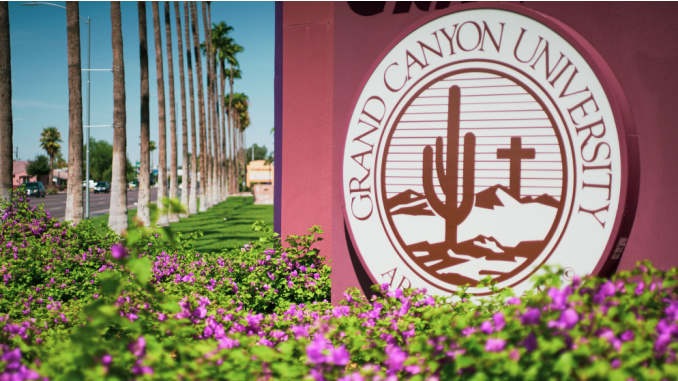
In a dramatic reversal of policy from the days of the Biden administration, the U.S. Department of Education (USDOE), under Secretary Linda McMahon and President Donald Trump, rescinded a $37 million fine against Grand Canyon University with prejudice Friday. The decision scraps the largest fine ever levied against a university by the USDOE.
As previously reported by AZ Free News, Grand Canyon University launched an appeal challenging the enormous fine and allegations of advertising false degree costs. The university was supported by the Goldwater Institute, which launched its own lawsuit in February after the USDOE failed to respond to a Freedom of Information Act request to gain clarity on the fine against GCU.
In a statement following the decision, GCU President Brian Mueller described the dismissal as welcome, but unsurprising news.
“The facts clearly support our contention that we were wrongly accused of misleading our Doctoral students and we appreciate the recognition that those accusations were without merit,” he said. “GCU is a leader in innovation, transparency and best practices in higher education and we look forward to working cooperatively with the Department in the future – just as we have with all regulatory agencies.”
The USDOE dismissed the case in its entirety with neither findings, fines, liabilities, nor penalties of any variety. According to GCU, the USDOE, “confirmed it has not established that GCU violated any Title IV requirements, including the claim that GCU ‘substantially misrepresented’ the cost of its doctoral programs that was alleged by ED officials under the Biden Administration. The Dismissal stated unequivocally that ‘there are no findings against GCU, or any of its employees, officers, agents, or contractors, and no fine is imposed.’”
In a statement the University said, “The proposed fine action was, by far, the largest the Department of Education had ever levied against a university. GCU filed an appeal to ED’s Office of Hearings and Appeals, maintaining that the unsubstantiated accusations were gross mischaracterizations based on isolated, out-of-context statements from certain enrollment documents and that, in fact, GCU students receive robust information about the time, cost and credits needed to complete a doctoral degree throughout their enrollment and onboarding process. Moreover, GCU maintains that its disclosures surrounding continuation courses, which are common in higher education doctoral programs, provide more information than is legally required or that other universities typically provide. As such, GCU has consistently insisted that it would contest any fine amount – even $1, let alone $37.7 million.”
In a post to X, Arizona Congressman Abe Hamadeh (R-AZ08) praised the dismissal writing, “The record-breaking fine imposed on Grand Canyon University (@gcu) was just one of many attacks by the Biden Administration on Christian organizations. Congressman Hamadeh applauds the Trump Administration’s decision to rescind the fine with prejudice.”
Congressman Andy Biggs made a similar post saying, “I’ve urged investigation into the outrageous fine since the moment it was handed down by the radical Biden-Harris regime. Thank you @POTUS and @EDSecMcMahon for working to ensure that the weaponization of government against @GCU isn’t allowed to stand!”
Matthew Holloway is a senior reporter for AZ Free News. Follow him on X for his latest stories, or email tips to Matthew@azfreenews.com.
by Matthew Holloway | May 10, 2025 | News
By Matthew Holloway |
The Arizona State Supreme Court has granted a petition for review in the case Center for Arizona Policy v. Hobbs, which revolves around Proposition 211 and the right of political donors to privacy.
The case, brought by the Goldwater Institute on behalf of the Center for Arizona Policy and the Arizona Free Enterprise Club argues that the protections of the Arizona Constitution, which are stronger than even the First Amendment to the U.S. Constitution, forbid Prop 211’s forced disclosure of donors and nonprofits who support or oppose ballot initiatives. The Goldwater Institute cited the Arizona Constitution in a press release, “The state constitution, after all, provides stronger protections for freedom of speech and privacy than does the federal constitution—promising both that ‘every person may freely speak, write, and publish on all subjects,’ and that ’no person shall be disturbed in his private affairs.’”
In Goldwater’s case summary, the organization warned, “Everyone has the right to support causes they believe in without fear of harassment, retaliation, or being canceled. Unfortunately, a new measure in Arizona—Proposition 211—tramples on this foundational right. It requires individuals who donate to nonprofits to risk having their private information reported to the government and disclosed to the public. It was sold to Arizonans under the guise of transparency and ‘disclosure.’ But voters weren’t told the full story.”
Goldwater Senior Attorney Scott Day Freeman explained, “This is a very exciting development. There are few rights more precious to Arizonans than their rights to free speech and to the ballot initiative process. The anti-privacy law undermines these freedoms by telling people that if they dare to support a political position, they have to give up their confidentiality and potentially become a target for retaliation and even violence.”
A lower Arizona court rejected the Goldwater’s arguments under the guise that “having an informed electorate,” in service of the government’s interests overrides campaign donors’ right to confidentiality, claiming that they can simply “opt out of contributing to campaign media spending.”
Former Arizona Supreme Court Justice, Andrew Gould, disagrees. Back in legal practice with the law firm Holtzman Vogel, and representing the plaintiffs alongside the Goldwater Institute, Gould said, “That’s just not true. Even under the law’s ‘opt-out’ provisions, some donors’ information must still be made public, and donors don’t really have a way of controlling how an organization spends donations, which means they can’t really control whether their information is made public.”
Because the case raises claims based on the Arizona Constitution, the burden of protecting donors’ privacy is even greater than in other states according to Gould who wrote, “Our state constitution provides stronger security for individual rights than the U.S. Constitution does. The authors of the state constitution intended to protect the right to donate to ballot initiative campaigns and the right not to have one’s ‘private affairs’ made public by the government. This law violates both those promises and says that if you donate to a nonprofit group that supports or opposes a ballot initiative, the government’s going to paint a target on your back.”
The Goldwater Institute referenced several serious incidents in the past decade which saw political donors and non-profits become targets for threats, vandalism, and violence from radical political extremists. It noted that donors to California’s anti-same-sex marriage initiative in 2008 became targets of property destruction and physical assault when they were effectively ‘doxxed’ by the state. A similar incident in 2020 unfolded when a group of non-profit organizations engaged California in a lawsuit after Sacramento published approximately 2,000 documents with donors’ personal identifying information. Inevitably this led to a campaign of violence and harassment by far-left extremists.
The California law that allowed this to happen was subsequently struck down by the Supreme Court of the United States in Americans for Prosperity Foundation v. Bonta in 2021.
Scot Mussi, President of the Arizona Free Enterprise Club said in a statement, “We are thankful that the Arizona Supreme Court accepted review of this vital case for our First Amendment liberties. Both the U.S. Constitution and the Arizona Constitution guarantee citizens the right to speak freely, which includes the right to not be forced to speak. Prop 211 not only violates this right for donors by silencing them from supporting causes they believe in but impairs the speech of nonprofits like ours as well. We are hopeful that the Arizona Supreme Court will rule in favor of the Constitution after considering the merits of the case.”
Matthew Holloway is a senior reporter for AZ Free News. Follow him on X for his latest stories, or email tips to Matthew@azfreenews.com.
by Matthew Holloway | May 6, 2025 | News
By Matthew Holloway |
The Goldwater Institute recently sent an email that its lawsuit announced in January against the Hobbs administration is moving forward.
In the email, Goldwater highlighted the potential impact of the Arizona Department of Water Resources (ADWR) controversial new rule imposing the requirement of a 100-year groundwater supply across wide swaths of the state.
Goldwater’s Vice President for Litigation Jon Riches wrote, “This government overreach sets a troubling precedent for other bureaucratic agencies to bypass the authority of the legislature. Due to ADWR disregarding the legislative process and the risks posed by the water rule, the Goldwater Institute is suing Governor Hobbs’ administration.”
Goldwater is challenging the Arizona Department of Water Resources’ (ADWR) controversial new rule imposing the requirement of a 100-year groundwater supply across wide swaths of the state. The troubling regulation was detailed earlier this year in an op-ed from Goldwater’s Vice President for Litigation Jon Riches and in a report by AZ Free News.
Riches explained that Hobbs’ appointed Director of ADWR, Tom Buschatzke, is “working outside Arizona law,” by implementing the new “unmet demand” rule, unilaterally without legislative approval or following the statutory rule-making process.
He wrote, “Despite Buschatzke’s apparent desire to act as a mini czar with unilateral power to determine this state’s water policy, his authority — like all government power — is constrained by Arizona law. And that law is crystal clear: When regulatory agencies like ADWR attempt to impose sweeping policies — such as halting all new home construction across large parts of the Valley — they must do so through formal rulemaking, allowing for public input. Instead, Buschatzke sidestepped this requirement and imposed his homebuilding moratorium with the stroke of a pen. The Goldwater Institute, where I work, is now suing the agency to halt the illegal rule.”
In the email, Riches warned, “If someone wanted to build a house, they would be blocked from doing so if another part of the designated region, miles and miles away, did not meet the criteria of this water rule.”
The email also outlined three direct impacts that Arizona taxpayers could expect to feel: “Increased housing costs, prevention of homebuilding, [and] a dangerous precedent for government overreach.”
Riches added, “This is one of the most critical lawsuits by the Goldwater Institute in our history. We have been successful in challenging unconstitutional laws in the past, and we are ready to fight this one.”
The complaint in Home Builders Association of Central Arizona v. Arizona Department of Water Resources can be found online here. The case is currently in the Maricopa County Superior Court pending a response from the ADWR.
Matthew Holloway is a senior reporter for AZ Free News. Follow him on X for his latest stories, or email tips to Matthew@azfreenews.com.
by Matthew Holloway | Apr 14, 2025 | News
By Matthew Holloway |
The Goldwater Institute has issued a report praising Arizona for pioneering “a freedom-based environment” for the development, testing, and deployment of autonomous vehicles or AVs.
Goldwater pointed to Executive Order 2015-09, signed by then-Governor Doug Ducey in 2015, which established a framework for development and testing requirements as the starting point for the free-market model.
The report highlighted the benefits of AVs, which for one manufacturer operated with 81% fewer airbag deployments, 78% fewer injury-causing crashes, and 62% fewer police-reported crashes than human-driven vehicles with over 20 million miles of rider-only service as of September 2024.
In a statement to AZ Free News Goldwater explained, “It’s not just about safer roads. AVs are revolutionizing mobility for elderly and disabled riders while unlocking massive economic potential. Unlike human drivers, AVs don’t get tired, distracted, or impaired—meaning fewer crashes and a more reliable transportation network.
“Yet while Arizona embraces the future, other states are slamming the brakes. Burdensome ‘driver in’ laws and city-level red tape threaten to stifle innovation and send AV companies packing. The question for policymakers is simple: regulate for yesterday, or innovate for tomorrow?”
According to the report, the 2015 EO, along with a 2018 follow-up to modernize the existing order to adapt to new technologies, were later enshrined into Arizona law by the legislature in 2021. Since the policy’s inception, 13 AV manufacturers have gained permission from state authorities to test and operate AVs in the state.
In its policy report, Goldwater argues that other states should adopt a policy similar to Arizona’s, referred to as “permissionless innovation” to “avoid erecting unnecessary regulatory barriers to AV innovation in order to reap the full benefits of this game-changing technology.” In particular, Goldwater criticized the innovation stifling single-party system in California where AV makers can wait over two years from proposal to deployment and a bill has advanced that would permit cities to create permitting requirements and restrict AVs’ hours of operations on city roads.
However, they add that other states are skewing in the opposite direction, instead applying regressive “Driver In” bills as well as municipal-level permitting regimes that lead to a Byzantine system of fragmented, inconsistent regulation.
Goldwater noted, “These efforts, driven by special interests and speculative fears, ignore the clear benefits and real-world data accumulated from years of studying AV safety.”
The think-tank observed that the experience gained in Arizona “offers a counterpoint—and a roadmap. States that follow the Arizona Model will not only attract investment and jobs, but also position themselves at the forefront of transportation’s next revolution. The choice facing lawmakers is simple: regulate for yesterday, or innovate for tomorrow. The roads of the future will see autonomous vehicles. And Arizona is already miles ahead.“
Matthew Holloway is a senior reporter for AZ Free News. Follow him on X for his latest stories, or email tips to Matthew@azfreenews.com.
by Matthew Holloway | Apr 8, 2025 | Education, News
By Matthew Holloway |
In October 2023, the U.S. Department of Education (DOE), under the Biden-Harris Administration, imposed a staggering $37 million fine against Grand Canyon University (GCU) in Phoenix, the largest privately owned Christian University in the nation. The fine came without revealing any serious complaint against the school. In February 2024, the Goldwater Institute announced that it advanced a lawsuit to determine why such a massive fine was levied. Now, a hearing has been scheduled in the case for April 18th.
Acoording to the Goldwater Institute, the DOE claimed that GCU “violated federal disclosure rules regarding continuing education courses for PhD students.” GCU leaders deny this outright. Further, in a press release regarding the fine, the DOE declined to include any complaints from students or members of the public to support its regulatory action.
When a federal judge in the U.S. District Court hears arguments in Goldwater Institute v. U.S. Department of Education, Goldwater hopes to compel the federal agency to disclose the alleged violation(s), which it believes are particularly suspicious. According to Goldwater, a public statement from Biden’s Secretary of Education Miguel Cardona vowed to “shut down” GCU.
Adding doubt to the DOE’s allegations, as Goldwater notes, GCU reportedly hasn’t raised tuition in over 15 years. The manner in which the fine was announced was also suspect with Goldwater noting, “The Department also announced its unprecedented fine with a widely reported press release that was heavy on rhetoric and bereft of any serious complaints from students or the public. It also appears that the fine was assessed in conjunction with suspicious coordination among various federal agencies.”
According to Goldwater, efforts through a Freedom of Information Act (FOIA) request to determine the motivation behind the fine have gone unanswered, leading up to the complaint.
“The request seeks emails between key individuals of the Department and other federal agencies that discuss the Department’s fine against GCU. The records may help inform the public about this extraordinary fine, as well as coordination between various federal agencies in what appears to be the intentionally targeting of a successful university based on extraordinarily thin allegations. However, the Department has refused to produce the records requested and has failed to otherwise comply with the FOIA.”
As reported by AZ Free News in February 2024, Goldwater staff attorney Stacy Skankey explained, “With its motto of ‘private, Christian, affordable’ and its track record of graduating students into high-demand and high-paying jobs, GCU is a success story by any metric. And it stands apart from universities across the country that are facing declining enrollment, that are indoctrinating students with radical politics, and that are under attack for failing to defend the First Amendment.”
In an op-ed for the Washington Times in December, Jon Riches, Goldwater Institute Vice President for Litigation, wrote, “As the Trump administration prepares to tackle an ambitious education agenda, ending the shameful attack on GCU should be a top priority. This would not only correct the injustice done to GCU but also make clear the broader principle that higher education should be a domain of innovation and student achievement — not a fiefdom for ideological conformity and bureaucratic rule.”
The initial action was brought by the Goldwater Institute during the Biden Administration and saw little to no response from former Secretary of Education Miguel Cardona. Though confirmed by neither party, the hearing had initially been delay and could be reflective of the whirlwind of changes at the DOE under Trump Administration.
The upcoming hearing could present a departure from the DOE’s previous position on the GCU fine, or at minimum provide transparency that was lacking under the previous administration.
Matthew Holloway is a senior reporter for AZ Free News. Follow him on X for his latest stories, or email tips to Matthew@azfreenews.com.