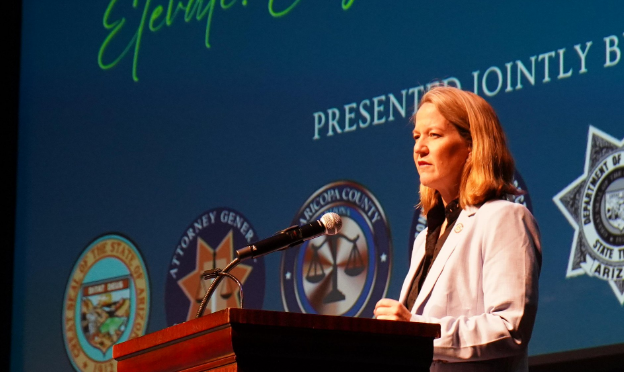
Arizona Attorney General Kris Mayes is facing serious criticism after legal threats issued to families using the Empowerment Scholarship Account (ESA) program. The threats slammed the brakes on purchasing “supplementary materials” considered self-evident in need by the State Board of Education.
As reported by the AZ Mirror, a July notice from Democrat Attorney General Kris Mayes’ office told the director of the ESA program that they may be in violation of Arizona law by issuing reimbursements to families for supplementary education materials, (i.e. flash-cards, periodic tables of the elements, early books for new readers) without requiring that parents provide documentation that it is required under a curriculum.
In the six-page letter, Assistant Attorney General Kathryn Boughton wrote, “Approving ESA funds for materials that have no nexus to the student’s actual curricular needs contradicts the intent of the program and constitutes a payment of funds made without authorization of law.” She went on to claim that doing so, “may enable account holders or vendors to engage in fraudulent behavior, such as purchasing items with ESA funds solely for the purpose of resale.”
She advised that director, John Ward stop authorizing the reimbursements immediately.
Faced with a potentially damaging legal battle, Superintendent of Public Instruction Tom Horne told parents in a statement that he would have to concede the point for now. “When I received the attorney general’s message, I sent it to the most knowledgeable people in my department,” Horne wrote.
“I asked them to look at it, not as an advocate, because we all disagree with the Attorney General, but in a neutral way, as though they were judges to determine if they could give me a reasonable assurance of success. They analyzed the statutes on which the attorney general relied, and indicated to me that as a neutral judge, they would rule against me if I made a fight out of it and refused to comply. Getting into a fight and losing, would be much more damaging.”
However, the tune from Mayes’ office changed sharply just one day after the Goldwater Institute filed lawsuit challenging the blatantly partisan determination. Attorneys from Goldwater representing two Arizona mothers wrote, “Following …unsuccessful legislative attempts, the office of Arizona Attorney General Kris Mayes initiated a new effort in July 2024 to dramatically limit the use of ESA funds, calling for a prohibition on the purchase of basic educational materials, including books, workbooks, and other ‘supplementary materials’ unless parents could provide an explicit ‘curricular’ document justifying the use of each specific book title or material for their child.”
“Arizona law expressly allows the purchase of such materials with ESA funds, however. In fact, state lawmakers added clarifying language in 2020 with the explicit purpose of ensuring that such purchases would not be denied, following the actions by former State Superintendent Kathy Hoffman that had restricted the purchase of many such items. The State Board of Education has likewise approved rules for the program explicitly permitting the purchase of these materials without additional documentation.”
The AG’s Office then began a campaign of feverishly walking back their determination with a statement responding to the suit. “The Attorney General has simply stated what is required by law,” adding, “The law doesn’t prevent parents from purchasing paper and pencils, but it does require that materials purchased with ESA funds be used for a child’s education.”
But this isn’t what Mayes’ office said in July when they demanded Superintendent Tom Horne’s department “promptly cease approving supplementary material expenses without the requisite documentation of a curriculum nexus,” no matter how self-evidently educational the materials are, as Matt Beienburg,the Director of Education Policy at the Goldwater Institute pointed out in an Arizona Daily Independent op-ed.
As Beienburg notes, Mayes’ office, far from simply targeting extravagant spending, threatened ESA administrators with legal liability unless they applied the same requirements on the list of obviously educational materials approved in the State Board of Education’s ESA Handbook: things like “books,” “workbooks,” “writing utensils,” “atlases/maps/globes,” “calculators,” “flash cards”, etc.
“Thesematerials are what Attorney General Mayes’ intervention is now blocking en masse—unless parents can cite a specific pre-established curriculum calling for the individual book title or resource,” Beienburg explained.
“In other words, the Attorney General’s office still demands that flashcards and other self-evidently educational materials be allowed only if a parent can produce an arbitrary piece of paper calling for their specific use.
The Attorney General’s attempted public deflection away from this fact demonstrates the absurdity of her summer demands. Perhaps she really does believe that families should have to justify their purchases of books like ‘Brown Bear Brown Bear, What do You See?’ and ‘Little People Who Became Great’ to wiser government bureaucrats. But for the rest of us, such restrictions are clearly nonsensical and—under state law, illegal.
The Attorney General is supposed to uphold state law, not torture it to impose her policy preferences. We encourage the Attorney General to withdraw her summer demand letter, or else acknowledge flatly that her position is that families should have to justify why they picked ‘Brown Bear Brown Bear, What Do You See?’ to read to their own children.”
Arizonans looking for more information about a ballot measure that addresses the state’s growing homelessness issues can access vital research from a local think tank organization.
Late last month, the Common Sense Institute Arizona (CSI) released a report “on the economic and fiscal impact of Proposition 312, finding that there is indeed a link between the increase in homelessness and declining property values.”
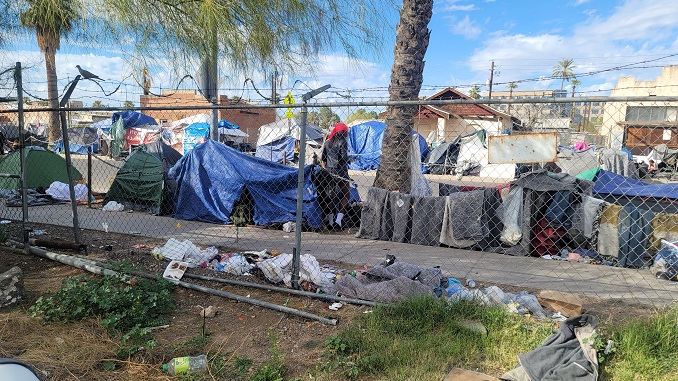
According to CSI, “Proposition 312 is aimed at tackling Arizona’s growing homelessness crisis, offering property owners the opportunity to receive tax relief for costs incurred due to unmitigated public nuisances, such as homelessness, vandalism, property crime, and drug use.”
The report from CSI found “that under the status quo, property owners in areas with unmitigated public nuisances are seeing their values decrease in real value [while] homelessness is on the rise.”
“The rising rates of crime, homelessness, and drug activity in key areas of Phoenix appear to have taken a toll on property values and overall economic activity,” said Glenn Farley, Director of Policy & Research for CSI. “In this kind of environment of declining relative property values and higher crime rates, there are ongoing problems requiring mitigation – like security and cleanup costs. In practice, though, the real impact is likely to be preventive: local governments may ultimately be more proactive about mitigating these nuisances if this proposal is enacted than they are today.”
The Arizona-based Goldwater Institute took a position in support of Proposition 312 ahead of the November General Election. On its website, the influential organization wrote, “We saw it in Phoenix’s homeless Zone when the city allowed lawlessness to run wild. We saw it in Tucson, too. Amid rampant homelessness, hardworking Arizona taxpayers are being forced to bear the burden of a city’s refusal to do its duty to protect public health and safety, paying out of pocket to install fences, hire security, clean up garbage, human waste, and other hazardous materials themselves. Prop 312 ensures that when government fails to enforce existing laws regarding illegal camping, loitering, pollution, and other nuisances, taxpayers will no longer be forced to foot the bill.”
Proposition 312 was made possible by the Arizona State Legislature earlier this year, when Republicans led the way to pass HCR 2023, which, if eventually passed by state voters in November, would “allow a property owner to apply for a primary property tax refund if the owner documents expenses caused by a city, town or county adopting a policy, pattern or practice which declines to enforce existing laws or the maintaining of a public nuisance” – according to the overview provided by the state House.
In a statement after the successful passage of the bill out of his chamber, Senate President Warren Petersen said, “There are instances where local governments routinely and repeatedly fail their citizens by not enforcing laws. An example of this would be the City of Phoenix’s handling of the former homeless encampment known as ‘The Zone.’ This area was not only a public safety and public health disaster for those who camped there, but it was also a detriment to the livelihoods of small business owners who set up their shops in the area.”
Petersen added, “Money talks, and as a way to encourage municipalities to enforce the law, Speaker Toma and I teamed up to sponsor HCR 2023/SCR 1006. This measure is a ballot referral that would protect law-abiding citizens. If approved by voters, property owners would be allowed to request a refund for expenses incurred to mitigate the problem, up to the amount of their property tax liability. The funds would be deducted from the local government’s state shared revenue.”
The chamber’s president also noted that “all Senate Democrats voted ‘no’” on the referral.
The key findings from CSI about Proposition 312 are as follows:
“Problem increasing: Crime, drug overdoses, unsheltered homelessness, and other public nuisances have risen dramatically in Arizona and the greater Phoenix area since 2019. But the impacts are disproportionate: the problem has become more visible in certain parts of the city. This creates a negative economic impact for those parts of the city where local officials have failed to enforce existing laws
“Property Value Loss: Commercial properties in Phoenix affected by unmitigated public nuisances have seen market rent appreciation fall to just 15.7% between 2019 and 2023, compared to the citywide rate of 30.2%. This represents up to $2.1 billion in lost property value due to slower appreciation in areas with high levels of homelessness, crime, and public nuisances.
“Increased Crime: In areas with high public nuisance activity, the average crime rates for drug offenses, burglaries, robberies, and arson were between 3 to 5 timeshigher than the Phoenix average, driving up costs for property owners due to increased security measures and property damage.
“Impact on Businesses: Businesses located in areas with elevated public nuisance levels experience significantly lower property appreciation and higher vacancy rates. The economic toll of unmitigated public nuisances has made it harder for businesses to thrive in these areas.”
During the legislative process this year, representatives from Barry Goldwater Institute for Public Policy Research, QuikTrip, Arizona Free Enterprise Club, Arizona Chamber of Commerce, Arizona Food Marketing Alliance, and the National Federation of Independent Business, indicated their support for the proposal on the Arizona Legislature’s Request to Speak system. Representatives from the League of Arizona Cities & Towns, Living United for Change in Arizona, Arizona Coalition to End Sexual and Domestic Violence, Professional Fire Fighters of Arizona, Arizona Association of Counties, County Supervisors Association of Arizona, Arizona Housing Coalition, and several state cities and towns, signed in to oppose the measure.
Interested voters can read the full CSI report regarding Prop 312 here.
Daniel Stefanski is a reporter for AZ Free News. You can send him news tips using this link.
Arizona Superintendent of Public Instruction Tom Horne issued a statement of support for a lawsuit challenging Attorney General Kris Mayes’ restrictions on the state’s school choice program.
Horne said that he maintains concerns that Mayes will demand the return of Empowerment Scholarship Account (ESA) funds from families based on her interpretation of the laws governing allowable expenses.
In July, Mayes advised the Arizona Department of Education (ADE) that, per her interpretation of the law, parents should no longer be reimbursed for supplementary educational materials not expressly outlined in curriculum.
Though Mayes acknowledged that the statute on which she based her interpretation didn’t offer a definition of “supplemental materials,” she argued in her letter to Associate Superintendent John Ward that the State Board of Education’s definition of the term should apply: “relevant materials directly related to the course of study for which they are being used that introduce content and instructional strategies or that enhance, complement, enrich, extend or support the curriculum.”
Mayes’ application of this definition requires explicit mention of all supplies required within a curriculum: even things like pencils and erasers. The ADE handbook doesn’t require documentation of items “generally known to be educational” in their purpose, such as pencils and erasers.
The attorney general directed Ward to provide documentation of total supplementary material expenditure from 2019 to present, as well as funds spent on curriculum materials without curriculum documentation and approved textbooks lacking proof of requirement by a qualified school or eligible postsecondary institution.
In response to Mayes’ directive, the Goldwater Institute sued on behalf of ESA mothers Velia Aguirre and Rosemary McAtee. The two mothers homeschool their children: Aguirre homeschools all three of her children, while McAtee homeschools seven of her nine children.
In their argument, the Goldwater Institute argued that Mayes’ directive was not only in violation of the law, it was a jeopardy to the existing backlog of tens of thousands of purchase orders — an issue that would inherently impact the education of many children relying on those ESA funds.
The Goldwater Institute also pointed out in a press release that not even public and private school curriculums necessarily list supplementary items such as pencils and erasers.
In a statement, Horne expressed hope that the Goldwater Institute would prevail in its lawsuit.
“The Department of Education concedes the argument of the Goldwater Institute. When this issue first arose in July, my concern was that the Attorney General could force Empowerment Scholarship Account holders to return funds if they did not comply with her office’s interpretation of the law. This lawsuit will settle the issue in court and my sincere hope is that the arguments made by Goldwater will prevail.”
Horne had issued an anticipatory show of support for a hypothetical lawsuit from the Goldwater Institute in a response on the ADE page for ESAs immediately following Mayes’ letter. Horne clarified that a prior court decision bound ADE from having the standing to file lawsuits.
The superintendent said that he doesn’t agree with Mayes’ interpretation that supplementary materials are required to be tied to curriculum. However, Horne said that Mayes’ directive was one his department advised him that he couldn’t challenge and win.
As of Monday, over 78,600 students were enrolled in the ESA Program.
AZ Free News is your #1 source for Arizona news and politics. You can send us news tips using this link.
The Payson Town Council’s August decision to incur a $70 million debt via a bond measure approved without a public referendum has triggered a lawsuit from concerned residents with the assistance of the Goldwater Institute. Goldwater is assisting resident Deborah Rose to challenge the measure despite the Town’s claimed legal pretext of an “emergency” to counter efforts from the public to stop it.
John Thorpe, a Goldwater attorney representing Deborah explained, “Our leaders want our money, but not our vote. They’re trying to take advantage of legal loopholes to saddle their own constituents with tens of millions of dollars of debt, systematically stripping power from the people by ignoring laws and twisting their truths.”
The town of Payson, AZ, wants to bypass voters, dump $70 million in debt on its residents, AND prevent citizens from challenging this overreach.
As noted by the Payson Roundup, the lawsuit seeks to block the bond resolution by arguing that no legal emergency actually exists. However, the outlet reported Payson Town Attorney Jon Paladini scoffed at the lawsuit as “specious,” and claimed it would be dismissed quickly. He told the outlet, “Bottom line is that the courts are prohibited from second guessing a legislative body like the council — a slew of cases tell us that. It’s about as close to being frivolous as we’ve seen.”
The use of the city’s emergency clause with a 6-1 vote forced the bond sale into immediate effect and brushed aside the typical 30-day period voters would have to gather signatures to force a vote.
The alleged justification for the “emergency” comes from speculation that at an upcoming meeting of the Federal Reserve, the Fed is expected to reduce interest rates by a quarter or half-point which would lower the interest rates the town would pay.
Thorpe argued that, “Government officials’ efforts to time the market, based on pure speculation about financial trends, is not an ‘emergency,’” and added that this use of the “emergency clause” violates the Arizona constitutional right to organize a referendum and vote on it.
“The so-called ‘emergency’ here is nothing more than town officials’ apparent belief that interest rates might rise in coming months, and that they’ll secure slightly better municipal bond terms now than they could in 30 days if they gave residents the opportunity to organize a referendum,”
He wrote, “When the council approved the bond measure, it slipped in an ’emergency clause,’ stating that the measure would go into effect immediately, without letting residents who might oppose the measure organize a referendum and put the issue to a vote. But the Arizona Constitution guarantees the right of referendum: the right of Arizonans to circulate petitions and refer bills, ordinances, and resolutions for a popular vote. It’s a cornerstone of democratic accountability in Arizona, and it means that the people—not politicians—have the last word in state and local government.
The Payson Town Council is trying to bypass that safeguard and short-circuit the democratic process using a legal loophole: a narrow exception allowing cities and towns to enact emergency measures without waiting for a referendum when such measures are ‘necessary for the immediate preservation of the peace, health or safety of the city or town.’ The so-called ’emergency’ here is nothing more than town officials’ apparent belief that interest rates might rise in coming months, and that they’ll secure slightly better municipal bond terms now than they could in 30 days if they gave residents the opportunity to organize a referendum.”
Paladini maintains that the bond sale measure meets the emergency clause designation and therefore the bonds for such general town projects as “a community and swim center, hiking trails and trailheads, covered event center to lure conventions,” and “upgrades to Main Street to create a business and entertainment district,” “improvements to streets and to public facilities like the police station and fire stations,” according to the Roundup, all constitute “emergency” spending. As noted in the Roundup, nearly all bond sales rely upon the “emergency clause” to sidestep the possibility of blocking them through referendum.
Should the Goldwater lawsuit succeed, it would enforce the standard that voters can in fact challenge bond measures as intended under the Arizona Constitution.
Arizona Senate President Warren Petersen and House Speaker Ben Toma filed an amicus brief in support of a lawsuit against Arizona State University and the Arizona Board of Regents for “unlawfully mandating racist DEI training for faculty.” The lawsuit was brought by Dr. Owen Anderson and the Goldwater Institute. The Arizona Board of Regents brought a motion to dismiss the case, which Petersen and Toma are urging the court to reject.
In the text of the brief, Petersen and Toma establish first and foremost that the case brought by Goldwater and Dr. Anderson “is a civil rights case,” citing Arizona Revised Statutes “enacted in part to prohibit discriminatory state and local government practices, including conduct that could qualify as, or lead to, a discriminatory work environment and even liability for the State.”
Sharing the brief, the Arizona Republican Party wrote in a post to X, “We refuse to normalize discrimination in higher education, or anywhere in the state of Arizona.”
🚨ICYMI: DEI or "Diversity, Equity, & Inclusion" is simply discrimination under another name, and we won't tolerate your tax dollars supporting radical left ideology that provides preferential treatment for individuals based on race, skin color, or sex.
As reported by Goldwater, the crux of the complaint by Dr. Anderson is that Arizona State University is using taxpayer funds to mandate Diversity, Equity, and Inclusion training among the university’s faculty. And that Dr. Anderson’s refusal to participate in the inherently discriminatory training has left him open to discipline from his superiors.
“I shouldn’t be forced to take training and affirm ideas with which I disagree as a condition of employment,’” Dr. Anderson said. “This ‘training’ is simply racism under the guise of DEI. It goes against my conscience, and I want no part of it.”
Goldwater Staff Attorney Stacy Skankey noted, “Arizona state law prohibits mandatory training for state employees and use of taxpayer resources to teach doctrines that discriminate based on race, ethnicity, sex, and other characteristics.”
“But the ‘ASU Inclusive Communities’ training teaches discriminatory DEI concepts, including things like ‘how…white supremacy [is] normalized in society,’ how to ‘critique whiteness’; ‘white privilege’; ‘white fragility’; and the need for ‘transformative justice.’ Even ‘seemingly innocuous questions and comments’—like asking people where they’re from or commenting on their hair—can be deemed ‘racist.’”
Skankey and co-counsel Parker Jackson, representing Dr. Anderson, alleged in the complaint that the Arizona Board of Regents and ASU are “using public money to prepare and disseminate mandatory faculty and staff training for its employees that presents forms of blame or judgment on the basis of race, ethnicity or sex, in violation of state law.” They add that the University is “compelling the speech of public employees by requiring faculty and staff to take an examination following a training that presents forms of blame or judgment on the basis of race, ethnicity or sex, and answer with Arizona State University’s ‘correct’ answers, in violation of the Arizona Constitution.”
The training included slides containing these objectively racial and gender discriminatory statements and concepts:
“[A]cknowledging the history of white supremacy and the social conditions for it to exist as a structural phenomenon.”
“How is white supremacy normalized in society.”
“[G]iven the socio-historical legacy of racism, sexism, homophobia and other forms of structural inequality, perceptions of authority and control are not always granted to minoritized [sic] faculty.”
“White Fragility.”
“What is White Privilege, Really.”
“Explaining White privilege to a broke white person… .”
“7 Ways White People Can Combat Their Privilege.”
“Racism … can take the form of … and include seemingly innocuous questions or comments, such as asking people of color where they are from … .”
“Sexual identities are linked to power, and heterosexuality, the dominant sexual identity in American culture, is privileged by going largely unquestioned.”
A video segment of the training includes the statements via transcript:
“[I]t scares people to talk about white supremacy or to be called a white supremacist. But if we start thinking about it in terms of whiteness as something that is culturally neutral and we’re moving it from that neutral space into a critical space.”
“[W]e also have to open the space to critique whiteness.”
“[W]hite supremacy … referring to here is the period between the 1500’s and the 1800’s that encompasses both Spanish colonization and Euro American colonization. And what colonization did, was it really created this system of binary thinking. There were folks that were inherently good and folks that were inherently bad, and that led to the systems of superiority that were then written into the foundation documents of our nation.”
The original complaint summarizes: “The Inclusive Communities training provides discriminatory concepts including, but not limited to: white people are inherently racist and oppressive, whether consciously or unconsciously; heterosexuals are inherently sexist and oppressive, whether consciously or unconsciously; white people should receive adverse treatment solely or partly because of their race or ethnicity; white people bear responsibility for actions committed by other white people; land acknowledgement statements are a way of holding one race or ethnicity responsible for the actions committed by other members of the same race or ethnicity; transformative justice calls for an individual to bear responsibility for actions committed by other members of the same race, ethnic group or sex; and dominant identities (whites or heterosexuals) are treated morally or intellectually superior to other races, ethnic groups or sexes.”
Skankey explained, “ASU is essentially forcing its employees to agree to a certain type of speech, which violates the Arizona Constitution’s broad protections for free speech.”
Speaking with Fox & Friends in March, Dr. Anderson explained, “I was told I need to ‘decolonize my classroom.’”
In a statement responding to the lawsuit, an ASU spokesman told Fox producers, “The Goldwater Institute suit misleads the court and misrepresents both the content and requirements of this training to make an argument the represents a political perspective but is not based on the law. ASU’s commitment to providing a support and welcoming educational environment for students of all backgrounds will continue and the university will respond appropriately to the Institute’s tactic.”
The case is currently awaiting a response from the Arizona Board of Regents.