Maricopa County Republicans no longer wish to challenge the voter-approved transportation sales tax.
The Maricopa County Republican Committee (MCRC) filed a motion to dismiss their lawsuit against Proposition 479 on Sunday.
The attorney for MCRC’s lawsuit, Bryan Blehm, filed the motion to dismiss on behalf of plaintiffs Craig Berland (chairman) and Shelby Busch (first vice-chairman).
Proposition 479 was styled as a continuation of a half-cent sales tax first established in 1985 and last renewed in 2004. The tax revenue funds Maricopa County infrastructure and will last until 2045.
Just short of 60 percent of voters passed Proposition 479. Polling months ahead of the election indicated this to be the case. The proposition came out of a Senate bill advanced by Republican leadership in both legislative chambers, SB 1102, which Senate President Warren Petersen hailed as “the most conservative transportation plan” in Arizona history.
Not all Republican leaders agreed. Arizona Freedom Caucus members expressed opposition to the Senate bill, as did the “conservative watchdog groups” they referenced.
“[This proposition is] a massive win for Hobbs and the Democrats,” said caucus member State Representative Justin Heap.
The Arizona Free Enterprise Club and Goldwater Institute also opposed Prop 479. The two entities claimed in remarks of opposition submitted to the county that the proposition would mostly fund transit.
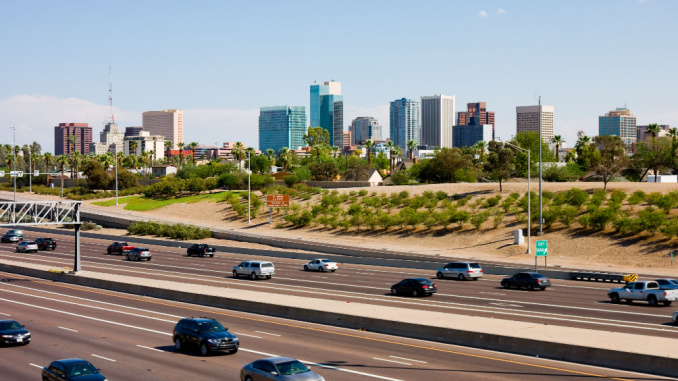
Per the Maricopa Association of Governments (MAG), 40 percent of the sales tax revenues is slated for the construction of freeways and highways, 22 percent for arterial roads and regional transportation infrastructure, and 37 percent for transit.
Democratic leadership at all levels stood in support of the proposition’s passage and opposition to the MCRC lawsuit, from Governor Katie Hobbs to Phoenix Mayor Kate Gallego.
MAG Regional Council also joined the county to argue for dismissal of the lawsuit. Kevin Hartke, MAG chairman and Chandler mayor, said in a statement to InMaricopa that the lawsuit went against the majority of voters and their desire for transportation funding.
“We won’t let a flawed claim stand in the way of our 40-year legacy of building one of the best transportation systems in the country,” said Hartke. “The transportation plan unanimously approved by the region’s elected leadership, sent to the ballot by the Maricopa County Board of Supervisors and overwhelmingly approved by the voters of Maricopa County, is critical to the quality of life of our residents and the continued strength of our local economy.”
MAG predicts the tax will generate up to $15 billion in revenue (using 2020 dollars) and slash commute length to an average of 30 minutes through 2050, even with an estimated influx of 1.7 million residents and 900,000 jobs.
MAG Executive Director Ed Zuercher indicated that county officials weren’t going to cease moving forward with their transportation plan, even if the lawsuit had progressed.
“The regional transportation plan that was unanimously approved by MAG’s mayors, tribal and county leaders, and supported by business leaders and the voters, will be implemented on schedule,” said Zuercher.
In reporting from last week, Arizona’s general contractors also sided with the efforts to protect the sales tax. The Arizona Chapter of Associated General Contractors of America had criticized MCRC’s lawsuit as “frivolous” and based on political contentions advanced by “disgruntled partisans.”
AZ Free News is your #1 source for Arizona news and politics. You can send us news tips using this link.
The Goldwater Institute released a report on Tuesday detailing the shocking expenditures of the Tolleson Union High School District (TUHSD). According to the report, the district has blown a total of $76,969 “on what amounted to luxury vacations for school board members and administrators,” per public records obtained by Goldwater.
In the space of two days, the board reportedly shelled out $42,000 in hotel costs, $22,000 of which was for the catering. And this was all for just thirty people. The math works out to a brutal $700 per person, per day.
Christopher Thomas, Goldwater’s director of legal strategy for education policy, told AZFamily, “Those are monies that could have been spent on teacher salaries and educational programs for students.”
According to Goldwater, despite the public access requirements of the state of Arizona’s Open Meetings Law, these “Board and Administrator Retreats,” which act as long-form working meetings, are essentially hidden from the taxpayer. Furthermore, Goldwater reported that, “As a result of the noted board member absences, many of the meetings held during the $42,000 retreat in 2024 lacked even a board quorum (a majority of the five-member board), meaning that under the law, these were not lawful meetings of the board at all.”
Thomas explained that the retreats, “lacked transparency that’s required by the Open Meeting Law.”
Matters of great public interest were reportedly decided at these retreats, including strategies for improving student participation and graduation rates, student attendance rates and test scores, and budget priorities and academic goals, all away from public and parental oversight.
The costs revealed did not include transportation or the hourly pay of those involved, as many of them were effectively “clocked-in” during these “retreats.”
TUHSD reportedly indulged board members and administrators at two four star resorts in 2023 and 2024: the JW Marriott Starr Pass in Tucson and the Hilton Sedona Resort at Bell Rock. Notably, Goldwater observed that although records pertaining to these expenses were requested in July, they weren’t released until the middle of November… after new bond and a budget overrides were approved by Tolleson Union voters and a member of the governing board was safely re-elected.
$76,969 in taxpayer dollars on luxury school board vacations…
At the JW Marriott Starr Pass in Tucson for the board’s two-day 2023 Board/Administrator Retreat, TUHSD reportedly paid $33,969 to the resort, which included $22,061 on catering. In 2024, the three day retreat at Hilton Sedona Resort at Bell Rock ran up a tab of $42,154 for 36 people.
“The leaders in this school district do not fundamentally understand that they are working with public dollars, and that every one of those public dollars has got to be spent in a way that gives the maximum benefit to the taxpayer and accomplishes their educational mission,” Thomas said.
Comparatively, as Goldwater Institute and AZ Free News previously reported, the Creighton Elementary School District’s Governing Board and Administrative Team attended a three-day, $4,000-per-person “diversity, equity, and inclusion” (DEI) conference at a Napa Valley wine country resort in July, which also drew heavy criticism of district leaders.
Arizonans enacted a major incentive for local governments to address homelessness.
Voters approved Proposition 312, which requires local governments to compensate its property and business owners for damages caused by the homeless. Governor Katie Hobbs certified the proposition on Monday alongside all other election results.
Proposition 312 would secure compensations through a refund on property tax payments up to an amount matching costs incurred by local government’s “failure to enforce laws and ordinances prohibiting illegal camping, loitering, obstructing public thoroughfares, panhandling, public urination or defecation, public consumption of alcoholic beverages, and possession or use of illegal substances.”
Should the cost of damages exceed the property tax bill, the proposition gives the owner the right to apply for a refund from their next property tax payment(s) in perpetuity until that initial balance is paid.
“Property owners would be eligible annually for refunds until the taxing entity begins enforcing the relevant public nuisance laws,” stated the ballot summary.
Policy experts anticipate the Arizona proposition to inspire other cities to adopt a similar policy.
The Goldwater Institute, which crafted Proposition 312, said in a statement on Monday that the measure provided another tool in addressing the homeless crisis facing Phoenix and major cities in other states. Victor Riches, Goldwater Institute’s senior communications manager, said in an opinion piece for The Wall Street Journal that the proposition should serve as sufficient motivation for local elected officials to act with more urgency.
“Proposition 312 should be a wake-up call for elected officials forcing law-abiding businesses and residents to pay the price for a crisis they didn’t create,” said Riches. “The message to politicians couldn’t be clearer: Do your job. Enough is enough.”
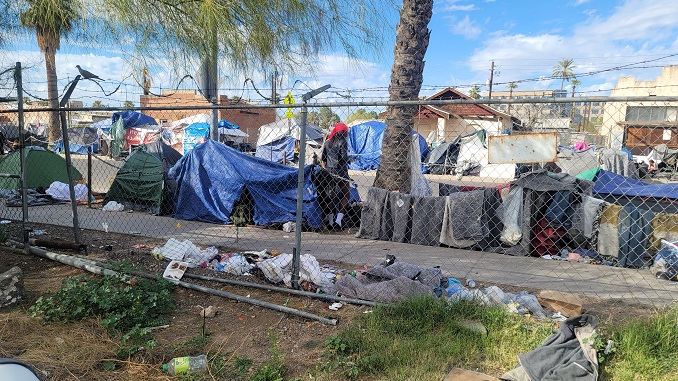
Riches identified Phoenix and its infamous downtown area unofficially cordoned off for the homeless (“The Zone”) as a prime example of the “government malfeasance” that allowed the adverse effects of homelessness on properties and businesses in the area.
“Property values plummeted in the Zone. Small businesses suffered. People lost their livelihoods as dozens of business owners had no choice but to close up shop,” said Riches. “And even as the city spent over $180 million to address the crisis (only a fraction of which is publicly accounted for), the number of homeless people in Phoenix rose 92% between 2018 and 2023.”
Nearly 59 percent of voters (1.8 million votes) approved Proposition 312. The legislative vehicle for the proposition, HCR 2023, passed in both chambers with bipartisan support earlier this year.
Major leftist organizations said in their arguments against Proposition 312 that the cities and counties shouldn’t face financial punishment for the acts of the homeless, and reduced tax revenue would hinder funding for community assistance geared toward homelessness.
Among those to oppose Proposition 312 were Civic Engagement Beyond Voting, Lutheran Social Services of the Southwest, Opportunity Arizona, Fuerte Arts Movement, Living United for Change in Arizona, and the ACLU of Arizona.
The Common Sense Institute Arizona (CSI) found in a report released last month that the proposition would likely improve property values.
AZ Free News is your #1 source for Arizona news and politics. You can send us news tips using this link.
A ballot measure to protect Arizonans from the rise of unabated homelessness in communities was overwhelmingly passed by voters in the General Election.
Earlier this month, Proposition 312 received almost 60% of the vote, cruising to a smooth victory on Election Night. The measure, which was referred to the ballot from the Arizona Legislature, stipulates that “property owners may apply for a tax refund for expenses incurred due to a governing authority’s failure to enforce certain public nuisance laws on or near the owner’s real property.”
The legislative vehicle for the measure, HCR 2023, was sponsored by House Speaker Ben Toma. It passed both chambers in the Arizona Legislature with bipartisan support and was transmitted to the Secretary of State’s Office in March of this year.
In a statement after the successful passage of the bill out of his chamber, Senate President Warren Petersen said, “There are instances where local governments routinely and repeatedly fail their citizens by not enforcing laws. An example of this would be the City of Phoenix’s handling of the former homeless encampment known as ‘The Zone.’ This area was not only a public safety and public health disaster for those who camped there, but it was also a detriment to the livelihoods of small business owners who set up their shops in the area.”
Petersen added, “Money talks, and as a way to encourage municipalities to enforce the law, Speaker Toma and I teamed up to sponsor HCR 2023/SCR 1006. This measure is a ballot referral that would protect law-abiding citizens. If approved by voters, property owners would be allowed to request a refund for expenses incurred to mitigate the problem, up to the amount of their property tax liability. The funds would be deducted from the local government’s state shared revenue.”
Speaker Toma also had said, “Business owners and residents alike are having their property stolen, vandalized, or terrorized and are desperate for help. That’s why I sponsored HCR2023, to hold our local governments accountable to our community members and to help provide some relief for property owners who have suffered damages because of a city’s purposeful failure to provide the public health and safety services we all pay for.”
The Arizona Chamber of Commerce and Industry, which was instrumental in promoting the proposition, issued a statement following the General Election win, writing, “Arizona voters have sent a clear message: Government, do your job. They do not want our state to become the next San Francisco or Los Angeles. Prop 312 is a win for property owners, businesses, and everyday Arizonans who too often shoulder the costs of unaddressed homelessness.”
“Arizona voters have sent a clear message: Government, do your job. They do not want our state to become the next San Francisco or Los Angeles. Prop 312 is a win for property owners, businesses, and everyday Arizonans who too often shoulder the costs of unaddressed homelessness. pic.twitter.com/IPLhHq5UAf
The Goldwater Institute, which also pushed for Prop 312’s passage, also took a well-deserved victory lap after the positive result. The organization’s President and CEO, Victor Riches, stated, “The voters sent a clear message this election cycle: they demand their tax dollars be used to enforce the law and address rampant homelessness. Now that Prop 312 is law, business and property owners will not be left holding the bag when municipalities refuse to do their job.”
Daniel Stefanski is a reporter for AZ Free News. You can send him news tips using this link.
The city of Phoenix will be in court on Wednesday over a lawsuit against its arrangement waiving $8 million in property taxes for a private real estate developer downtown.
The Arizona Court of Appeals will hear the case, Paulin v. City of Phoenix. The Goldwater Institute filed the lawsuit in May 2022.
Goldwater Institute Vice President for Litigation Jon Riches claimed the property tax exemption violated both the Arizona Constitution and court precedent prohibiting the use of taxpayer dollars to benefit private interests.
“Arizona courts have been clear time and again: taxpayer dollars are to be put to public use, not to benefit private, special interests,” said Riches.
Phoenix waived the property taxes on a downtown high-rise development project by assuming the legal title from real estate developer Hubbard Street Group and leasing the property back to them. The city did so in order to capitalize on Arizona’s Government Property Lease Excise Tax (GPLET) abatement provisions. In so doing, the city of Phoenix ensured the Hubbard Street Group protection would be saved from having to pay millions in property taxes for the term of the lease — eight years. After that better part of the decade is up, the city will return the title back to the developer.
The Goldwater Institute maintains that this workaround adopted by the city amounts to, essentially, tax evasion: an abuse of GPLET and a loss of a revenue stream at a burden to other taxpayers.
As reported previously, the city of Phoenix assumed ownership after it declared the developer’s project, “Skye on 6th,” to be part of a slum or blighted area. As part of their arrangement with the city’s assumption of their legal title to the development, Hubbard Street Group agreed to pay over $500,000 in rent to the city, $30,000 to two school districts, and dedicate 10 percent of its residential units to workforce housing.
Skye on 6th is marketed as “the height of luxury.” The most affordable rooms (studios listed at 400 square feet) start at $1,500 a month. The most expensive rooms are on their penthouse floor, where rent starts at $4,500 a month and goes up to over $6,700 a month.
The project cost nearly $88 million to develop.
One of the represented taxpayers in the case, Bramley Paulin, successfully sued the city last year, Paulin v. Gallego, when he challenged the city’s restriction on temporary signage for the Super Bowl LVII. The Maricopa County Superior Court ruled the city’s resolution on signage was an unconstitutional restraint on free speech and delegation of government power.
Paulin and the other taxpayer in the case, Mat Englehorn, reside and own businesses in the Phoenix area.
The oral arguments are scheduled to occur on Wednesday at 9:30 am.
In 2020, the Maricopa County Superior Court ruled against a similar GPLET arrangement between the city of Phoenix and another high-rise developer.
In his ruling, Superior Court Judge Christopher Coury questioned whether GPLET could be relevant any longer given the tendency for abuse.
“This judicial officer questions whether the death knell for the GPLET’s usefulness has rung,” wrote Coury.
AZ Free News is your #1 source for Arizona news and politics. You can send us news tips using this link.