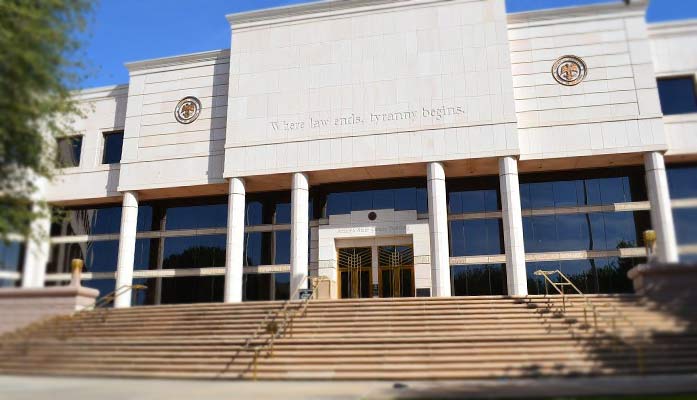
We tried to warn them. But Pinal County officials decided to move forward with their illegal and unconstitutional transportation tax anyway. Thankfully, on Tuesday, the Arizona Supreme Court issued a tremendous victory for Pinal County taxpayers and the rule of law.
And while it’s disappointing that taxpayers were forced to pay thousands of dollars to defend this illegal tax scheme in court, the Pinal County Board of Supervisors will now have to end the collection of this tax and issue refunds to aggrieved taxpayers.
A tax on retail sales below $10,000
This all started in 2016 when Pinal County officials began turning the political wheels to send a $640 million tax increase to voters to fund a wide array of transportation projects throughout the region.
Several Arizona legislators along with the Free Enterprise Club and the Goldwater Institute are celebrating a major court victory for Arizona taxpayers after a Maricopa County Superior Court judge struck down the largest tax hike in state history on Friday.
Today, @maricopacounty Superior Court Judge John Hannah ruled against Prop 208, determining that the $$ raised from the tax would exceed the constitutional spending limit for education.
Judge John Hannah’s ruling bars enforcement of Proposition 208, which imposed a significant income tax surcharge on small-business owners and individuals making over $250,000 a year. Prop 208, also called the Invest in Education Act, was narrowly passed by voters in November 2020 and was immediately challenged in court on multiple grounds, including a conflict with Arizona’s Constitution.
Governor Doug Ducey called Hannah’s ruling “a win for Arizona taxpayers,” adding that it is marks “another step in undoing the damage of Prop 208 and making sure we continue to benefit from having the lowest flat income tax rate in the nation.”
The Goldwater Institute-sponsored lawsuit was filed in February 2021 on behalf of numerous taxpayers, small business owners, and legislators. Last summer, the Arizona Supreme Court agreed with the plaintiffs’ argument that the surcharge taxes from Prop 208 were considered “local revenues” subject to spending limits under the state’s Constitution. The Justices sent the case back Hannah for a determination of whether Prop 208’s Local Revenues Provision runs afoul of the Constitution’s Education Expenditure Clause by violating that limitation. In a decision today, the judge agreed that Proposition 208 violated the Constitution.
“This Court understands the remand order as a direction to declare Proposition 208 unconstitutional in its entirety, and to enjoin its operation permanently, if the Court finds as a fact that the annual education spending limits imposed by the Arizona Constitution will prevent Arizona’s public schools from spending a ‘material’ amount of Proposition 208 tax revenue in 2023,” Hannah wrote in his ruling. “On that basis, the Court is obligated to strike down Proposition 208.”
Reaction to the ruling came swiftly, despite a possibility the Justices may be asked by the losing parties to review Hannah’s order later this year.
“While we expect the ruling may be appealed, we are confident the Arizona Supreme Court will find 208 unconstitutional, as they did last year. Arizona is – and will remain – a state that knows how to prioritize education while keeping taxes low and attracting jobs,” Gov. Ducey said.
Senate President Karen Fann, one of the plaintiffs, called Friday’s ruling “a major victory” against an initiative she said misled voters by trying to get the tax-and-spend hike around the Constitution.
“Out-of-state special interests tried to deceive our voters,” Fann said after Hannah released his ruling. “We are thrilled that this job-killing tax hike won’t go into effect.”
Many attributed the success of the lawsuit to the work of the Goldwater Institute which pointed out concerns with Prop 208’s constitutionality well before Election Day in 2020.
“Today’s decision puts a nail in the coffin of the unconstitutional, job-killing Proposition 208, and it cements Arizona’s position as the national leader in lower taxes and building a stronger economy,” said Victor Riches, President and CEO of the Goldwater Institute.
On Tuesday, the Arizona Supreme Court ruled that Pinal County’s transportation excise tax was unlawful. The ruling affects two 2017 voter-approved measures from the Pinal County Regional Transportation Authority (RTA) Pinal County Board of Supervisors. The two measures instituted a tax on purchases under $10,000, constituting a two-tiered retail transaction privilege tax (TPT) that would pay for infrastructure.
BREAKING NEWS – MASSIVE Goldwater victory for taxpayers' rights!
The Arizona Supreme Court just ruled that Pinal County's "transportation excise tax" is ILLEGAL. pic.twitter.com/BhRBGH1cwp
— Goldwater Institute (@GoldwaterInst) March 8, 2022
The Arizona Supreme Court disagreed with the county’s assertion that the tax afforded a modified and variable rate in accordance with state law.
“We therefore conclude that the two-tiered retail TPT structure in Proposition 417 is neither a ‘modified rate’ nor a ‘variable rate’ under § 42-6106(C). In this case, until the legislature ‘expressly delegates’ to counties the authority to implement this tiered-rate tax on specified businesses—an authority that is ‘strictly construed’ — Pinal County’s two tiered retail TPT structure as part of a transportation excise tax is unlawful and invalid,” wrote the court.
The ruling marked the Goldwater Institute’s seventh Arizona Supreme Court ruling in their favor. The institute’s vice president of litigation, Timothy Sandefur, asserted that the ruling ensured clarity, ease, and lowered costs for businesses.
“The legislature intended state taxes to be uniform — not to allow each of the state’s 15 counties to set their own rules. To allow that would make Arizona inhospitable for business, because it would transform the state into a crazy quilt of different tax rules in each locality,” wrote Sandefur. “[I]t marks a victory for taxpayers not just in Pinal County but throughout Arizona. In tough economic times—with inflation and fuel costs rising—the last thing Arizona needs is for public officials to create more and more complicated tax rules that take more of people’s earnings away and drive away job-creating industry.”
We just won a big victory for taxpayers – it's our 7th win before the AZ Supreme Court!
The last thing AZ needs right now is for government officials to create complicated tax rules that take away more of people's hard-earned money and drive away jobs. https://t.co/uuJNlJHg0d
— Goldwater Institute (@GoldwaterInst) March 8, 2022
Corinne Murdock is a reporter for AZ Free News. Follow her latest on Twitter, or email tips to corinne@azfreenews.com.
A new report released by the taxpayer-watchdog group Goldwater Institute is calling on the Arizona Legislature to address the use of public money by the League of Arizona Cities and Towns for purposes which go against the public’s interest.
“Taxpayer-Funded League Lobbies Against Taxpayer Interests,” the report by Jon Riches and Jenna Bentley, details the use of taxpayer funds by the League of Arizona Cities and Towns in ways which represent the interests of public officials and government bureaucrats rather than the interests of the taxpaying public.
“The League uses taxpayer dollars to help fund its political efforts, frequently lobbying in favor of or against proposed legislation at the Arizona Legislature,” according to Riches, the Goldwater Institute Director of National Litigation, and Bentley, the Goldwater Institute Director of Government Affairs. “While the League supports and opposes bills sponsored by members of both political parties, its agenda is decidedly anti-freedom, pro-government, and partisan.”
The situation can easily be addressed if state lawmakers approve three reforms, the report states.
“It is time to protect taxpayers by prohibiting taxpayer-funded lobbying activities while also increasing transparency and accountability when local governments advocate at the legislature through membership organization,” Riches and Bentley assert.
To start, the report recommends extending the current ban enacted in 2017 on using taxpayer funds to pay for lobbyists who represent the state government. The ban should also apply to local government governments and the League, Riches and Bentley propose.
“Cities and towns could still voluntarily join together to discuss issues of mutual concern—but do so without expending taxpayer resources on lobbying,” they say.
Then, there needs to be state legislation passed to address the disproportionate rate of dues paid to the League by smaller municipalities. This occurs because overall dues are capped for Arizona’s larger cities, resulting in a higher per capita rate for citizens of smaller communities.
“Residents of small cities and towns should not bear a disproportionate burden in financing the League and its activities,” the report states. “After all, larger cities receive the same services from the League that smaller cities do.”
The third recommendation put forth by Riches and Bentley calls on lawmakers to ensure better transparency by the League, which is a nonprofit organization comprised exclusively of local governments. In fact, more than a dozen League employees are currently active in the Arizona State Retirement System (ASRS) and several retired League employees receive ASRS pensions.
“League employees themselves are technically private employees, but in many ways they enjoy the benefits of government employment,” the report notes. “Given that the League’s membership is comprised solely of public bodies and its employees receive government perks, one would expect the League to be subject to the same transparency and accountability measures that apply to other public entities.”
These reforms, according to Riches and Bentley, would go a long way toward ensuring tax dollars are used to advance the public’s business, not to amplify the voice of special interest lobbyists.
“The Arizona Legislature can protect municipal taxpayers from the abuses that occur when local governments use taxpayer resources to lobby state government and blur the line between public and private activities,” the report recommends. “It is time to protect taxpayers by prohibiting taxpayer-funded lobbying activities while also increasing transparency and accountability when local governments advocate at the legislature through membership organizations.”
Flagstaff City Council voted last Tuesday to waive its land use restriction for property owners who submitted around $50 million in legal claims under the Arizona Private Property Rights Protection Act.
The Goldwater Institute submitted a demand letter on behalf of property owners in July. At the time, claims amounted to over $23 million for over 50 property owners.
Under the city’s High Occupancy Housing (HOH) Plan, residential and mixed-use properties faced restrictions such as a limit on the density and number of bedrooms and units, and additional requirements for automobile and bicycle parking standards. The HOH Plan would affect buildings with more than 75 bedrooms or 30 units per acre in dormitory or apartment-style units.
In part, the Private Property Rights Protection Act, or Prop 207, requires government to compensate property owners for any land use laws that restrict the right to “use, divide, sell, or possess” a property and thereby reduce its fair market value.
“If the existing rights to use, divide, sell or possess private real property are reduced by the enactment or applicability of any land use law enacted after the date the property is transferred to the owner and such action reduces the fair market value of the property the owner is entitled to just compensation from this state or the political subdivision of this state that enacted the land use law.“
Under Prop 207, individuals that believe a land use law impacts their property’s fair market value must submit a demand letter to the government who enacted the law. The government must then choose to either compensate the property owner, waive the law for that property, or amend the law entirely.
Prop 207 also doubles down on private property protections within the state and federal constitutions, adding further measures to define and restrict eminent domain.
The Goldwater Institute confirmed with AZ Free News that even more property owners have contacted them about claims.
This Tuesday, the Flagstaff City Council discussed the HOH Plan again during a work session. A presentation on the subject noted that there were 87 Prop 207 claims in all, totaling over $50 million. In reviewing the plan, the presentation asked the council if it would like to maintain the plan, modify certain aspects of it, or scrap it entirely.
Corinne Murdock is a reporter for AZ Free News. Follow her latest on Twitter, or email tips to corinne@azfreenews.com.