“From the data on the class of 2025, college admissions officers and future employers can reasonably conclude that if the applicant is a graduate of Arizona schools, more likely than not, they cannot proficiently read, write, perform math, or understand science in comparison to their peers.”
A Legal Process also noted that a majority of Arizona’s 2025 graduates failed to meet one core academic benchmark. “55% of Arizona’s students can graduate high school and still not demonstrate college-ready level competency in a single core academic subject matter,” the publication said.
World Population Review published Public School Rankings by State 2025, which shows Arizona dead last overall in four categories: K-12 performance, school funding and resources, higher education quality, and safety. This is corroborated by Consumer Affairs, which rated Arizona number one on its list entitled, “Which states rank poorly for education?”
Arizona wastes between $10,000 and $14,000 per student, depending on the source. Meanwhile, the average ESA is estimated between $6,000 and $9,000 for students in 1st through 12th grade. Current trends also reveal that K-12 families are ditching government education at an impressive rate. Even if these calculations are off by 10 decimal points, my conclusion remains the same: The A-F School Letter Grade classification system is a complete joke, and school choice is the one good thing happening in Arizona education.
“Arizona school district superintendents receive high salaries. Yet, the true scale of that pay is often obscured by a triangle of complex contract provisions that school boards, and the superintendents themselves, deliberately design to mask the full measure of compensation from taxpayers…
These same school districts go to great lengths to block access to superintendent contracts—in some cases even from their own board members—shielding from the public how tax dollars enrich those who often are their community’s highest-paid public employees.”
Goldwater requested more than 40 superintendent contracts—official records that should be accessible to the general public—only to receive the documents after four months of repeated requests and warnings of potential litigation. The following information is also sourced from their report:
Not including health insurance or pension costs, Arizona superintendents’ base salaries average $215,000 a year, while taxpayers are charged up to $490,000 per superintendent after accounting for “lucrative perks.”
In addition to pension benefits, several school districts are double-charging taxpayers for superintendents’ retirement packages.
Taxpayers are funding superintendents’ personal and vacation leave to the tune of 15 weeks off, when combined with school holidays. When vacation days are unused, superintendents receive a payout in the form of additional compensation.
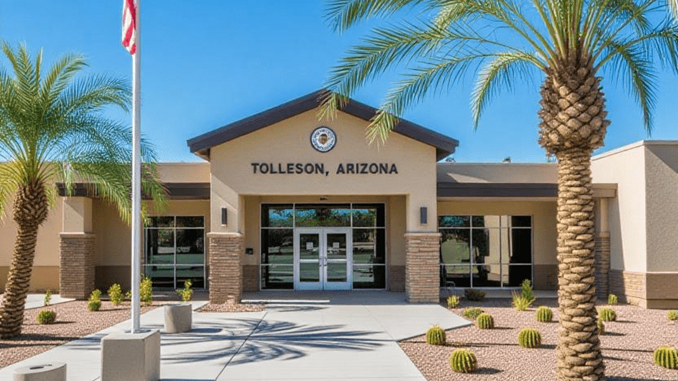
Goldwater rightly called attention to Tolleson Union High School District Superintendent Jeremy Calles, who makes off with roughly $500,000 a year. Although Tolleson ranks as the 16th largest district in the state, Calles earns at least $100,000 more than any other Arizona Superintendent. Not surprisingly, he was accused of financial misconduct and, according to ABC 15, the auditor general’s investigation into Calles is expected to be completed by January 2027.
Notably, Calles also stands accused of inflating enrollment numbers, loaning $25 million to the Isaac School District, and allowing one teacher to resign with full benefits after complaints that the former employee had an inappropriate relationship with a student. Regardless, Calles appears to have an explanation for everything. And, despite the embarrassing controversy, he still finds half a million reasons to show up for work.
“There are so many good things happening [in] our district right now that it is difficult to put them all into one newsletter…Our letter grades continue to rise…Success is not without consequence. If we are going to be the best district in the state, then we cannot get there by trying to do what everyone else is doing; we have to innovate.”
He signed off by stating that how Tolleson residents respond to a bond and override this November will “reveal how the community feels about the direction of the district.” I know how I would vote if I lived in Tolleson—it’s the same way I’m voting in Peoria.
If you’re anything like me, you’re a fish out of water when it comes to district finance. Simple is the only way I know how to be. Thus, maintenance and overrides (M&O) allow school districts to exceed their budget for salaries and daily operations by 15% in most cases. M&Os are marketed to the public as a means to “enhance student safety and special education programs.” Districts sell educators on increased pay, so (radical) teachers’ unions generally support overrides as well.
Tax increases are presented to homeowners in fractions and decimals and crumbs, rather than the sum total. Consequently, landowners must research their property value before they can know the full size of their “fraction.” Note that since overrides have literally been in place for decades, district representatives automatically expect taxpayers to honor the tradition of compliance as they’ve done in previous elections.
“Despite a 5% drop in district school enrollment since 2019, Arizona’s public-school districts have continued to expand facilities, increase capital spending by 67% to $8.9 billion, and boost transportation costs by 11.3% to $561.2 million, even as eligible bus riders plummeted by 45%…The fastest-shrinking districts have increased capital spending the most, with 20% of districts (serving 73% of students) receiving 81% of capital funding.”
Let’s be real. Taxpayers are not investing in gifted programs or sponsoring all-day kindergarten. This, my fellow proletariats, is what you call a bailout.
Rather than telling Arizonans how to vote in this election, I will instead refer you back to the information covered in this post. I encourage parents, property owners, and slighted educators to use sound judgment at the ballot box. Remember, the most basic definition of insanity is doing the same thing over and over again, expecting a different result.
Again, I’m no mathematician. But I’m willing to believe that at least a significant portion of the funds required to increase teacher salaries, enhance special needs programs, and implement cutting-edge safety plans can be found in the bank accounts of every district’s highest-paid employee.
Tiffany Benson is the Founder of Restore Parental Rights in Education. Her commentaries on education, politics, and Christian faith can be viewed at Parentspayattention.com and Bigviewsmallwindow.com. Follow her on socials @realtiffanyb.
On Tuesday, the Goldwater Institute announced a new initiative to educate lawmakers and students across the country and advocate for the resurrected concept of “federalism.”
Based upon its newly released report, “Federalism and State Constitutions: Model Language for ‘Tenth Amendments’ in State Constitutions,” Goldwater is launching a civics offensive to rekindle federalism in state governments, urging them to etch the spirit of the 10th Amendment directly into their own constitutions.
Dubbed the “Blueprint for Federalism,” the initiative from the group’s Van Sittert Center for Constitutional Advocacy was introduced with a policy report offering lawmakers a ready-made template: model language mirroring the U.S. Constitution’s reservation of powers to the states and the people. It’s a direct shot at the creeping centralization that’s turned America’s “laboratories of democracy” into mere outposts of Washington bureaucracy.
“America’s founders wisely recognized it from the beginning—the best chance for a sprawling young republic to survive would be for important political decisions to remain close to the people,” the Goldwater Institute declared in unveiling the plan.
Describing civic education as “in decline” and leaving generations adrift on the basics of our constitutional republic, the blueprint calls for states to put the measure on ballots starting in 2026, just ahead of the nation’s 250th anniversary of the Declaration of Independence.
Matt Beienburg wrote in a post to X, “What if Americans could stop fearing that every 4 years might usher in an over-powered president of the other party who will wreck the country? Whether you’re on the left or right, we already have the blueprint for empowering Americans rather than Washington D.C.”
The Goldwater Institute is proud to launch a new initiative to promote one of the core pillars of our republic, the Tenth Amendment, to statehouses and schoolrooms across the country.
As federal overreach swelled vastly under the Biden administration, including mandates on everything from education to energy, states like Arizona have already led the charge, making the legislature fertile ground for Goldwater’s initiative. Back in 2014, Arizona voters approved a constitutional tweak affirming the U.S. Constitution’s supremacy and barring state resources from propping up unconstitutional federal acts. It’s one of nearly a dozen states with similar guardrails, from Massachusetts’ 1780 original to Louisiana’s 1998 update.
Co-authors Matt Beienburg, director of education policy at Goldwater, and Sean Beienburg, an associate professor at Arizona State University’s School of Civic and Economic Thought and Leadership, lay out the playbook in the report. The core text proposed for state constitutions is a near-verbatim nod to the U.S. Constitution’s Tenth Amendment: “The powers not delegated to the United States by the Constitution, nor prohibited by it to the States, are reserved to the States respectively, or to the people.”
In full, the proposed language reads:
“The Constitution of the United States is the supreme law of the land to which all government, state and federal, is subject.
The government of the United States is a government of enumerated powers, and all powers not delegated to it, nor inhibited to the states, are reserved to the states or to the people thereof.
Among the sovereign powers so reserved to the states is the exclusive regulation of their own internal government; but the people’s retained right of local self-government should be exercised in pursuance of law and consistently with the Constitution of the United States.”
The blueprint goes even further, though, pitching add-ons like explicit vows to uphold federal supremacy and rejecting funding for D.C. edicts that trample state sovereignty. It’s nonpartisan ammo, aimed at red strongholds and blue bastions alike, to spark a public awakening on where power truly belongs.
The Goldwater Institute has notched over 400 wins across all 50 states, including more than 50 policy and litigation triumphs in 2024 alone. This latest salvo fits their 2025 battle plan, as reported by AZ Free News: dismantling DEI indoctrination in universities, slashing government meddling in property, water rights, and healthcare, shielding parental rights in schools, and addressingunconstitutional tax hikes.
In the report, the authors push for a 2026 ballot blitz to “recommit legislative bodies to the principle of federalism” and ignite a nationwide conversation on the republic’s blueprint. The Goldwater Institute has the full model language for state constitutions and a deeper dive available online.
Ever since Arizona passed universal school choice, the Empowerment Scholarship Account (ESA) program has been the target of the Red for Ed teachers’ union, Democrat lawmakers and their corporate media allies. They demand transparency and accountability for alleged abuse of ESA dollars—all while scandal after scandal continues to pop up in our state’s K-12 public schools.
We saw it at the beginning of the year when the Isaac Elementary School District (IESD) was placed under a state receivership after it was determined that it had a budget shortfall of over $12 million! And this wasn’t a surprise. The Auditor General had been sounding the alarm on IESD’s mismanagement of funds for five years!
But where was the corporate media? Where was the digging? Where was the series of articles and threads on X exposing the corruption?
We got none of it. Instead, we have certain Red For Ed reporters, like Craig Harris, attacking Arizona’s popular ESA program with liberal talking points about unspent funds and alleged waste and abuse.
But if the failures of IESD weren’t enough, now we have the sordid financial tale of Tolleson Union High School District, a story so scandalous that it should make every taxpayer’s blood boil…
School bureaucrats who have mismanaged their finances are hoping that voters will blame a convenient scapegoat: families using Empowerment Scholarship Accounts (ESAs) to educate their children. As usual, their allies in the legacy media are trying hard to help them shift the blame—but the numbers don’t lie.
Channel 12 recently ran a story titled “Deer Valley teachers self-fund or rely on classroom wish lists for basics, while ESA parents buy luxury items with state tax dollars.” Most of the article reads like a press release from Deer Valley Unified School District Superintendent Curtis Finch, who claims that the ESA program has “zero accountability,” “no oversight,” and is “out of control.” Meanwhile, the article quotes teachers in Deer Valley who are spending hundreds of dollars from their own pockets to cover school supplies for their students.
The implication is clear: district schools are financially starved while ESA families waste money on frivolous luxuries. But the reality is exactly the opposite.
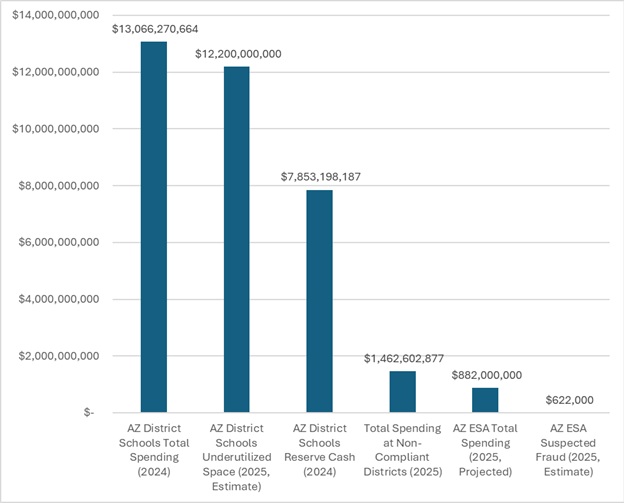
Misuse of the ESA program is vanishingly small. The Arizona Department of Education’s internal audit had turned up $622,000 in ESA funds that are “possible fraud or misuse.” That’s approximately 0.05% of total ESA spending over the past two years.
Misuse of funds in the ESA or any other public program must be detected, deterred, and punished. This is in fact happening in the ESA program, as the Arizona Department of Education had already found the misuse, suspended accounts of those responsible, and reports that it is “in the process of collecting more than $600,000” in improper spending. All of this makes the ESA program far more transparent and accountable than Arizona school districts, which do not post their purchases.
And while Deer Valley teachers may indeed purchase their own school supplies, it has nothing to do with the ESA program and everything to do with misplaced district priorities.
One of the oldest tricks in the school district advocate playbook involves pretending that teachers must buy their own classroom supplies because of a lack of funding. The Channel 12 story cites a Deer Valley biology teacher who said she “spends at least $500 of her own money every summer for her classroom.”
Days after the report aired, former Deer Valley school board candidate Tiffany Hawkins revealed that Deer Valley Unified had spent $560,407 to send students and staff on trips to Disneyland, Knott’s Berry Farm, Sea World, Universal Studios, and other destinations in Arizona, California, Hawaii, Indiana, and Texas. Apparently, the district leadership decided that these trips took precedence over classroom supplies for Deer Valley teachers.
Don’t hold your breath waiting for Channel 12 to cover that. Deer Valley Superintendent Finch—who recently faced charges of stonewalling public records requests and illegal electioneering on school grounds—attacked the ESA program for “out of control” spending with “zero accountability.” But his critiques of the ESA program much more accurately describe spending in his own district.
The Arizona Auditor General reports that Deer Valley spends $13,717 per pupil, meaning that a classroom of 25 students thus generates over $340,000 in total revenue. Where did this money go? Mainly not to teachers.
The Auditor General reports that Deer Valley average teacher pay is $2,163 below the state average. If Deer Valley is not prioritizing teachers, what is it prioritizing instead? The Auditor General report helpfully provides an answer: “high” and “very high” spending on administration and transportation, respectively, compared to a group of peer school districts.
The Goldwater Institute recently published a study of Arizona school superintendent compensation. Goldwater needed to use the open-records law to obtain this information, as districts compensate their superintendents in a variety of creative ways outside of their base salary, including providing either vehicles or “car allowances,” extra retirement benefits, and other perks.
The Goldwater Institute found that Deer Valley provides a total compensation package for their Superintendent of $290,505, including a car allowance of $10,000. This car allowance alone could have provided 20 teachers with $500 each for classroom supplies.
Even if one were to take the highly perverse view that students were the indentured servants of the school districts in which they reside, it would still be absurd for Deer Valley Unified officials to blame their problems on the ESA program. Arizona Department of Education reports show that 10,966 students lived within the boundaries of Deer Valley Unified but attended other public schools in 2024.
Deer Valley Unified meanwhile “drained” almost 3,000 students and their funding from other public schools. At the end of 2024, only 709 students had left a Deer Valley school to participate in the ESA program. Four different public schools outside Deer Valley Unified each have enrolled more students who reside in the district than the ESA program. Moreover 217 total public schools outside the district enroll Deer Valley Unified resident students.
Luckily, Arizona policymakers have decided that Arizona children are not merely funding units for their local school districts. Arizona families can use ESAs to choose the schools that are the best fit for the interests and aspirations of their children.
Arizona school districts have never had as much money as they have now, enough apparently to prioritize trips to California and perks for superintendents. If Deer Valley Unified officials hope to gain the enrollment of the thousands of resident students who have chosen to pursue their education elsewhere, a clear path forward would be to prioritize their funding.
Purchasing classroom supplies for teachers would be a great first step.
Matthew Ladner is a Senior Advisor for education policy implementation and Jason Bedrick is a Research Fellow at the Heritage Foundation’s Center for Education Policy.
After overcoming months of stonewalling, the Goldwater Institute has issued a report revealing that school district superintendents in Arizona are awarded some of the most lucrative public service contracts in the state.
The report, by Goldwater’s Director of Legal Strategy for Education Policy Christopher Thomas, uncovered perks including “car allowances,” performance bonuses, duplicate private retirement packages (“funding private retirement accounts on top of their already generous state pension benefits”), and “generous personal and vacation leave banks” that can be “cashed out.”
“For taxpayers, the secrecy should set off alarms,” Thomas said in an article for Goldwater. “Superintendents are not just any employee—they are the CEOs of their districts, the highest-paid public servants in many counties. They are also the only officials directly accountable to the elected school board. The superintendent’s job is important, and high salaries may be justified. But the current system of secrecy and delay erodes public trust.”
In a post to X, the Goldwater noted that the superintendents enjoy, “Duplicate retirement packages. Monthly car allowances large enough to lease high-end sports cars. Performance bonuses,” and added, “These are just some of the benefits that AZ school superintendents receive that make them among the state’s highest paid public employees…”
Duplicate retirement packages. Monthly car allowances large enough to lease high-end sports cars. Performance bonuses.
These are just some of the benefits that AZ school superintendents receive that make them among the state’s highest paid public employees…
In the text of the report entitled, “The Hidden Ways Arizona School Superintendents Are Paid,” Thomas analyzed contracts from 41 of the largest school districts in Arizona, extracted over four months despite “district stonewalling,” and “a tangle of complex contract provisions that school boards, and the superintendents themselves, deliberately design to mask the full measure of compensation from taxpayers.“
Perhaps the most egregious example highlighted in the report is the compensation package for the embattled Superintendent of the Tolleson Union High School District, Jeremy Calles.
Although the district ranks only 16th in size statewide—and continues to face corruption allegations while posting student proficiency rates below both state and peer averages (21% in math and 26% in English)—Superintendent Calles receives an annual compensation package of $491,360, exceeding that of every other surveyed superintendent by more than $100,000.
Calles’ full earnings include a base salary of $361,584, already the highest in Arizona by $111,000, per Goldwater, plus $72,316 in performance pay, substantial retirement contributions beyond his state pension, a car allowance, and the ability to bank up to 120 unused personal days for a potential $166,184 cashout upon his departure from office.
The Tolleson Union High School District is hardly unique in this respect, according to the report. Monthly stipends or “car allowances” are in place at districts ranging from $500 per month at Marana USD and Littleton ESD to as much as $1,250 per month in Amphitheater USD and Sahuarita USD. Some districts even offer these as annual lump sums, such as Tucson USD, which offers a cool $20,000 annually, or Laveen ESD, which comes in just shy at $19,475 per year.
Concluding his report for the Goldwater Institute, Thomas summarized both the extravagant compensation packages and the seemingly deliberate lack of taxpayer transparency into them. “Superintendents have important jobs. In each district, they are the one employee the school board hires, supervises, and may ultimately terminate,” he said. “The superintendent is responsible for student achievement, implementing board policy, recommending staff hires, and overseeing school district finances. They understandably command the highest salary in the school district. However, there should be greater transparency in just how much they are paid. Their contracts may be among the most important public documents held by school districts. Because of this, these contracts should be readily available to the public.”
Thomas further recommended corrective action, adding, “In addition, school districts should publish total compensation analyses for their superintendents, listing the value of all the perks that are included in their contracts. It is likely that most school board members do not fully understand how their superintendent is paid, nor all the sources of compensation the superintendent receives. Surprisingly, many have never even seen the superintendent’s contract, and some have been denied access when they’ve requested it.”