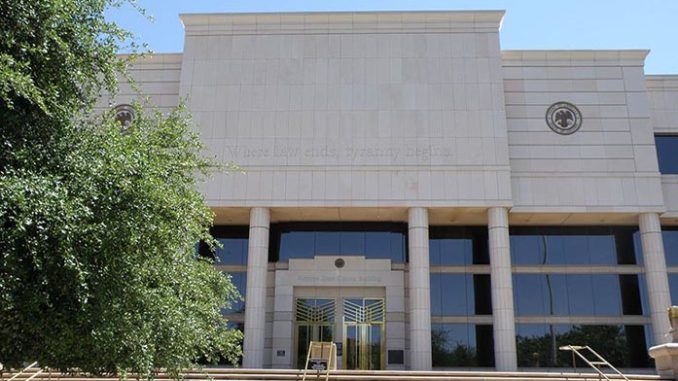
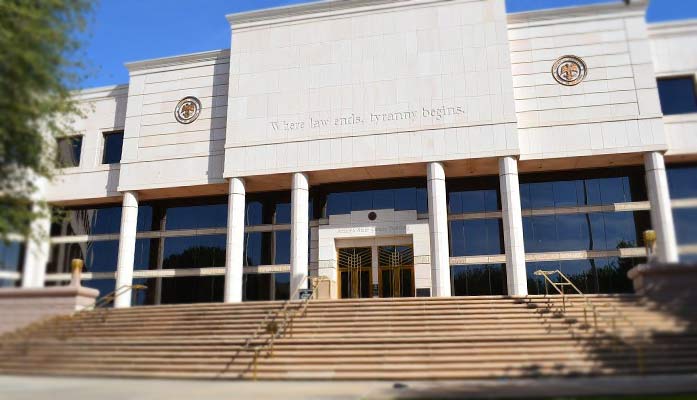
Attorneys from the Goldwater Institute, representing the Center for Arizona Policy and the Arizona Free Enterprise Club, joined former Arizona Supreme Court Justice Andrew Gould on Thursday to challenge Proposition 211. The measure, called the “Voters’ Right to Know Act,” is being contested on the grounds that it violates the state Constitution’s protections for free speech and privacy.
In the wake of Turning Point USA co-founder Charlie Kirk’s assassination—and a decade marked by attacks on political figures—the security risks of effectively doxxing political donors loom large in the case.
If upheld, the law would force nonprofit groups that weigh in on ballot measures or reference incumbents near an election to publicly disclose their donors—not just names and amounts, but also home addresses and employers—in a searchable database.
In today’s climate of escalating political violence—from death threats and swatting to vandalism, arson, and even assassinations—a database like this could essentially become a “hit list.”
In the AZ Supreme Ct today w my @GoldwaterInst colleagues to defend free speech & privacy rights in the #Prop211 case. You can learn more about the case here https://t.co/AzcEiCOulg
And watch the oral argument live in a few minutes on the court’s website: https://t.co/dkcgE7KDHC
In a press release the Goldwater Institute explained its position stating, “While proponents of the Voters’ Right to Know Act say they’re simply combatting so-called ‘dark money’ in politics, it is clear to Goldwater and its clients — the Center for Arizona Policy, the Arizona Free Enterprise Club, and individual donors — that their real intent is to intimidate their political opponents into silence.”
“Arizona’s Proposition 211 is as un-American as it is dangerous. No one should be exposed to retaliation or violence simply for supporting causes they believe in,” said Jon Riches, Goldwater’s Vice President of Litigation. “The law also violates Arizona’s Constitution, which provides stronger protections for freedom of speech and privacy than even the U.S. Constitution. That’s why we at the Goldwater Institute believe the Arizona Supreme Court will ultimately strike down Proposition 211.”
Prop 211 is silencing free speech in Arizona!!!
At today’s press conference, Scot Mussi of the Arizona Free Enterprise Club explained how this vague and dangerous law forced us to curtail our speech last campaign cycle. Why? Because Prop 211 puts the privacy and safety of donors… pic.twitter.com/fgctJGt5K4
Arizona Free Enterprise Club President Scot Mussi added, “They’re afraid of the activist organizations out there. They’re afraid of politicians and others that want to exact retaliation because they simply support a position or belief that they disagree.”
Mussi characterized the law as “a dangerous threat to our right to free speech and association.”
“As drafted, the law can be used to unconstitutionally target and harass private citizens, including our organization and our supporters,” Mussi stated. “We are confident that the Supreme Court will recognize the danger this law poses and will rule in our favor.”
In a statement to AZ Free News in May, Mussi elaborated on the potential for political intimidation: “Both the U.S. Constitution and the Arizona Constitution guarantee citizens the right to speak freely, which includes the right to not be forced to speak. Prop 211 not only violates this right for donors by silencing them from supporting causes they believe in but impairs the speech of nonprofits like ours as well.”
Peter Gentala, President of the Center for Arizona Policy, stated in a press release that Proposition 211 “creates an atmosphere of fear among those who support nonprofits that engage in the most pressing issues in Arizona today.”
Goldwater Institute attorneys and former Arizona Supreme Court Justice Andrew Gould are set to argue against Proposition 211 at the Arizona Supreme Court on September 11th. The Goldwater attorneys and Justice Gould argue that Prop 211, which requires nonprofit organizations to disclose the personal information, including names and addresses, of all their donors, violates the Arizona State Constitution’s guarantee of privacy.
According to Goldwater, “Under that law, donors to organizations that spend money on initiative campaigns must have their names, addresses, phone numbers, and employment information placed on a publicly accessible government list—thereby inviting retaliation, ostracism, and even violence.”
Goldwater Vice President of Litigation Jon Riches told AZ Free News, “Arizona’s Proposition 211 is as un-American as it is dangerous. No one should be exposed to retaliation or violence simply for supporting causes they believe in. The law also violates Arizona’s Constitution, which provides stronger protections for freedom of speech and privacy than even the U.S. Constitution.”
He continued, “That’s why we at the Goldwater Institute believe the Arizona Supreme Court will ultimately strike down Proposition 211 and offer the first clear roadmap for mounting state constitutional challenges to donor-disclosure laws across the country.”
The legal challenge was brought by Goldwater Institute on behalf of the Center for Arizona Policy and the Arizona Free Enterprise Club, working on the basis that “Arizona’s constitution forbids the state from stripping people of their confidentiality as the price of supporting or opposing a political view.”
The AZ Supreme Court will hear @GoldwaterInst’s lawsuit challenging the constitutionality of Prop 211, a 2022 law that strips donors & nonprofits of their privacy rights if they support or oppose ballot initiatives. https://t.co/aUU8E40rK1
The Arizona State Constitution, unlike its federal counterpart, offers explicit protections for privacy in Article 2, Section 8, which reads, “No person shall be disturbed in his private affairs, or his home invaded, without authority of law.” Likewise, under Article 2 Section 6, the right for all Arizonans to “freely speak, write, and publish on all subjects,” when coupled with the landmark Supreme Court of the United States case Citizens United v. Federal Election Commission would seem to overwhelmingly uphold the right of Arizonans to donate privately to support or oppose a political cause.
As the late Justice Antonin Scalia observed, “The dissent says that ‘speech’ refers to oral communications of human beings, and since corporations are not human beings they cannot speak. Post, at 37, n. 55. This is sophistry. The authorized spokesman of a corporation is a human being, who speaks on behalf of the human beings who have formed that association—just as the spokesman of an unincorporated association speaks on behalf of its members. The power to publish thoughts, no less than the power to speak thoughts, belongs only to human beings, but the dissent sees no problem with a corporation’s enjoying the freedom of the press.”
In May, Scot Mussi, President of the Arizona Free Enterprise Club, echoed that sentiment writing, “We are thankful that the Arizona Supreme Court accepted review of this vital case for our First Amendment liberties. Both the U.S. Constitution and the Arizona Constitution guarantee citizens the right to speak freely, which includes the right to not be forced to speak. Prop 211 not only violates this right for donors by silencing them from supporting causes they believe in but impairs the speech of nonprofits like ours as well. We are hopeful that the Arizona Supreme Court will rule in favor of the Constitution after considering the merits of the case.”
The legacy media seem to be on a mission: tear down Arizona’s groundbreaking school choice program with false accusations and inaccurate reporting.
Fortunately, facts don’t lie, even if the media does.
The Arizona Capitol Times declared this week in astonishing terms, “Education department under fire for approving $124M in improper ESA [education savings account] purchases.”
Such astronomical levels of fraud would seem to threaten the very foundations of the historic school choice revolution that has swept the nation. There was just one problem, the headline was completely false.
Not only were the supposed dollar amounts exaggerated up to 100 times greater than the amounts of improper spending actually reported by the department, but these purchases weren’t even approved in the first place.
Here’s the story the media won’t tell: Arizona’s 2022 adoption of a fully universal ESA program has been a nation-leading success, allowing parents across the state to give their children an education best suited to their needs.
To its credit, the Times quickly retracted its original headline and issued a formal correction admitting “an inaccurate dollar amount” in its first draft and eliminating the suggestion that the purchases were “approved.” Unfortunately, such journalistic ethics appear not to be shared by the Times’ more ideological media counterparts in Arizona, particularly those of the teachers’ union-aligned 12News team, who have resolutely declined to correct or retract their false reporting.
12News’ Craig Harris, for instance, has repeatedly and falsely declared that the state has “approved” ESA purchases for iPhones, televisions, and other non-educational items over the past year.
But all those purchases haven’t been approved, as the State Board of Education’s ESA Handbook—ratified by members appointed by both former Gov. Doug Ducey and Gov. Katie Hobbs—makes clear. The document expressly states that while families’ ESA purchases under $2,000 are promptly reimbursed by the state, these items “are not deemed ‘approved’ by the Department, until they are audited OR the timeframe to audit the orders has passed [2 fiscal years].” Just like their tax returns filed with the IRS, these families’ ESA purchases are processed up front and subject to enforcement afterwards.
Yet, 12News either knowingly misrepresented the status of these orders or else incompetently failed to perform basic due diligence to learn how the program operates.
By 12News’ anti-ESA logic, the IRS should apparently also withhold refunds to taxpayers until their tax returns have been audited potentially years later, rather than promptly when the returns are filed.
Unfortunately, this is not the first time that 12News’ anti-school choice reporters have been exposed in such light. In 2018, Harris (then with the Arizona Republic) falsely reported that Arizona charter schools produced worse student graduation rates and worse outcomes on the state A-F letter grade system than district schools. Both claims turned out to have been fabricated results stemming from a faulty, agenda-driven data analysis by Harris’ team.
In 2024, 12News’ Joe Dana likewise doubled down on false claims that ESAs cost state taxpayers more than the public school system per student by conveniently ignoring major sources of public school funding. The state’s Classroom Site Fund, for example, allocates over $1,000 for every public school student in the state and gives not a penny to ESA families.
Undeterred by journalistic standards, Dana’s 12News team also went further, deceptively extracting a fragment of a statement given by the state’s budget director (given in response to a completely different question) to suggest the ESA program had created unprecedented strain on the state budget.
The Heritage Foundation’s Matt Ladner and Jason Bedrick have already exposed a litany of deceptive claims flowing from outlets like 12News, while more prestigious national news organizations like The Washington Post have seen their recent anti-ESA narratives similarly debunked. Yet none of these outlets have expressed any contrition for their deceptive coverage.
Indeed, in perhaps the richest of ironies, Harris’ 12News team recently attacked ESAs for “hurting” high-performing schools like Arizona charter network BASIS by competing with it for students. Never mind that Harris previously attacked BASIS for its alleged poor stewardship of taxpayer funds. Now that it is clear he and the media were on the wrong side of that school choice debate as well, they have simply shifted to a new enemy in their war on parents.
Looking at the whole of Arizona’s education landscape, there is no question that those who seek to defraud the state—whether via the traditional public school system or its competitors—should be prosecuted to the full extent of the law. But if there is a scandal in our education system, it is the dishonest reporting by journalists who are more disturbed by parental empowerment than by the tens of billions of dollars squandered year after year in chronically poor performing public schools.
Matt Beienburg is the Director of Education Policy at the Goldwater Institute.
Have you heard the charge that Arizona families are using Empowerment Scholarship Accounts (ESA) for babysitting? Or that ESA families are sitting on millions of dollars that they’re using for expensive, overseas vacations? Or that the ESAs only benefit wealthy families who live in high-performing school districts?
These claims range from “lacking key context” to “lacking any evidence whatsoever.” The main source of these and other horror stories that school-choice opponents tell is reliably left-leaning Arizona media outlets such as Channel 12 and the Arizona Republic.
It’s no surprise. Reporters at these outlets, such as Craig Harris, have a history of inaccurate agenda-driven “reporting” on Arizona’s school choice policies. Recent articles and “news” segments from these and other outlets are in keeping with this history.
Award-Winning Errors
In 2018, the Republic released a series criticizing Arizona’s charter schools. The series won the paper a Polk Award. The only problem is that it was riddled with errors.
For example, the Republic claimed that Arizona’s traditional district schools outperformed the state’s charter schools as measured by the state’s A-F school grading system and graduation rates. Both these claims were demonstrably false, but the Republic never ran a correction.
Matthew Beienburg of the Goldwater Institute detailed at length the numerous errors the Republic made to reach those incorrect conclusions, describing the story as “astonishingly deceptive.” For example, they counted one charter school as having a graduation rate of 0% when the school only offered instruction through 9th grade. Two more schools that supposedly had 0% graduation rates had closed years earlier. Another charter school with a low graduation rate was an alternative school that operated under the Yuma County Juvenile Justice Center—hardly an apples-to-apples comparison for typical district schools.
In 2019, the Republic released an above-the-fold, front-page story claiming that 100 of Arizona’s then 544 charter schools were in imminent danger of closure. The report said it was a “near certainty” that at least 50 would close “in the near future.” You’d think such a sensational claim would warrant a healthy dose of skepticism, but the Republic was more than happy to breathlessly repeat the claims nearly unchallenged.
Six years later, 580 charters operate in the state, defying predictions of a mass extinction. In fact, on the most recent National Assessment of Educational Progress, Arizona’s charter school students scored over two grade levels higher than district students on 8th grade mathematics and by almost two grade levels on 8th grade reading. The state’s charter school students also scored higher than any other statewide average on both subjects.
You won’t see those facts reported by Arizona’s legacy media.
Journalism’s Credibility Crisis
For careful journalists concerned with their personal credibility and the declining credibility of their profession with the American public, these embarrassing errors might have sparked some self-reflection upon their sources and practices. For the Republic, it was merely a warmup for more of the same.
Author Amanda Ripley, interviewed for a book she wrote on deep problems of journalism, noted the “strange and insular world of journalism prizes,” which encourage simplistic “us versus them” stories. “This adversarial model that we’ve got going in education, journalism, and politics no longer serves us. There’s a good guy and a bad guy and everything’s super clear, it just breaks down. And we keep awarding prizes in that model. But 99 percent of stories are not that clear-cut,” Ripley noted.
In other words, as if journalism did not have enough problems amid a pronounced decline in public confidence, journalism awards—like the Polk Award given to the Republic team for their inaccurate and ideological anti-charter school series—encourage advocacy-style journalism.
There Is No Evidence Families Used ESAs for Babysitting
Channel 12’s recent anti-choice crusade involves a series of clumsy attacks on Arizona’s Empowerment Scholarship Account program.
One myth Channel 12 has been attempting to spread is the notion that participants in the ESA program are using their accounts to pay for “babysitting.” In fairness, this claim is based upon a since-corrected misstatement by a representative of the Arizona Treasurer’s Office. The ESA program, however, has a list of allowable uses for accounts, and babysitting is not now—nor has it ever been—an allowable use.
Despite the correction by the Treasurer’s Office, some in the media are still spreading the claim. Asked about this on KTAR days after the correction, reporter Craig Harris of Channel 12 (who authored or co-authored the erroneous Republic articles described above) artfully claimed that the Arizona Department of Education’s use of risk-based auditing on low-dollar purchases means that we really don’t know whether parents are using ESA accounts for babysitting or not.
We can likewise state that we really don’t know whether any random person has cheated on his or her federal income taxes. After all, the IRS does not audit every single income tax return—instead they use a technique known as “risk-based auditing” to detect and deter fraud. This is the same technique that Arizona law established to ensure accountability in the ESA program, as recommended by the Arizona Auditor General, and it is used by numerous government agencies.
Journalists have no evidence that anyone has ever used the ESA program for babysitting. But if it happened and they were caught, just like the hypothetical tax cheat, the hypothetical ESA offender would face fines or even jail time. The combination of risk-based auditing and consequences for fraud is why the United States has one of the highest tax compliance rates in the world.
ESA Parents Are Not Really “Subsidizing Vacations”
Channel 12 is likewise playing fast-and-loose with the facts when they claim that Arizona parents are “using education tax dollars to subsidize their vacations.” That phrasing gives the impression that ESA funds are being used for flights, food, or hotel stays—none of which are allowable expenses under the ESA statute.
The reality is that families are using ESA funds to buy tickets to museums, zoos, aquariums, and other educational venues that are—appropriately—allowable expenses under the ESA statute, and which public schools regularly purchase as well.
ESAs Expand Educational Opportunity
Stories from the same outlets also claim the ESA is “hurting high-performing public districts.” Even setting aside that such statements treat children as mere funding units for district schools, reporters’ use of the term “high-performing” is out of step with what most parents think it should mean.
The article notes that the “top five school districts losing students who left for [ESAs] are: Mesa, Deer Valley, Chandler, Peoria and Scottsdale,” and that all these districts received an “A” letter grade from the state except for Mesa, which received a “B.”
But are Arizona’s school letter grades a reliable indicator of quality? Absolutely not.
In the 2023-24 academic year, Arizona awarded 677 schools “A” grades, while only four schools “F” grades—yet only a third of Arizona students passed the state math exam.
By contrast, GreatSchools is a much harsher grader than state bureaucrats. In Maricopa County, the state awarded 325 “A” grades and only two “F” grades, while GreatSchools gave 49 “A” ratings and 111 “F” ratings. For obvious reasons, parents trust GreatSchools more than they trust state bureaucrats.
In the five districts that parents are fleeing most for ESAs, the percentage of students scoring “proficient” or higher on the state math test ranges from 30% in Mesa to 58% in Chandler. Fewer than half of students scored proficient in Deer Valley and Peoria as well.
Reporters who are hostile to parental choice in education might call that “high performing,” but most parents don’t.
Arizona families deserve accurate reporting on education policy, not sensationalized narratives built on flimsy foundations. Arizona media’s pattern of misrepresenting school choice programs—from the error-ridden charter school series to unfounded attacks on ESAs—undermines the public’s understanding of legitimate educational options.
While parents increasingly turn to alternatives like ESAs and charter schools that demonstrably outperform traditional districts, journalists have a responsibility to report these developments fairly, not perpetuate myths that serve no one except those invested in maintaining the status quo. Arizona’s children benefit when families have genuine choice in education, and they deserve journalism that illuminates rather than obscures the facts about their options.
Matthew Ladner is a Senior Advisor for education policy implementation and Jason Bedrick is a Research Fellow at the Heritage Foundation’s Center for Education Policy.
The Goldwater Institute has filed a federal lawsuit against the Equal Employment Opportunity Commission (EEOC), demanding answers about an ongoing government case targeting a California-based moving company with a $15 million fine for alleged age discrimination.
At the center of the dispute is Meathead Movers, a family-owned business founded in 1997. The company has grown into California’s largest independently owned moving company, employing more than 300 workers. Its business model emphasizes physical endurance and customer service, with employees jogging to and from trucks when not carrying furniture.
The EEOC launched an investigation into Meathead Movers in 2017, accusing the company of discriminating against older applicants and using marketing materials that allegedly promote age bias. The case is unusual because it is an “agency-initiated” lawsuit—meaning the EEOC filed it without an official complaint from an alleged victim. The EEOC only pursues a small number of such cases each year.
According to the Goldwater Institute, that lack of a public complaint is precisely why the group is now suing the federal government. In March, the Institute submitted a public records request asking the EEOC to disclose whether any individuals had actually filed complaints against Meathead Movers and whether similar actions had been taken against other companies. The EEOC denied the request, citing privacy concerns.
The Goldwater Institute argues that the refusal to disclose this information violates federal transparency laws. “Privacy is for individuals, not government agencies,” the Goldwater said in a statement. “Transparency is a legal requirement, especially when taxpayer-funded agencies wield their power against private businesses.”
Critics of the EEOC’s case say the lawsuit defies common sense. Moving companies, by nature, require employees capable of lifting heavy furniture and working long hours in physically demanding conditions. The Goldwater Institute points out that Meathead Movers has employed workers of all ages and argues there is no evidence of systemic discrimination.
“This isn’t just about one company,” said a spokesperson for the Goldwater Institute. “If the government can pick a successful business, launch a multimillion-dollar enforcement action without an actual complaint, and then refuse to explain why, it sets a dangerous precedent for small businesses everywhere.”
As the lawsuit moves forward, the Goldwater Institute says it will continue to press for the release of records, arguing that public accountability is at stake.
Jonathan Eberle is a reporter for AZ Free News. You can send him news tips using this link.