by AZ Free Enterprise Club | Jan 25, 2025 | Opinion
By the Arizona Free Enterprise Club |
As President Trump gets to work cleaning up Joe Biden’s failed economy, the last thing the people of Arizona need is to be sending their hard-earned dollars to woke Hollywood. But that’s exactly what’s happening.
Thanks to a law passed in 2022, movie companies that film in Arizona will begin receiving refundable tax credit subsidies this year—up to 15 percent if they spend up to $10 million in production costs, 17.5 percent if they spend between $10 million and $35 million, and 20 percent if they spend over $35 million. Then, to top it all off, these movie companies can get an additional 2.5 percent if they meet other criteria.
But here’s the real kicker. The keyword in all of this is “refundable.” This essentially means that if a movie company qualifies for more credits than they owe in taxes, the State of Arizona sends them a check!
So, how much does this outrageous tax scheme cost the people of Arizona?
Up to $125 million each year!
For that kind of money, there must be at least some kind of return on this investment, right? Nope.
If a company comes to Arizona, films a movie, mentions our state in the credits but decides not to release or distribute the film, it still receives the money.
Yes. You read that right. Arizona taxpayers could be funding Hollywood movies that won’t ever see the light of day…
>>> CONTINUE READING >>>
by Matthew Holloway | Jan 25, 2025 | News
By Matthew Holloway |
Governor Katie Hobbs is now facing a serious legal challenge from the Goldwater Institute, acting on behalf of the Home Builders Association of Central Arizona, to put a stop to what Goldwater described as “one of the most significant bureaucratic overreaches in Arizona’s history.”
On Wednesday, Goldwater announced the lawsuit against Arizona’s Democrat Governor stating that Hobbs is “taking illegal actions” that would worsen the state’s ongoing housing crisis by imposing a certification requirement in parts of Maricopa County that, in addition to showing a 100-year groundwater supply, must also meet the dubious standard of “unmet demand.”
Writing for Goldwater, Stacy Skankey explained, “Although the phrase ‘unmet demand’ does not exist in Arizona law, this new rule now requires homebuilders to show a 100-year groundwater supply across the entire water management area (a specially designated area with a reliance on groundwater) rather than at the site of the proposed development. In other words, if a groundwater shortage is projected anywhere within a management area, the Department of Water Resources now claims that there is insufficient groundwater elsewhere in the Valley.”
As reported by AZ Free News in December, Goldwater penned a letter to the Arizona Department of Water Resources (ADWR) urging the agency under Hobbs to reconsider its “AMA Wide Unmet Demand Rule,” noting that the new rule was in violation of the law having been imposed without legislative approval or via the required rulemaking process.
According to ADWR, “Unmet demand occurs when the model cannot simulate pumping of all demands included, thereby creating a pumping shortfall or deficit. This pumping shortfall or deficit occurs when there is insufficient saturated aquifer to satisfy the pumping demand (i.e., the depth-to-water level reaches bedrock) or when the depth to water exceeds 1,100 feet after 100 years of simulated pumping.”
Essentially, unmet demand occurs when the state’s modeling is insufficient to predict demand. In other words, the basis for shutting down Arizona housing development is that the Hobbs administration’s simulation doesn’t work.
As noted in an op-ed for the AZ Capitol Times by CEO of the Home Builders Association of Central Arizona Jackson Moll and Goldwater Institute Vice President for Litigation Jon Riches, the Phoenix Active Management Area (AMA) Groundwater Model being used by the Hobbs administration, coupled with the ‘unmet demand’ standard, moves the goalposts on developers who have mitigated impact on the state’s water needs for nearly 30 years by replenishing pumped groundwater back into the water table.
Riches said in a statement, “Decisions on vital statewide concerns like the availability of affordable housing and the responsible stewardship of our natural resources should be made through a transparent, democratic process—not imposed by executive fiat.”
Moll added, “Gov. Hobbs’ deeply inaccurate and flawed claim that Arizona is running out of groundwater is having devastating effects on housing affordability in the state, which already ranks among the worst in the country.”
Matthew Holloway is a senior reporter for AZ Free News. Follow him on X for his latest stories, or email tips to Matthew@azfreenews.com.
by Daniel Stefanski | Jan 22, 2025 | News
By Daniel Stefanski |
One of Arizona’s leading watchdog organizations is starting off the new year with a significant lawsuit.
Last week, the Goldwater Institute announced that it had challenged “Arizona’s unconstitutional tax subsidies for filmmakers.” The lawsuit, McEwen v. Arizona Commerce Authority, was filed in the Superior Court of the State of Arizona for Maricopa County.
In that lawsuit, attorneys for the Goldwater Institute wrote that “this case challenges the constitutionality of a state program that subsidizes the film industry and private film companies to the tune of millions of dollars in refundable tax credits each year.” The filing adds that “The Arizona Motion Picture Production Program violates the Arizona Constitution’s Gift Clause, both facially and as applied to two film production projects approved to receive taxpayer-funded subsidies.”
Parker Jackson, a Staff Attorney at the Goldwater Institute, wrote a blog post about the lawsuit after it was filed with the court. He said, “…In 2022, when the state legislature controlled a $5.3 billion surplus, film industry executives and lobbyists who for years had failed to revive a subsidy program seized their chance to get back in on the action. They cobbled together enough votes to enact the Arizona Motion Picture Production Program, which provides up to $125 million in refundable tax credits each year to qualified film production projects. ‘Refundable’ means that if a film company qualifies for more in credits than they owe in taxes, the state cuts them a check! That’s even worse than the old program, which only allowed for ‘transferable’ credits (meaning the recipient could transfer or sell the credit to someone else, but the state didn’t directly send them cash).”
Jackson shared that “After delays due to administrative rulemaking and recent strikes that rocked the film industry, the state is set to finally begin issuing the first round of credits this year. The Arizona Commerce Authority has begun the process of approving subsidies up to $1.2 million for a single project.”
The Goldwater attorney finished his piece, saying, “These types of abuses are exactly why the Arizona Constitution prohibits the state from subsidizing or otherwise giving out money for private purposes unless taxpayers receive direct benefits in return. That means that the state can contract with private companies to perform services or provide supplies at fair market rates, but donations, grants, subsidies, and other forms of corporate aid are not allowed.”
Daniel Stefanski is a reporter for AZ Free News. You can send him news tips using this link.
by Matthew Holloway | Jan 12, 2025 | Economy, News
By Matthew Holloway |
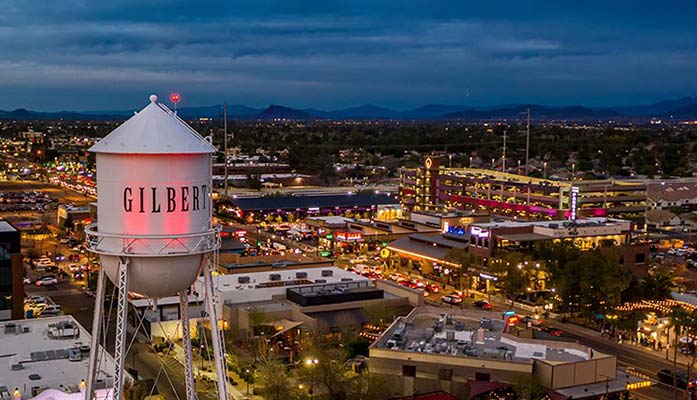
The Town of Gilbert is the target of a lawsuit by the Goldwater Institute on behalf of the Home Builders Association of Central Arizona and a local property owner, Jonathan Barth, for allegedly violating the Arizona Constitution which bans tax increases on “services.”
According to Goldwater, the tax increase imposed by the Town of Gilbert includes “many types of business that do not produce tangible goods, such as advertising, photography, utilities, hotel/lodging, and construction.”
Goldwater is challenging two of the tax increases in particular: on homebuilding and short-term rental properties.
As noted in the text of the lawsuit, the Arizona Constitution prohibits “any county, city, town, municipal corporation, or other political subdivision of the state, or any district created by law” from creating any new or increasing any existing transaction-based taxes on the “privilege to engage in, or the gross receipts of sales or gross income derived from, any service performed in this state.”
The new tax ordinance in question, per the Town of Gilbert’s website, imposes a 0.5% increase in the existing sales tax and creates a “use tax” to be “paid for by residents and businesses when purchases are made online with out-of-state vendors who do less than $100K of sales in Arizona per year.”
The lawsuit explains that, “As a result of the Ordinance, individuals, businesses, and taxpayers, including Plaintiff Jonathan Barth, who engage in the rental or lease of real property, including for transient lodging, will pay a higher tax rate for the services they perform. Additionally, individuals, businesses, and taxpayers that engage in general contracting services, including the members of Plaintiff Home Builders Association of Central Arizona (“HBACA”), will pay a higher tax rate on the services they perform.”
Barth, an educator and father of five, will be impacted because he earns supplemental income by managing his detached bungalow as a rental for short-term tenants. He told Goldwater, “This tax hike makes it all the more difficult to make ends meet in Gilbert.”
Former Mayor Brigette Peterson and all of the members of the Town Council are named as defendants in addition to the town itself.
The town allegedly intends to use the projected $55 million yield of this new tax for “Critical Infrastructure Projects,” adding that “Time is of the essence as many of Gilbert’s services are over capacity and new infrastructure is needed.”
The Goldwater Institute has found however, that these “Critical Infrastructure Projects,” include pickleball courts, splash pads, a ropes course, and a “statement” bridge.
The Home Builders Association of Central Arizona (HBACA) told Goldwater that the new taxes will result in increased construction costs in the town as well. HBACA CEO Jackson Moll warned, “Gilbert officials are trampling on their own constituents’ rights with no regard for the consequences their illegal actions will have on taxpayers and homebuyers. The Arizona Constitution is clear: increasing taxes on services, including on construction contracting, is unlawful.”
As previously reported by AZ Free News, the Goldwater Institute pursued a similar action against the Town of Payson in September when the Town Council decided to incur a $70 million debt via a bond measure without a public referendum.
Matthew Holloway is a senior reporter for AZ Free News. Follow him on X for his latest stories, or email tips to Matthew@azfreenews.com.
by Matthew Holloway | Dec 20, 2024 | News
By Matthew Holloway |
According to a recent letter from the Goldwater Institute, Governor Katie Hobbs’ administration has imposed a regime of regulation that has ground the development of new home construction in the fast-growing areas of Maricopa County to a halt. Now, the organization is challenging the validity of the newly established rules.
A press release this week from Goldwater stated that the action conducted by the Arizona Department of Water Resources (ADWR), which lacks the approval of the Arizona legislature or a formal regulatory approval process, is “driving up housing costs for all Arizonans and threatens to stifle economic growth in our state.”
Goldwater went on to characterize the ADWR’s move as “one of the most significant bureaucratic overreaches in Arizona’s history.” In its letter to the agency, it urged leaders to reverse course.
Jon Riches, Goldwater’s Vice President for Litigation, explained in his letter:
“ADWR has imposed two AMA-Wide rules that have prevented HBACA (Home Builders Association of Central Arizona) members from obtaining Certificates of Assured Water Supply. The first of these invalid rules provides that, if groundwater modeling predicts that a well may not be able to fully satisfy projected demand in any location within the Phoenix AMA Model domain within the next 100 years, then there is no groundwater available throughout the entire model domain (‘AMAWide Unmet Demand Rule’). The second invalid rule provides that if modeling predicts that depth-to-water will exceed 1,000 feet in any location within the Phoenix AMA in the next 100 years, then there is no physical availability of water anywhere within the Phoenix AMA model domain (‘AMA-Wide Depth-to-Water Rule’).”
Goldwater noted that the AMA-Wide Unmet Demand Rule doesn’t exist under Arizona law and was not adopted through the legal rulemaking process. It argued that under previous rulings in Arizona courts, the policies are “rules” and are legally subject to Administrative Procedure Act’s (“APA”) rulemaking process. Specifically, it cites “an agency policy as a rule subject to the Administrative Procedures Act’s rulemaking process as one that ‘is generally applicable, and … implements, interprets or prescribes law or policy, or describes the procedure or practice requirements of an agency.’”
Furthermore, the rule was reportedly created under what Goldwater refers to as a “flawed concept,” the eponymous “unmet demand,” which establishes that if a groundwater shortage is projected by models at any location within a given management area, then zero groundwater across that area will be considered available for any use.
“The model further compounds this issue by arbitrarily placing wells throughout the management area that do not move over the course of 100 years, far in excess of the life expectancy of most wells,” Goldwater writes.
”If water in a hypothetical well is projected to dip below a certain depth in the East Valley, the agency declares a water shortage for developments in entirely unrelated areas like the West Valley.”
In the release, the Goldwater Institute expressed concern that the Hobbs administration took this action unilaterally, effectively defying both the legislative and judicial branches of the Arizona government in what amounts to a massive overreach of her executive authority.
Matthew Holloway is a senior reporter for AZ Free News. Follow him on X for his latest stories, or email tips to Matthew@azfreenews.com.