by Matthew Holloway | May 1, 2026 | News
By Matthew Holloway |
Arizona’s off-cycle elections draw significantly lower voter turnout than general elections while deciding billions of dollars in public spending, according to a new report from the Goldwater Institute.
The report, titled “Off-Cycle Voting in Arizona: Economic and Democratic Costs?”, was authored by Henry Thomson, an associate professor at Arizona State University. It analyzes municipal and school district elections held outside of regularly scheduled general election cycles.
A 2018 state law sought to require that most Arizona elections, except special and recall contests, be held alongside regularly scheduled general elections. However, the City of Tucson challenged the law, prompting a legal dispute over whether the state can mandate election timing for charter cities. In 2020, the Arizona Supreme Court ruled that charter cities have constitutional authority over local election matters and that state law cannot override those provisions unless the issue is one of statewide concern.
According to the report, voter turnout in recent off-cycle municipal elections in Arizona averaged 26.9%, which the analysis states is more than 44 percentage points lower than turnout in comparable on-cycle elections. The report attributes this difference to the timing of elections held outside traditional November general election dates.
The report further states that the composition of the electorate in off-cycle elections differs from that of general elections. It describes off-cycle voters as, on average, older and wealthier, and more likely to have a direct financial interest in government spending decisions.
Thomson writes that these differences in turnout and voter composition may influence policy outcomes. The report states that policies adopted through off-cycle elections may reflect the preferences of a smaller subset of voters rather than the broader electorate.
The report also highlights the scale of fiscal measures decided through off-cycle elections. In November 2023, $4.36 billion in school district spending measures were placed on ballots in Maricopa County, an amount it compares to the county’s annual budget of approximately $4.35 billion.
Examples cited in a Tuesday press release from the Goldwater Institute included a regional transportation plan approved by voters in Pima County in 2026, authorizing approximately $2.67 billion in spending, with less than one-third of registered voters participating, as well as a 2023 Phoenix bond election with a turnout of approximately 22% that authorized hundreds of millions of dollars in spending.
The report argues that the timing of elections is a policy choice made by local governments and may affect participation levels. It states that holding elections outside of general election cycles can result in lower turnout.
“Off-cycle elections convert community decision-making into a procedural rubber stamp, providing a democratic varnish of approval to policies pushed by special interests that benefit from growing local governments and ballooning municipal budgets,” Thomson wrote in the report. “They allow a small, unrepresentative electorate to decide enormous public spending commitments at the local level and should be reformed.”
The report recommends aligning local elections with higher-turnout general election cycles as a potential reform. It states that such changes could increase participation and broaden the electorate involved in local fiscal decisions that impact taxpayers for decades.
Matthew Holloway is a senior reporter for AZ Free News. Follow him on X for his latest stories, or email tips to Matthew@azfreenews.com.
by Staff Reporter | Apr 28, 2026 | News
By Staff Reporter |
Rep. Andy Biggs (R-AZ-05) introduced legislation this week to create stronger rules on court-ordered federal oversight of police.
The proposed bill is a direct response to the ongoing monitorship of the Maricopa County Sheriff’s Office (MCSO), which began well over a decade ago following racial profiling allegations under the administration of former Sheriff Joe Arpaio.
Biggs’ Monitor Accountability Act would further limit federal district courts’ discretion on monitor selection and duration.
The bill as written would limit monitors to five years of service, prohibit courts from reappointing the same monitors under the same court order, prohibit monitors from coming from the same law firm or employer, cap monitor compensation and encourage courts to require pro bono or reduced-cost work, require public comment on proposed monitors prior to court appointment, limit extensions of monitorship to those without substantial and sustained compliance, and require case reassignment to a different judge after six years.
Additionally, the Monitor Accountability Act would apply retroactively to monitorships older than six years. This would ensure Maricopa County — Biggs’ impetus for the bill — secures a new monitor and judge.
The costs associated with the monitorship have neared $350 million according to Biggs and the county, about a tenth of which has gone to the court-appointed monitor and his firm. Proponents of continued monitorship counter that the actual cost of the monitorship amounts closer to $60 million.
Biggs, who is running to unseat Gov. Katie Hobbs this November, released a statement claiming that the MCSO monitorship, among others, has become exploitative.
“The federal monitor’s continued existence in our county and propensity for moving the goalposts from his original charge only serves to exploit taxpayers and undermine the brave work of the men and women who serve our communities — and this is only one of dozens of similar arrangements across the country,” said Biggs. “It’s time for Congress to take back the reins from rogue judges and monitors who have exceeded appropriate bounds.”
Cochise County Sheriff Mark Dannels joined Biggs’ statement with support for the bill as a corrective measure to prevent further exploitation of the monitor system.
“We’ve seen this problem first-hand in Arizona: Maricopa County has been the victim of a rogue monitor for more than 13 years, costing taxpayers hundreds of millions of dollars and shifting resources away from keeping the community safe,” said Dannels.
The Maricopa County Board of Supervisors filed a motion to end the monitorship last December, and in February testified to a House Judiciary Committee hearing on their effort in court. Biggs led that subcommittee hearing.
The board has pleaded for relief from what it claims to be indefinite taxpayer spending to keep up with ever-moving goalposts.
The Goldwater Institute has also requested the court to publicize the invoices associated with MCSO’s monitorship.
“[T]he government should not be allowed to keep such information secret unless there’s good reason, and even then, they’re required to specify what those reasons are,” stated the organization’s vice president of legal affairs, Timothy Sandefur.
The Department of Justice, who initially filed the lawsuit under former President Barack Obama along with the ACLU, signaled support for an end to MCSO’s monitorship.
AZ Free News is your #1 source for Arizona news and politics. You can send us news tips using this link.
by Staff Reporter | Apr 26, 2026 | News
By Staff Reporter |
The housing moratorium crippling new construction in the Valley imposed by Gov. Katie Hobbs’ administration may not go on for much longer.
The Maricopa County Superior Court struck down the moratorium on Tuesday in Home Builders Association of Central Arizona v. Arizona Department of Water Resources, et al.
Under Hobbs, the Arizona Department of Water Resources (ADWR) issued new groundwater regulations rolled out in November 2024 dubbed the “Unmet Demand Rule” and the “Depth-to Water Rule.”
Per the court, these rules went impermissibly beyond the longstanding obligation for builders outlined in Arizona law, which required assurance of sufficient groundwater supply in order for each development to take place (100 years’ worth).
ADWR imposed the rules based on a groundwater model claiming that unmet demand and exceedance of the 1,000-foot depth-to-water limit existed throughout Phoenix. In other words, their regulations meant a developer seeking a certificate for one subdivision had to answer not just for their development area, but for the water status of the entire Valley. This resulted in ADWR’s indefinite suspension on granting certificates to any developers.
The consequence of these regulations brought new home construction to a halt throughout Maricopa County. The Home Builders Association of Central Arizona (HBACA), a trade association for the residential construction and development industry, challenged ADWR’s authority to impose new rules.
ADWR attempted to style the Unmet Demand Rule as a new implementation of an old rule, but the Maricopa Superior Court Judge Scott Blaney rejected that view as an undoing of the necessary limitations of administrative agency powers.
“‘To permit this would neuter all statutory limits on agency rule-making[,]’” stated Blaney in his ruling, quoting HBACA’s argument.
Blaney also found that ADWR didn’t follow state law on agency rulemaking under the Administrative Procedures Act. Blaney invalidated both rules.
“ADWR acted unlawfully by implementing two agency rules without first complying with the mandatory provisions of the APA[,]” wrote Blaney.
The Arizona Free Enterprise Club (AFEC) called the court ruling a win and criticized ADWR’s model justifying the overturned regulations as flawed.
“The Maricopa County Superior Court has struck down the Hobbs Administration’s attempt to impose a sweeping housing moratorium based on its flawed water model — a stinging loss for Katie Hobbs and a ruling that the state failed to follow proper legal procedures,” stated AFEC. “This is a major victory for transparency, accountability, and Arizona homeowners.”
Jonathan Riches, vice president for litigation and general counsel for the Goldwater Institute, represented the Home Builders Association of Central Arizona. Goldwater Institute’s vice president for legal affairs, Timothy Sandefur, hailed the ruling as a necessary check on an administrative state attempting to impose greater burdens than that which the law requires.
“The case is also a reminder of the dangerous power that the pervasive ‘administrative state’ wields over our daily lives — as unelected and unaccountable bureaucracies exert authority over every detail of construction, business, and property ownership, to cite just a few examples,” said Sandefur. “The only solution to the arbitrariness and lawlessness of these agencies is to rein in their power — and for courts to ensure that they obey the law.”
AZ Free News is your #1 source for Arizona news and politics. You can send us news tips using this link.
by Matthew Holloway | Apr 14, 2026 | Education, News
By Matthew Holloway |
A new report from the Goldwater Institute alleges that Arizona’s public universities are not complying with state requirements to provide students with instruction in American civics, history, and economics. The findings follow previous Goldwater reports examining the integration of Diversity, Equity, and Inclusion content into both honors and American civics courses.
The report, titled “Civic Decline: Arizona’s Public Universities Smuggle DEI into Required American Civics Courses,” examines how the state’s three public universities are implementing the Arizona Board of Regents (ABOR) American Institutions policy within their general education programs.
The policy requires universities to incorporate coursework covering key areas of American civics, explicitly stating:
“The study of American Institutions will include at minimum (I) how the history of the United States continues to shape the present; (II) the basic principles of American constitutional democracy and how they are applied under a republican form of government; (III) the United States Constitution and major American constitutional debates and developments; (IV) the essential founding documents and how they have shaped the nature and functions of American Institutions of self-governance; (V) landmark Supreme Court cases that have shaped law and society; (VI) the civic actions necessary for effective citizenship and civic participation in a self-governing society – for example civil dialog and civil disagreement; and (VII) basic economic knowledge to critically assess public policy options and to inform professional and personal decisions.”
The report asserts that some universities are allowing courses outside of traditional civics instruction to satisfy those requirements.
Timothy Minella, director of higher education policy at the Goldwater Institute and the report’s author, said universities are not meeting the intent of the requirement.
“Arizona’s public universities are failing students by allowing niche courses steeped in DEI to satisfy the state’s robust history and civics requirements,” Minella said in a statement released with the report.
At Arizona State University, Minella states that courses such as “Anthropology of American Democracy,” “Social Welfare, Work, and Justice in the US,” and “Theatre and U.S. Democracy” are being used to meet civics requirements.
He argues that the first course, “ ‘Anthropology of American Democracy,’ fails to meet AMIT requirements and instead centers on the claim that American society oppresses certain groups.”
“The syllabus states that the course ‘emphasizes the relationship between personal narratives and broader historical forces, highlighting how belonging, rights, and obligations are experienced differently across diverse social, racial, and cultural contexts.’ … In the list of required readings for the course, there are only two that could plausibly be considered ‘founding documents’: the U.S. Constitution (which appears in only one section of the course) and the Declaration of Sentiments from the Seneca Falls Women’s Rights Convention.
Almost every other reading comes from specialized anthropological studies, including ‘I’m American, not Japanese!: The Struggle for Racial Citizenship among Later-Generation Japanese Americans’ and ‘Replicate, Facilitate, Disseminate: The Micropolitics of U.S. Democracy Promotion in Bolivia.’ Revealing the course’s leftist orientation, one module covers ‘anthropology’s role in American Empire Building,’ requiring students to read excerpts from Base Nation: How U.S. Military Bases Abroad Harm America and the World.”
At Northern Arizona University, Minella’s report identifies courses such as “Sociology of Chicanx and Latinx Communities” and “Indigenizing Museums and the Art World” as qualifying for civics and history requirements.
The report also alleges that the University of Arizona has failed to implement the American Institutions policy.
Minella wrote, “In utter defiance of ABOR’s directive, the University of Arizona (UA) has so far failed to implement AMIT at all. UA’s plan to integrate AMIT into general education has been mired in delays and troubling protocols.”
In December 2025, Mark Stegeman, an associate professor of economics at the University of Arizona, warned the university was failing to implement a civics program in accordance with the ABOR mandate, describing the U of A proposal for a single 3-unit course as “a car crash in the making.”
The report recommends that state lawmakers take action if universities do not fully comply with the policy.
The findings follow a separate March report from the Goldwater Institute examining honors colleges at Arizona public universities, including Barrett, The Honors College at Arizona State University, and the W.A. Franke Honors College at the University of Arizona, and the integration of Diversity, Equity, and Inclusion into honors programs and American civics courses.
The Civic Decline report is available on the Goldwater Institute’s website.
Matthew Holloway is a senior reporter for AZ Free News. Follow him on X for his latest stories, or email tips to Matthew@azfreenews.com.
by Matthew Holloway | Apr 1, 2026 | Economy, News
By Matthew Holloway |
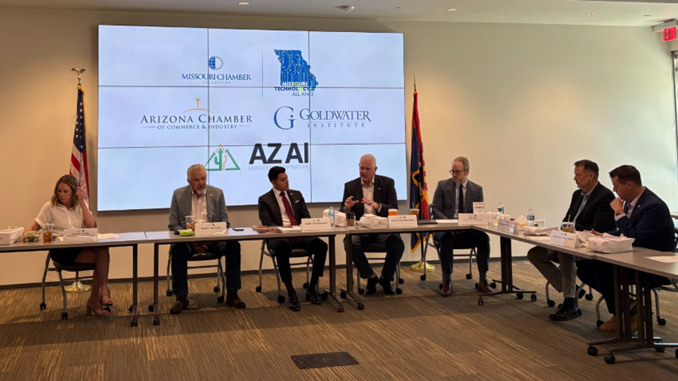
The Arizona Chamber of Commerce & Industry and the Goldwater Institute hosted a delegation of Missouri policymakers in Phoenix to discuss economic competitiveness, innovation, and pro-growth policy, according to a joint release.
The meeting focused on Arizona’s approach to building a competitive environment for emerging industries and long-term economic growth.
The discussion followed the Chamber’s recent launch of its AZ AI Leadership Initiative, which aims to strengthen Arizona’s position in emerging technologies and the broader digital economy.
Arizona has seen rapid expansion in AI and data center infrastructure, driven by growing demand for computing power and cloud services. Major investments from companies such as Taiwan Semiconductor Manufacturing Company (TSMC), which is constructing advanced semiconductor fabrication facilities in Phoenix, along with large-scale data center developments by Google and Meta Platforms in Mesa, and Amazon Web Services in Goodyear, have helped position the state as an emerging hub for both semiconductor production and AI-related computing capacity.
Participants included legislative leaders, policy experts, and representatives from the Arizona Commerce Authority, who shared insights into the state’s policy framework and economic development strategies.
“Arizona’s growth didn’t happen by accident,” said Courtney Coolidge, executive vice president of the Arizona Chamber of Commerce & Industry. “It reflects deliberate policy choices that prioritize certainty, competitiveness, and a regulatory environment where businesses can invest, innovate, and scale.”
Arizona lawmakers participating in the meeting included House Speaker Steve Montenegro (R-LD29), Majority Leader Michael Carbone (R-LD25), Rep. Jeff Weninger (R-LD13), Rep. Justin Wilmeth (R-LD2), chair of the House Artificial Intelligence and Innovation Committee, Senate President Pro Tempore T.J. Shope (R-LD16), and Senate Majority Whip Frank Carroll (R-LD28).
“Arizona has made a conscious decision to lead on innovation rather than wait for other states to set the pace,” Montenegro said. “That kind of alignment and forward-looking policy environment allows industries to grow and scale here.”
Lawmakers and policy leaders highlighted sectors including advanced manufacturing, semiconductors, aerospace, autonomous systems, and emerging technologies as areas where Arizona has seen sustained growth.
“Arizona’s success in attracting major investment is tied directly to our focus on advanced manufacturing, infrastructure, and supply chain strength,” Carbone said.
Weninger pointed to Arizona’s regulatory and tax structure as a factor in business investment.
“Companies are looking for certainty,” Weninger said. “Arizona’s predictable regulatory environment and competitive tax structure give businesses the confidence to invest and expand.”
Participants also discussed the role of infrastructure, water policy, and land use in supporting statewide growth. “We’ve been intentional about making sure economic development isn’t concentrated in one region,” Shope said.
Carroll said Arizona’s approach to economic development has positioned the state for continued expansion, particularly in emerging industries.
Wilmeth emphasized the importance of flexibility in regulating new technologies. “We’ve taken a thoughtful approach to emerging technologies by avoiding premature regulation,” he said.
Victor Riches, president and CEO of the Goldwater Institute, said policy certainty and deregulation remain key factors in supporting innovation.
“As emerging technologies continue to reshape industries, policy certainty and deregulation matter more than ever,” Riches said. “Arizona needs to ensure an environment where innovation can move forward.”
The Missouri delegation included state senators and policy advisors, including Sen. Travis Fitzwater, Sen. Maggie Nurrenbern, Sen. Karla May, Sen. Barbara Anne Washington, Sen. Jamie Burger, policy advisor to Gov. Mike Kehoe, Johnathan Shifflett, and representatives from the Missouri Chamber of Commerce, Karen Buschmann, and Jared Hankinson.
The meeting explored how elements of Arizona’s economic policy framework could be adapted in other states and how interstate collaboration could support broader economic growth.
Matthew Holloway is a senior reporter for AZ Free News. Follow him on X for his latest stories, or email tips to Matthew@azfreenews.com.