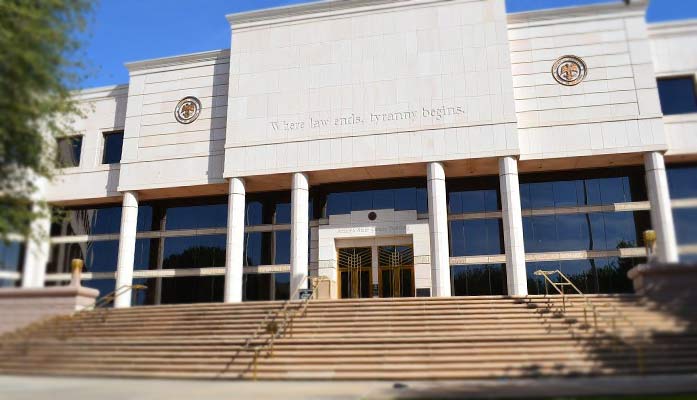
Goldwater Institute attorneys urged the Arizona Supreme Court on Tuesday to allow Arizona State University (ASU) professor Owen Anderson to pursue his lawsuit alleging that the school’s “Inclusive Communities” employee training violated state law.
During oral arguments in Arizona Board of Regents v. Anderson, Goldwater Institute Vice President for Litigation Jon Riches argued that the Arizona Court of Appeals applied the wrong legal analysis when it concluded that Anderson had no implied private right to enforce the statute in court.
If a legal right exists, so does the right to enforce it.
That's the case we made before the Arizona Supreme Court today on behalf of @dr_owenanderson, a professor at ASU who is fighting for his right NOT to be forced into discriminatory DEI training. pic.twitter.com/OoPngHtixm
“Where there is a legal right, there is a legal remedy, is one of the oldest maxims in Anglo-American law,” Riches told the justices. “For decades, this court has applied that principle to find implied causes of action where a statute does not expressly create them. Yet without citing a single one of this court’s cases, the lower court did exactly what this court commanded it not to; it treated legislative silence as dispositive as to whether a statute creates a cause of action. But as this court [has held], legislative silence begins rather than ends the inquiry.”
In a post to X on Tuesday, Anderson invoked the legal maxim in Latin, writing, “‘ubi jus ibi remedium’ if there is a right there is a remedy. A cornerstone principle of common law. Yet @ASU and @AZRegents are asking the @AZCourts to suspend this principle and keep me as an employee from holding them responsible for racist DEI training.”
Anderson also shared a clip from the hearing in which Justice Clint Bolick characterized the right-remedy maxim as “the indispensable common law principle” and invoked Chief Justice John Marshall’s discussion of the principle in the landmark 1803 decision Marbury v. Madison.
Following the hearing, Anderson posted a statement saying, “That was an excellent hearing today before the @AZCourts. Jonathan Riches for @GoldwaterInst presented a solid case. The Justices asked the @AZRegents lawyer questions that exposed the contradiction at the heart of their claims, with their lawyer at one point stumbling so badly as to say, ‘I forgot the question.’ Oops! Now we wait for a decision.”
That was an excellent hearing today before the @AZCourts Jonathan Riches for @GoldwaterInst presented a solid case. The Justices asked the @AZRegents lawyer questions that exposed the contradiction at the heart of their claims, with their lawyer at one point stumbling so badly…
The Supreme Court limited its review to whether the Court of Appeals failed to apply the factors established in the court’s 1988 Transamerica Financial Corp. v. Superior Courtdecision before finding that A.R.S. § 41-1494 provides no implied private right of action.
Those factors include the statute’s context and language, its subject matter, its effects and consequences, and the law’s overall purpose. Riches argued that the lower court improperly treated the Legislature’s silence about a private cause of action as conclusive instead of beginning the broader analysis required under Transamerica.
The Arizona Board of Regents asked the justices to uphold the appellate ruling. In its supplemental brief to the Supreme Court, the board argued that courts should begin with the statutory text and consider secondary factors such as legislative history, consequences, and purpose only when the text is ambiguous.
The board maintained that § 41-1494 regulates government conduct without creating a private right or remedy. It also pointed to the statute’s annual compliance-reporting requirement and argued that lawmakers left enforcement to elected officials. The board said nearly all surrounding statutes contain express private rights of action, indicating that the Legislature deliberately omitted one from § 41-1494.
The statute prohibits the state, its agencies, and political subdivisions from requiring employees to undergo training, orientation, or therapy that presents blame or judgment based on race, ethnicity, or sex. It also prohibits the use of public money for such training and directs the Arizona Department of Administration to submit an annual compliance report to the governor and legislative leaders.
Anderson’s case began after ASU informed employees in October 2022 that they were required to complete its “Inclusive Communities” training. Anderson, a philosophy and religious studies professor, filed suit against the Board of Regents in 2024, seeking declaratory and injunctive relief.
Anderson alleges that the training presented prohibited concepts involving race, sex, and identity. His court filings cite training materials discussing “whiteness,” white supremacy, heterosexual privilege, land acknowledgments, and efforts to “decolonize the university.” The accompanying examination identified designated answers concerning systemic bias, transformative justice, and the incorporation of diversity, equity, inclusion, and belonging throughout the university.
A Maricopa County Superior Court judge found that the statute contained no express private cause of action but concluded that it implied one for employees subjected to prohibited training. The Arizona Court of Appeals reversed that decision in December, finding that the statute “unambiguously does not create a private right of action.”
The Court of Appeals left Anderson’s underlying allegations about the training unresolved. The Supreme Court’s current review also concerns the enforcement question rather than whether the content of ASU’s training violated § 41-1494.
The Board of Regents has disputed that the training was mandatory. Anderson said the alleged injury arose from being required to undergo the training.
“Well, I think the hurt is in taking the training, and so I would ask them to consider it from their perspective if they were asked to sit through hours of training that involved racial discrimination against a group they identify with, they would be offended by that and feel hurt,” Anderson said. “So the hurt — the consequence — is just in the fact that I had to sit through that.”
Anderson previously asked the Supreme Court to accept the case after the appellate ruling, arguing that public employees would otherwise lack an effective way to enforce the training prohibition. Goldwater’s petition sought recognition of an implied private cause of action allowing employees to challenge alleged violations by government employers.
The Supreme Court took the case under advisement following Tuesday’s arguments. Anderson said that he intends to proceed toward trial if the justices recognize his right to bring the claim. The court has not announced a deadline for its decision.
The Arizona Supreme Court will hear arguments Sept. 1 in Arizona State University (ASU) professor Owen Anderson’s effort to pursue a lawsuit alleging the school’s mandatory employee training violated state law. The law bars public employers from requiring training that assigns blame or judgment based on race, ethnicity, or sex.
The justices agreed to review whether the Arizona Court of Appeals should have applied factors established in a 1988 state Supreme Court decision before concluding that the law gives employees no implied private right to sue. The court’s review is limited to that enforcement question.
Anderson’s allegation that ASU violated the law remains unresolved. The Court of Appeals also did not decide whether the training’s contents violated the statute.
As AZ Free News reported in February, Anderson asked the high court to take the case after the Court of Appeals held in December that the statute supplied no private cause of action. His attorneys at the Goldwater Institute argued in their petition that the ruling departed from the method Arizona courts have used to determine whether lawmakers intended an implied remedy.
ASU forced a professor to take DEI training as a condition of employment.
ASU required employees to complete its “Inclusive Communities” module, one of three employee-training modules described in the Court of Appeals’ memorandum decision. According to Goldwater’s case materials, employees were instructed to repeat the training every two years, and Anderson viewed but did not complete the module or its accompanying quiz. The philosophy professor brought his lawsuit against the Arizona Board of Regents in 2024, alleging that the training presented race- and sex-based concepts prohibited by state law.
The statute bars the state and its political subdivisions from requiring employee training that presents “blame or judgment” based on race, ethnicity, or sex. It also prohibits the use of public money for such training and directs the Arizona Department of Administration to submit an annual compliance report to the governor and legislative leaders. The law exempts sexual harassment training from its restrictions.
“Ultimately, the question now before the Arizona Supreme Court isn’t a left or right issue—and it’s not just about DEI—it’s about whether a state employee has the right to hold their employer accountable when it violates the law,” Anderson said in a statement released by the Goldwater Institute.
In a statement to AZ Free News, Dr. Anderson added, “This case is now an employment case. ABOR/ASU is arguing a state employee does not have standing to hold them accountable for breaking § 41-1494. That means this is not a conservative vs. liberal issue. It is an employment issue that will affect all state employees going forward.”
A Maricopa County Superior Court judge denied the Board of Regents’ motion to dismiss Anderson’s statutory claim. The judge found that the Legislature had created an implied right for affected public employees to enforce the prohibition, despite the absence of an express authorization to sue. The Board then filed a special-action petition with the Court of Appeals, which accepted jurisdiction and vacated that portion of the trial court’s ruling.
The appellate panel concluded that the statute’s text contains neither an express nor an implied private right of action. It pointed to the statutory compliance reporting system and said a mandamus action could compel officials to submit the required reports. The panel left the superior court free to consider a separate request for equitable or declaratory relief if a proper party raises that issue on remand, according to the December decision
Goldwater’s petition for review argues that the appellate court should have applied the factors set out in Transamerica Financial Corp. v. Superior Court. Those factors include the statute’s context, language, subject matter, effects, consequences, spirit, and purpose. Goldwater contends that the law protects an identifiable group of public employees and that the reporting requirement does not give an employee a remedy after an alleged violation.
In its supplemental brief, the Board of Regents argues that the Court of Appeals correctly began with the statutory text. The Board says the provision prohibits specified government conduct without granting individuals a cause of action, and that the Legislature’s inclusion of a reporting system shows the enforcement approach it selected. It also points to express private remedies in surrounding statutes and argues that the Legislature deliberately left them out of § 41-1494.
Goldwater Vice President for Litigation Jon Riches said that lawmakers intended state employees to be able to challenge alleged violations in court.
“There is no doubt that when Arizona lawmakers banned mandatory DEI trainings for state workers, they intended for those workers to have ability to challenge their employers in court,” Riches said. “We’re now asking for the Arizona Supreme Court to correct the lower court’s error and restore Arizonans’ right to hold government agencies accountable when they violate the law.”
The hearing comes as Arizona voters prepare to consider Proposition 142 on the November ballot. The separate proposed constitutional amendment would expand the state’s prohibition on preferential treatment and restrict compelled support for race- or ethnicity-based preferential treatment in public education and employment, according to the official ballot language.
Teachers’ union activists were once again dealt a serious blow after the Arizona Supreme Court issued an order effectively removing an initiative from the ballot that aimed to undo the state’s universal school choice program.
Nearly four years ago to date, a similar initiative was removed from the ballot for failing to have the required number of signatures. Katie Hobbs, secretary of the state at the time and now the governor, held out on invalidating the ballot initiative.
The court’s order to recalculate the signature totals using the trial court’s formula, issued on Tuesday, is projected to have brought Proposition 212, the Protect Education Act, below the required signature total following a legal challenge filed by the Goldwater Institute in Clark v. Fontes.
Protect Education Accountability Now, the political action committee (PAC) behind the Protect Education Act, confirmed that the Arizona Supreme Court order meant their initiative would not qualify for the ballot.
The PAC blamed “big money in partnership with Republican lawmakers and the anti-public education lobby” for the initiative’s demise.
A spokesperson for the PAC stated that the initiative should have been included on the ballot regardless of the invalid signatures.
“This does not reflect what Arizona voters want. It does not reflect the overwhelming support of educators, parents and public school advocates across the state who volunteered their time and demanded a voice in reforming a program that abused taxpayer money and pulled funding from their neighborhood public schools,” said the spokesperson. “Instead, the hard-earned resources educators raised to fund this were buried under a mountain of big money, political power, and a system that consistently sides with special interests.”
— Protect Education Ballot Initiative (@ProtectEdAct) August 18, 2026
Activists submitted around 420,000 signatures to qualify for the ballot. Pending a review incited by the Goldwater Institute’s court challenge, the number of valid signatures will fall to a projected total of approximately 245,000. The initiative needed approximately 256,000 to qualify for the ballot.
Nearly 70,000 signatures were invalidated due to their discovery as duplicates or having been collected by legally ineligible circulators, like felons. The court also upheld the trial court ruling which invalidated entire sheets of signatures due to the petition circulator providing an address at which they weren’t living.
The ballot measure would have rolled back the universality of the Empowerment Scholarship Account (ESA) program by imposing an income cap.
The union-backed Protect Education Act appears to have fallen short of the valid signatures needed to make the November ballot.
In this special Keep Arizona Free Update with @Darla4freedom:
➡️ The campaign submitted roughly between 416,000-421,000 signatures, but after trial… pic.twitter.com/l7886cgtT9
The court also agreed with a lower court ruling that the ballot language drafted by Secretary of State Adrian Fontes was false and misleading because it used the term “voucher” to describe the ESA program. Vouchers must be spent immediately and only at certain approved schools, whereas ESA program funds may be rolled over and applied to various schooling types and educational resources.
The PAC behind this second failed initiative to end universal school choice raised more than $7.5 million and spent more than $7.2 million.
More than $6.5 million, or 87%, came from the National Education Association. $810,000, or nearly 11%, came from the Arizona Education Association.
Other major donors included $50,000 from the United Food and Commercial Workers Active Ballot Club, the PAC of a D.C.-based union; and $50,000 from Arizonans for Quality Education, a corporation or LLC based in Phoenix.
The latter entity was formerly known as Friends of ASBA, with ASBA standing for the Arizona School Boards Association, and was registered as a domestic nonprofit corporation, according to Arizona Corporation Commission (ACC) records.
AZ Free News is your #1 source for Arizona news and politics. You can send us news tips using this link.
The Protect Education Act is projected to fall more than 10,000 valid signatures short of the number required to qualify for Arizona’s November ballot after a court challenge removed thousands of petition signatures and county recorders completed their validity reviews.
The Arizona Free Enterprise Club (AFEC) announced Monday that applying the trial court’s rulings and county signature-validity rates leaves the initiative with approximately 245,000 valid signatures. Arizona law required the campaign to produce 255,949 valid signatures.
The calculation follows an expedited ruling Thursday from Maricopa County Superior Court Judge David McDowell in Clark v. Fontes, the lawsuit challenging the petitions submitted by Protect Education, Accountability Now, the political committee behind the initiative.
At the time of McDowell’s ruling, the final outcome remained unresolved because Maricopa and Apache counties had not yet completed their reviews. The Arizona Capitol Timesreported that the Secretary of State’s initial review had reduced the campaign’s submitted total to 389,376 signatures before the court considered challenges to individual circulators, petition sheets, and duplicate signatures.
🚨 BREAKING: “PROTECT EDUCATION ACT” FALLS SHORT
Based on the trial court’s ruling in Clark (@ClarkRimsza) v Fontes and county signature validity rates, the union-backed anti-ESA initiative does not have enough valid signatures to qualify for the November ballot.
McDowell’s ruling left 348,269 signatures presumptively valid before application of the counties’ random-sample validity rates. The court also addressed 24,369 duplicate signatures and challenges involving more than 110 petition circulators.
“The court agrees that it is conceivable that a double count could occur, but the court cannot make a decision based upon a hypothetical double counting of duplicate signatures,” McDowell wrote.
The initiative’s supporters submitted 421,451 signatures on July 2. Save Our Schools Arizona and the Arizona Education Association were among the organizations backing the campaign.
The Goldwater Institute filed its challenge July 20, alleging that tens of thousands of the submitted signatures should be rejected because of duplicate entries, defects in circulator registrations, and petitions collected by people who were legally ineligible to circulate them.
The amended complaint raised more than 73,300 objections. Those included allegations involving unregistered paid circulators, signatures collected before circulator registration, inaccurate addresses or contact information, identification problems, and circulators whose felony convictions or other legal circumstances allegedly made them ineligible.
McDowell ultimately invalidated signatures collected by several circulators. Four circulators were disqualified because of criminal histories. The judge also invalidated several thousand signatures collected by circulator Tyrone Crispell after finding his denial that he misrepresented the initiative to prospective signers was not credible.
AFEC said Monday that nearly 70,000 signatures were disqualified through the challenge, including duplicates and signatures gathered by legally ineligible circulators.
“This is a major victory for Arizona parents, students, and the integrity of our elections,” AFEC President Scot Mussi said. “This anti-school choice initiative and its union backers spent more than $7 million dollars trying to dismantle school choice in our state, but they still could not collect enough lawful, valid signatures to qualify for the ballot.”
Campaign-finance figures compiled by Transparency USA from Arizona disclosure records show the Protect Education, Accountability Now committee had reported more than $7.5 million in total expenditures through July 30. The National Education Association accounted for approximately $6.57 million in cash and in-kind contributions, while the Arizona Education Association contributed another $810,000.
The Protect Education Act, designated Proposition 212 during the ballot-review process, would make several changes to Arizona’s Empowerment Scholarship Account (ESA) program. The measure would generally limit eligibility to families earning $150,000 or less, with exceptions including students with disabilities, certain military families, and students assigned to poorly performing public schools.
The proposal would also establish additional requirements for participating private schools and tutors, restrict certain ESA expenditures, and generally require unused annual ESA funds to be returned to the state.
The signature dispute is separate from litigation over how Proposition 212 would be described to voters. Last week, Maricopa County Superior Court Judge Julie Ann Mata ordered Secretary of State Adrian Fontes to rewrite portions of the proposition’s descriptive title and “yes” and “no” statements after finding that the existing language omitted significant provisions of the measure. Judge Daniel Martin separately ordered revisions to the Arizona Legislative Council’s publicity-pamphlet analysis.
The teachers’ unions and their allies at Save Our Schools (SOS) have proven time and time again that they will do anything to kill universal school choice in Arizona.
They’ve fought expansion of the program. They’ve pushed to cap it. They’ve worked with activist reporters in the legacy media with ties to the Red for Ed teachers’ union to push false claims about it. And we all witnessed it four years ago when they made their not-so-triumphant proclamation that they had enough signatures to repeal the program—only to discover they had miscounted by more than 50,000 signatures.
But their latest attempt to overturn the program is their lowest yet.
Earlier this month, the teachers’ unions and SOS announced they had submitted more than 420,000 signatures for a ballot initiative that would end the universal eligibility of Arizona’s Empowerment Scholarship Accounts (ESA) program.
Given their track record, the Arizona Free Enterprise Club worked closely with the Goldwater Institute and other school choice advocates to review the petitions. What we found was far more disturbing than another failed signature count.
Dozens of Convicted Felons—Including Registered Sex Offenders—Hired to Collect Signatures
The teachers’ unions and SOS want Arizonans to believe that their “Protect Education Act” campaign is a grassroots effort led by concerned parents and educators. But they made a very different choice when it came time to build their campaign…