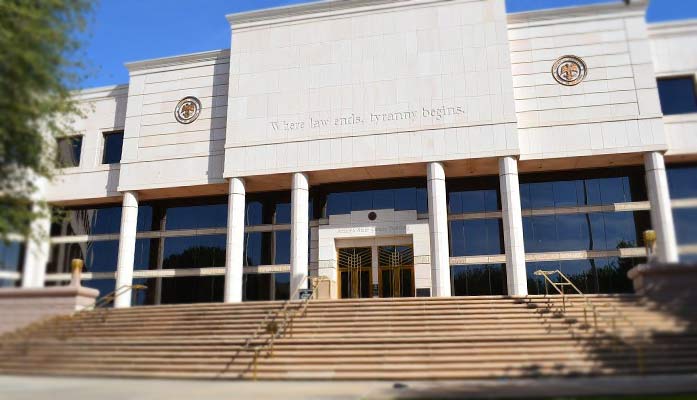
The Goldwater Institute has filed a motion in Maricopa County Superior Court seeking to intervene on behalf of two Air Force veterans in a lawsuit challenging a proposed constitutional amendment that would protect certain scholarship funds for children of military families.
The motion was filed on behalf of Nickolas Kupper and Robert Figueroa, whom Goldwater identified as Air Force veterans whose children currently participate in Arizona’s Empowerment Scholarship Account (ESA) program. The proposed intervenors are seeking to defend House Concurrent Resolution 2048, the “Military Families College Savings and Scholarship Protection Act,” which the Legislature recently referred to the November 2026 ballot.
The lawsuit was filed by the Protect Education Accountability Now Committee, Save Our Schools Arizona, and voter Linda May Lyon against the State of Arizona and Secretary of State Adrian Fontes. According to Goldwater’s motion to intervene, the plaintiffs are asking the court to block HCR 2048 from appearing on the November ballot.
Arizona's military families don't deserve to have their children's educational opportunities ripped from their hands. That's why we're stepping up to defend them. https://t.co/ayRcX5JbBE
— Goldwater Institute (@GoldwaterInst) July 2, 2026
Goldwater said in a July 2 announcement that Kupper and Figueroa are seeking to defend the measure because their families have used ESA funds for years and have a direct interest in the outcome of the litigation.
“Proposed Intervenors seek to intervene as Defendants to defend the constitutionality of House Concurrent Resolution 2048 (‘HCR 2048’), the ‘Military Families College Savings and Scholarship Protection Act,’ which is a legislative referral passed to protect the educational stability of military families,” the motion states.
HCR 2048 proposes adding a new section to Article XI of the Arizona Constitution. Under the measure, the state could not confiscate funds from the scholarship account of a child of a military family if the account is maintained under a state program that designates such students as eligible and allows the funds to be used for tuition or fees at eligible postsecondary institutions.
The measure defines a “child of a military family” as a student who is the child of a person serving on active duty in the U.S. armed forces, who was serving on active duty when the student’s eligibility was initially determined, or who was killed in the line of duty.
The proposed amendment also contains a nonseverability provision. If a future law or voter-approved measure violates the military-family scholarship protection, the entire conflicting law or measure would be void, and a court could not sever only the offending portion.
The House passed HCR 2048 initially on March 2, the Senate passed it on June 12 by a 16-13-1 vote, and the House passed the final reading on June 13 by a 31-22-7 vote.
Goldwater’s motion argues that Kupper and Figueroa have a right to intervene because the lawsuit directly threatens their ability to secure long-term constitutional protections for their children’s education funding.
“By seeking to keep HCR 2048 off the ballot, Plaintiffs directly threaten to block Proposed Intervenors’ ability to secure long-term constitutional protections for their children’s educational funding,” the motion states.
The filing also argues that the existing government defendants cannot adequately represent the families’ specific interests. Goldwater said Fontes is defending the measure as a neutral election administrator, while Kupper and Figueroa are defending the substantive validity of the proposed amendment because their children rely on ESA funds.
In its July 2 statement, the Goldwater Institute said, “The Arizona Constitution is clear: Arizona voters have the right to amend the state constitution, and the Military Families Protection Act would trump the activists’ efforts to cripple the scholarship opportunities currently afforded to Arizona military families and others.”
The lawsuit comes as ESA opponents are also seeking to place the Protect Education Act on the ballot. Save Our Schools Arizona says the proposal is intended to “reform Arizona’s universal ESA voucher program” and increase transparency and accountability.
The Protect Education Campaign announced last week that it submitted 421,451 signatures to the Secretary of State’s Office.
The Protect Education Act proposal would require unused ESA money to revert to the state and be directed to public schools, and it would bar families making more than $150,000 annually from joining the program. It would also ban ESA spending on non-educational or luxury items and require the Arizona Department of Education to report how much voucher funding each school receives.
HCR 2048 could conflict with the Protect Education Act because the proposed constitutional amendment would block future laws or ballot measures from changing the protected scholarship-account funds for military families.
Goldwater argued in its motion that the litigation is directly tied to that conflict, saying an adverse ruling could remove HCR 2048 from the ballot and leave the families’ ESA accounts vulnerable to “regulatory and financial rollbacks” under the competing Protect Education Act.
“Without HCR 2048, Proposed Intervenors’ educational accounts will remain highly vulnerable to systemic legislative and political volatility, including the exact regulatory and financial rollbacks slated under Plaintiffs’ competing ‘Protect Education Act,’” the motion states.
Kupper and Figueroa are asking the court to allow them to enter the case as defendants, either as a matter of right or by permission. They also said they intend to file a motion to dismiss the plaintiffs’ claim rather than expand the litigation with counterclaims.
The case is assigned to Maricopa County Superior Court Judge Joseph Kreamer.
Arizona families using the Empowerment Scholarship Account (ESA) program will no longer be required to submit curriculum documentation when purchasing general educational supplemental materials, such as basic school supplies, under a settlement agreement announced by the Goldwater Institute.
The agreement resolves a lawsuit brought by ESA parent Velia Aguirre against the State of Arizona, the Arizona Department of Education (ADE), and Superintendent Tom Horne over the documentation requirements.
The settlement, which took effect July 1, states that ESA families “shall not be required to submit a specific curriculum document” when purchasing items identified as “general educational supplemental materials” in the 2025–2026 ESA Handbook.
After pushing this bureaucratic abomination for 2 years, the office of Attorney General Kris Mayes has walked back its unlawful demands. No more permission slips needed to buy pencils and children's books:
The dispute began after Attorney General Kris Mayes’ office sent a 2024 letter to the ADE opening a public monies investigation into ESA spending approvals. The Attorney General’s Office said at the time that ADE guidance appeared to allow expenses beyond the statutory framework for the ESA program, including the approval of supplementary materials without documentation demonstrating a curricular connection.
In the letter, Mayes’ office asked the ADE to “promptly cease approving supplementary material expenses without the requisite documentation of a curriculum nexus,” and requested information on ESA spending for supplementary materials, curriculum materials, and textbooks from the 2019–2020 school year through the 2023–2024 school year.
The Goldwater Institute, which represented Aguirre, said in a September 2024 press release that the directive forced parents to justify purchases of basic school supplies and educational books. Goldwater said Aguirre had purchases such as “Where the Red Fern Grows,” a periodic table poster, and pencils rejected for failing to satisfy the curriculum documentation requirement.
Arizona law allows ESA funds to be used for several categories of educational expenses, including tuition at qualified schools, textbooks, tutoring, curricula, and supplementary materials.
The law defines “curriculum” as “a course of study for content areas or grade levels, including any supplemental materials required or recommended by the curriculum, approved by the department.”
After Mayes’ 2024 letter, the ADE posted guidance stating that supplementary materials, including common school supplies such as pencils, paper, glue, and crayons, required curriculum support. The ADE’s ESA support page stated that items previously allowed without curriculum documentation “now do require a curriculum.”
Goldwater filed suit in September 2024 on behalf of Aguirre and Rosemary McAtee, arguing that the documentation requirement imposed new burdens on families buying ordinary educational materials. Goldwater said at the time that parents were being required to show that each purchase was explicitly called for in a curriculum, including items such as pencils, erasers, flashcards, and children’s books.
Under the settlement, ESA families purchasing general educational supplemental materials must attest that the items are intended to support a curriculum or course of study for the qualified student and are not being purchased for another purpose. The agreement also requires ESA holders to indicate the curriculum or course of study the materials support by selecting categories such as reading or grammar, social studies, science, mathematics, physical education, art, vocational instruction, or other.
The agreement states that the ADE will not require a specific curriculum document as a prerequisite for approval or processing of general educational supplemental material purchases. It also provides that the ADE may require an ESA holder to enter the name of the curriculum or course of study in a text box when selecting “Other,” once technologically feasible or no later than the second quarter of fiscal year 2027.
The settlement does not eliminate the ADE’s oversight authority. Rather, it states that nothing limits the ADE’s ability to review or audit individual expenditures or ESA accounts, disallow expenses, seek repayment, or report an ESA holder to the Attorney General’s Office for investigation of fraud, misuse of funds, or unlawful expenditures.
The agreement also preserves the Attorney General’s authority to investigate or enforce the law in cases involving fraud, misuse of funds, or unlawful expenditures, and to request information in specific cases where there is a reasonable basis to believe a violation occurred.
The State disputed in the settlement agreement that the ADE enforced the alleged documentation policy and maintained that the ADE has the authority and obligation to confirm that ESA expenditures are allowable under statute and rules. The parties agreed to resolve the case to avoid the time, expense, and uncertainty of further litigation.
Goldwater characterized the settlement as a victory for ESA families.
“ESA holders shall not be required to submit a specific curriculum document when purchasing items identified as ‘general educational supplemental materials’ in the 2025–2026 ESA Handbook,” Goldwater wrote, quoting the settlement agreement. The organization said the change means families will no longer have to provide individualized curriculum documentation for ordinary educational purchases such as pencils and children’s books.
In a press release on July 2, Matt Beienburg, Director of Education Policy at the Goldwater Institute, summarized the legal victory:
“This means no more manufactured paperwork from parents simply to appease the bureaucratic whims of politicians. No more wasted hours explaining why hundreds of individual items, like pencils or children’s literature, are necessary for a child’s education.
“Instead, parents will simply acknowledge via a single check box for a purchase order or reimbursement request that the purchases are intended to support the course of study for an ESA student. What was once the needless compounding of minutes into hours to comply with the attorney general’s demands will now be two clicks of a mouse.”
The parties agreed to file a stipulation dismissing the case with prejudice within 10 days of executing the settlement.
Activists reported that they have turned in more than 420,00 signatures for a ballot initiative that would end the universality of Arizona’s school choice program.
Supporters wearing red shirts reading “Public School Proud” affiliated with Save Our Schools Arizona (SOSA) gathered outside the secretary of state’s office to watch the box truck delivery of the boxes containing the signatures for the ballot initiative. Both SOSA and the Arizona Education Association (AEA) were behind the initiative.
SOSA and the AEA contend the universality of the Empowerment Scholarship Account (ESA) program diverts far too much in funding away from public schools. Families within the program don’t have to depart their public schools; however, since the expansion of the ESA program to all students in 2022, enrollment in public schools has declined. Defenders of the ESA program counter that per-pupil spending in the program costs less than in public schooling.
ESA program funds may be used for private school tuition, tutoring, online courses, homeschool curriculum, educational therapies, textbooks, educational software, testing fees, and college courses.
The Protect Education Act (PEA) would impose income restrictions on the ESA program.
Estimates show that approximately 20,300 current students in the ESA program would be disqualified under the PEA initially, though that number would grow to exclude more than half of Arizona’s families with school-aged children due to inflationary impact on incomes outpacing the income cap adjustment.
The act would also impose accreditation requirements and further restrictions on spending.
The ESA program has reported the enrollment of more than 100,000 students. More than 8,200 were listed as new students enrolled for the next school year.
Those who support keeping the universality of the ESA program have been maneuvering to preserve protections for some member families.
The Republican majority in the state legislature passed a ballot measure of their own last month: HCR 2048, the “Military Families College Savings and Scholarship Protection Act,” which would amend the Arizona Constitution to prohibit the confiscation of ESA program funds from students belonging to military families.
Should voters approve both the lawmakers’ measure and PEA, it is likely the latter would be voided under language included in the former.
In addition, Doug Ducey, the former governor who signed universal school choice into Arizona law, made an announcement Thursday of a political action committee dedicated to securing school choice protections for military families. Ducey was announced as the chairman of the Protect Military Families PAC.
“Out-of-state special interests and their union allies are trying to take educational scholarships away from the children of Arizona’s military families,” said Ducey.
Serving alongside Ducey on the political action committee is Ashley Ragan, president of InCompliance AZ.
Out-of-state special interests and their union allies are trying to take educational scholarships away from the children of Arizona’s military families.
That is why today, we are proud to launch Protect Military Families PAC @ProtectMilFam.
The Goldwater Institute, a public policy think tank and litigation organization, filed a motion in the Maricopa County Superior Court earlier this week on behalf of two military families involved in the ESA program.
The organization said that about 1,000 other military families stand to be disqualified from the ESA program should the universalization end.
AZ Free News is your #1 source for Arizona news and politics. You can send us news tips using this link.
The Arizona Supreme Court has kept a constitutional challenge to Arizona’s donor disclosure law alive, ruling that conservative organizations and anonymous donors may try to prove Proposition 211 violates the state constitution’s free speech protections as applied to them.
In its June 29 decision in Center for Arizona Policy Inc. v. Arizona Secretary of State, the court did not strike down Proposition 211, also known as the Voters’ Right to Know Act. The justices rejected the plaintiffs’ broad facial challenge to the law, along with their claims under the Arizona Constitution’s Private Affairs Clause. But the court ruled that the Center for Arizona Policy, the Arizona Free Enterprise Club, and two anonymous donors sufficiently alleged that the law’s disclosure requirements could unconstitutionally burden protected political speech and association.
The case now returns to the Maricopa County Superior Court, where the plaintiffs will have the opportunity to develop their as-applied challenge and attempt to show that compelled disclosure of donors could expose supporters to harassment, retaliation, reprisals, or other harms tied to their advocacy.
Scott Freeman, senior attorney at the Goldwater Institute, which represented the plaintiffs, called the ruling “an important victory for every Arizonan who believes people should be free to support the causes they care about without fear of government-compelled disclosure.” He added that the court recognized that citizens are entitled to try to prove compelled donor disclosure violates Arizona’s free speech protections.
“From the very start, this case has been about protecting the freedom of everyday Arizonans,” said Peter Gentala, President of Center for Arizona Policy (CAP). “No one should have to choose between supporting a cause they believe in and fearing harassment, retaliation, cancellation, or personal safety. Today’s decision affirms what we’ve always known to be true: our constitutional freedoms belong to every one of us, not just to those whose views happen to be popular at the moment.”
The Voters’ Right to Know Act requires nonprofit groups that weigh in on ballot measures or reference incumbents near an election to publicly disclose their donors—not just names and amounts, but also home addresses and employers—in a searchable database.
The court’s majority opinion was authored by Chief Justice Ann Timmer and joined by Justices James Beene and William Montgomery, along with retired Justice Rebecca Berch. Justice Kathryn Hackett King concurred in part and dissented in part, joined by Vice Chief Justice John Lopez and Justice Clint Bolick. Justice Maria Elena Cruz was recused.
The majority held that Arizona courts must interpret the state constitution’s Speak Freely Clause independently from the First Amendment. The court said federal free speech cases may be consulted when helpful, but the Arizona Constitution remains its own source of free speech protection. “The Speak Freely Clause tolerates no censorship or restraint…for speech that falls within the Clause’s protective scope,” Timmer wrote.
The court also concluded that donations made to an organization for the purpose of funding campaign media or knowingly allowing donations to be used for that purpose can constitute expressive conduct protected by the Arizona Constitution’s Speak Freely Clause.
For compelled election disclosure laws, the court adopted an Arizona-specific standard requiring the state or another defender of the law to show that the disclosure requirement meaningfully furthers election integrity or transparency and does not unreasonably burden or hinder protected expression.
Applying that framework, the court found that Proposition 211 meaningfully furthers election integrity and transparency. The court also found, however, that the plaintiffs had sufficiently alleged that the disclosure requirements may impose a concrete burden on their speech because public disclosure could expose donors or organizations to harassment, retaliation, reprisals, or other harms tied to their advocacy.
The court cited allegations that CAP and the Arizona Free Enterprise Club (AZFEC) had faced threats and harassment connected to their issue advocacy. The opinion noted that CAP alleged it received a message stating, “Sooner or later, you will die, and some of us pray it is sooner,” and “You are a cancer that will soon be sliced out of our nation’s sick body. I will make it my personal mission to bury every single one of you.” AZFEC reported that staff had received threats of violence and that one staff member’s car had been vandalized in retaliation for communicating AZFEC’s message.
The two anonymous donors alleged that they had previously donated more than $5,000 to nonprofit organizations involved in campaign media and would limit future donations to avoid disclosure. The court found those allegations sufficient at this stage to allow the as-applied free speech claim to proceed.
“Free societies depend on people being willing to speak, advocate, and support important causes without fear of retaliation,” said Scot Mussi, President of the Arizona Free Enterprise Club. “Today’s decision ensures that Arizonans will have the opportunity to demonstrate that the Arizona Constitution protects those freedoms.”
Andrew Gould of Holtzman Vogel, who argued the case for the plaintiffs, said the decision establishes that the Arizona Constitution is an “independent source of liberty” and confirms that Arizona courts are not required simply to follow federal free speech doctrine, adding it “recognized that plaintiffs may challenge compelled donor disclosure when it chills protected expression.”
The Goldwater Institute’s case page states that the organization represents the Center for Arizona Policy, the Arizona Free Enterprise Club, and two private donors in the lawsuit against the Arizona Secretary of State, the Arizona Citizens Clean Elections Commission, and public officials charged with implementing and enforcing Proposition 211.
Campaign Legal Center, which represents Voters’ Right to Know, framed the ruling as a victory for disclosure. In a statement, the organization said the court affirmed Proposition 211’s constitutionality by rejecting the broad challenge to the law while allowing the plaintiffs to attempt to prove serious harm from the disclosure requirements as applied to them.
Campaign Legal Center President Trevor Potter said the ruling affirmed “Arizonans’ right to know” who is spending major money to influence elections. The organization said Proposition 211 was supported by 72% of Arizona voters in 2022 and was designed to trace original sources of money spent in elections.
Justice King’s partial dissent, joined by Lopez and Bolick, would have gone further than the majority. The dissent argued that political advocacy before an election is core political speech and that anonymous speech contributes to liberty.
The case now returns to the Maricopa County Superior Court for further proceedings on the plaintiffs’ as-applied Speak Freely Clause claim. The court did not strike down Proposition 211, and the plaintiffs still must prove that the law unconstitutionally burdens their speech as applied to them.
A Goldwater Institute-backed measure to constitutionally protect Empowerment Scholarship Account (ESA) funds for children of military families will go before Arizona voters in November after receiving legislative approval.
House Concurrent Resolution 2048, sponsored by Rep. Michael Way (R-LD15), asks voters to amend Article XI of the Arizona Constitution by adding a new section prohibiting the state from confiscating money from certain scholarship accounts of students who are children of military families.
Under the resolution text, the prohibition would apply if the scholarship account is established and maintained by the state under a program that designates children of military families as eligible to receive scholarship money, and if the student may use the money for tuition or fees at eligible postsecondary educational institutions. The resolution states that the provision is not limited to scholarship account programs established and maintained by the state only for children of military families.
The measure defines a “child of a military family” as a student whose parent is serving on active duty in the U.S. Armed Forces, was serving on active duty when the student’s eligibility was initially determined, or was killed in the line of duty. The measure defines “confiscate” as seizing, transferring, or otherwise taking money from a scholarship account.
The resolution includes exceptions for closures of accounts tied to individualized findings of illegal activity or wrongdoing after due process. It also accounts for routine account closures, including voluntary closure or failure to renew an account, graduation from an eligible postsecondary institution, or loss of eligibility after a student fails to enroll in an eligible postsecondary institution for at least four consecutive years after graduating from high school.
HCR 2048 also states that if a bill enacted into law or a voter-approved measure on or after Nov. 1, 2026, violates the proposed constitutional provision, the entire bill or measure is void and a court may not sever any portion of it. The resolution directs the Secretary of State to submit the proposition to voters at the next general election.
The measure passed the Senate on June 12 by a 16-13-1 vote and passed the House on final reading June 13 by a 31-22-7 vote.
The Goldwater Institute described the measure as its “Military Family Protection Act” and said it is intended to protect military families participating in Arizona’s ESA program from future efforts to redirect or reclaim scholarship funds.
The Arizona Department of Education (AZED) currently lists 100,713 students enrolled in the ESA program this school year. The department’s Fiscal Year 2026 Quarter 1 report, covering July 1 through Sept. 30, 2025, counted 93,993 ESA students, including 975 students in the category for students whose parent is active-duty military or was killed in the line of duty.
Goldwater’s Director of Education Policy, Matt Beienburg, told lawmakers that military families should not lose scholarship funds through a separate ballot proposal aimed at the ESA program.
“There is a current ballot measure being proposed to attack the scholarship funds and confiscate the scholarship funds of children, including military families,” Beienburg said. “These families should not be treated as a piggy bank to raid. These are families who have protected this nation.”
Rep. Way said the measure is intended to prevent Arizona from reclaiming scholarship money after families were promised access to the program.
“This measure asks a very simple question: should Arizona be allowed to take scholarship money from military families after we promised them? My answer is no,” Way said.
The referral comes as opponents of the ESA program are circulating the Protect Education Act, a proposed ballot initiative that would impose new restrictions on the ESA program. The campaign says the measure would require background checks and safety standards for voucher-funded schools, add spending transparency rules, prohibit non-educational and luxury purchases, cap family income for ESA eligibility at $150,000 with annual inflation adjustments, require unused ESA funds to be returned, and require voucher-funded schools to be accredited or administer approved assessments. The campaign says students with disabilities would be exempt from the income cap and assessment provisions.
In an op-ed for AZ Free News, Matthew Ladner and Jason Bedrick of the Heritage Foundation wrote that AZED published the results of a random audit of the ESA program in March 2026, “finding very low rates of misspending relative to other publicly funded programs and even lower rates of fraud. Less than 2% of ESA funds were spent on unallowed items, and 0.3% of the funds were spent on items considered ‘egregious’ or fraudulent.”
AZED disputed claims that the ESA program had a 20% fraud rate in a March release, saying about 2.0% of dollars spent by ESA account holders were for items deemed unallowable under program rules and that actual fraud or egregious purchases accounted for 0.3%.
“The submission of a purchase that is deemed unallowable does not constitute fraud,” AZED said. “Most are innocent mistakes, such as an error in a form that must be resubmitted, or educational items that are not on the allowable list but that the user could have in good faith believed were permitted. Some examples would be backpacks, lunch boxes and water bottles.”
AZED said the 20% figure represented program participants selected for risk-based auditing and “had nothing to do with fraud.” The department said action is taken to recover or collect funds or refer matters to law enforcement when necessary, and that more than $1.2 million had been recovered through that process.
Opponents of HCR 2048 have argued that its voidability provision could invalidate ESA reform proposals if voters approve conflicting measures. ABC15 reported that critics said the measure is aimed at blocking the Protect Education Act, while supporters said it is intended to protect scholarship funds promised to military families.
HCR 2048 was one of three education-related ballot referrals approved before the Legislature adjourned. Senate Republicans said the measures were intended to protect military families, direct more education dollars into classrooms, and restrict the use of taxpayer-funded school resources for labor organization activities.
“These scholarship funds were created for helping the children of military families pursue higher education,” Senate Appropriations Committee Chairman David Farnsworth said. “When government faces budget pressures, dedicated funds can become tempting targets. Arizona should never balance its books on the backs of military families or treat money set aside for their children’s futures as a piggy bank.
“This referral permanently protects those funds and ensures they remain available for the students they were intended to serve.”