Downtown Phoenix’s residents experienced a glimmer of hope in the ongoing homeless crisis last month after a court declared the city to blame. If the city doesn’t appeal the court’s order, it may be the end of the massive encampment known as “The Zone.”
The decision flies in the face of the precedent set by other cities: plans and spending that yield no favorable results, ultimately forcing the residents to learn to live with the crime and squalor. Yet, Phoenix may no longer be resigned to the same fate borne by most other major cities. Downtown property and business owners were vindicated in their belief: city officials’ plans, spending, and promises alone don’t qualify as results.
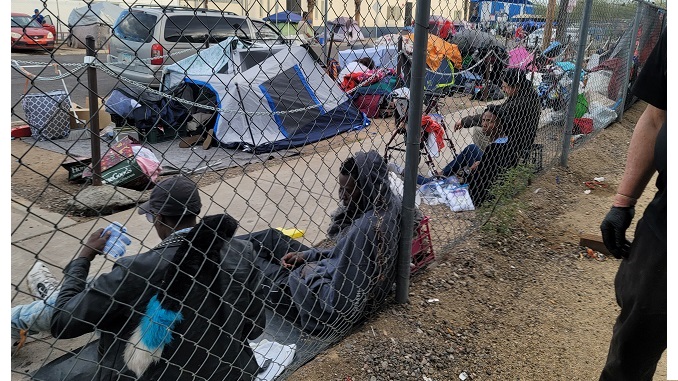
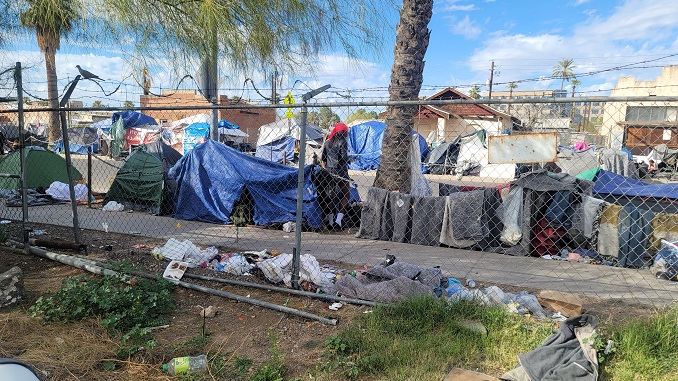
Requiring results of the city could mean The Zone may cease to exist in the near future — restoring a square mile of the current wasteland of city-sanctioned slums into a healthy business district — but only if the city of Phoenix decides to follow through on the court-ordered action to resolve the homeless crisis. Cleaning up The Zone would mean finding shelter and services for around 800 homeless residing in the area, according to a census conducted by the Human Services Campus late last month.
Homeless sit outside a business in The Zone.
The first bout of legal relief came for The Zone’s residents and business owners after the Maricopa County Superior Court ruled last month that the city of Phoenix was at fault for The Zone. The court ordered the city to show that it’s taking “meaningful steps” toward fixing The Zone. They have until July 10 to do so, with a trial date scheduled for June.
The ruling came days after the city of Phoenix promised to finally meet to fix The Zone, a promise prompted by back-to-back murders in the encampment.
Vice President for Legal Affairs at the Goldwater Institute, Timothy Sandefur, who submitted an amicus brief in the case, told AZ Free News that this ruling was a good first step toward remedying The Zone — but that the city has a ways to go.
“I think this is a first step and a very important one,” said Sandefur.
Sandefur said that the superior court indicated the best next steps for the city would be to build structured campgrounds and establish treatment programs, rather than continue with their current “housing first” approach.
However, notice of a settlement in a separate, federal case issued recently may complicate matters in finally getting the city of Phoenix to fix The Zone.
In the Arizona District Court case, the ACLU and the city held mediation about three weeks ago.
Details of the settlement weren’t made public. The Phoenix City Council plans to convene April 18 in an executive session — a meeting not open to the public — to discuss the terms of the settlement. At some point after, the Phoenix City Council will announce the settlement terms during a public meeting.
Of note, the city attempted to dismiss the superior court case — but not the federal case. The city also spent just shy of $100,000 fighting the superior court case.
Ilan Wurman, another lawyer on the lawsuit against the city, told AZ Free News that the court’s order to fix The Zone was thorough to the point where he imagined it would be difficult for the city to fight it.
“The court’s ruling is such a thorough victory for the business and property owners that it will be very hard for the city to overcome it at a full trial on the merits,” said Wurman. “We hope the city does the right thing and considers a settlement or simply follows through on the court’s instructions — that will save a lot of expense to taxpayers and it will be better for the unsheltered community as well.”
In remarks to the press, the city stresses that it has allocated around $140 million to solve the homeless crisis. However, there’s a difference between commitment and spending. Of the $120 million in COVID-19 relief funds received to address the homeless crisis, the city has only spent about 10 percent.
Of what little the city has spent for the homeless crisis, the Maricopa County Superior Court assessed that none of this spending has actually mitigated the crisis.
Homeless use drugs inside Phoenix’s sprawling encampment known as The Zone.
“With few exceptions, the action items about which city representatives testified centered around the creation of more bureaucracy, additional staff positions, and obtaining additional funding for programs to vaguely address homelessness in general,” stated Judge Scott Blaney. “The Court received very little evidence — if any — that the City intends to take immediate, meaningful action to protect its constituent business owners, their employees, and residents from the lawlessness and chaos in the Zone.”
However, in a recent interview, Mayor Kate Gallego indicated that the city was attempting to follow through on a “housing first” approach, and claimed that the city was “working very hard” to fix the homeless crisis.
As AZ Free News previously reported, “housing first” — also referred to as “permanent supportive” or “affordable” housing — holds the theory that the homeless will choose to seek employment, become financially responsible, and receive mental health care and/or substance abuse treatment if food and housing are provided. The theory also posits that enabling the homeless to choose their housing and support services will make them more likely to remain in that housing and stick with self-improvement initiatives.
Gallego shared that the city was working on launching seven new shelter options in partnership with various organizations, and that the city is hoping to receive additional help from both the state and federal government. She mentioned that she would meet with the Maricopa County Board of Supervisors.
Gallego disclosed that she recently spoke with Gov. Katie Hobbs about the homeless crisis — a conversation that had last occurred during Hobbs’ inauguration week in January. The mayor said that Hobbs was looking for additional resources to provide the city.
“Residents should feel confident that they’re going to see changes,” said Gallego. “The message we want to send to the public is that we recognize it’s a problem and we want to solve it.”
When questioned, Gallego didn’t directly deny that the city wouldn’t appeal the superior court’s decision.
In another interview, Gallego claimed that adequate law enforcement was taking place in The Zone. Gallego’s claim conflicted with the various investigative reports and witness accounts that depicted minimal law enforcement in The Zone.
“We treat every member of our community the same when they commit a crime. We want to be consistent and to enforce breaking the law,” said Gallego. “If you commit a crime, it is the same regardless of your housing status.”
However, the “Gaydos and Chad Show” testified to witnessing a myriad of criminal activity during a recent excursion in The Zone — including drug use, public defecation and urination, and prostitution — but not seeing any police presence. In response, Gallego claimed the city’s police were “too aggressive” when handling the homeless. The mayor cited the Arizona District Court case against the city as justification for her claim. However, that lawsuit concerned whether the city could enforce camping and sleeping bans, as well as whether the city had a right to seize or throw away items from homeless encampments as part of cleanup efforts. The lawsuit does not address police response to criminal activity.
Watch: The Zone – Homelessness and Crime Rampant in Phoenix
Corinne Murdock is a reporter for AZ Free News. Follow her latest on Twitter, or email tips to corinne@azfreenews.com.
The Goldwater Institute announced on Tuesday that they submitted a supportive brief in a lawsuit accusing Washington Elementary School District (WESD) of discriminating against Christians.
WESD decided to end its contract with Arizona Christian University (ACU) earlier this year over the school’s religious beliefs. The lawsuit was filed initially by Alliance Defending Freedom (ADF) on behalf of ACU early last month.
WESD is the largest elementary school district in the state, and had partnered with ACU for 11 years without issue, according to court documents.
In their press release, the Goldwater Institute claimed that WESD violated the constitutional rights of free speech, freedom of religion, and freedom of association for both ACU and its students to free speech. The Goldwater Institute further claimed that WESD’s actions ran afoul of the Arizona Constitution’s “religious test” clauses, which prohibit the government from discriminating based on religion when making hiring decisions.
The organization also pointed out that WESD committed the alleged discrimination despite grappling with an ongoing, historic teacher shortage like other districts.
In the Goldwater Institute’s amicus, or “friend-of-the-court,” brief, the organization said that WESD had unconstitutionally conditioned employment based on ACU’s faith.
“Defendants’ hostility toward Christians is apparently so intense that they cut off a long-standing teacher training program during an historic nationwide teacher shortage, simply because the teachers attended Arizona Christian University (ACU)—a school that espouses traditional Christian beliefs on its website,” said the organization.
ACU believes in Biblical teachings on marriage and sexuality, including that “God created man and woman in His image and likeness, that God wonderfully and immutably creates each person as male or female, and that God intends sexual intimacy to occur only between a man and woman who are married to each other,” per court filings.
AZ Free News first broke the story about WESD’s alleged discrimination. The ultimate decision to cut ties with ACU traces back to public comments from WESD Governing Board Member Tamillia Valenzuela.
Valenzuela — a self-described neurodivergent, queer furry — declared during a board meeting that ACU’s mission of prioritizing Jesus Christ’s teachings didn’t align with WESD priorities. In previous board meetings, Valenzuela has decried any Christian presence at WESD. In contemplating whether to continue the district’s contract with Grand Canyon University (GCU), Valenzuela insisted that WESD should cut ties there as well due to the university being a private Christian institution.
“I am wondering if there’s other options available, one so we are not actively engaging with an institution that’s causing harm and also so we can have options that are not based on a certain faith,” said Valenzuela.
ADF has asked for a preliminary injunction in the case. Their filing outlined various grievances against WESD in regard to their opposition against ACU for its religious beliefs. This included WESD governing board member remarks accusing ACU student teachers of being “openly bigoted,” causing LGBTQ+ people to feel “unsafe.”
“The School District’s policy therefore is loud and clear: Christians with disfavored beliefs are neither welcome nor allowed to serve in the District,” stated ADF.
There will be oral arguments in the case, Arizona Christian University v. Washington Elementary School District, next Tuesday at 10:30 a.m. at the Sandra Day O’Connor courthouse.
Corinne Murdock is a reporter for AZ Free News. Follow her latest on Twitter, or email tips to corinne@azfreenews.com.
On Monday, the Maricopa County Superior Court ruled that the city of Phoenix is at fault for the homeless crisis, most evident in the massive encampment downtown known as “The Zone.”
Judge Scott Blaney ruled that city officials had done nothing to improve The Zone, declaring it a public nuisance. Rather, Blaney declared that the city had created and maintained The Zone. Blaney added that the actions undertaken by the city, allegedly to address the homeless crisis, had served only to grow its bureaucracy and throw money into government and nonprofit programs that haven’t yielded any discernible results.
“With few exceptions, the action items about which city representatives testified centered around the creation of more bureaucracy, additional staff positions, and obtaining additional funding for programs to vaguely address homelessness in general,” stated Blaney. “The Court received very little evidence — if any — that the City intends to take immediate, meaningful action to protect its constituent business owners, their employees, and residents from the lawlessness and chaos in the Zone.”
Blaney ordered the city to abate The Zone by permanently removing the encampments in public rights of way; cleaning up the biohazardous materials including human feces and urine, drug paraphernalia, and other trash; and removing individuals committing offenses against the public order. Effectively, the judge ordered the city to enforce existing laws.
The city has until July 10 to achieve material results toward compliance with the court’s ruling.
In the 23-page ruling, Blaney agreed with arguments posed by the plaintiffs, made up of residents and business owners in The Zone: that the city stopped enforcing laws within The Zone, resulting in increased violent crime, property crime, prostitution, public indecency, public drug use, a blocks-long biohazard, fire hazards, and environmental destruction.
Notably, Blaney agreed that the owners of Maker Kitchens had the right to install the dinosaur statues on the right of way adjacent to its building to discourage the homeless from re-establishing their encampments after the city did a cleanup to do gas line work. Blaney ruled that the city had arbitrarily enforced its laws so as to ignore violations by the homeless on that land and yet demand removal of the statues.
Blaney ruled that the city couldn’t force the restaurant to remove the dinosaur statues until it cleaned up The Zone or the court issued a further order.
Blaney ruled that the city had “abused its discretion through the arbitrary application of the law and provision of taxpayer funded security in The Zone.” He also ruled that the residents and business owners who filed the lawsuit had a strong possibility of receiving damages on the basis of irreparable injury, should the city not provide relief by mitigating The Zone.
🦕These mysterious dinosaur statues will likely face extinction after the City of Phoenix and nearby homeless population want them removed from ‘The Zone’. They popped up earlier this week along 9th Ave in the public right of way. More tonight @FOX10Phoenixpic.twitter.com/LxfNRZzpwg
Blaney agreed that city leaders erroneously applied the Ninth Circuit Court of Appeals’ ruling in Martin v. City of Boise, which determined that municipalities couldn’t enforce public camping laws against the homeless when no adequate temporary shelter options existed.
The judge further noted that the city had wholly ignored the residents’ and business owners’ proposals to resolve the homeless crisis, an outdoor shelter space, presented in January 2020 — just before the crisis “really got out of hand.” However, the city ignored all proposed plans to mitigate the crisis until one month before the plaintiffs filed their lawsuit, last October. That’s when the city approved the construction of a “sprung structure” containing 200 additional shelter beds.
Yet, Blaney stated that the city’s proposed shelter options were either designed as temporary, being seasonal, or as speciality situations, being intended for domestic violence survivors or COVID-19 response.
At one point in his ruling, Blaney surmised that violent, organized crime had taken root in The Zone. AZ Free News reported that gangs run The Zone, assaulting and charging encampment space rent to the homeless.
“The evidence also strongly suggests that the City created and maintained the dire situation that currently exists in The Zone through its failure, and in some cases refusal, to enforce criminal and quality of life laws in The Zone,” said Blaney. “The City’s refusal to meaningfully enforce statutes and ordinances in The Zone has created a classic ‘siren song’ to certain individuals that are enticed at their peril by The Zone’s drugs, sex, and lack of societal rules.”
The court’s ruling comes days after the city promised it would arrange some kind of meeting on the issue at some point following back-to-back murders in The Zone.
Corinne Murdock is a reporter for AZ Free News. Follow her latest on Twitter, or email tips to corinne@azfreenews.com.
Jonathan Haidt is a professor at NYU, an acknowledged leader in the field of social psychology, and a champion of free speech. He recently faced a requirement that all scholars wishing to present research to the Society for Personality and Social Psychology were to submit a statement explaining “whether and how this submission advanced the equity, inclusion, and antiracism goals of SPSP.”
He resigned instead. This was no small sacrifice, but Haidt takes his principles seriously. Moreover, as he pointed out on his way out the door, “Most academic work has nothing to do with diversity.”
Scholars working, for example, on ultra-bright, nano-structured photo emission electron studies would be required to present their “anti-racist” bona fides. Academics in all disciplines, as well as administrators, would be forced to “betray their quasi-fiduciary duty to the truth by spinning, twisting or otherwise inventing some tenuous connection to diversity.”
This is not just another quibble among pointy-headed academics. Refusing jobs to dissenters is meant to quash the last remnant of open debate in American higher education.
Our universities, particularly the elite, were once celebrated as sanctuaries for unpopular ideas, where free discourse was sacrosanct and none need face fear of censure over doctrinal disputes.
But when the Left achieved numerical domination in the majority of universities over recent decades, their mindset evolved into rooting out the few dissenters in their midst, or, better yet, blocking them from getting a job in the first place.
The reason so-called anti-racists feel justified in forcing their views into unrelated disciplines, such as the hard sciences, is that they view the entire world through the lens of race. Ibram S. Kendi, the leading proponent of anti-racism, writes “there is no such thing as a non-racist or race-neutral policy.”
Their opinions on everything from raising taxes (good) to merit-based promotion in schools (bad) are race-based. It follows that if you disagree with their views, then you’re a racist.
The philosophy of anti-racism is profoundly anti-education and anti-merit. Colleges and universities are less and less committed to the search for truth or the transmission of knowledge. Instead, they are in thrall to the endless dictates of the ironically titled “social justice” bureaucracy.
DEI offices, larger than many academic departments (and better paid), are now sprouting in the halls of academia. 25% of all universities now mandate DEI statements from job applicants, and 40% more are considering jumping on the bandwagon.
DEI statements are loyalty oaths to race-based ideologies, similar to those required by authoritarian regimes throughout history. They often demand evidence of the applicant’s past support of such notions as Critical Race Theory, which holds that an individual’s tendency to racial bias can be reliably determined from their skin color.
To our state’s shame, Arizona’s universities have enthusiastically thrown themselves into the front lines of this movement. According to a Goldwater Institute report, Arizona State University last fall required DEI loyalty oaths for 81% of all job applicants. NAU was at 73% while the University of Arizona demanded 28% bend the knee to be considered for a job.
Such required ideological allegiance makes a mockery of the value of any research these aspiring scholars may do. The results are predetermined. In 2020, two major research organizations and 16 scientific societies issued a joint statement that researchers “must stand against the notion that systemic racism does not exist.” No research was cited.
Topics like urban crime, immigration, and welfare fraud are rarely studied when only the approved narrative is permitted anyway. Ignoring data inconsistent with the agenda gives us startling conclusions as when “scientists” proclaimed that family dinners and church services were COVID “superspreaders,” while massive racial protests and pro-abortion rallies were no problem.
The Left has a way with words. Diversity now means rigid conformity. Equity stands for unearned equal outcomes. Inclusion means exclusion of dissenters.
But Americans are starting to catch on. Outraged parents are protesting overt racism in school curricula. A growing number of universities and corporations are pulling back on DEI mandates. In Arizona, SCR 1024 is a proposed constitutional amendment that will hopefully be on the ballot next election. It would eliminate racist instruction in our public schools.
Take heart.
Dr. Thomas Patterson, former Chairman of the Goldwater Institute, is a retired emergency physician. He served as an Arizona State senator for 10 years in the 1990s, and as Majority Leader from 93-96. He is the author of Arizona’s original charter schools bill.
Racist policies have no business in Arizona. And in 2010, our state’s voters made that clear when they passed Proposition 107. This amendment to Arizona’s Constitution banned affirmative action programs in the state that were administered by statewide or local units of government, including state agencies, cities, counties, and school districts. But as we’ve become all too familiar with here in the U.S. and the state of Arizona, politicians and bureaucrats have figured out ways to skirt the language in our constitution. That’s led to where we are today.
Under the guise of words that sound harmless enough like “diversity,” “equity,” and “inclusion” (DEI), Critical Race Theory (CRT) and similar programs largely flew under the radar and have been used to indoctrinate our students. Floods of parents eventually caught on, making it their mission to stop the invasion of CRT and DEI in our school districts. And while the newly elected Superintendent of Public Instruction, Tom Horne, has already taken steps to stop such indoctrination in our schools, there’s more work to be done.