“The right of the people to keep and bear arms shall not be infringed.” Unless you are New Mexico Governor Lujan Grisham, who thinks she can just declare a public health emergency and ignore what the Constitution says. Yes, in her view, she can declare an emergency and then all “rights” are on the table, and she is free to suspend them as she wishes.
Thankfully, this was too far for even anti-gun politicians like Rep. Ted Lieu from California and New Mexico’s own Attorney General who said he would not defend the declaration in court. In other words, it was so clearly unconstitutional that even the most radical gun control advocates distanced themselves from it.
Abuses of Emergency Powers During COVID
But it is an important reminder of the abuse of emergency powers we all experienced during COVID, and why it is critical to rein in these powers. While it’s clearly unconstitutional to suspend the 2nd amendment with an emergency declaration, most states over the last 100 years have granted extremely broad powers to the executive branch to declare so-called public health “emergencies…”
If someone in the private sector illegally took money that didn’t belong to them and then refused to return it, what do you think would happen? They could be heavily punished with fines. They could face sanctions. They could even end up in jail, depending on the offense.
But for about a year and a half, Pinal County has been allowed to drag its feet in refunding $80 million that it illegally collected from taxpayers. It’s just another example of government officials who think they are above the law.
This all started back in 2016 when Pinal County officials proposed a $640 million transit tax hike to voters in order to fund a wide array of transportation projects throughout the region. But after unveiling the plan, the county faced strong opposition from retailers, home builders, auto dealers, and multiple taxpayer watchdog groups.
This should’ve been enough for county officials to recognize that the community didn’t support their proposal. But they were too committed to their scheme. So, what did they do?
The Maricopa County Superior Court ruled on Wednesday that the city of Phoenix violated the law by enabling the existence of the infamous mass homeless encampment downtown known as “The Zone.”
Judge Scott Blaney declared in his ruling that the city displayed utter disregard for law-abiding citizens, instead issuing preferential treatment to the homeless by tolerating lawbreaking.
“[I]n their zeal to assist homeless individuals occupying the Zone, City personnel appear to be utterly indifferent to the plight of the City’s constituent property owners, their families, and small business owners that are attempting to make a living,” said Blaney. “The City’s refusal to meaningfully enforce statutes and ordinances in the Zone has created a classic siren song to certain individuals that are enticed at their peril by the Zone’s drugs, sex, and lack of societal rules.”
Blaney ordered the city to clear The Zone by Nov. 4, and keep the area clear of encampments and biohazards associated with the homeless (public defecation, drug paraphernalia, trash) thereafter. Blaney directed counsel for all parties to reconvene on Nov. 30 to review the city’s compliance with his order.
Blaney ruled that the city “intentionally” stopped or materially reduced the enforcement of criminal, health, and quality-of-life laws in The Zone; transported homeless individuals into The Zone with taxpayer-funded “courtesy rides” from police officers and community partners like Community Bridges; and generally allowed and even encouraged the occupation of The Zone.
As such, Blaney said the city was to blame for the increase in violent crime, organized crime, public drug use, biohazards, property crimes, prostitution, public indecency, fire hazards, blocked rights of way, environmental deterioration, and businesses’ decline.
The judge noted that prior to 2018, homelessness was limited, encampments weren’t present in the area, and residents considered the area safe. The ruling traced The Zone’s origins to early 2019, when current Mayor Kate Gallego assumed office.
A major argument presented by the city for their neglect of The Zone was a lack of shelter beds. Blaney declared the city failed to provide credible evidence of this claim; he also pointed out that there’s an unknown number of homeless individuals who are homeless by choice. City representatives admitted at trial that they determine whether an individual is “involuntarily homeless” based on self-reporting, not an investigation into that individual’s case. Some, as Blaney said, could well have the means to secure shelter through government benefits or a disability pension.
City representatives also admitted in testimony that it was their strategy to not prosecute individuals within The Zone for any crimes committed. The representatives relied on euphemistic language to describe their decriminalization approach, expressing that they “would prefer” those individuals to not “become justice involved.”
Blaney determined that the city’s approach essentially legalized all crime for any individual within The Zone.
“[I]f a homeless individual is confronted for an alleged crime, the city’s strategy is to pursue services for the individual instead of a conviction,” said Blaney.
As reported by AZ Free News and told to the residents who sued the city, police officers were advised that “the Zone is off-limits to enforcement.” Blaney also noted that the city appeared to reverse this policy of keeping police out of The Zone following his preliminary injunction earlier this year.
Blaney also detailed police’s delayed response to emergency calls, resulting in non-actions like asking a homeless individual to leave private property but refusing to remove those offenders from public easements or sidewalks adjacent to the property, even if that individual was intoxicated or high on drugs.
The mass encampments grew from an impasse of “service resistant” homeless that apparently stumped the city with their preference to life on the streets. These “service resistant,” reportedly didn’t want to follow the rules of the shelters by giving up their contraband of drugs and weapons, their pets, their partners, or the many possessions they’d accumulated that wouldn’t fit in the shelter space. According to a 2022 survey of the homeless conducted by the city, nearly 20 percent expressed this sentiment.
It’s likely the “service resistant” recognized that they could have the best of both worlds: three meals a day and a steady supply of other resources, like heat relief or hygiene packs provided by the city at no cost with no questions asked, and the ability to live “rule-free” and partake in all the drugs, alcohol, and prostitution they desired without fear of punishment from law enforcement.
“Although unthinkable for the general public, there are many individuals in the Zone that choose to live in a tent on the sidewalks or in the street, with three meals each day provided by the Human Services Campus and the ability to engage in antisocial behavior and drug use,” observed Blaney.
The city defended their inaction over the impasse. Their witness, Sheila Harris, attempted to convince Blaney of her plan to implement “permanent supportive housing” or “housing first,” in which homeless individuals are given the housing and then all other problems, like drug addiction, are dealt with afterward. Harris was credited as the main expert behind the city’s current approach in solving homelessness.
Blaney rejected Harris’ proposal. He sided with the perspective that the enforcement of laws resulted in more law and order, not less.
Blaney said that Harris’ “unusually soft” and “more expensive” approach wouldn’t come close to solving the causes behind homelessness or the myriad of dangers they’ve created, namely mental health and drug issues. Rather, Blaney pointed out that the increased enforcement of laws and interventions have proven to incentivize the homeless to either return to live with friends or family, move into transitional housing, or move to other cities with “more permissive laws” and no camping bans.
“According to Dr. Harris, the City of Phoenix’s plan, which she helped create, uses less enforcement and instead looks to an individual’s wants and needs,” said Blaney. “Although the Court agrees that all individuals, homeless or not, deserve to be treated with dignity, the Court does not believe that Dr. Harris’ unusually soft approach to addressing the dangerous and chaotic conditions in the Zone would be effective.”
Blaney also expressed doubt in the city’s estimation that 70 percent of individuals accepted services which translated into a permanent movement from the streets. The judge said that number was potentially misleading, noting that the city wasn’t able to disclose how many of those individuals accepted a “free hotel room for the night” before returning to The Zone the next day.
Unlike the homeless, the city would enforce laws on regular citizens, Blaney noted. The judge pointed out the irony of the city’s arbitrary enforcement of right-of-way law in its handling of a local business who took the opportunity presented by some gas line work to install sculptures in a spot where the homeless had been encamped. Yet, the city took no issue with the homeless encampment in the same spot also in violation of right-of-way law.
Corinne Murdock is a reporter for AZ Free News. Follow her latest on Twitter, or email tips to corinne@azfreenews.com.
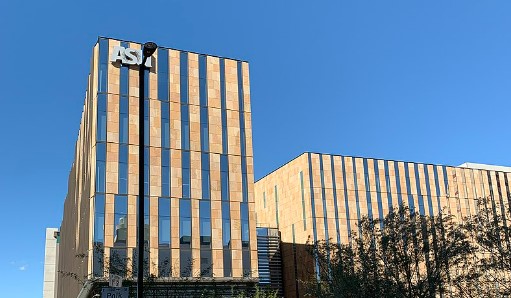
A required biennial training program for Arizona State University (ASU) employees and faculty violates state law, per a complaint letter submitted by the Phoenix-based Goldwater Institute.
In a letter to the Arizona Board of Regents (ABOR) on Tuesday, the organization alleged that the ASU Inclusive Communities, a required biennial training program for all employees and faculty, violates a new law passed last year, A.R.S. § 41-1494.
The law prohibits public funding for training that promulgates “blame or judgment on the basis of race, ethnicity or sex.” The department of administration is required to submit an annual report listing all state agencies complying with the law to the governor, the state senate president, the house speaker, and the secretary of state.
Per the law, “blame or judgment” qualifies as declaring that race, ethnic group, or sex determines inherent moral superiority, racism, sexism, oppression over another race, ethnic group, or sex. It also qualifies as concepts declaring an individual’s race, ethnic group, or sex as definitive of their moral character, endowing responsibility for the actions of others within their shared biological traits, insisting on negative, self-conscious feelings such as guilt or anguish with regard to their biological traits, and meriting discrimination or adverse treatment against them.
“Blame or judgment” also includes the concept that meritocracy or traits such as hard work are racist, sexist, or created by members of a particular race, ethnic group, or sex to oppress members of another race, ethnic group, or sex.
In their complaint letter, the Goldwater Institute noted that the ASU training does impart blame or judgment based on race, ethnicity, or sex.
“The statute makes clear that while the state may, of course, teach that such ideas exist, it may not promulgate these messages of blame or judgment in any official sense, or mandate the participation of employees at any session where these ideas are promulgated,” said the organization. “The ‘ASU Inclusive Communities’ training, however, is premised on the ‘blame or judgment’ referred to in this statute.”
The organization included the following quotes from obtained training materials reportedly promulgating the concepts that white people are inherently privileged, racist, and supremacist, regardless of intent or consciousness, and that heterosexuals are inherently privileged and maintaining power over other “sexual identities”:
“[A]cknowledging the history of white supremacy and the social conditions for it to exist as a structural phenomenon”
“How is white supremacy normalized in society”
“[G]iven the socio-historial [sic] legacy of racism, sexism, homophobia, and other forms of structural inequality, perceptions of authority and control are not always granted to minoritized [sic] faculty.”
“White Fragility”
“What is White Privilege, Really”
“Explaining White privilege to a broke white person […]”
“7 Ways White People Can Combat Their Privilege”
“Racism […] can take the form of […] and include seemly innocuous questions or comments, such as asking people of color where they are from […]”
“Sexual identities are linked to power, and heterosexuality, the dominant sexual identity in American culture, is privileged by going on largely unquestioned.”
“[I]t scares people to talk about white supremacy or to be called a white supremacist. But if we start thinking about it in terms of whiteness as something that is culturally neutral and we’re moving it from that neutral space into a critical space.”
“[W]e have to open the space to critique whiteness.”
“[W]hite supremacy […] referring to here is the period between the 1500’s and the 1800’s that encompasses both Spanish colonization and Euro-American colonization. And what colonization did, was it really created this system of binary thinking. There were folks that were inherently good and folks that were inherently bad, and that led to the systems of superiority that were then written into the foundational documents of our Nation.”
The Goldwater Institute requested ABOR to direct ASU to cease spending any public monies on its Inclusive Communities training, or make the training optional rather than mandatory.
Additionally, the organization suggested that ABOR audit ASU’s other courses and the activities and courses of the University of Arizona (UArizona) and Northern Arizona University (NAU) to ensure compliance. As examples of potential anti-discriminatory violations, the organization linked to the UArizona Office of Diversity, Equity & Inclusion trainings, the UArizona Eller College of Management Diversity, Equity and Inclusion training, and the NAU employee and faculty training.
Corinne Murdock is a reporter for AZ Free News. Follow her latest on Twitter, or email tips to corinne@azfreenews.com.
The Goldwater Institute asked a judge to make Pinal County return the $80 million in taxes it illegally collected. It’s been nearly a year and a half since the county learned it had to return the funds to the taxpayers.
The organization filed a request for a permanent injunction with the Arizona Superior Court in the Arizona Tax Court on Monday.
The $80 million came from a sales tax disproportionately applied to purchases under $10,000. Arizona law doesn’t allow that sort of tax arrangement, which the Arizona Supreme Court affirmed in a ruling issued last year, in Vangilder v. Arizona Department of Revenue.
The Arizona Department of Revenue (ADOR) promised to return the $80 million quickly. The Pinal Regional Transportation Authority (PRTA) has held the funding in an interest-bearing escrow account, with ADOR playing an administrative role in the distribution of the funds.
ADOR gave notice to the superior court last September that it was “setting up a system to process refund claims.”
Yet at the close of last month, ADOR announced that it wouldn’t process refunds at all until PRTA decides the final disposition of the funds. ADOR also indicated that it was the legislature’s duty to figure out how to return the funding, and that no laws were passed during this last session to that effect.
“For these reasons, until the PRTA makes a decision regarding the final disposition of these funds, the Department cannot process any refund claims for the invalidated Pinal County transportation tax,” said ADOR.
The Goldwater Institute declared in their request for a permanent injunction that this decision was unlawful, a “knowing defiance of the law” that constituted an illegal withholding of taxpayer funds violative of court rulings.
“Neither PRTA nor ADOR has any lawful authority to refuse to return illegally obtained and illegally withheld tax money,” stated the organization.
The organization also noted that both the PRTA and ADOR repeatedly neglected to set up a system for efficient returns of the funds should they fail to defend the tax in court.
In a press release, Goldwater Institute Vice President of Legal Affairs Timothy Sandefur stated that the taxpayers were long overdue for their refund.
“The department blames the county, but whoever is at fault, the bottom line is clear: taxpayers are legally entitled to refunds — and the state and county government are refusing to give the money back,” said Sandefur. “[This is] money they have no right to keep, because they had no right to take it.”
The PRTA and ADOR ignored their warnings to postpone collection of the tax in order to avoid administrative difficulties in returning the funds. PRTA also assured the court and the Goldwater Institute in 2018 that it would have a returns system in place.
“[A]t the end of the day if we are not successful, but we have but all this money in escrow by agreement, there will be — the system will play out as it should, through refund claims and the like, and no one will essentially be harmed in that anyone who overpaid will be entitled to a refund, plus interest,” stated PRTA’s counsel.
ADOR told AZ Free News in an emailed statement in February that taxpayers who paid the invalidated tax are able to file claims for what they paid with interest until April 9, 2026.
Corinne Murdock is a reporter for AZ Free News. Follow her latest on Twitter, or email tips to corinne@azfreenews.com.