by Daniel Stefanski | Sep 8, 2023 | News
By Daniel Stefanski |
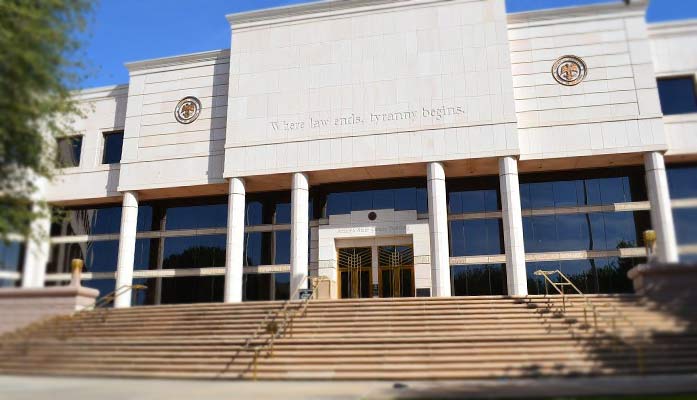
An Arizona-based organization is going to court again to protect the interest of state voters.
This week, the Goldwater Institute announced that its legal team had filed a special action petition with the Arizona Supreme Court on behalf of four state voters, “urging the high court to strike down the current retention election system for Court of Appeals judges and ensure all voters have an equal say.”
The release from Goldwater makes the case that “all Arizonans periodically vote on whether to retain each of the justices of the Arizona Supreme Court,” but that “they cannot vote on the retention of all the judges on the Court of Appeals…whose decisions set statewide legal precedent.” The reason for this being that “a voter’s residency limits their choices to only those Court of Appeals judges who resided in a corresponding geographic area of the state when appointed.”
According to the Goldwater Institute, “approximately 60 percent of Arizona voters get to vote in retention elections for Court of Appeals judges residing in Maricopa County but only 10 percent of voters can participate in retention elections for Court of Appeals judges residing in the far smaller Pinal, Cochise, Santa Cruz, Greenlee, Graham, or Gila counties.”
Former Arizona Supreme Court Justice and current special counsel for this case, Andrew Gould, said, “If a judge’s decision will affect the whole state, it shouldn’t matter where in the state he or she lives. The current system is unfair to the millions of Arizona voters who are bound by the decisions of the judges on the Arizona Court of Appeals, and it raises serious constitutional questions.”
There are four plaintiffs, who are all represented by the Goldwater Institute in this matter. The first is Bonnie Knight, who lives in Yuma County and only has the ability to vote on the retention of judges in Division 1 (which excludes Maricopa County). The second is Deborah McEwen, who lives in Santa Cruz County and only has the ability to vote on the retention of judges in Division 2 (which excludes Pima County). The third is Sarah Ramsey, who lives in Pima County and only has the ability to vote on the retention of Court of Appeals Judges in Pima County. The final plaintiff is Leslie White, who lives in Maricopa County and only has the ability to vote on the retention of Court of Appeals judges in Maricopa County.
The plaintiffs sued Secretary of State Adrian Fontes “in his official capacity because under the state constitution the Secretary of State’s office receives judicial retention candidate declarations and certifies to the county boards of supervisors which candidates’ names shall appear on the ballot.”
The petition for special action makes two arguments for the state’s Supreme Court Justices to consider. First, that “the judicial retention provisions of A.R.S. 12-120.02 violate Arizona’s Free and Equal Elections Clause.” And second, that “Section 12-120.02 violates the Equal Privileges and Immunities Clause because it discriminates among voters based on their residency, and therefore denies the right of all citizens to vote equally in judicial retention elections.”
In conclusion to their petition, the plaintiffs asked the Court to exercise its mandamus jurisdiction and “(1) declare the judicial retention provisions of A.R.S. 12-120.02 unconstitutional to the extent they prohibit statewide electors from voting in judicial retention elections for judges on the Court of Appeals, (2) enjoin those portions of A.R.S. 12-120.02 that prohibit statewide retention elections, and (3) order the Secretary of State to certify that the names of all Court of Appeals judges who declare their candidacy for retention in all future elections must be placed on the ballot statewide.”
Daniel Stefanski is a reporter for AZ Free News. You can send him news tips using this link.
by Daniel Stefanski | Aug 7, 2023 | Education, News
By Daniel Stefanski |
One of Arizona’s most-influential organizations is bringing facts to the conversation surrounding the state’s historic school choice expansion program.
Last month, the Director of Education Policy for the Goldwater Institute, Matt Beienburg, responded to the latest political attacks against Arizona’s Empowerment Scholarship Accounts (ESA) program, releasing a comprehensive fact-check to promote the truth.
Beienburg’s fact-check came after the Governor’s Office issued a memo, which targeted the ESA program, showing that it “could cost the state over $943 million, with over 53% of all new K-12 education spending going towards only 8% of Arizona students.” In conjunction with the release of that memo, Democrat Governor Katie Hobbs said, “The universal school voucher program is unsustainable. Unaccountable school vouchers do not save taxpayer money, and they do not provide a better education for Arizona students. We must bring transparency and accountability to this program to ensure school vouchers don’t bankrupt our state. I’m committed to reforming universal vouchers to protect taxpayer money and give all Arizona students the education they deserve.”
The fact-check from the Goldwater Institute refuted three claims made against the ESA program. First, that “spending on ESA vouchers could account for 53.25% of all new K-12 education spending in the FY2024 budget going towards only 8% of Arizona students.” Beienburg put forward three facts in opposition to the claim: that “total spending on universal ESA students makes up just 2% of total Arizona K-12 spending,” that “Arizona public school districts are projected to receive over 60% (more than $570 million) of all new K-12 funding in FY 2024, despite making up 0% of the growth in students served this upcoming year,” and that “even under the Arizona Department of Education’s (ADE) highest projections, the ESA program would be funding the education of roughly 8% of Arizona’s students (including a disproportionately high percentage of students with severe disabilities) for less than 6% of the total taxpayer cost of educating Arizona’s students.”
The second claim refuted by Goldwater was that “there is an increased cost to the State when a student leaves a public district school and enrolls in the ESA voucher program. This occurs because the ESA award amount is based on the state funding provided to charter school students, which is higher than the state funding provided to district school students.” Goldwater issued one fact in opposition to this claim – that “the average savings per ESA student is even higher when including other (non-formula) spending on public school students. In total, JLBC reports over $3 billion (roughly $3,000 per student on average) of additional spending by state and local taxpayers per public school student outside the basic funding formula. ESA students receive none of this funding.”
The third – and final – claim refuted by Goldwater was that “new estimates indicate the ESA voucher program may cost taxpayers up to $943,795,600 annually, resulting in a potential $319,795,600 General Fund shortfall in FY 2024.” Goldwater issued four facts in opposition to this claim, including that “Gov. Hobbs’ office itself does not believe the report that it is using as the basis for these figures;” that “Gov. Hobbs’ office mistakes the cost ESA awards by thousands of dollars per student;” that “the nonpartisan JLBC continues to project ESA costs in line with the state budget; “ and that “even if the higher enrollments and total ESA award amounts estimated by ADE do materialize, they would not represent the net cost to taxpayers of the program.”
Beienburg closed his fact-check, writing, “Arizona’s ESA program now offers tens of thousands of families an opportunity to pursue the best education possible for their children at a lower cost than traditional public schooling. The governor and her budget office owe it to parents and the public to provide the facts about ESAs free of manipulation.”
Daniel Stefanski is a reporter for AZ Free News. You can send him news tips using this link.
by Daniel Stefanski | Jul 19, 2023 | Education, News
By Daniel Stefanski |
A fight for the future of some federal grant dollars for Arizonans appears to be brewing.
Last week, John Thorpe with the Goldwater Institute sent a letter to Arizona Treasurer Kimberly Yee, expressing the organization’s “concern about Governor Hobbs’ purported cancellation of ESA-related grants that would enable children to attend all-day kindergarten” and urging Yee’s office “to go forward with the program as a legal obligation and for the sake of the parents.”
The Goldwater Institute’s letter references Hobbs’ action in May, which determined that “a $50 million grant made to the Treasurer in the final hours of the Ducey Administration is illegal and invalid.” Hobbs said at the time, “Illegally giving $50 million to private schools while failing to properly invest in public education is just one egregious example of the previous administration’s blatant disregard for public school students.”
After receiving the governor’s notice earlier this year, Treasurer Yee released a statement, writing: “It is clear Governor Hobbs does not care about what is best for Arizona kids or respect the rights of parents to determine the best environment to educate their child. Instead, she is using these children as pawns in a desperate and transparent attempt to win back support from union bosses and her ultra-progressive base. Educational choice is the civil rights issue of our time, and unfortunately, Governor Hobbs thinks she knows better than parents. I fundamentally disagree, and so do Arizona families.”
In that statement, Yee also said that her legal team was “currently reviewing the lawfulness of the governor’s move and determining next steps.”
The Goldwater Institute’s June 14th letter to Treasurer Yee states that “on January 1, 2023, the Governor’s Office entered an Interagency Service Agreement with the Treasurer’s Office to provide up to $50,000,000 in federal grant money from the American Rescue Plan (ARPA), via the ESA program, to children in kindergarten starting with the 2023 academic year…In exchange for your office’s commitment to administer and report on the grant program, the Governor made a contractual commitment to provide the funds and to ‘work with’ your office ‘to establish a cadence whereby [the Governor] will transfer funding to [the Treasurer] to then disburse to grant program recipients.’ The Agreement was, and is, a legally binding contract.”
Thorpe’s letter also asserts that “nothing in the Agreement or in state law permits unilateral termination by the Governor,” calling Hobbs’ prior justifications “groundless,” adding that “the Governor has no right to simply cancel an agreement based on unfounded speculation that the agreement violates the law.”
The first-year Arizona governor had touted that by taking this action, her office had “adverted a violation of federal law and the State Constitution.”
The attorney for the Goldwater Institute’s Scharf-Norton Center for Constitutional Litigation also communicated that “we find it troubling that Governor Hobbs is attempting this rollback of the ESA program after a long history of campaigning against, and promising to end, the Legislature’s recent expansion of the Arizona Empowerment Scholarship program.” He continued, “Having already failed in her bid to defund the ESA program through the budget process earlier this year, it appears Governor Hobbs is attempting to cancel the all-day kindergarten grants, not in order to comply with state or federal law (as described above, the program is entirely lawful), but as part of a transparent effort to harm and undermine the ESA program wherever possible.”
In a supplemental post, Thorpe added, “It’s simple: the governor does not have a right to lawlessly renege on promises made to Arizona families. Goldwater will never stop fighting to empower parents, expand choices in education, and to hold government officials accountable – in Arizona and throughout the country.”
Daniel Stefanski is a reporter for AZ Free News. You can send him news tips using this link.
by Corinne Murdock | Jun 30, 2023 | News
By Corinne Murdock |
The city of Phoenix is being sued over its capitalization of a loophole to shield high-rise luxury apartments from up to an estimated $7 million in property taxes.
The city of Phoenix effectively agreed to relieve private real estate developer Hubbard Street Group of around $7 million in property taxes by taking ownership of their property, “Skye on 6th,” and declaring it part of a slum or blighted area while the developer continues to operate and manage the property. In return, the developer agreed to pay a total of $525,000 in rent to the city, pay $32,000 to two school districts, and dedicate 10 percent of its residential units to workforce housing for the eight years of the lease. The city arranged this deal through the state’s statutory provisions outlining the Government Property Lease Excise Tax (GPLET).
In the case Paulin v. City of Phoenix, two taxpayers represented by the Goldwater Institute sued the city over allegedly violating the Arizona Constitution’s Gift Clause and Evasion Clause.
Since local governments are exempt from property taxes, GPLET enables governments to accrue revenue on its property by leasing to businesses. The Goldwater Institute, on behalf of the two Phoenix taxpayers, argues that the city took advantage of GPLET by assuming ownership of the property of interest to a private business in order to provide a special tax break to that business. Although the government sustains a reduced revenue stream and taxpayers pay more under such an arrangement, the Goldwater Institute alleges that local politicians may claim business growth while paying off the business with a tax write-off.
“[U]nder this arrangement, private property is conveyed in form to the government while in substance being owned and operated by a private party for the sole purpose of evading property taxes to which other taxpayers are subject,” stated the complaint. “The result of this arrangement is a gift of public resources to a private business, and a conveyance of property to evade taxes in violation of Arizona’s Constitution.”
Those poised to lose out on their share of the $7 million in tax payments would include the city, Maricopa County, Maricopa County Community College District, Central Arizona Project, Maricopa Special Healthcare District, Fire District Assistance Tax, and special taxing districts for library and flood control. Phoenix Elementary School District and Phoenix Union High School District are the two school districts receiving the tens of thousands to reportedly offset their share of the lost tax revenue.
The Goldwater Institute also disputed the city’s characterization of the contested property as located in a slum or blighted area: a condition required for an eight-year tax abatement as provided in the GPLET agreement between Phoenix and the developer.
A hearing on the case took place last week in the Maricopa County Superior Court. The city argued that taxpayers upset by their arrangement with the developer were truly upset with the existence of GPLET. The city contended that the taxpayers should petition lawmakers to reform GPLET law to prevent their actions.
Counsel for the city also contended that any claims that their actions violated the Gift Clause would render GPLET impossible to use.
The city also claimed that Hubbard Street Group was chosen through the request-for-proposal (RFP) process, and disputed the claim that Hubbard Street Group approached the city first.
The Goldwater Institute argued that there were no actual reservations of ownership, control, or management of the property. They also argued that the city never intended to hold onto the property itself, but always intended to convey the property back to the lessee. Counsel for the developer contended that claim, referencing a contract provision that the property will be owned by the city.
In a statement, Goldwater Vice President for Litigation Jon Riches said that Phoenix’s use of GPLET is unconstitutional.
“The Arizona Constitution prohibits the transfer of property to evade taxes that are otherwise owed and that other taxpayers must pay,” said Riches. “Here, the city of Phoenix allowed private property to be transferred to the city even though it will never be used as city property so that one special interest could avoid paying taxes on it. We are hopeful the court will agree this artificial transfer violates the Constitution.”
In 2020, the Maricopa County Superior Court struck down a similar GPLET arrangement between the city of Phoenix and another high-rise residential developer. Four months later, the city entered into the currently-contested GPLET agreement with Hubbard Street Group.
A ruling on the case may occur sometime within the next several months.
Corinne Murdock is a reporter for AZ Free News. Follow her latest on Twitter, or email tips to corinne@azfreenews.com.
by Daniel Stefanski | May 14, 2023 | News
By Daniel Stefanski |
In the middle of a hectic week at the Arizona Legislature, Democrat Governor Katie Hobbs signed a wildly popular bill to increase veterinary care for pets.
On Tuesday, Governor Hobbs signed SB 1053, sponsored by Senator T.J. Shope, which “allows a veterinarian to use an audio-video communication medium to establish a veterinarian-client patient relationship and prescribe drugs subject to certain terms and conditions.”
Last week, after the bill cleared the Legislature, Shope wrote, “By now, you’ve heard me talk a lot about SB 1053, a bill I’ve sponsored that would allow veterinarians to utilize telemedicine to care for our pets. After this bill passed out of the House by a nearly unanimous vote, 57-1, it passed out of the Senate on Final Read this week with supermajority support and has been transmitted to the Governor’s desk. I, along with the Arizona Humane Society and many other pet owners, hope Governor Hobbs will do what’s best for our animals and sign this bill into law.”
Senator Shope and Co. got their wish with Hobbs’ signature. The Goldwater Institute had also been a huge proponent of the bill and cheered on the new law. Goldwater’s Director of Government Affairs, Jenna Bentley, tweeted, “A great day for pets in Arizona as SB 1053 is signed into law! This bill expands access to veterinary telemedicine services. Something that cannot happen soon enough for many animal owners, especially in rural areas of our state.”
The Goldwater Institute also posted an article from Mark Cushing, who is the Founder & CEO of the Animal Policy Group. Cushing praised the bill and explained why this proposal was sorely needed in the Grand Canyon State, writing, “A chronic shortage of veterinarians has created veterinary deserts throughout the United States. Pet owners of all ages don’t hesitate to seek veterinary advice and care, but such care is often available only through digital tools. Veterinary trade associations resist these changes, ignoring the key principle that telemedicine requires an informed choice by the veterinarian and pet owner to proceed without an in-person examination of the pet.”
Cushing also used the passage of Shope’s bill to encourage other states to follow in Arizona’s footsteps: “During the COVID pandemic, 19 states allowed pet owners to utilize telemedicine to initiate veterinary care with no reports of harm to pets. The Canadian province of Ontario, where 15 million people live, has enjoyed veterinary telemedicine for five years and also reported no complaints of injuries to pets. The Arizona Legislature looked at the lessons from these jurisdictions, considered the experience of human medicine, and made the right choice. The door is now open for more states to follow Arizona’s lead.”
Daniel Stefanski is a reporter for AZ Free News. You can send him news tips using this link.