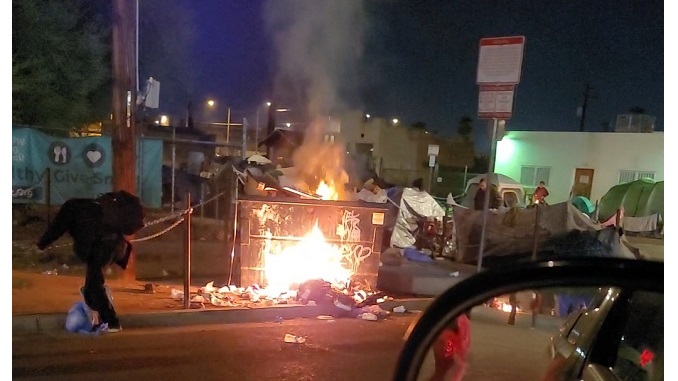
Last Friday, the Maricopa County Superior Court denied the city of Phoenix’s motion to extend the deadline imposed to clean up The Zone.
Maricopa County Superior Court Judge Scott Blaney apparently rejected the city’s insistence that they’d begun taking sufficient action.
“The Court interprets this argument as meaning the injunction is unnecessary because the City is already taking steps to abate the horrible conditions in the Zone,” wrote Blaney. “But the Court issued the Preliminary Injunction based, in part, upon the City’s past failure to address the issues in The Zone, as well as the City’s apparent lack of intent to do so until faced with possible judicial intervention.
In their motion to stay the court’s preliminary injunction, the city said it didn’t dispute the current conditions of the homeless encampments, but opposed the actions they were required to take, namely the court’s suggestion of campgrounds. The city took issue with the required deadline of July 10.
“[D]eciding how to spend taxpayers’ money, deliver services, and create new infrastructure for public housing is a legislative, not judicial function,” stated the city. “[T]he order intrudes into local law enforcement and prosecutorial discretion in what appears to be an order to take mandatory enforcement action — ignoring any analysis of the facts on the ground and ordering sweeping relief in its stead.”
The city further claimed that Blaney violated the constitutional separation of powers. It also seemed to question the judge’s description of homeless individuals’ conduct as a “nuisance.” Blaney’s ruling outlined the many ways that The Zone qualified as a public nuisance. The city said it couldn’t guarantee cleaning up The Zone.
“While the City seeks to maintain a clean and crime-free environment for its residents, those are outcomes that the City simply cannot guarantee, even with the expenditure of significant resources,” stated the city.
The city also claimed that Blaney’s order didn’t reflect public interest or the true desires of the Phoenix community. That contradicts the numerous business owners and residents of The Zone and elsewhere in the city that have complained about the homeless crisis.
“The City’s policies are the product of community meetings with policymakers, the gathering of information from all relevant stakeholders, and the advice of experts at the City and throughout the community,” wrote the city. “To circumvent this process and supplant the City’s plans with the Court’s own judgment is against public interest.”
🧵INBOX: Welcome to The Zone, the epicenter of the homeless crisis that @CityofPhoenixAZ refuses to solve. This man is one of many that will likely live and die on these streets under the city's current approach to homelessness. I investigated & uncovered shocking details… pic.twitter.com/snb8QkvjsA
The homeless crisis spiraled following the election of Mayor Kate Gallego, a Democrat, in 2019.
The Maricopa County Superior Court ruled in late March that the city of Phoenix was at fault for the current state of The Zone, and imposed a cleanup deadline this summer. The ruling came days after city officials promised to meet to discuss solutions for The Zone, in the wake of back-to-back murders.
Details of a settlement in a separate, federal case haven’t been publicized yet.
Democratic leadership has generally downplayed the urgency of the public nuisances and dangers presented by The Zone.
Corinne Murdock is a reporter for AZ Free News. Follow her latest on Twitter, or email tips to corinne@azfreenews.com.
Days after a powerful Arizona government watchdog group scored a major victory in the City of Phoenix, it is turning its attention to a neighboring city over the same issue.
On Monday, John Thorpe, a Staff Attorney with the Goldwater Institute, sent a letter to Tempe Mayor Corey Woods and councilmembers, expressing serious concerns about the proposed ordinance “Relating to the Payment of Prevailing Wages on City Construction Contracts” to be considered at the Council’s upcoming meeting on May 4.
Thorpe noted his understanding that “the proposed ordinance imposes, among other measures, prevailing wage and apprenticeship requirements on all contractors who participate in public works projects for the City for contracts exceeding $250,000.”
Much like the letter the Goldwater Institute previously transmitted to the City of Phoenix, Thorpe warned, “if the City adopts this ordinance and regulates matters that are expressly pre-empted by state law, it will expose the City to a high risk of litigation, as well as costs and attorneys’ fees for parties who successfully challenge the unlawful ordinance.” He also highlighted the troubling nature of the Council’s consideration of this proposal “with less than one week’s notice and little chance for input from those most affected.”
The Goldwater Institute was again representing the Arizona Builders Alliance and the Associated Minority Contractors of Arizona.
The letter to Tempe’s municipal leaders follows the repeal of the prevailing wage ordinance from the City of Phoenix last month after a change of two councilmembers. The vote flipped from 5-4 (approval of prevailing wage) to 6-3 (opposition of prevailing wage). Phoenix Mayor Kate Gallego voted to repeal the ordinance, writing, “Workers deserve a living wage – and we can deliver that through a robust, public process that doesn’t put the city in legal and financial jeopardy. That’s why I voted with a majority of Council to direct city staff to find legally viable ways to increase wages on city projects.”
On behalf of the Goldwater Institute, Thorpe cheered on the reversal from the City of Phoenix, stating, “Yesterday’s repeal….is a reminder that Goldwater will never stop fighting to hold government accountable and to defend Americans’ economic freedom from burdensome, counterproductive regulations.”
The Arizona Attorney General’s Office is still considering a 1487 complaint from Democrat Senator Catherine Miranda, who submitted the request on April 17 to “clarify the apparent conflict between two statutes and consequently determine whether Phoenix has the authority to enact prevailing wage at the municipal level.” Though Tempe isn’t the focus of the inquiry to the state’s chief law enforcement officer, her final disposition could give valuable direction and information if more cities and towns attempt to pass versions of the prevailing wage ordinance.
Daniel Stefanski is a reporter for AZ Free News. You can send him news tips using this link.
The state budget sits at $2.5 billion, an unanticipated increase, despite a leap in school choice enrollments.
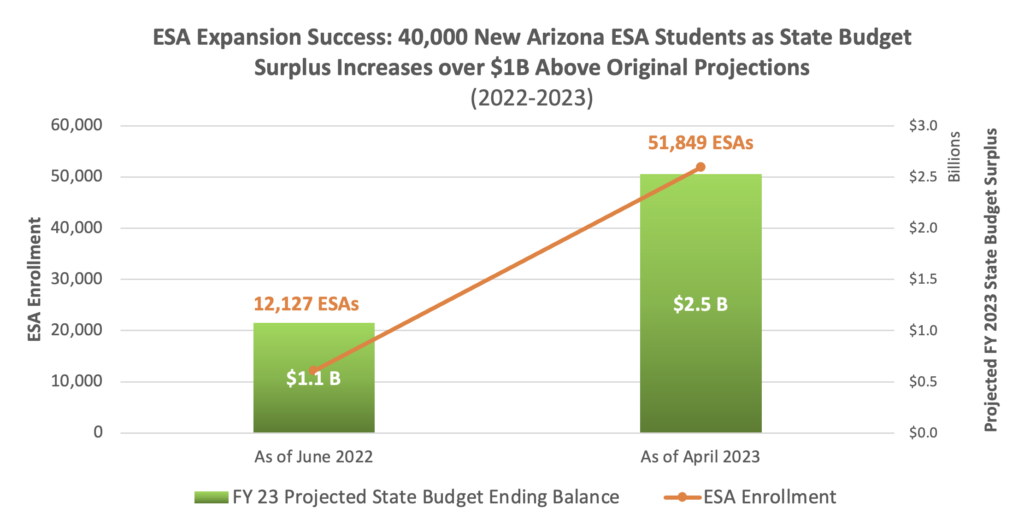
Nearly 40,000 students have joined Arizona’s universal school choice program; 7,000 have joined this year alone. Prior to the Education Savings Account (ESA) Program extension to all students, there were just over 12,100 students enrolled. At present, there are over 51,800.
Yet, this addition of tens of thousands of students didn’t hurt the state budget; the surplus has only increased as ESA Program enrollment increased. The surplus hit $2.5 billion this month, where last June it was $1.1 billion.
The ESA Program has also reflected a cost-saving measure for the state. Each student in the ESA Program receives scholarship funds of about $7,000 — about half of what the average public school spends on each student. Based on current program participants, that means that these students originally cost the state $725 million on average while in public schools, whereas they cost just over $362 million within the ESA Program.
Following these latest figures, ADE opened up enrollment for the ESA Program for the 2023-24 school year.
Arizona’s first in the nation ESA program is officially open for the 2023-2024 school year! Every child deserves a quality education no matter their zip code, and ESAs allow parents from any income level to choose what is best for them! #InParentsWeTrusthttps://t.co/mEm56eKYd7
— Arizona Department of Education (@azedschools) April 17, 2023
Gov. Katie Hobbs has rejected the cost-saving argument of the ESA Program. Shortly after taking office, Hobbs proposed rolling back the ESA Program, making the argument that universal school choice would bleed the state of $1.5 billion over the next decade. Yet, the Arizona public school system takes about $15 billion annually, or $150 billion over the next decade.
The Goldwater Institute, a public policy think tank who pointed out this disparity in an analysis defending universal school choice, argued that Hobbs’ arguments of frugality weren’t intellectually honest.
“To argue that taxpayers can afford the latter, but somehow not the former, defies basic common sense,” stated the organization.
We have a constitutional responsibility to fund our public schools. If we continue down the current path, we will not be able to fulfill that responsibility. That's why my budget called for a rollback of the ESA program to ensure Arizona has a sustainable https://t.co/JnVBGtxuvl…
The state legislature also increased public school funding by $600 million for this year. Anti-school choice activists continue to claim that the schools don’t receive adequate funding.
🔥 States across the nation are rejecting ESA voucher scams 👏 AZ's catastrophic rollout of universal ESA vouchers has become a cautionary tale — and in many states, lawmakers on both sides of the aisle are waking up ⏰ #AZVouchersHurt#AZVoucherWatchpic.twitter.com/awhwjIdC21
The Common Sense Institute found that the state saved $500 million annually after about 31,000 students exited the public school system from 2019 and following the COVID-19 pandemic. They also projected an $8 million end-of-year surplus based on enrollment trends.
According to the Joint Legislative Budget Committee (JLBC) report issued last week, base revenue growth is projected at nearly nine percent – a nearly two percent increase from January’s forecast, or $750 million.
JLBC noted that this year’s fiscal growth rate reflected a 64 percent increase in corporate income tax collections, much higher than the 10 percent increase in the federal collections. Additionally, individual income tax refunds increased by 54 percent.
Corinne Murdock is a reporter for AZ Free News. Follow her latest on Twitter, or email tips to corinne@azfreenews.com.
Just days after a powerful Arizona government watchdog group threatened possible legal action, the City of Phoenix repealed a controversial ordinance that had passed the previous month.
On Wednesday, the Phoenix City Council voted to repeal the prevailing wage ordinance, 6-3, after a change of two councilmembers. Councilmembers Kesha Hodge Washington, Jim Waring, Ann O’Brien, Kevin Robinson, Debra Stark, and Mayor Kate Gallego voted for the repeal; while Councilmembers Yassamin Ansari, Laura Pastor, and Betty Guardado voted to maintain the ordinance.
After the vote, Mayor Gallego took to Twitter to explain her decision, writing, “Workers deserve a living wage – and we can deliver that through a robust, public process that doesn’t put the city in legal and financial jeopardy. That’s why I voted with a majority of Council to direct city staff to find legally viable ways to increase wages on city projects. I believe in doing things the right way, not the fast way, and that’s what we decided to do today. I am optimistic that we will find a path forward for better pay for construction workers while, at the same time, put sound policy on the books that survives legal challenges.”
Workers deserve a living wage—and we can deliver that through a robust, public process that doesn’t put the city in legal and financial jeopardy. That’s why I voted with a majority of Council to direct city staff to find legally viable ways to increase wages on city projects.
The Goldwater Institute, which had sent a letter to the Council earlier in the month, championed the news out of Phoenix. John Thorpe, a staff attorney with Goldwater, stated, “Yesterday’s repeal is good news for businesses, their employees, and all taxpayers – and it’s a reminder that Goldwater will never stop fighting to hold government accountable and to defend Americans’ economic freedom from burdensome, counterproductive regulations.”
It's a VICTORY for small businesses, minorities, younger workers, and taxpayers! 🎉
The Phoenix City Council repealed its illegal “prevailing wage” ordinance—a mandate that restricts small businesses and imposes burdensome requirements: https://t.co/47D3oNbsI8
Thorpe wrote that the ‘Prevailing Wage Ordinance for City Projects’ law, “introduced on short notice with almost no chance for public scrutiny from anyone it would impact, required businesses that contract with the city for construction projects costing more than $250,000 to follow a slew of new requirements: they would have had to provide their employees with wages and benefits based on complicated formulas produced by the federal government, keep painstaking records, and comply with a host of other rules and regulations. Worse still, all these regulations came with the risk of heavy fines and potentially crippling lawsuits, even for minor infractions.”
On March 21, three Phoenix City Councilmembers – Carlos Garcia, Betty Guardado, and Laura Pastor, sent a letter to City Manager Jeff Barton, requesting a Special Meeting the following day to consider the Prevailing Wage Ordinance for City Projects. The three councilmembers wrote, “We believe it is time for leadership to address the lack of skilled construction workers needed to fill the rising demand for labor in Phoenix. We know that areas of the country with prevailing wages for city projects have a greater supply of apprentices and pathways for young people to find and join a skilled trade. A prevailing wage ordinance for city projects will ensure that our development growth is matched with the skilled labor we urgently need when we invest in the growth of our communities.”
The next day, the Ordinance was approved by a vote of 5-4. Councilmembers Garcia, Guardado, Pastor, Sal DiCiccio, and Yassamin Ansari voted in favor of the Ordinance. Garcia and DiCiccio have since left the Phoenix City Council, being replaced by Kevin Robinson and Kesha Hodge Washington.
On April 13, the Goldwater Institute, representing the Arizona Builders Alliance and the Associated Minority Contractors of Arizona, sent a letter to the Phoenix City Council to “express serious concerns” about the Ordinance passed on March 22. Thorpe, writing again for Goldwater, informed the City that if “the enacted version of the ordinance regulates matters that are expressly pre-empted by state law, it exposes the City to a high risk of litigation.” Thorpe outlined that “when the Legislature enacts a law on a matter of statewide concern, that law pre-empts and overrides any conflicting municipal provision. In this instance, voter-approved state law dating back to 1984 expressly provides that ‘prevailing wage’ requirements for public works contractors are a matter of statewide concern and may not be imposed by municipalities.”
Thorpe also found “it troubling that this ordinance was enacted after providing the public barely twenty-four hours’ notice and without any meaningful input from the many stakeholders it will affect.” He also pointed out that “the final version (of the ordinance) enacted by the Council has not yet been made publicly available,” which he questioned the existence of “any legal authority the City possesses to withhold a duly enacted ordinance from public inspection.”
Democrat Senator Catherine Miranda also waded into the discussion on the City of Phoenix’s action in March, submitting a 1487 request to Arizona Attorney General Kris Mayes on April 17, to “clarify the apparent conflict between two statutes and consequently determine whether Phoenix has the authority to enact prevailing wage at the municipal level.”
Before the new coalition voted to repeal the Prevailing Wage Ordinance, another Democrat Senator, Anna Hernandez, voiced her disapproval with Mayor Gallego’s pending action, tweeting, “(Mayor Gallego) is once again turning her back on our union brothers and sisters.” Hernandez also shared an excerpt from a questionnaire that Gallego filled out during her mayoral run, where she wrote, “At the end of the day, prevailing wage laws are good for working families in the city of Phoenix and I will do what I can to support the enforcement of federal prevailing wage law, and advocate for a reintroduction of Arizona’s state or city prevailing wage law.”
As expected, the agenda for today’s Phx City Council mtg added on the Repeal to Prevailing Wage. @MayorGallego opposes this ordinance and has now ensured that it will be repealed with her new council.
Arizona’s bet on universal school choice is already paying off. At the same time that enrollment in the state’s Empowerment Scholarship Account (ESA) program is surging, the state’s revenue surplus has gone through the roof.
In the first four months of 2023 alone, enrollment in Arizona’s ESA program has soared by 7,000 students, bringing the total number of children served to over 51,000. And now, new data released this past week by the nonpartisan Joint Legislative Budget Committee (JLBC) show that over a similar period, the state’s estimated revenue surplus has surged by an extra $750 million, putting the total state budget surplus this year at $2.5 billion.
Before Arizona’s historic universal ESA expansion took effect, just 12,000 students were participating in the program. This means that during the first school year where every family in the state can use their child’s public education dollars to customize that student’s schooling, nearly 40,000 new students have received ESA support for private or at-home learning opportunities. And all this is happening as state coffers have overflown with over $1 billion dollars more in revenue than originally forecast.
Sources: Arizona Joint Legislative Budget Committee (JLBC) FY 2023 Appropriations Report: $1,077,036,700 projected FY 2023 ending balance based on enacted budget. Arizona JLBC Finance Advisory Committee April 2023 Briefing Materials: $2,530,157,100 projected FY 2023 ending balance (revised). Arizona Department of Education ESA Program 2022 Quarter 4 Report: 12,127 ESA students. Arizona Department of Education ESA Program Homepage as of April 17, 2023: 51,849 ESA students.
Indeed, this extraordinary economic momentum comes in the wake of Arizona enacting the nation’s first fully universal ESA program. Sponsored by state Representative Ben Toma and signed into law by former Governor Doug Ducey last summer, the new legislation took effect in September 2022.
Since then, leftwing activist organizations such as Save Our Schools (SOS) Arizona have attempted to portray the program as financially ruinous. Yet this same organization—whose leaders were forced to admit that they had miscounted the number of signatures they collected in opposition to the program last fall by more than 50,000—has again opted for partisan wish-fulfillment rather than numerical reality.
With a typical ESA scholarship award around $7,000 per student—that is, about half of the roughly $14,000 spent on average per student in a public district school—the ESA program now serves roughly two kids for the cost of each one in a traditional public school district.
Unsurprisingly, when compared to the roughly $15 billion now spent each year on Arizona public schools, the ESA program makes up only a sliver of total K-12 spending. Scholarship awards for students who’ve joined the program under the universal ESA expansion amount to roughly 2% of the total spending on public school students. In fact, despite claims by SOS and other opponents of school choice that ESAs have drained public schools of funding, state lawmakers increased ongoing public school funding by more than $600 million in the same year that the universal ESA expansion took effect.
In short, the ESA program makes up only a small share of the state’s spending on education, but with over 50,000 participants and growing, it will continue to provide a lifeline for all students in need. It’s already done just that for students with special needs and other vulnerable populations ever since Goldwater created the nation’s first ESA program in Arizona more than a decade ago—delivering life-changing results at lower costs than public school offerings.
Despite such real-world impacts on families, critics have doubled down to suggest that the program’s success is a sign of failure and financial unsustainability. Indeed, teachers union-aligned groups have suggested that because more students have opted into the ESA program than originally estimated, it must be too expensive. (Note the sharp contrast to their usual take on education spending, which is only ever portrayed as an investment, rather than a cost.)
It is true that demand for ESAs has already beaten initial estimates, and it is true that the expansion, which passed in the final days of last year’s legislative session, was enacted separately from the state budget—meaning ESA awards were not incorporated into the projected costs of the original budget. But ESA award amounts have already been factored into the state’s updated budget projections released this January for the current and upcoming fiscal year. In fact, it’s the very same state budget analysts who assume that the program will grow even further to 57,000 students by the end of this school year who also report the state is now sitting on a $2.5 billion cash surplus for next year. (Of note, that surplus is in addition to the state’s $1.4 billion rainy day fund, which former Governor Ducey and conservative lawmakers also accumulated to cushion the state from any future economic turbulence.)
The state budget analysts were characteristically cautious in their recommendations to spread out the massive war chest. They suggested that if all $2.5 billion were spent this year, the state budget would simply break even next year, before the balance increases again to an estimated $600 million surplus by 2026. But in any case, their projections make clear that the same Arizona lawmakers who unleashed universal school choice have helped steward robust economic vitality and have created a situation where Arizona lawmakers are again weighing how best to spend or return excess tax revenues. Indeed, as the JLBC analysts reported in January—even before the latest upward revisions—the state has enjoyed “an increase of $1.06 billion over the original revenue estimate included in the FY 2023 budget enacted in June 2022” due to “significantly stronger revenue growth than originally projected.”
There is no doubt that global financial uncertainty, the risk of fiscal and monetary mismanagement from Washington D.C., and warnings of mild or severe recessions should perennially weigh on the minds of state legislators. But when it comes to ESAs and the state’s financial solvency, one thing is clear: universal school choice and successful economic stewardship easily go hand in hand.
Arizona has just proven it.
Matt Beienburg is the Director of Education Policy at the Goldwater Institute. He also serves as director of the institute’s Van Sittert Center for Constitutional Advocacy.