by AZ Free Enterprise Club | Dec 18, 2022 | Opinion
By the Arizona Free Enterprise Club |
In this past November’s election, Arizona voters were misled into passing Prop 211. Billed as the “Voters’ Right to Know Act” that’s supposed to “Stop Dark Money” in our state, it sounds harmless enough. But that was all a part of the clever messaging from its campaigners—like former Arizona Attorney General Terry Goddard—to scare the average person into voting “yes.”
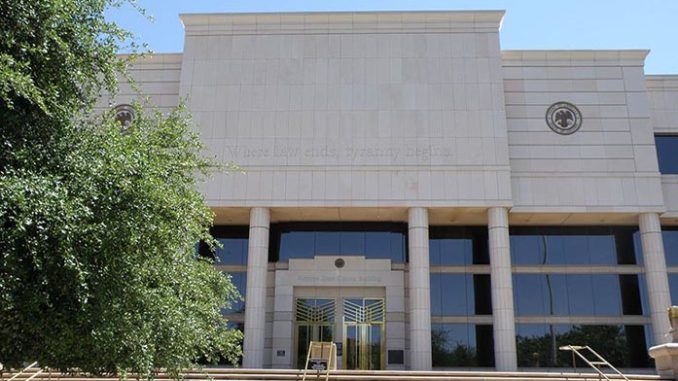
Unfortunately, it worked. But Prop 211 is unconstitutional, and that’s why the Arizona Free Enterprise Club, in partnership with the Center for Arizona Policy and the Goldwater Institute, filed a lawsuit to stop the Act from being enforced…
>>> CONTINUE READING >>>
by Terri Jo Neff | Nov 26, 2022 | News
By Terri Jo Neff |
If government officials threaten to force you from your home because of a zoning violation, should you be able to seek a court order blocking the forced removal? Or must you wait until you are actually homeless to fight back?
That is a question the Arizona Supreme Court could consider next year, in a case out of Sierra Vista that has garnered the attention of the Goldwater Institute and private property advocates across the state.
Among the plaintiffs are several longtime city residents of a mobile home park who filed a lawsuit in early 2021 arguing that city zoning officials should not be allowed to force them to move the recreational vehicles (RVs) they live in and that anti-RV ordinances violate their constitutional rights.
A Cochise County judge and the Arizona Court of Appeals ruled there is nothing that can be done in advance to stop the city from enforcing the ordinance. The lawsuit can only proceed if the city actually moves forward with making the residents leave, according to the court rulings.
The Goldwater Institute’s Scharf-Norton Center for Constitutional Litigation took issue with the city’s position as well as the legal reasoning of the judge and appellate court. The organization has filed an amicus (friend-of-the-court) brief asking the Arizona Supreme Court to hear the case which the RVers are appealing.
Timothy Sandefur, attorney for the Institute, notes that prospective injunctive or declaratory relief against a threatened future unconstitutional government act “is a routine procedure.” As such, the amicus brief asks the justices to order the requested injunction to protect the residents.
“This case is like a hypothetical situation in which a plaintiff files a lawsuit for an injunction to prevent a defendant from converting her personal property, or building a factory that will pollute her land, and the superior court tells her the case is unripe because no theft or pollution has yet occurred—before adding, ‘come back after your property has been stolen or ruined,’” Sandefur wrote.
Under city zoning definitions, RVs are considered temporary shelters that are not allowed as permanent residences in a manufactured home subdivision. RVs are, however, permitted as permanent residences in up to 30 percent of the total spaces in a manufactured home park.
The 160-lot Cloud 9 property involved in the dispute is considered a manufactured home subdivision despite being called a mobile home park for decades. In July 2020, a notice of non-compliance gave several residents, including Amanda Root, 30 days to remove their RVs despite the fact most had lived at Cloud 9 for years and did not have funds to move elsewhere.
The city agreed to take no action on the zoning order while attorneys for the residents and the city attempted to resolve the matter. But in February 2021, the city council rejected a proposed amendment which would have allowed Root and the other impacted residents to continue living in RVs at their current locations.
A lawsuit was filed a short time later seeking an injunction preventing the city from enforcing any evictions while the case was litigated. The city’s twofold argument contended the restrictive ordinances related to RVs are constitutional and that there is no legal basis for a court injunction at that time.
Judge David Thorn of the Cochise County Superior Court denied the injunction, pointing out there was no “injury” caused by the threats of enforcement. The Arizona Court of Appeals also passed on hearing the case due to no showing of actual harm, although the appellate court noted there could be harm in the future.
The Arizona Supreme Court will decide in early 2023 whether to hear the case or to leave in place Thorn’s decision that nothing can be done until Sierra Vista officials try to enforce the zoning violations.
by Terri Jo Neff | Oct 30, 2022 | News
By Terri Jo Neff |
In 2016, Pima County used more than $15 million in county assets as collateral to lure an aspiring space tourism company connected to now-Sen. Mark Kelly to Tucson despite myriad questions about whether the deal was constitutional.
The Arizona Court of Appeals answered one of those questions on Oct. 26, ruling that a major provision of the county’s deal with World View Enterprises violated the Gift Clause of the Arizona Constitution. That deal allows World View to purchase its Pima County-financed office and manufacturing complex on prime commercial land for only $10 in 2036.
Pima County has 30 days to file a petition for review with the Arizona Supreme Court. If no petition is filed, the case goes back to the Pima County Superior Court for further proceedings in compliance with the appellate decision.
Jan Lesher, the current Pima County Administrator, notified the county supervisors that the Pima County Attorney’s Office will discuss the appellate decision during an executive session on Nov. 1.
Former Pima County Administrator Chuck Huckelberry, with support from Kelly, attracted World View’s corporate and manufacturing operations by promising to construct a Space Port (launch pad) on county-owned land near the Tucson International Airport. In addition, the county designed and constructed a 142,000 square-foot complex on 12 acres of adjacent county-owned land.
The $19 million cost of the project, which includes interest Pima County pays for financing the construction, was justified, supporters like Kelly and Huckelberry claimed, because of the 400 high-paying jobs and $3.5 billion of economic impact World View would bring to the area.
For its part, World View is to reimburse the county’s outlay via rent payments as part of a 20-year Lease-Purchase Agreement. Then when the lease is up, World View can purchase the office / manufacturing complex (sans the Space Port property) for $10.
The problem with that provision, according to the Court of Appeals, is that the building will still have a 30-year lifespan in 2036 and a fair market value of $14 million.
“The ‘give’ then, by Pima County, is $14 million and its ‘get’ is $10,” wrote Chief Judge Karl Eppich in the Oct. 26 appellate decision. He added that the provision was “lopsided” from the perspective of the county because the purchase price represents only .0000007 percent of the property’s value.
Eppich wrote that the expenditure of public funds to benefit a private company is legal under the Arizona Constitution only when a public purpose is served and only if the benefit or consideration between the public and the private entity is not “grossly disproportionate.”
“We agree with Taxpayers that the $10 purchase option amounts to an unconstitutional subsidy because the consideration received by Pima County is grossly disproportionate to the value of the World View facility,” he wrote.
Kelly became an advisor for World View in 2013 after getting to know the company’s founders. He has continued his relationship with the company even though those founders are no longer affiliated with World View and have started a competing new space tourism company in Florida.
World View, which still claims people will travel to the edge of the stratosphere someday via its proprietary balloons, has significantly missed most of its annual staffing and payroll targets. County officials have also had to revise the agreement at least once to address several months of late rental payments.
Timothy Sandefur is vice president for Legal Affairs at the Goldwater Institute and is one of the attorneys who represent three Pima County taxpayers who sued the county shortly after the World View agreement was announced in 2016.
“County governments exist to protect the rights of citizens and allow them to pursue their own business in their own way—not to pick winners and losers in the marketplace, or gamble with taxpayer money,” Sandefur said after the appellate decision was announced. “When they do, the consequence is often that taxpayer money simply floats away.”
Sandefur also addressed the possibility that Pima County will ask the state’s highest court to consider the case.
“Although they could appeal the decision to the Arizona Supreme Court, it seems well past time for Pima County officials to admit that this entire deal was both illegal and foolhardy,” he said.
by Corinne Murdock | Oct 17, 2022 | News
By Corinne Murdock |
Earlier this month, a lawsuit against the city of Phoenix for facilitating a crime-riddled homeless encampment in the downtown area dubbed “the Zone” received a legal boost. The Zone has over 1,000 individuals, making it the largest homeless encampment in the state and one of the largest homeless encampments in the country.
The Goldwater Institute, a Phoenix-based public policy think tank and litigation organization, submitted an amicus brief in support of the lawsuit in early October. They petitioned the court to require the city to clean up The Zone.
The brief summarized that the city’s dereliction of duty violated multiple laws, including a 1985 Arizona Supreme Court decision constituting the invitation of vagrants into an area as an illegal nuisance as well as state law forbidding cities from maintaining activities that pollute public waterways.
READ: GOLDWATER INSTITUTE AMICUS BRIEF
In a press release, the Goldwater Institute’s vice president for legal affairs, Timothy Sandefur, contested that it was “outrageous” that the city would withhold police protection from the property and business owners within The Zone.
“It’s not compassion to let people live on the streets, in an atmosphere riddled with unpoliced gang violence,” wrote Sandefur. “Hardworking Phoenicians should be able to rely on the public services their tax dollars pay for — and their elected officials owe them a duty to enforce the laws.”
Sandefur highlighted one of the businesses harmed by the city’s facilitation of The Zone: Arizona Rock Products Association (ARPA), a trade organization for the mining and rock industry. Sandefur relayed how the homeless started fires, left used needles and condoms, defecated and urinated, broke into cars, trespassed, and stole food from a refrigerator on ARPA property.
“ARPA is one of the many crucial contributors to Arizona’s economy, all of whom deserve to have their public officials enforce the law and protect their rights,” wrote Sandefur. “Yet thanks to this nuisance the city has created, ARPA is finding it increasingly difficult to do business at all in Arizona.”
The case, Brown v. City of Phoenix (CV2022-010439), was filed in August in the Maricopa County Superior Court and will be heard by Judge Alison Bachus.
The 19 plaintiffs represent property and business owners located within The Zone: Freddy Brown, Joel and Jo-Ann Coplin, Joseph and Deborah Faillace, Karl Freund, Gallery 119, Michael Godbehere, Jordan Evan Greeman, Rozella Hector, Daniel and Dianne Langmade, Ian Likwarz, Matthew and Michael Lysiak, Old Station Sub Shop, PBF Manufacturing Company, Phoenix Kitchens Spe, and Don Stockman.
In their lawsuit, the plaintiffs accused the city of Phoenix of concentrating the homeless population within The Zone. The plaintiffs noted that city officials had full authority to adopt “irrational” policies, but asserted that those policies couldn’t cause nuisance and damage to civilians.
“In short, instead of seeking to solve the homelessness crisis, the City has effectively invited this population to construct semi-permanent tent dwellings on the public sidewalks and rights of way in Plaintiffs’ neighborhood, and to make the Zone their home,” stated the lawsuit. “The City has not only permitted this illegal conduct and maintained it on public lands within its control, but it has also encouraged it through a policy of directing other homeless persons from around the city to the Zone.”
The plaintiffs noted that a “substantial portion” of the homeless residents within The Zone were mentally ill or addicted to drugs, and consistently in violation of quality-of-life ordinances prohibiting loitering, disturbing the peace, drunken and disorderly conduct, drug use, domestic violence, and obstruction of streets, sidewalks, and other public grounds.
“In the Zone and its environs, laws are violated with impunity; residents are subject to violence, property damage, and other criminal and civil violations of laws designed to protect the quality of life of residents; property values have been erased; trash and human waste litter streets and yards; and, most tragically, a great humanitarian crisis unfolds as homeless residents of the Zone die on daily basis,” read the lawsuit.
Corinne Murdock is a reporter for AZ Free News. Follow her latest on Twitter, or email tips to corinne@azfreenews.com.
by Michele Hamer | Sep 30, 2022 | Opinion
By Michele Hamer |
If you’re confused about the Arizona Empowerment Scholarship Account (ESA) program expansion to all Arizona K-12 students, you’re not alone. The recent passing of HB 2853, gives parents and guardians who opt out of the public-school option, a portion of taxpayer funds to use for tutoring, private school tuition, home schooling, and special-needs therapies. Much of the confusion comes from advocates for and against this expansion by complicating the issue with opposing scenarios.
I believe both sides of the debate must begin under the auspices of Arizona law. Specifically, the Parents’ Bill of Rights, which states: “All parental rights are reserved to a parent of a minor child without obstruction or interference from this state, including the right to direct the education, upbringing, moral or religious training and make all health care decisions for their minor child.”
Opponents to Arizona’s ESA program expansion, like Save Our Schools and teachers’ unions, who have tried and failed to get enough signatures to stop HB 2853, feel parents are unqualified and can’t be trusted with these taxpayer funds to direct the education of their children. The Democrats of Greater Tucson take that mistrust of parents to a heinous level in a recent post. They write “With no accountability protocols, this creates an opportunity for extremist-xenophobic-homophobic-white nationalist-MAGA groups to develop their own little Hitler Youth Academies to indoctrinate impressionable minors.” The four false cheering points of the anti-ESA crowd can be easily debunked with facts:
- ESAs don’t siphon funds away from public schools: The inconvenient truth as explained by the Goldwater Institute is the “ESA program now gives back nearly $1,000 per child to the public school system each time a student switches to an ESA from a public school. This is because ESA students forfeit their funding from several pots of state taxpayer funded money (such as the ‘Classroom Site Fund’ and ‘Prop 123’ add-on revenues) when they leave their district or charter school, and all of that money gets redistributed back to the public school system instead. (For instance, for the 2022-2023 school year alone, the Classroom Site Fund raised $945 million dollars, with every one of Arizona’s 1.1 million public school students getting almost $900 each from it. ESA students, on the other hand, completely give up their claim to those dollars and instead send them back to their public-school peers, who end up with more money per pupil than they had before.” Read more here.
- ESAs do have monetary accountability and transparency: According to the Arizona Department of Education’s 2022/2023 ESA Handbook, when an Account Holder enters into an ESA contract with the Department, the Account Holder is required to report all expenses made with ESA funds. To maintain ESA program eligibility, debit card receipts must be submitted in the quarter that the transaction occurred. Complete invoices or receipts must be included when submitting expenses or making payments in the “Class Wallet” platform. All required credentials must be included when submitting debit card receipts or reimbursements.
- Parents can’t spend the ESA money on anything they want: The Arizona Department of Education’s 2022/2023 ESA Handbook is quite clear on their “Spending and Program Requirements” in Chapter 2. There are twenty-one out of seventy pages in this handbook explaining what is approved and unapproved spending. For instance, if your child needs a computer for online classes, you would think that is an approved expenditure, but it’s not.
- ESAs have academic accountability and transparency: I find the teachers’ union claim to the contrary laughable after the Arizona Department of Education’s recent release of the state’s assessment data. Overall, only 41% of students passed the English component, and a mere 33% passed the math portion. Where is the accountability for this disaster?
The biggest inconvenient truth is that home-schooled and private school students outperform public school students on state standardized tests and college entrance exams. As the number of homeschooled children in the United States grows, the statistics of student outcome cannot be ignored. According to Think Impact, homeschooled students score between 80% and 90% regardless of their parents’ level of education. On average, homeschooling one child costs the parent(s) between $700 and $1,800.
Business Wire, a Berkshire Hathaway company, reports a Back to School Survey shows 47% of parents are considering dropping school and going to homeschooling. Results from the EdChoice survey in 2020 showed that the top reasons parents had considered homeschooling before the COVID-19 shut down included freedom in exploring their child’s interests; safety concerns about schools; schools did not meet the needs of the children; and parents wanted to mold their children as per their own practices and beliefs.
Private schools have a long history of superior academic outcomes to public schools according to the National Center of Educational Assessment, but here’s another inconvenient truth the opponents of school choice via ESAs aren’t telling you; private schools deliver better family life outcomes than students who attend public schools. (See Figure 1)
Our education system has become a bloated, bureaucratic mess that is desperately trying to hang on to power over our children that is not legally theirs to have. Schools have one job, and that is to give our children a great academic education and they are failing. Compared to other nations, the United States fell to 24th in high school literacy in 2012 and continues to decline.
Parents, guardians, and concerned citizens are on the front lines, exposing the inconvenient truths regarding problems in our schools. We need to give them our support. I don’t believe the teachers’ unions, Save Our Schools, and their media cohorts are going to give up after their first defeat to stop ESA expansion.
Please contact your state representatives and tell them to uphold Arizona law which gives our parents the right to direct the education of their children.
Michele Hamer is a candidate for the Prescott Unified School District Governing Board. You can find out more about her campaign here.