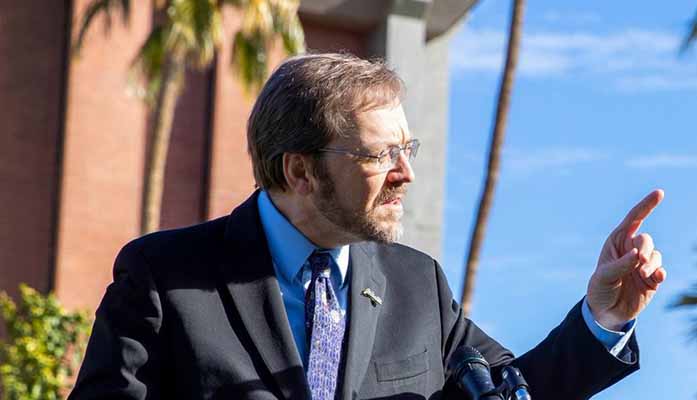
Nicole Solas, the Rhode Island mother who was sued by the nation’s largest teacher union for requesting public records, offered advice to Arizona parents facing similar transparency battles. As AZ Free News reported last week, Scottsdale Unified School District (SUSD) will post the names of individuals online who submitted records requests — an update that inspired controversy within the community.
The National Education Association of Rhode Island (NEARI), a teacher’s union, sued Solas last year for seeking records on Critical Race Theory (CRT) and gender theory from her child’s Rhode Island school. Not only was Solas sued — the school district attempted to charge Solas $74,000 for access to the requested records.
Solas advised Arizona parents to be loud and engaged until they achieved victory. Her examples of loud engagement were submitting public records requests and filing lawsuits. She advised that district officials would “fold like a paper tiger.” Solas offered the advice and discussed her ongoing legal battle on “Conservative Circus” with host James T. Harris on Tuesday.
Solas pointed out that parents speaking out at school board meetings serves to inform the public, which she says has a far greater impact on schools.
“Keep in mind that when you make public comment at school board meetings, you’re doing that to talk to, not the school board, you’re trying to talk to people that don’t know what’s going on,” said Solas. “You need to be brave.”
Parent Nicole Solas discusses being attacked by teachers' union on curriculum transparency and also being kicked of https://t.co/VT8Snw7eWJ
The Goldwater Institute, a Phoenix-based think tank and legal organization, represented Solas in the lawsuit, National Education Association of Rhode Island, et al. v. South Kingstown School Committee, et al. Most recently, the Rhode Island Superior Court denied Solas’ motion for summary judgment early last month.
Nicole Solas wanted to know what her daughter would be taught in kindergarten.
Her school district hit her w/a $74K bill for asking. But she hasn’t stopped fighting for academic transparency.
Most recently, Twitter deplatformed Solas with a permanent ban for speaking out against child grooming. She revealed that she is seeking legal representation currently to restore her account.
Corinne Murdock is a reporter for AZ Free News. Follow her latest on Twitter, or email tips to corinne@azfreenews.com.
An expansion of Arizona’s Empowerment Scholarship Account (ESA) program has long been a cornerstone platform issue for Conservative lawmakers. And on Saturday, Gov. Doug Ducey made comments which have supporters believing he will sign into law what he called “the most expansive school choice legislation in the nation.”
House Bill 2853 creates a roughly $7,000 education credit for each of the 1.1 million K-12 student in Arizona to attend any school of their choice, whether it be a public, private or charter school, or even homeschooling. Ducey has called passage of the bill sponsored by House Majority Leader Ben Toma (R-Peoria) a “monumental moment for Arizona’s kids and families.”
Our kids will no longer be locked in under-performing schools. Today, their future success is unlocked. With this legislation, Arizona will now be the first state in the nation to offer all families the option to choose the school setting that works best for them. 2/
I commend Senate President @Fannkfann, House @speakerbowers, @RepBenToma and all the lawmakers who voted for this important legislation for helping to cement Arizona’s position as the top state for school choice. 3/3
That sentiment was shared by the Goldwater Institute, which noted Arizona’s new universal ESA expansion provides school choice for all students and “empowers families to choose the best schooling option for their children regardless of their zip code.”
HB2853 will take effect on behalf of the state’s more than 1.1 million students a mere 90 days after signed by the governor. The credit, which is paid out as scholarships, can be used for expenses such as tuition and tutoring, transportation, education tools (i.e. textbooks and computers), and other costs directly related to supporting a student’s educational needs.
And they said it couldn’t be done! The most expansive school choice program in the nation has passed the legislature and is on its way to the Governor’s desk! #HB2853pic.twitter.com/4CxLoUKsGm
In addition, Corey A. DeAngelis of the Washington DC-based American Federation for Children tweeted about the bill which now allows all Arizona families to direct their student’s ESA dollars to the educational institution that can best serve the student.
BREAKING: Arizona Senate just passed a bill to fund students instead of systems.
This will be the most expansive school choice initiative in the nation.
All families will be able to take their children's education dollars to the education providers of their choosing.
— Corey A. DeAngelis (@DeAngelisCorey) June 25, 2022
However, organizations such as Save Our Schools have threatened to push back on the new legislation if Ducey signs it. The group advocates for funding the needs of public school systems instead of the needs of individual students, even when a family has determined a private, charter, or home school situation is better for the student than a public school setting.
EDITOR NOTE: The original article has been updated to reflect that Gov. Ducey has not yet signed HB2853 despite his public comments in support of the legislation.
On Wednesday, Arizona became the first state to allow patients to access individualized treatments otherwise blocked by the FDA. The bill was dubbed the “Right to Try for Individualized Treatments,” an expansion of original Right to Try law allowing patients with life-threatening illnesses to undergo clinical trials of the treatments of their choosing.
Governor Doug Ducey signed the bill, SB1163, into law. The Phoenix-based Goldwater Institute, a conservative and libertarian public policy think tank, pioneered the original Right to Try law. That law also began in Arizona. It eventually received approval from Congress under former President Donald Trump.
Goldwater Institute President and CEO Victor Riches said that the new law ensured protections for a fundamental right: the right to save one’s own life.
“The right to try to save one’s own life is one of the most precious rights of all,” said Riches. “America doesn’t have to wait for the FDA to reform itself in order to put patients first. States can and should act now to protect all Americans’ fundamental right to try to save their own life.”
Goldwater Institute Executive Vice President Christina Sandefur said that the law provided new hope for Arizonans. Sandefur called the law “Right to Try 2.0.”
As AZ Free News reported, the bill was inspired by the Riley family in Phoenix. Two of their three daughters, Keira and Olivia, were born with metachromatic leukodystrophy: a sudden, fatal disease that attacks nerves in the brain and spinal cord. Due to FDA restrictions, the Rileys had to seek treatment outside of the country. They were forced to raise tens of thousands of dollars at the height of the pandemic in 2020 in order to relocate to Italy for the five months they needed to access treatment for Keira. The experimental gene therapy was their last hope to save her life.
Olivia couldn’t qualify for the treatment because she was already symptomatic. As of this report, she was transferred to hospice. The average life expectancy for metachromatic leukodystrophy patients is six years.
Kendra Riley, the girls’ mother, spoke with conservative radio host James T. Harris about the bill’s enactment. Riley said that the next step would be to have the rest of the nation pass similar laws.
“You think if your child has one chance in the entire world to live a normal life, we should be able to have access to it in America,” said Riley. “The medicine is there but bureaucracy and insurance shouldn’t be holding it back. Everyone should have the right to a chance at a normal life. I truly hope this helps everyone.”
As they were rallying support for the bill, Sandefur characterized current law as immoral.
“It is unconscionable that an American patient has to travel to another country to Europe in order to be able to get access to a treatment that could save their lives,” said Sandefur.
Corinne Murdock is a reporter for AZ Free News. Follow her latest on Twitter, or email tips to corinne@azfreenews.com.
One Phoenix family is fighting for their daughters’ lives: not only against the odds of the fatal genetic disease they both suffer from, but against the Federal Drug Administration (FDA) regulations that prohibit access to a potential cure. The life-saving treatment, a gene therapy, is only available in Milan, Italy — thousands of miles away at the cost of anywhere between $1,000 to $2,000 per round trip flight ticket.
The two of three daughters in the Riley family, Keira and Olivia, were born with metachromatic leukodystrophy, a sudden-onset, fatal disease that causes a buildup of lipids on critical nerves in the brain and spinal cord, which in turn damages the myelin sheath that protects nerve cells. Medical journals identify this occurrence as a result of a deficiency in sulfatide enzymes, which break down lipids. The Riley family had to raise tens of thousands of dollars at the height of the pandemic in 2020 to relocate to Italy for five months so they could save Keira.
Olivia didn’t qualify for the experimental gene therapy because she was already symptomatic. Within 90 days of showing her symptoms, Olivia lost the ability to walk and talk.
“How do you even deal with that as a parent? Imagining two out of your three kids will soon be gone?” said their mother, Kendra.
Due to cases like that of the Riley family, the Arizona legislature is considering a new law to expand on current laws enabling terminally ill patients to try treatments not yet approved by the FDA: SB1163, or the “Right to Try for Individualized Treatments.”
The Goldwater Institute pioneered the original Right to Try law that began in Arizona and eventually was approved by Congress under President Donald Trump, guaranteeing patients with life-threatening illnesses that exhausted all other options to participate in clinical trials of the treatments of their choosing.
Christina Sandefur, Goldwater Institute Executive Vice President, dubbed SB1163 the “Right to Try 2.0” — an expanded upgrade to the original law tailored for more individualized needs. The State Senate passed the bill last month, and it’s awaiting a final vote before the House.
“It is unconscionable that an American patient has to travel to another country to Europe in order to be able to get access to a treatment that could save their lives,” said Sandefur.
For the Riley family, it appears that the experimental gene therapy worked — since January 2021, Keira hasn’t exhibited any symptoms and has developed normally. In mid-January, the FDA granted the same treatment Keira received in Italy. The treatment was given approval, in part, because of results from the Milan, Italy trials.
Corinne Murdock is a reporter for AZ Free News. Follow her latest on Twitter, or email tips to corinne@azfreenews.com.
The Supreme Court (SCOTUS) announced earlier this month that it would consider the constitutionality of the Indian Child Welfare Act (ICWA), federal law that determines when states can rescue abused or neglected Indian children, as well as foster rules. This law applies to tribal children and those eligible to live on a tribe but living off of a reservation. Essentially, ICWA does all it can to keep Native American children within their own families or with other Native Americans, and requires state officials to apply a higher degree of scrutiny over abuse to determine whether abuse exists. While other children’s cases need only present “clear and convincing evidence” of abuse, Native American children’s cases would need to present “without a reasonable doubt.” ICWA was enacted to prevent the government from taking Native American children from their families.
Phoenix’s nationally-acclaimed public policy research and litigation organization, the Goldwater Institute, requested SCOTUS to review ICWA; they’ve challenged the federal law for years. In light of the SCOTUS announcement, Goldwater Institute Vice President of Litigation Timothy Sandefur discussed ICWA on the “Andy Caldwell Show.”
Sandefur described the law as unconstitutional and depriving children of fair treatment. He noted that Native American children are at greater risk for molestation, abuse, gang membership, and suicide, arguing that already-vulnerable children were only hurt more by ICWA.
“The rules that [ICWA] sets for child protection are actually less protective for a child than the laws that apply for every other racial group,” said Sandefur.
TUNE IN today at 4:30 PM MT/6:30 ET!
Goldwater's @TimothySandefur will be on the @ACaldwell_Show to analyze SCOTUS' decision to hear a challenge of the unconstitutional federal law that discriminates against Native American kids.
— Goldwater Institute (@GoldwaterInst) March 1, 2022
The case SCOTUS will consider, Brackeen v. Haaland, comes from a culmination of different cases brought by several parents desiring to adopt Native American children but were denied due to not being Native American themselves.
Sandefur described one case that the Goldwater Institute worked on, in which a mother wanted to terminate the rights of her abusive husband so that her new husband could legally adopt her son. If the child had been any other race, the rights could’ve been terminated. However, ICWA applied. Under ICWA, it was “prohibitively difficult” to terminate an abusive parent’s right, even in the case of a mother requesting that action.
In a press release, Sandefur also noted that ICWA also violates the separation of the federal and state governments by requiring states to enforce federal law and interpret their own laws differently.
Corinne Murdock is a reporter for AZ Free News. Follow her latest on Twitter, or email tips to corinne@azfreenews.com.