by Goldwater Institute | Jul 29, 2021 | Education, Opinion
By the Goldwater Institute |
The public’s business should be open to the public. And under Rhode Island law, it is. Yet when mom Nicole Solas sought to attend the meeting of a publicly funded committee that meets weekly to discuss and make recommendations on policies that apply across her daughter’s school district, she was told that the meeting was closed and parents were not welcome.
Now, the Goldwater Institute is pushing back: We’ve joined with the Stephen Hopkins Center for Civil Rights in Rhode Island to represent Nicole in a complaint before the state attorney general asserting that the school district has violated Rhode Island’s Open Meetings Act (OMA) by closing these meetings to the public.
Rhode Island’s OMA was enacted to ensure that “public business be performed in an open and public manner and that the citizens be advised of and aware of the performance of public officials and the deliberations and decisions that go into the making of public policy.” The presumption under that law is always in favor of public access.
Yet in March 2021, the South Kingstown School Committee signed an agreement with the South Kingstown BIPOC Advisory Board to hold weekly meetings where district policies ranging from student discipline to coaching to hiring would be discussed and where recommendations would be made on those issues by the Board to the School Committee. In other words, the Board was charged with advisory power by the School Committee over matters of significant public interest—the education of South Kingstown’s youth. The Board is also publicly funded with taxpayer dollars by the School Committee, and two members of the School Committee’s subcommittee on policy sit on the Board.
>>> READ MORE >>>
by Goldwater Institute | Jul 25, 2021 | Opinion
By Christina Sandefur of the Goldwater Institute |
Representing the owners of more than 50 properties, the Goldwater Institute has filed over $23 million in claims against the city of Flagstaff, Arizona, over an ordinance that went into effect in March that deprives residents of their property rights. That could be just the tip of the iceberg, as thousands more may have claims under state law.
In March, Flagstaff adopted a High Occupancy Housing Plan supposedly designed to address an increase in student housing. In actuality, the plan imposes sweeping regulations that deprive a wide variety of property owners, including families and small businesses, of their right to decide what to do with their land.
Flagstaff’s ordinance comes nearly two decades after the infamous Kelo v. New London U.S. Supreme Court decision of 2005, in which the Court gave state officials virtually carte blanche to seize private property for whatever reasons politicians consider worthwhile. But Arizona voters rejected the Court’s vast expansion of government power by adopting a ballot measure that creates some of the strongest protections for home and business owners in the country. Under Arizona’s Private Property Rights Protection Act (known as Prop 207), government must pay people whenever it takes away their right to use their property and thereby diminishes its value…
>>> READ MORE >>>
by Terri Jo Neff | Jul 14, 2021 | News
By Terri Jo Neff |
Attorneys for the Goldwater Institute and the City of Phoenix will be in court Wednesday to argue over whether government workers subjected to a collective bargaining agreement can be forced to finance union activities, including a union’s political endeavors.
The issue before Judge Daniel Martin of the Maricopa County Superior Court is a legal challenge brought on behalf of two city employees over a practice known as “release time” approved by the Phoenix City Council in 2019. Release time allows some city employees to be paid to work for their private union instead of working for the public.
Employees utilizing release time are allowed to engage in activities such as lobbying, union membership drives, filing grievances against the employer, and wage and benefit negotiations. Release time activities of city employees are subject to the discretion and control of the union, not the city which pays the employees.
In May 2019, the City of Phoenix signed a Memorandum of Understanding (MOU) with the American Federation of State, County, and Municipal Employees, Local 2384, Field Unit II (AFSCME) which serves as the exclusive bargaining unit for a wide range of public workers, including but not limited to electricians, mechanics, security guards, street technicians, and maintenance workers.
AFSCME is the nation’s largest public services employees union with more than 1.3 million working and retired members. The MOU applied to all City of Phoenix employees assigned under Field Unit II whether union members or not, and it provides for myriad release time benefits, including four full-time release positions.
“That means that four city employees are released full-time to work exclusively for the union at the public’s expense,” according to the Goldwater Institute, which also noted nearly 3,200 additional paid work hours are available to other union representatives. That is roughly equivalent to 80 weeks of full-time work.
The MOU between Phoenix and AFSCME also guarantees compensatory time for high-ranking union officials using release time, as well as additional hours and payment for AFSCME members who attend union seminars, lectures, conventions, and workshops.
In October 2019, attorneys with the Goldwater Institute sued the City of Phoenix on behalf of two Field Unit II city employees who contend the release time salaries and benefits in the MOU are funded by all government employees of a specific bargaining unit.
The result, the lawsuit argues, is that non-union members are forced to fund union activities in violation of the First Amendment to the U.S. Constitution, along with Arizona’s Right to Work laws and other state constitutional provisions, the employees contend. The lawsuit also contends the four full-time release time employees “are not contractually required to provide an accounting to the City for how they use release time.”
Judge Martin will hear oral arguments Wednesday and Friday in dueling motions for summary judgment filed by the parties. Court records show AFSCME has been granted intervenor status in the case.
Among the organizations also opposed to release time policies is the American Legislative Exchange Council (ALEC) which has developed draft legislation that lawmakers across the country can use in an effort to ban paid union activity by public employees.
Under the ALEC draft legislation, it would be “against public policy” for a public employer like the City of Phoenix to enter into a deal with any private union to compensate a public employee for union activities.
“While public employees should not be prohibited from freely associating outside of their employment duties, including hiring individuals to help represent their interests, this should occur at public employee, not taxpayer, expense,” according to the ALEC website.
by Goldwater Institute | Jul 12, 2021 | Education, Opinion
By the Goldwater Institute |
In too many of our nation’s classrooms, children are being taught that everything should be seen through the lens of race—a divisive and damaging worldview that negates the value of the individual. Instead of reading our country’s founding documents, students are being told that America was founded on fundamentally hateful and intolerant ideas. And they’re learning that the American Dream isn’t really for everyone. What is a parent to do?
In a new paper released by the American Enterprise Institute, Goldwater Institute Director of Education Policy Matt Beienburg shows that in order to truly put parents—and not bureaucrats—in control of kids’ education, more sunlight is the answer. And Goldwater is leading the effort to bring that sunlight to school districts across America, in the form of academic transparency.
To date, state lawmakers have dealt with the issue of politically charged classroom content by either doing nothing or banning certain curricula or materials. But neither path is sufficient to proactively root out political content in our schools. And neither path gives parents the power they need to make the best possible decisions regarding their children’s education.
>>READ MORE >>>
by AZ Free News | Jul 2, 2021 | News
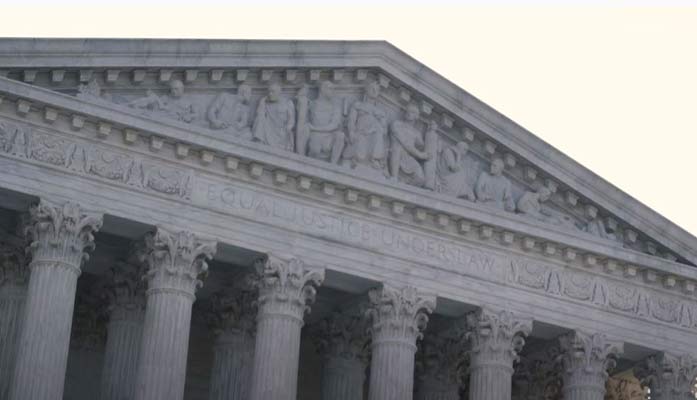
On Friday morning, the U.S. Supreme Court, in a landmark decision, struck down California’s demand that nonprofit advocacy groups turn over confidential information about their donors. The 6-3 ruling in Americans for Prosperity Foundation v. Bonta is considered a major victory for First Amendment advocates.
At issue was a dispute that began in 2014, when the Thomas More Law Center and the Americans for Prosperity Foundation went to federal court to challenge California’s rule.
“The case ends more than a decade of litigation that began when then-Attorney General Kamala Harris abruptly ended the practice that allowed nonprofits to turn in their annual reports with private information redacted, as a security measure. That had been allowed for many years, since if the Attorney General’s office ever actually needed such information, it could easily get it in many other ways—such as a subpoena or audit,” explains Timothy Sandefur of the Goldwater Institute in a blog post. “But in 2010, Harris ordered any nonprofit that collected money in California to hand over copies of their unredacted IRS paperwork. That information would be placed into a government database that Harris promised would be kept confidential. Of course, it wasn’t—a trial judge later found almost 2,000 instances in which Harris’s office allowed this information to be publicly circulated. (The Goldwater Institute received such a demand, but refused to disclose this information.)”
Chief Justice John Roberts wrote the majority opinion which reverses the 9th Circuit Court opinion.
In his blog post, Sandefur says the Court’s ruling “vindicates the privacy rights of millions of Americans who choose to contribute to nonprofit organizations that articulate the political, cultural, or religious values they hold dear. That choice is guaranteed by the First Amendment—yet many federal, state, and local officials continue to devote their powers to stripping donors of their privacy rights whenever they exercise that constitutional freedom. This is often done under the guise of “transparency,” but transparency is for government—privacy is for people. Today’s decision is a victory for the free speech rights of all Americans, whatever their ideological background—and we look forward to continuing the fight for freedom of speech and privacy at the federal, state, and local levels.”