by AZ Free Enterprise Club | May 17, 2024 | Opinion
By the Arizona Free Enterprise Club |
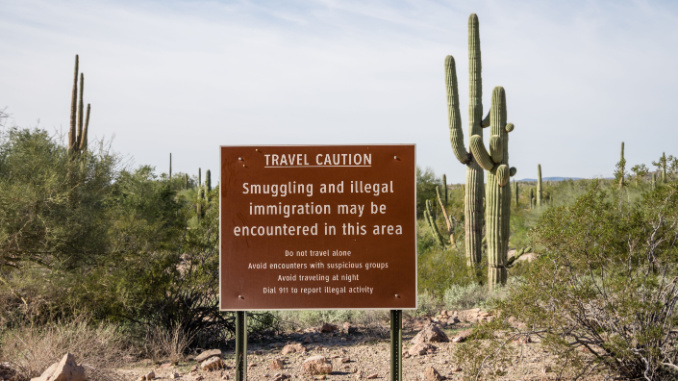
Illegal immigration is the number one issue heading into November’s election, and Democrats have no one to thank but themselves. Over the past three years, the left has single-handedly created an open-border disaster under the neglectful policies of a Biden administration that has completely abandoned its constitutional duty to protect each state from invasion. As ground zero for the current border crisis, the people of Arizona know this all too well.
A surge in illegal immigrants in the Tucson Border Sector along with a dramatic rise in the number of “gotaways” has left our state on edge. Meanwhile, cartel violence has increased near southern Arizona communities, and we’ve even seen a report revealing that thousands of “special interest aliens” from mostly Middle Eastern countries have been apprehended while crossing the border illegally in the past two years. And that’s just barely scratching the surface of the catastrophe that has become our border.
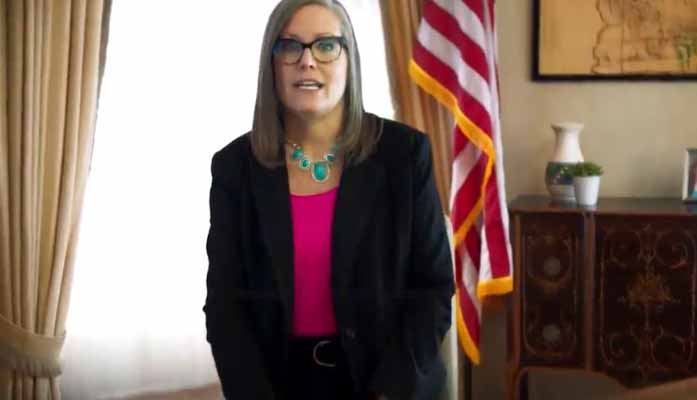
You would think that the governor of a state facing a daily invasion would do something, but Katie Hobbs has proven time and time again that she would rather ignore the problem and hope it goes away. So, after Hobbs vetoed the Arizona Border Invasion Act (SB 1231), which would have significantly enhanced our state’s border security, Republican legislators decided it was time to allow voters to take matters into their own hands through the Secure the Border Act (HCR 2060). And the response from Democrats has been telling…
>>> CONTINUE READING >>>
by Daniel Stefanski | May 13, 2024 | News
By Daniel Stefanski |
Arizona Republicans and Democrats stepped up their messaging war after a legislative effort to launch a border-related ballot referral commenced in the state Senate.
On Wednesday, the Arizona Senate Committee on Military Affairs, Public Safety and Border Security held a hearing to consider HCR 2060, the newly amended ballot referral from Republicans to deal with the border crisis affecting the state.
Governor Katie Hobbs, a Democrat, took a proactive approach to opposing the legislative effort, issuing a statement to adamantly express her disdain for the referral. She wrote, “Passing a job-killing, anti-business initiative that demonizes our communities is not the solution to our border crisis. The bill I vetoed earlier this year lacked support from businesses, farmers, and law enforcement in border communities. This ballot initiative won’t secure our border. Instead, it will put Arizona entrepreneurs out of business, kill jobs and prevent law enforcement from keeping our communities safe. Arizona should not pay the price for the federal government’s inaction.”
Republican leaders in the Arizona Legislature were quick to respond to Hobbs’ statement against their bill. Arizona House Speaker Ben Toma, the sponsor of the referral, said, “Of course, Governor Hobbs and Demcorats like her and President Biden always oppose real effort to enforce America’s border and protect its citizens. Their deliberate open-border policies are disastrous and people have had enough.”
Senate President Pro Tempore T.J. Shope added, “This is a completely illogical statement not based on any type of reality…The real question I have for Governor Hobbs is, what have you done on the border other than veto bills? The people will have the final say and THE PEOPLE want strong border security!”
Maricopa County Attorney Rachel Mitchell, who attended a press conference with Arizona Republicans and law enforcement on Wednesday, stated, “This afternoon I stood with Arizona House Republicans, Arizona Senate Republicans, Law Enforcement and the Border Patrol Union on the Secure the Border Act. Fentanyl is pouring across the border. It’s getting into the hands of our young people. We must work to address the Biden Border Crisis. The voters will have a chance in November to approve this referendum and send a message to Washington DC. Enough is enough!”
On the other side, legislative Democrats shared their vehement disgust for the referral. State Representative Analise Ortiz posted, “Republicans lost on abortion, now they are changing the rules to go after our immigrant community and businesses. HCR 2060’s new language is SB 1070 ‘show me your papers’ law on steroids. It’s an unconstitutional, divisive, xenophobic, election-year dog whistle.”
Democrat members of the Arizona Latino Legislative Caucus put out a joint statement in opposition to the bill. They asserted, “Voters know that our state has come far since the dark days of SB 1070. Mexico is our largest trading partner, and our economies are intrinsically connected and aligned. This measure shows that Republicans are willing to sacrifice that progress and reverse our economic growth just to divide our state and hold onto power. We cannot, and will not let hate win.”
With the amendment to the original measure, HCR 2060 was approved by the Senate committee with a partisan 4-3 vote. It will now be considered by the full Senate chamber.
Daniel Stefanski is a reporter for AZ Free News. You can send him news tips using this link.
by Daniel Stefanski | May 3, 2024 | News
By Daniel Stefanski |
A recent Arizona poll had bad news for the state’s second-year governor.
On Tuesday, Emerson College Polling published its survey of swing states in the 2024 election. Arizona Governor Katie Hobbs, a Democrat, garnered 38% approval, compared with 42% disapproval from respondents (with 20% neutral).
Hobbs’ results were some of the worst in the swing states among her fellow governors. Her approval rating was the lowest of the seven polled, and her disapproval numbers were one percentage point lower than the highest – which went to Michigan Governor Gretchen Whitmer, also a Democrat.
The swing states polled were Arizona, Georgia, Michigan, North Carolina, Nevada, Pennsylvania, and Wisconsin.
The Arizona governor’s approval was two percentage points lower than President Joe Biden’s in her state. Biden obtained a 40% approval and a 51% disapproval.
Emerson College showed that former President Donald J. Trump held a four-percentage point lead in a head-to-head match-up in Arizona with current President Joseph R. Biden – 48% to 44% with eight percent of respondents undecided. When additional ballot options were added to the polling question, Trump maintained his four-point advantage in the Grand Canyon State – 44% to 40%.
Spencer Kimball, the executive director of Emerson College Polling, highlighted that “Independent voters break for Trump over Biden in Arizona (48%-38%).
The country is quickly heading toward the November 2024 election, with Arizona figuring to feature a prominent role in determining the individual who will assume the reins of the Executive Branch of the nation for the next four years. Most polls this year have shown that President Trump has built a lead over Biden in Arizona, though much time remains until the fall showdown.
Daniel Stefanski is a reporter for AZ Free News. You can send him news tips using this link.
by Daniel Stefanski | Apr 22, 2024 | News
By Daniel Stefanski |
One Arizona Republican lawmaker is cheering on the success of her efforts to protect children in her state this legislative session.
Earlier this week, Senator Janae Shamp issued a press release to highlight two of her bills that were recently signed into law by Democrat Governor Katie Hobbs. Those bills were SB 1236 and SB 1404.
According to the legislative fact sheets for both proposals, SB 1236 would “modif[y] offender age thresholds that require the Department of Public Safety to include offenders of specified offenses on the Internet Sex Offender Website;” while SB 1404 would “require registered sex offenders with legal custody of a child to provide name and enrollment information on the child and expand mandatory community notifications to include level-one sex offenders of a dangerous crime against children.”
Hobbs signed SB 1404 on March 29, and SB 1236 on April 16.
“This session, I made it my goal to be a living nightmare for sex offenders,” said Senator Shamp. “I introduced several bills, including SB 1236 and SB 1404, to protect our state’s most innocent and vulnerable, while increasing consequences for criminals who commit these horrific crimes. DCACs include sex trafficking, mutilation, prostitution, and commercial sexual exploitation. These crimes have lifelong, and potentially deadly effects on a child. Every parent and every school deserves to know who these criminals are in order to better protect their children.”
Both laws will go into effect in the State of Arizona 90 days after the legislature adjourns for the 2024 session.
Daniel Stefanski is a reporter for AZ Free News. You can send him news tips using this link.
by Paula Scanlan | Apr 15, 2024 | Opinion
By Paula Scanlan and Christy Narsi |
Governor Katie Hobbs has a rare opportunity to do something with the overwhelming support of her citizens, and that would make her a groundbreaker. She could become the first female governor to sign the Women’s Bill of Rights.
This shouldn’t take courage. This legislation, which was just passed by the Arizona state house, defines words like “woman” and “female” so when it comes to laws that use these words, we can all speak a common language. The bill also declares the state’s important interest in preserving female-only spaces and opportunities when privacy, safety, or fairness are implicated. Importantly, this law doesn’t prevent policymakers or local leaders from deciding to allow trans-identifying individuals from being included in any arena, but it gives us a language so that there is truth in advertising, and we have the ability to reserve some spaces and opportunities just for women.
We both know personally why this is so important.
I, Paula Scanlan, was a teammate of Lia Thomas at the University of Pennsylvania. Governor Hobbs, you’ve undoubtedly heard about how Lia Thomas – formerly Will Thomas when he competed on the men’s team – took competition spots, won titles, and smashed female records from female swimmers like me. But perhaps you haven’t heard about what it was like to have to share a locker room with him. As a sexual assault survivor, I was forced to change next time him, and have him undress just a few feet away from me, often several times a day. When I tried to tell administrators that I was uncomfortable sharing such private spaces with fully intact men, they told me I should get counseling, that I shouldn’t complain, and that they didn’t care about how this felt to me or the other women on my team.
I, Christy Narsi, serve as a chapter leader for Independent Women’s Network in Phoenix, and I hear daily from moms who are concerned about the message that we are sending our daughters today. We hear of mothers who are concerned about their daughters’ safety when they are forced to face bigger, stronger male-bodied athletes on the athletic fields. My colleague, Payton McNabb, had to face a male volleyball player on the court when she was a junior in high school. He spiked the ball in her face so hard that she had a serious concussion and brain injury. More than two years later, she still has partial paralysis. Why are women and girls’ safety concerns being brushed aside? Why is it that women and girls are being told that they need to step aside, that their dreams and aspirations don’t matter and have to be sacrificed for male-bodied athletes who want to join the women’s teams?
Governor Hobbs, as I’m sure you know, this is about more than just sport. Women’s rights—and the very concept of womanhood—are under assault as never before in history. Inmates in women’s prisons are being put at risk when they allow male prisoners—including violent sex offenders—into women’s prisons around the country. Men are entering female sororities, domestic violence shelters, and educational training programs that were created specifically to encourage women’s engagement.
Overwhelmingly Americans recognize that it isn’t fair to force women to compete against biological men. To back up this common sense is hard scientific data, like that outlined in the Competition Report, which shows that a human being who goes through male puberty, when testosterone levels rise by about 20 times, enjoys an irreversible advantage in strength and athletic power. Taking testosterone suppressors later in life doesn’t change that reality. Data shows that men have physical advantages—not just in terms of strength and speed but in lung capacity and how their hearts process blood—that are hard-wired in their bodies. This is why there are women’s leagues and competitions in the first place, and why it is simply dangerous and inhumane to have female inmates forced to share their spaces with men.
We are so grateful that Arizona’s state legislature decided to do something about it by passing this truth-in-advertising legislation. We hope that you will sign this bill into law and stand up for women’s rights in Arizona—and be a model for others across the nation.
Paula Scanlan is an ambassador with Independent Women’s Voice and a former swimmer at the University of Pennsylvania. Christy Narsi is the co-leader of the Independent Women’s Network Arizona Chapter, and is based in Surprise, AZ.