by Corinne Murdock | Jan 31, 2024 | Education, News
By Corinne Murdock |
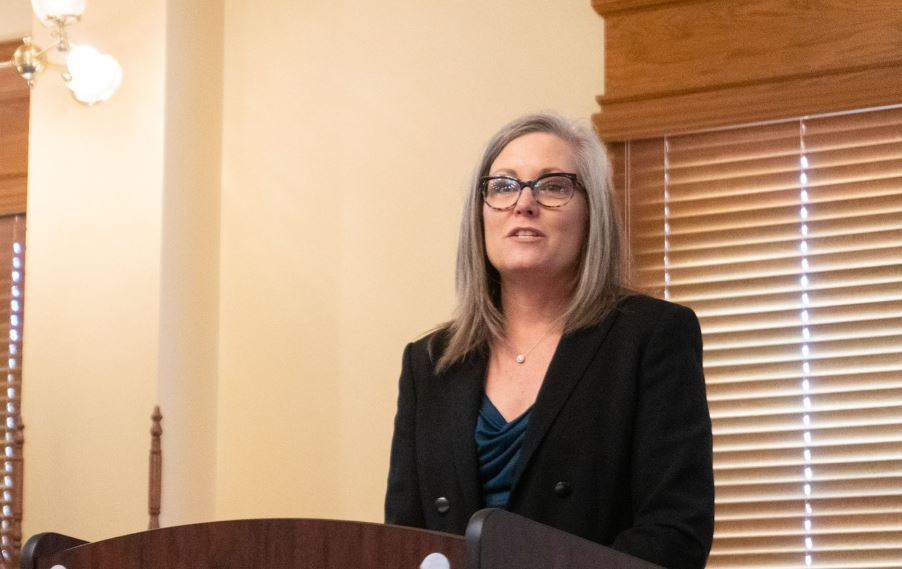
Gov. Katie Hobbs has introduced legislation that would end the entirety of Arizona’s school choice program come 2032.
On Monday, Hobbs announced the release of the bill, part of a forthcoming package, to bring to heel and then end the Empowerment Scholarship Account (ESA) program.
In the press release announcing the legislation, neither Hobbs nor Democratic leaders mentioned the provision ending the entire ESA Program: both the universal and special education components. The coalition characterized the legislation as containing accountability and transparency measures.
As justification for the legislation, the governor repeated claims of misused ESA funding that have been debunked by Arizona Department of Education (ADE) officials.
“Arizonans deserve to know their taxpayer dollars are being spent giving Arizona children the education they deserve, not on luxury car driving lessons, ski trips, and water park passes,” said Hobbs. “We must bring accountability and transparency to the ESA program.”
The bill, SB1399, was introduced by Sen. Minority Leader Mitzi Epstein (D-LD12). Under the bill, the ESA Program would end on July 1, 2032 unless continued by an act of the legislature approved by the governor.
The bill also would:
- Require educators at ESA-funded schools to have a higher education; at least three years of teaching experience; and specialized skills, knowledge, or expertise related to the subject matter of instruction
- Require fingerprinting and background checks for ESA-funded educators and tutors
- Prohibit sales of items purchased using ESA funds
- Require preapproval of transactions of $500 or more
- Require the purchase of the least-expensive version of educational goods or services
- Require ADE to disclose the legal rights waived by admission to the program
- Require ADE to estimate the funds needed for the ESA program for the upcoming fiscal year
- Implement additional performance and fiscal reporting requirements for ESA-funded schools
- Require ESA-funded schools to adhere to outside individualized education programs or Section 504 plans
- Establish annual audits of ESA-funded schools
- Establish a legislative committee review of the ESA program to determine its economy and efficiency, achievements and shortcomings
Epstein also didn’t mention the bill’s total eradication of the ESA Program. Rather, the senator indicated that her issue with the ESA Program concerned its universalization.
“The unaccountable government expansion of ESA vouchers has put our state’s financial security, and our students, at risk,” said Epstein. “These commonsense safeguards will be vitally important for giving Arizona children a safe and quality education, and bring the same accountability and oversight to ESAs that we expect for any taxpayer spending.”
Similarly, House Minority Leader Lupe Contreras (D-LD22) — anticipated to introduce mirror legislation soon — said that the legislation consisted of “basic standards” for transparency and accountability.
The governor put the legislature on notice of the forthcoming legislative package earlier this month.
The day after Hobbs dropped her legislation, ADE Superintendent Tom Horne released the latest data on the ESA Program. Horne reported a projected surplus of $28 million through the 2024 fiscal year, which ends in June.
Citing the projected surplus, Horne denounced the accusations from Hobbs and Democratic lawmakers that the state’s budget woes were attributable to the ESA Program expansion.
“Whatever budget issues state lawmakers are facing this year, they have not been created by the ESA program or any other aspect of basic state aid for education,” said Horne. “The fact there is a surplus in basic state aid, including the ESA program, demonstrates our commitment to good financial stewardship.”
Matt Beienburg of the Goldwater Institute, a major proponent of the ESA Program, said that Hobbs’ proposal constituted “an all-out assault” on students and their families as well as a “government takeover” of private schools.
“Building off Gov. Hobbs’s recent proposal to rip away 50,000 ESA scholarship awards, this legislation goes even further and would terminate the entire ESA program—including for students with special needs—before thousands of these children even complete their studies,” said Beienburg. “This legislation would impose a government takeover of private school tuition rates and operational decisions, attempting to destroy private education and parental autonomy, forcing thousands of families back into a system they’ve desperately tried to escape.”
Corinne Murdock is a reporter for AZ Free News. Follow her latest on Twitter, or email tips to corinne@azfreenews.com.
by AZ Free Enterprise Club | Jan 27, 2024 | Opinion
By the Arizona Free Enterprise Club |
A contentious fight is brewing in the Arizona legislature, the possible reauthorization of the Arizona Commerce Authority (ACA). Governor Hobbs has made the reauthorization a top priority of her administration this session, mentioning it in her State of the State address. But the debate has an ironic element considering the history of its inception.
In 2011, the state was crawling out of a crippling recession, having lost literally hundreds of thousands of jobs and even selling off the state Capitol buildings to dig out of a deficit. The legislature, in collaboration with the Brewer Administration, introduced an omnibus bill sold as a “jobs package” which refashioned the bureaucratic Department of Commerce into the Arizona Commerce Authority, and incorporated both new targeted tax credit programs and incentives, as well as phased in corporate income and commercial property tax cuts.
Democrats a Decade Ago Opposed the ACA
The bill at the time was uniformly opposed by Democrats, including then Representative Katie Hobbs. Republicans mostly coalesced around the bill, with a handful of key conservatives voting in opposition of the legislation, largely in protest of the corporate welfare and multi-million-dollar “deal closing” fund with no legislative oversight. For those unfamiliar with the deal closing fund, it is a large pot of money appropriated to the Director of the Commerce Authority to throw at corporations to convince them to relocate to Arizona.
After the ACA was passed and signed into law, it would seem that only a few conservative voices and the Club itself would prove prophetic at the lack of oversight and inevitable gift clause violations, which is a constitutional protection from the government subsidizing private industry…
>>> CONTINUE READING >>>
by Corinne Murdock | Jan 21, 2024 | Economy, Education, News
By Corinne Murdock |
Gov. Katie Hobbs’ proposed education funding plan is “dangerous and unsustainable” according to State Treasurer Kimberly Yee.
Hobbs’ plan, if passed by the state legislature, would renew Proposition 123 for another decade and increase the state land trust fund to nearly nine percent. In a statement on Tuesday, the treasurer accused the governor of irresponsible mismanagement of taxpayer funds amid record inflation.
“Governor Hobbs wants to raid the land trust to cover for her mismanagement of the state budget and overzealous spending plans in an ever-increasing inflationary environment,” said Yee.
Yee warned that Hobbs’ plan would violate the Enabling Act, the terms under which Arizona achieved statehood in 1910. She recommended a four to five percent distribution, declaring Hobbs’ vision “unfeasible” based on past performance.
“My office has not reported a 10-year return over 8.9 percent in nearly two years. Over the span of the last 10 years, only 32 months have had a 10-year return over 8.9 percent,” said Yee.
That’s something the governor acknowledged in her announcement of her plan: the average 10-year annualized return amounts to just over seven percent.
Proposition 123, the Arizona Education Finance Amendment, was a voter-approved 2016 constitutional amendment to increase education funding by $3.5 billion over a decade using monies from the general fund and state land trust fund. Yee oversees the land trust fund.
Although Yee declared the funding plan wasn’t sustainable, Hobbs claimed that there were ample funds going unused.
“[We shouldn’t] let billions of dollars accrue in a bank account and do nothing to address our immediate needs,” said Hobbs.
Hobbs marketed her renewal plan as a means of increasing education funding without raising taxes.
“The choice is clear: we can give our children a quality education or let billions of dollars stand idle without addressing our immediate needs,” said Hobbs.
Under the governor’s plan based on a decade-long average distribution, 2.5 percent will continue general school funding ($257 million), 4.4 percent will raise educator compensation ($347 million), 1.5 percent will increase support staff compensation ($118 million), and .5 percent will invest in school capital for safety and security ($39 million).
State Sen. Christine Marsh (D-LD04) is sponsoring the bill with the governor’s plan. Marsh also sits on the Senate Education Committee.
“Renewing and expanding this vital funding source for our schools is crucial to ensuring Arizona’s students receive the high quality education they deserve,” said Marsh.
Corinne Murdock is a reporter for AZ Free News. Follow her latest on Twitter, or email tips to corinne@azfreenews.com.
by AZ Free Enterprise Club | Jan 20, 2024 | Opinion
By the Arizona Free Enterprise Club |
If any business owner saw 450% growth in one of the company’s products or programs during a 15-month period, they would be ecstatic. And it’s safe to say that whatever that program was doing must be working. But for Governor Katie Hobbs and her allies in the teachers’ unions, who have never been known for their math skills, it’s a completely different story when it comes to the ESA program.
Back in July 2022, when then-Governor Doug Ducey signed universal school choice expansion into Arizona law, 13,400 students were enrolled in the ESA program. That number has now grown—as of January 16, 2024—to an astounding 73,415 students—a near 450% growth. Clearly, the program is in high demand, and it is definitely working. But after signing the Republican budget bill last year, without any cap or restrictions on ESAs, Hobbs is now trying to push a barrage of regulations that would effectively dismantle the popular program…
>>> CONTINUE READING >>>
by Daniel Stefanski | Jan 17, 2024 | News
By Daniel Stefanski |
Partisan lines have been drawn over the Arizona Governor’s Executive Budget Proposal for Fiscal Year 2025.
Late last week, Democrat Governor Katie Hobbs released her second budget for the Grand Canyon State. In a statement accompanying the announcement, Hobbs said, “Arizonans are counting on us to make the state we call home the best place to live, work, and raise a family. We made incredible progress during my first year in office, and my Executive Budget proposal builds on this foundation and expands opportunities for every Arizonan to reach their full potential. We are cutting out the wasteful taxpayer spending while making critical investments that will help middle class families buy a home, expand access to childcare, make prescription drugs more affordable, and protect disabled Arizonans and seniors. This is what it looks like to invest in our communities and build a state that works for every Arizonan.”
Legislative Republicans were quick to come out in opposition to the governor’s proposal. Senate Appropriations Chairman John Kavanagh wrote, “These elements in her proposal are dead on arrival with the Republican Majority. Her grandstanding of bipartisanship during her State of the State Address is a far cry from the reality of this budget proposal, as her funding cuts strictly target Republican priorities.”
House Appropriations Chairman David Livingston added, “Like last year’s proposal, the governor’s budget is an unserious mess. Her revenue and enrollment predictions don’t reflect reality, and her solution to the deficit proposes cuts to K-12 and water investments. We understand most of this is meant to appeal to her base. When she is willing to engage more seriously, Republicans are ready.”
Hobbs’ allies in the Arizona Legislature supported her proposal. House Democratic Leader Lupe Contreras released a statement, saying, “We applaud the Governor for producing a budget that protects the priorities that will drive our state forward and that our caucus has consistently championed for our communities – public education, affordable housing, childcare for working families and vital services for the most vulnerable Arizonans. She is listening and leading.”
The Senate Democrat Caucus posted, “This budget is a good first step in providing Arizona families with assistance in affording the high costs of childcare, housing, and prescription medications.”
In the inaugural week of the 2024 legislative session, Republicans and Democrats took political shots at one another over the budget in anticipation of the governor’s proposal. Arizona Senate President Warren Petersen accused his Democrat counterparts of “refusing to come to the table for budget negotiations,” threatening that his caucus might have to move on without them. The Senate Democrats Caucus clapped back at the Republican chamber leader, asserting that he had “moved forward on every other budget without Democrats, so this newest attempt at grandstanding falls flat.”
The early back-and-forth between the two political parties follows Democrat Governor Katie Hobbs’ second State of the State address, where she called on legislators to “find common ground” and to “work together to solve this gap.”
Both parties have vastly differing approaches to solving the state’s budget shortfall, though their rhetoric is somewhat similar at the start of the legislative session. In the Senate Republicans’ Majority Plan for 2024, they vowed to complete this mission “without irresponsibly tapping into the Rainy-Day Fund or using budget gimmicks,” promising instead to “use sound fiscal management strategies, like trimming unnecessary spending and prioritizing government’s top functions.” Hobbs stated that her soon-to-be-released budget would “rein in wasteful spending without sacrificing public safety and public education, establish guardrails on unaccountable programs without hurting hard-working families, and tighten our collective belts through increased efficiencies and innovation without gutting programs that support small businesses, seniors, and those in need.”
Last year, House and Senate Republicans approved a budget that was vetoed by Hobbs. Despite many partisan fights in the public eye between Republicans and the governor, Petersen and House Speaker Ben Toma deftly managed a surprise budget compromise, in which their policy priorities remained largely intact. Hobbs will be under increased pressure this time around to extract more concessions from Republicans – especially over the Empowerment Scholarship Account (ESA) program.
Daniel Stefanski is a reporter for AZ Free News. You can send him news tips using this link.