by Daniel Stefanski | Mar 2, 2024 | News
By Daniel Stefanski |
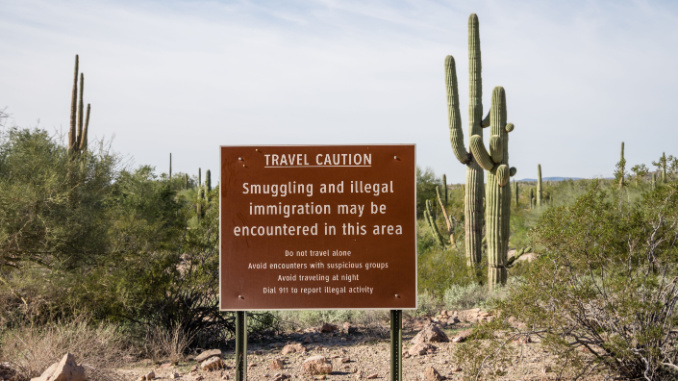
On Wednesday, the Arizona House of Representatives passed SB 1231, the Arizona Border Invasion Act. The bill, which was sponsored by Senator Janae Shamp, would “make it unlawful for a person who is an alien (unlawful immigrant) to enter Arizona from a foreign nation at any location other than a lawful port of entry, [and] outline penalties for violations of illegally entering Arizona and provides immunity from civil liability and indemnification for state and local government officials, employees and contractors who enforce this prohibition,” according to the purpose from the Arizona State Senate.
The vote in the House was 31-28 in favor of SB 1231, with one seat vacant. Earlier this month, the bill passed the Senate with a 16-13 vote (with one member not voting).
“Arizonans want and deserve safe communities, but the invasion at the border has led to countless fentanyl overdoses, rapes, murders, human smuggling, child sex trafficking, high-speed chases, subsequent deadly car crashes, and other heinous crimes that are forever transforming our state and the lives of our citizens right before our eyes,” said bill sponsor Senator Janae Shamp.
Senator Shamp also called on the governor to use every tool available to her office to help law enforcement enforce the law, writing, “Governor Katie Hobbs has declared on numerous occasions her disapproval for the lawlessness caused by the federal government’s open border policies and her desire to take action to protect our citizens. This legislation is exactly what our local law enforcement needs and has asked for to rein in the dangerous criminal activity that’s being thrust upon law-abiding Arizonans by the Biden Administration. The Legislature has done its job. Now is her chance to protect the citizens of Arizona by signing this bill into law, so that we can take the handcuffs off of our law enforcement and allow them to do their job.”
On the Arizona Legislature’s Request to Speak system, a representative from Arizona Catholic Conference endorsed the bill, while representatives from the American Civil Liberties Union of Arizona, the City of Phoenix, and Arizona Faith Network signed in in opposition to the legislation.
One of Senator Shamp’s colleagues, Senate President Pro Tempore T.J. Shope, also highlighted the passage of the bill through both chambers of the state legislature and echoed the desire for the governor to sign the legislation. He posted, “I call on Governor Hobbs to sign this bill and make good on her promise from the State of the State Address this year to take the situation at our Border seriously. Katie Hobbs, sign SB 1231.”
Arizona House Democrats vehemently protested the bill on the floor before it won final passage. The Caucus’ “X” account called the measure the “ghost of SB 1070,” and confidently predicted a veto from Governor Hobbs.
Despite a heightened tone in rhetoric from Governor Hobbs over the border crisis, the Democrat chief executive of Arizona is unlikely to go along with many – if any – of the immigration-related bills currently being offered in the legislature by Republicans. Legislative Republicans have pointed to Hobbs’ vetoes of their border bills in the 2023 session as proof that her actions speak louder than words, and the forthcoming decisions on these new proposals will certainly add to that narrative as an election year kicks into high gear for both political parties.
Daniel Stefanski is a reporter for AZ Free News. You can send him news tips using this link.
by Corinne Murdock | Mar 1, 2024 | News
By Corinne Murdock |
Gov. Katie Hobbs’ office used the Arizona Department of Transportation (ADOT) drone to film the Pride flags on the Executive Tower last June.
AZ Free News is only now reporting on these facts because it took nearly nine months for the governor’s office to respond to our public records request.
Public records revealed that ADOT’s lead drone pilot captured at least 15 clips — over 21 minutes of raw footage — of the Pride flags hanging on Hobbs’ office. The displayed flags were the version of the rainbow Pride flag known as the “Progress Pride” flag, due to their inclusion of white, pink, and blue to represent transgenderism, and black and brown to represent both non-white individuals and those who died from HIV/AIDS.
The display was the first of the kind by the governor’s office. Hobbs previously hung a mainstream Pride flag while secretary of state in 2019, but legislative leadership removed it after several hours. Hobbs revealed the Pride flags on the first day of Pride Month.
“Kicking off pride month leaving no room for doubt that in Arizona, we celebrate the light and energy the LGBTQ+ community brings to our state,” said Hobbs.
ADOT drones are intended for inspections and surveying work on state infrastructure, such as highways and bridges. They were acquired about six years ago through a combination of state and federal funding.
ADOT received much of its drone fleet through a Federal Highway Administration-sponsored Arizona Council for Transportation Innovation program in 2018. At the time, the drones cost $18,100 in federal funds and over $4,500 in matching state funds.
According to public salary data from 2022, ADOT’s lead drone pilot makes over $79,200 a year: an average of $41 an hour on a 40-hour workweek. Drone piloting also requires certification from the Federal Aviation Administration (FAA), which generally costs around $200.
As part of the display, public records documented how Hobbs invited guests to watch her unfurl the flags from the balcony and stand with her on the ground floor to admire the flags from below. Hobbs then hosted an hour-long “Pride Roundtable” with those guests.
Among those present at the roundtable were advocates of transitioning children’s genders, including those with personal experience like Lizette Trujillo. She was accompanied by her daughter, 15-year-old Danny, who identifies as a boy.
Other advocates present included two men identifying as women: Gaelle Esposito, lobbyist with Creosote Partners, and Jeanne Woodbury, interim executive director for Equality Arizona.
Additional public record requests revealed that the governor’s office sourced the flags from Phoenix Pride, the LGBTQ+ activist organization behind the annual Pride Festival. The organization reached out to the governor’s office last Easter.
Last year’s Pride Festival drew controversy for including overtly sexual displays such as genitalia and fetish costumes, nudity, and condom bars. Conversely, Hobbs’ takeaway from the festival last year was that the LGBTQ+ community was one of love and light.
Hobbs identified LGBTQ+ policies as her main priorities throughout her gubernatorial campaign. Her first executive order prohibited gender identity discrimination in state employment and contracts; however, Hobbs campaigned on taking anti-discrimination protections even further.
The governor promised to enact protections similar to those in Civil Rights laws: bans on LGBTQ+ discrimination in housing, education, adoptions, foster care, insurance, public accommodations, and credit procurement, as well as a ban on law enforcement profiling based on gender identity and sexual orientation.
Corinne Murdock is a reporter for AZ Free News. Follow her latest on Twitter, or email tips to corinne@azfreenews.com.
by Corinne Murdock | Feb 7, 2024 | News
By Corinne Murdock |
In a race against Thursday’s deadline to prevent a potential conflict between state law and the federal election calendar deadline, Republican lawmakers have advanced a proposed set of bills while Democrats have balked. It’s unlikely the bills will become law, however, as Gov. Katie Hobbs quickly rejected them as “dead on arrival.”
Republican lawmakers from both the House and Senate announced their proposed solution, two bills, on Monday afternoon; by Tuesday morning, a joint committee had advanced the bills.
In a press release, the lawmakers said that the pair of bills, SB1733 and HB2785, would provide counties with an additional 19 days in the primary election calendar and an extra 17 days in the general election calendar to comply with federal deadlines.
State Sen. Wendy Rogers (R-LD07), chair of the Senate Elections Committee, expressed hope that Hobbs would sign the legislation if passed, claiming that a refusal would cause election turmoil and voter disenfranchisement. However, Hobbs dismissed the proposal almost immediately after its release.
“This commonsense solution promises to strengthen voter confidence, is backed by all Arizona county recorders, and allows our men and women who are serving in our armed forces overseas the opportunity to cast a ballot in our elections,” said Rogers.
HB2785 sponsor State Rep. Alexander Kolodin (R-LD03) remarked that it was “highly unlikely” the feared calendar conflict would come to fruition, and that the solution was “more complicated” than some other, unnamed solutions.
“There were many simpler ways to solve this problem, some of which do not require legislative solutions,” said Kolodin. “Nevertheless, we negotiated in good faith and agreed to accept this more complicated solution in exchange for signature verification and several other commonsense reforms.”
The solution aligns with recent requests by election officials, including that of Maricopa County Supervisor Bill Gates over the weekend.
On Tuesday, both SB1733 and HB2785 passed quickly and narrowly out of a special joint meeting with the Senate Committee on Elections and the House Elections Committee. Democrats uniformly opposed the bills, while all Republicans voted for them.
Arizona House Democrats described the bills as “a Christmas tree of unrelated and controversial policy provisions” that they and, likely, Hobbs would oppose.
Arizona Senate Democrats claimed that the alleged excess provisions in the proposed legislation would disenfranchise voters and hinder ballot access.
In a joint statement issued over the weekend, Hobbs and Secretary of State Adrian Fontes clarified that the governor wouldn’t approve any bill that carried “harmful unrelated legislation.”
The contested provisions include the imposition of the state’s first signature verification standards, as well as the expansion of signature curing hours to the weekend before and after an election for those elections including federal offices.
The proposed legislation would also create a category of verified early ballots exempt from review for voters who show ID when turning in their mailed early ballot in person.
The Arizona Association of Counties gave their support for both bills during Tuesday’s committee hearing.
Corinne Murdock is a reporter for AZ Free News. Follow her latest on Twitter, or email tips to corinne@azfreenews.com.
by AZ Free Enterprise Club | Feb 4, 2024 | Opinion
By the Arizona Free Enterprise Club |
If all else fails, run and hide. That seems to be the motto for Katie Hobbs anytime she’s confronted with a challenge. We saw it during her 2022 gubernatorial campaign when she refused to debate Kari Lake. We saw it when she ducked reporters asking for her reasoning behind refusing to debate Kari Lake. We saw it when she hid in a restaurant bathroom after another reporter asked her why she didn’t like discussing politics. And now that she’s governor, it should come as no surprise that Hobbs has chosen the same approach when it comes to the border crisis.
During the last three years, the Biden administration has completely abandoned its constitutional duty to protect each state from invasion, and Texas had enough. The state moved to defend itself from an unprecedented flow of illegal immigration due to the federal government’s negligence. And it has so far been supported by governors from 25 states who signed a joint statement standing with Texas.
Given Arizona’s dangerous situation at our own border, you would think Governor Hobbs would sign on or at least have something to say. But once again, she has chosen to run and hide…
>>> CONTINUE READING >>>
by Daniel Stefanski | Feb 1, 2024 | News
By Daniel Stefanski |
Arizona’s leading legislative Republicans are taking the state’s Secretary of State to court in advance of the 2024 election cycle.
On Wednesday, the State Senate Republican Caucus announced that President Warren Petersen and House Speaker Ben Toma filed a challenge in Maricopa County Superior Court over the recently published Elections Procedures Manual (EPM), “requesting the court throw out a number of provisions in the EPM, which violate or conflict with current Arizona election laws.”
“Both the Secretary and our Governor have a track record of not following the law. As a result, I’m taking action to protect the integrity of our elections,” said President Petersen. “This reckless EPM opens the door to unlawful activity and undermines the voter confidence measures Republican lawmakers have implemented over the years.”
Toma added, “The Arizona Legislature is taking steps necessary to protect the integrity of Arizona’s elections…. Secretary Fontes has exceeded his jurisdiction, using the EPM to exercise lawmaking powers that do not belong to him. Our lawsuit aims to halt this overreach and nullify the unlawful provisions in the manual to ensure a fair and lawful electoral process for all Arizonans.”
The lawsuit, which was filed by attorneys of Statecraft PLLC and Snell & Wilmer L.L.P., asked the Superior Court for a preliminary injunction prohibiting the implementation or enforcement of the 2023 EPM to the extent it purports to:
- Allow county recorders to merely move to inactive status – rather than cancel the registrations of – voters who affirmatively stated on juror questionnaires that they do not reside in the relevant county and have not responded within 35 days to a notice from the county recorder;
- Prohibit county recorders from relying on information provided by third parties in determining whether there is reason to believe a registered voter is not a United States citizen;
- Delay implementation of statutorily required maintenance of the active early voting list until January 2027;
- Excuse mistakes or errors in the statutorily required registrations of paid or out-of-state ballot measure petition circulators;
- Compel county boards of supervisors to reflexively vote to adopt only the returns provided by the election official when conducting a canvass; and
- Authorize the Secretary of State to certify a statewide canvass that consists of returns of fewer than fifteen counties.
The legislative Republicans will have stiff opposition in court from the trio of statewide Democrats who were responsible for producing and approving this EPM: Secretary of State Adrian Fontes, Governor Katie Hobbs, and Attorney General Kris Mayes. When Fontes issued the 2023 EPM at the end of last year, he said, “Free, fair and secure elections have been this group’s commitment to the voter from the very beginning. This is what happens when a committed group of leaders comes together to serve their community. It’s good for our democracy and it’s good for Arizona.”
Governor Katie Hobbs, who preceded Fontes, said, “Partisan politics should have no role in how we run our elections. This EPM builds on the 2019 EPM and 2021 draft EPM from my tenure as Secretary of State and will ensure dedicated public servants from across the state will have the guidelines they need to administer free and fair elections. Together, we can protect our democracy and make sure every Arizonan has the opportunity to have their voice heard.”
As Secretary of State, Hobbs was required to finalize the EPM in 2021, but a divided government shared with Republican Governor Doug Ducey and Attorney General Mark Brnovich stymied the quest to secure a green light for the manual. Hobbs and Brnovich were also mired in an ongoing political feud, which resulted in legal bar charges that the Secretary of State brought against the state’s top prosecutor and several of his attorneys. After receiving Hobbs’ updated manual, Brnovich sued the SOS “to compel her production of a lawful EPM.” Brnovich alleged that “the SOS failed to provide the Governor and Attorney General with a lawful manual by October 1, 2021, as required, and instead included nearly one-hundred pages of provisions not permitted under the EPM statute.” The challenge from the former Attorney General was rendered unsuccessful, and the state was forced to revert to the previous cycle’s EPM (2019) to govern the 2022 races.
Daniel Stefanski is a reporter for AZ Free News. You can send him news tips using this link.