by Matthew Holloway | Jul 14, 2024 | News
By Matthew Holloway |
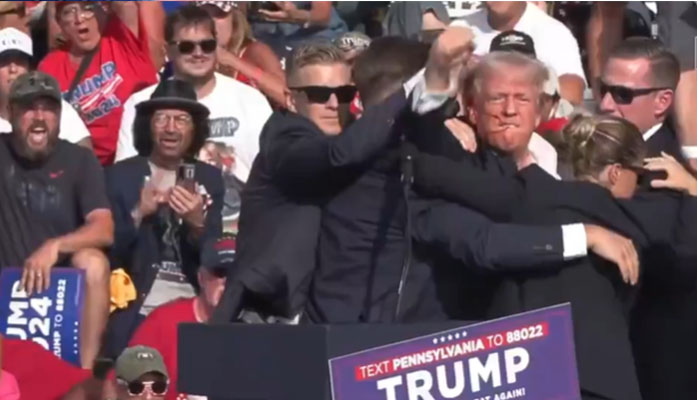
Donald J. Trump, the 45th President of the United States and presumptive Republican 2024 nominee, survived an attempted assassination in Butler County, PA, on Saturday. According to reports, an assailant opened fire with a 22-caliber rifle from a rooftop approximately 150 yards away from the mainstage where Trump was addressing his rally, grazing him in the right ear and killing a rally attendee. The Secret Service told reporters that two spectators were also critically injured. The would-be assassin was engaged by police snipers according to the New York Post with one bystander saying, “They blew his head off.”
As the shots rang out, President Trump can be seen raising a hand to his ear and exclaiming “Oh!” after the first round grazed him. A moment later he dropped to the ground and was swarmed by Secret Service Agents as rally goers took cover behind him. One of the agents can be heard on microphone shouting “Get down, get down, get down, get down!” Seconds later, per the Associated Press, the agents can be heard saying “shooter’s down.” The agents conferred for a few moments before helping Trump rise to his feet. After asking for his shoes, Trump is heard telling his agents to wait before looking out to the crowd with blood trailing across his face from his wounded ear and mouthing, “Fight, Fight, Fight” to his supporters.
Trump was transported to an area hospital in stable condition and released later in the evening.
Within moments, Arizona politicos and elected officials began to respond to the narrowly averted assassination.
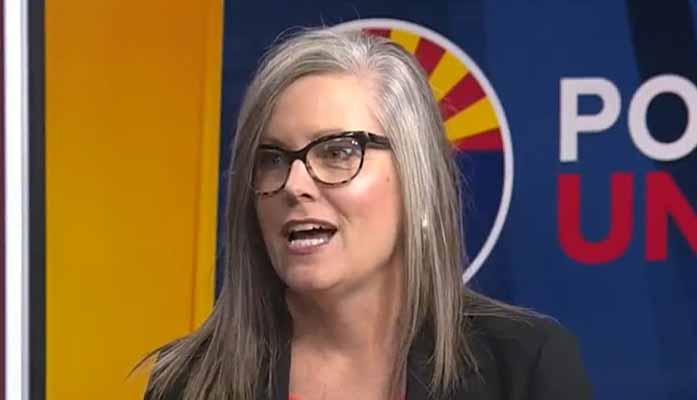
Governor Katie Hobbs (D) posted a statement to X saying, “Political violence is unacceptable, and has no place in this country. I am glad that former President Trump is safe, and hope that others at the rally were not seriously injured. I hope the perpetrator of this heinous act will be swiftly brought to justice.” Her comments echoed the sentiment of many prominent Democrats such as Senate Majority Leader Chuck Schumer (D-NY) condemning political violence.
Speaker of the Arizona State House of Representatives Ben Toma (R-AZ-27) wrote within minutes, “Praying for President Trump, first responders, and any others who may have also been injured at the rally.”
Arizona Senate Presdient Warren Peterson looked back on a recent attempt by Democrats in Congress to strip Trump of Secret Service protection in a post to X saying, “It is a good thing the Democrats have not been successful in taking the secret service from Trump.”
In April, Democratic Congressman Bennie Thompson from Mississippi, the Ranking Member of the Committee on Homeland Security led an effort to remove Trump’s protective detail known as the Disgraced Former Protectees Act (H.R. 8081) as reported by USA Today. The bill was co-sponsored by Reps. Troy A. Carter Sr., Barbara Lee, Frederica Wilson, Yvette D. Clarke, Bonnie Watson Coleman, Jasmine Crockett, Joyce Beatty, and Steve Cohen.
Arizona’s Democrat Attorney General Kris Mayes offered her thoughts in a statement to X as well writing:
“The attack against former President Trump must be strongly condemned by ALL Americans — no matter their political beliefs. Poltical violence is never acceptable. Never. My thoughts are with the former President and anyone else who may have been injured or hurt at today’s rally.”
Maricopa County Attorney Rachel Mitchell noted, “This is horrifying. Violence is never the answer. Praying for a full and speedy recovery for President Trump.”
Arizona Secretary of State Adrian Fontes offered his statement, notably without mentioning Trump by name, saying, “I condemn political violence in the most unequivocal terms. NO American political figure should ever be threatened with OR acted against with violence. If we want to beat a political opponent, we do it with ballots, not bullets.”
Arizona State Senator Janae Shamp lauded the efforts of the U.S. Secret Service protecting President Trump writing, “God bless the men and women who put their lives on the line to protect President Trump! #absoluteheroes”
State Rep. Steve Montenegro (R-AZ-29) shared a now iconic image of Trump raising his fist defiantly saying, “Praying for President Trump. #StandWithTrump”
Republican Senate primary candidate Kari Lake issued a statement saying, “I am shaken and horrified by the assassination attempt on President Trump’s life today. I am praying for President Trump and the innocent attendees who were tragically injured or killed. I am grateful for the brave Secret Service agents and law enforcement officials for their swift action and for preventing this incident from becoming even more tragic.”
She later joined RSBN during the network’s live coverage and wrote, “Today, we saw an assassination attempt on a man who’s been fighting for this country. I’m praying for Donald Trump. I’m praying just as much for his family, & the people in that crowd, & more than anything, I pray for this great Republic & that we can come together as Americans.”
Fellow GOP Senate contender, Pinal County Sheriff Mark Lamb, wrote, “Our prayers are with President Trump and his entire family. I applaud the quick reaction and work of law enforcement and members of the Secret Service to move the President to safety and neutralize the suspect.”
Congressman Ruben Gallego (D-AZ), who is also running for the Senate seat of outgoing Sen. Kyrsten Sinema (I-AZ), wrote, “Absolutely horrible. Political violence should never be tolerated. I hope President Trump and everyone at the rally is safe. Grateful Secret Service and law enforcement got the situation under control so quickly.”
President Trump made a statement posted to Truth Social, first thanking the Secret Service and law enforcement and offering condolences to those injured and killed and their families: “I want to thank The United States Secret Service, and all of Law Enforcement, for their rapid response on the shooting that just took place in Butler, Pennsylvania. Most importantly, I want to extend my condolences to the family of the person at the Rally who was killed, and also to the family of another person that was badly injured.”
He added, “It is incredible that such an act can take place in our Country. Nothing is known at this time about the shooter, who is now dead. I was shot with a bullet that pierced the upper part of my right ear. I knew immediately that something was wrong in that I heard a whizzing sound, shots, and immediately felt the bullet ripping through the skin. Much bleeding took place, so I realized then what was happening. GOD BLESS AMERICA!”
Senator Tim Scott (R-SC), a popular contender to serve as Trump’s Vice Presidential pick, declared on X, “Let’s be clear: This was an assassination attempt aided and abetted by the radical Left and corporate media incessantly calling Trump a threat to democracy, fascists, or worse.”
Fellow VP short-lister Sen. J.D. Vance echoed a similar sentiment saying, “Today is not just some isolated incident. The central premise of the Biden campaign is that President Donald Trump is an authoritarian fascist who must be stopped at all costs. That rhetoric led directly to President Trump’s attempted assassination.” He also condemned Rep. Thompson for his efforts to strip Trump of his protective detail saying “Remember this? I do. Kick his ass out of Congress. Absolute scumbag.”
Former Governor of North Dakota Doug Burgum, another rumored potential VP, noted, “Please join Kathryn and me in praying for President Trump, his family and everyone attending the rally today,” adding, “We all know President Trump is stronger than his enemies. Today he showed it.”
Possible Vice-Presidential pick and former presidential candidate Vivek Ramaswamy offered a lengthy statement saying in part, “First they sued him. Then they prosecuted him. Then they tried to take him off the ballot. The only thing more tragic than what just happened is that, if we’re being honest, it wasn’t totally a shock. Biden’s inevitable ritual condemnation of political violence today (when it comes) will be insufficient and irrelevant. No amount of verbiage today changes the toxic national climate that led to this tragedy.
Apoorva and I mourn for the rally attendee who was apparently killed by the shooter. We believe the fact that President Trump is safe right now is nothing short of an act of God. My heart tells me God intervened not just for Trump, but for our nation. Today, the future survival of the United States of America came down to less than a hair’s width in the path of a bullet.”
He added, “If any good comes of today, let it be this: Americans just had the chance to see our next President’s true character, unvarnished. He took the fire, he took the hit, he felt the blood, and then he stood right back up for the people he was put here to lead. Regardless of who you vote for, let’s unite around the TRUTH that what happened today is unacceptable, now and forever.”
Matthew Holloway is a senior reporter for AZ Free News. Follow him on X for his latest stories, or email tips to Matthew@azfreenews.com.
by Staff Reporter | Jul 13, 2024 | News
By Staff Reporter |
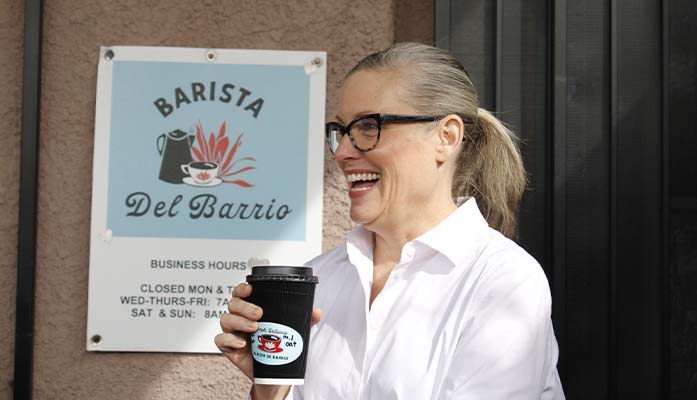
Governor Katie Hobbs has prioritized the fundraising of millions of dollars to flip the state legislature over to Democrats over the governance of the state.
According to the campaign finance records, Hobbs’ gubernatorial campaign has collected over $2.6 million from 2023 through March: just over $2.1 million in 2023, and nearly $468,000 from January through March of this year.
Campaign totals from April through the present of this year weren’t yet available on the campaign finance reporting website.
Out of the over 27,800 individual contributions Hobbs’ campaign received from last year through this March, around 8,600 were from out of state.
The top donors since Hobbs took office last year include $10,800 contributions from AFSCME People, United Here PAC, UFCW Local 99 PAC, AZ CWA State Council PAC, and USAA Employee PAC.
The second-highest level of contributions were around 180 individual contributions of $5,400 donations, and about 30 individual contributions of $5,000.
Several organizations and entities also donated sums of $5,400: Moms Fed Up, Smart TD PAC, JP Morgan Chase & Co Arizona PAC, the Pascua Yaqui Tribe, Gila River Indian Community, Tohono O’Odham Nation, Salt River Pima Maricopa Indian Community, DRIVE Committee (the Political Action Committee of the International Brotherhood of Teamsters), Pattern Energy Group PAC, Southwest Regional Council of Carpenters Issues Committee, Molina Healthcare PAC, Salt River Project, Realtors of Arizona PAC, Arizona Dispensaries Association PAC, Boilermakers-Blacksmiths Leap, Amalgamated Transit Union – Cope.
Other high-level donations included the Arizona Hospital and Healthcare Association PAC, $5,000; Republic Services, $4,400; American Airlines PAC, $3,000; and UNS Energy Corporation PAC , $2,500; Wells Fargo; Arizona Employee PAC, $2,500; and American Property Casualty Insurance, $2,400.
Hobbs told Capitol Media Services that her position of authority created “the perfect storm” to secure the state legislature for her party.
“This is the first time we’ve been this close and had a Democratic governor,” said Hobbs. “And this is what I’m focused on this election is governing majorities who will work with me.”
Fundraising emails from the Hobbs campaign focused on securing greater legalization of abortion in the state.
Hobbs has vetoed around 200 Republican-led bills since taking office last year.
Democrats haven’t held a trifecta in nearly 60 years. The Republicans hold a slim majority in both the House and Senate: 31 out of 60 seats in the former, 16 out of 30 seats in the latter.
Hobbs’ campaign manager, Nicole DeMont, bragged that Hobbs had collected millions in her first year as governor while her predecessor, Doug Ducey, collected only about $160,000.
The millions excludes the excess in donations (estimated over $1.5 million) to Hobbs’ much-scrutinized inauguration fund, which DeMont established as a 501(c)(4) nonprofit.
The Arizona Secretary of State has a complete list of all candidates eligible to appear on the ballot.
AZ Free News is your #1 source for Arizona news and politics. You can send us news tips using this link.
by Staff Reporter | Jul 11, 2024 | News
By Staff Reporter |
In a press gaggle on Wednesday, Governor Katie Hobbs revealed a semblance of doubt about President Joe Biden’s fitness for office.
Hobbs acknowledged that the ongoing concerns over Biden’s apparently diminished cognitive functions were exacerbated by his debate performance last month.
“There’s so much on the line in this November’s election. From the president down to our state legislative races: our fundamental freedoms, our very democracy,” said Hobbs. “And I know that Arizonans have been concerned about the president’s age, and since the debate I think those concerns are even more top of mind. And I think the president has a lot to do to assure Arizonans and Americans, and I know that he knows that is his job over the coming weeks.”
When pressed as to whether her assessment meant a withdrawal of support for the president, or preference that he step aside for another to take his place, Hobbs reassured that Biden could fulfill presidential duties a second go around should he remain the candidate.
“Joe Biden can do the job, and that’s all I’m going to say about the situation,” said Hobbs. “It’s up to the president. He’s the nominee. There’s no indication that’s going to change.”
Hobbs indicated that she would still vote for Biden because the alternative, former President Donald Trump, was too poor a choice to consider.
“I have one vote in this election just like everyone else,” said Hobbs. “To me, the choice is abundantly clear: the guy who’s trying to uphold democracy, and the guy who’s trying to tear it down.”
Hobbs had an up close and personal opportunity to assess Biden last week. She and 20 other Democratic governors convened with the president in a private meeting, wherein Politico reported Biden advising that he’d been cleared in a medical checkup following the debate.
That private meeting reportedly focused on addressing governors’ concerns of Biden’s fitness for office, a sudden and unanticipated meeting arranged shortly after Press Secretary Karine Jean-Pierre avoided questions from the press about Biden’s last medical exam.
The governor refused to disclose additional details of the meeting.
The remarks signal a pivot from Hobbs’ initial response to Biden’s debate performance. In an interview with media last week, Hobbs had dismissed those concerns of his cognitive abilities by remarking that she wasn’t “a fan of debates” either, a reference to her refusing to debate with former GOP opponent Kari Lake during their 2022 gubernatorial race.
“As the president himself has said, don’t compare him to the Almighty, compare him to the alternative, and by that metric the choice is abundantly clear in this race,” said Hobbs.
Since taking office, Hobbs has dedicated a significant portion of her focus into securing a Democrat majority in both the Arizona House and Senate, raising millions for the effort. Some of those funds have come from Hobbs’ controversial inaugural fund.
Democratic Congressman Raul Grijalva announced late last week that he wanted Biden to drop out of the race, though should the president choose to stay he would support.
AZ Free News is your #1 source for Arizona news and politics. You can send us news tips using this link.
by Staff Reporter | Jul 5, 2024 | News
By Staff Reporter |
Governor Katie Hobbs’ high rate of vetoes in election-related legislation was featured in a new Ballotpedia report released this week.
That report also detailed the thousands of election-related bills considered nationwide, highlighting those passed and vetoed in Arizona specifically.
Arizona with its divided government saw the passage of three key election bills, and the veto of seven.
The digital nonprofit featured several key bills passed by the Arizona legislature this year: HB 2785, which modified the statewide primary date by one week; SB 1342, which provided compensation to political party designees for post-election audit hand counts, with a limit of 75 percent of those conducting the hand count from being members of the same political party; and HB 2482, which required county election officials to notify voters of registration record changes within 24 hours.
Ballotpedia also highlighted the seven bills vetoed by Governor Katie Hobbs: SB 1060, allowing federal candidates to choose observers at polling centers; SB 1330, replacing the term “drop box” with “ballot box” or “container”; SB 1097, making school board races partisan; HB 2393, allowing for an alternative presidential preference election for overseas military voters; HB 2404, prohibiting county recorders from issuing voter registration cards to out-of-state addresses; HB 2612, prohibiting individuals convicted of ballot abuse offenses from holding elected public office; and HB 2031, reducing the threshold for asking voters to expand the board of supervisors from 150,000 to 125,000.
Hobbs’ vetoes pushed Arizona to the top in terms of highest vetoes nationwide.
Although Arizona was featured as one of the key states reviewed, the state didn’t make the top 10 for most active overall in passing bills. With the exception of Maryland and Virginia, all of these states had Republican trifectas. In order from most activity to least: Tennessee, Georgia, Virginia, Louisiana, Idaho, South Carolina, Utah, West Virginia, South Dakota, and Maryland.
Arizona was, however, most active among the 10 states with divided governments.
In its report, Ballotpedia tallied the total of election-related legislation considered across Arizona and the rest of the nation: over 3,700 bills.
The nonprofit also noted that legislation topic or type was often determined by the political party leading the state. In Republican-led states, the election-related bills focused on ballot harvesting or collection, voter registration drives, noncitizen voting, or ranked-choice voting. In Democrat-led states, the bills focused on ballot curing for absentee or mail-in voting, voter suppression, and election disinformation or misinformation.
Bipartisan support existed for about eight percent of bills on topics such as voter list maintenance, protections for elections officials and workers, presidential electors, and voting by eligible but incarcerated individuals or felons.
States with a Republican trifecta and Republican or other sponsorship of the bills enacted the greatest majority of election-related legislation: 64 percent (196 bills). Democratic trifecta and Democratic or other sponsorship of the bills enacted 19 percent of the legislation (57 bills). “All other” totaled 17 percent (52 bills).
However, states with Democratic trifectas considered more changes to election laws than those states with Republican trifectas or divided governments. Ballotpedia noted that this was true for the third year in a row of their tracking history.
AZ Free News is your #1 source for Arizona news and politics. You can send us news tips using this link.
by AZ Free Enterprise Club | Jun 23, 2024 | Opinion
By the Arizona Free Enterprise Club |
Last weekend, the Arizona legislature completed its constitutional duty and finally passed a state budget, concluding its business for the year. Looming over the entire process was a budget deficit that needed to be filled—fluctuating from around $1.6 billion to just over $2 billion over the 3-year budgeting period.
Though the left and the media wanted to blame historic tax cuts and landmark school choice expansion for the shortfall, the real problem was record spending that resulted in Arizona’s budget growing by over 50% in the last five years. So, when lawmakers gaveled into session in January, the solution was to right-size state spending. Our organization even provided a roadmap for a successful budget process:
- Cut spending to align with current and future funding projections
- Don’t raid the rainy-day fund
- Don’t use budget gimmicks to balance the sheets
- Don’t roll back our school choice programs
- Don’t raise taxes
So how did the legislature do? Here is a breakdown of the good and the not so good results from the budget:
>>> CONTINUE READING >>>