by Staff Reporter | Aug 15, 2024 | News
By Staff Reporter |
A state senator instrumental to protecting vulnerable children is also key to Republican control of the Arizona Legislature.
State Senator Shawnna Bolick is hoping her constituents give her the green light to return for her first full term in the Arizona Legislature after returning from a brief hiatus. Bolick was appointed by the Maricopa County Board of Supervisors in July 2023, when then-State Senator Steve Kaiser surprisingly resigned from his office. The Phoenix-area mother of two had previously served for two terms in the Arizona House of Representatives (2019-2023).
Earlier this year, Bolick authored SB 1372, which “proscribes a court from ordering family reunification treatment that requires certain conditions for participation unless both parents consent,” according to the overview from the Arizona House of Representatives. The bill overwhelmingly passed the state senate with a 19-9 vote (with two members not voting), and it cleared the House with a 32-27 result (with one member not voting).
Governor Katie Hobbs, a Democrat, signed the bill in April.
In a statement after the bill’s signing, Bolick said, “A number of families reached out to me with their horror stories surrounding reunification camps, and I was compelled to take action. Unqualified individuals have been profiting off of the disfunction being forced upon countless kids, and the judicial system seems to be none the wiser to this scheme. Many times, these kids are taken in the middle of the night, sent to seedy locations like motels, sometimes out of state, and are basically brainwashed into agreeing to spend time with a parent that is either mentally, emotionally, or physically harming the child, while having no contact with the parent that the child actually feels safe with.”
Bolick added, “I’m thrilled this bill was signed into law, but I’m utterly appalled nine out of 14 Senate Democrats and nearly all House Democrats voted ‘no’ on protecting our children from this heinous victimization. Their vote against this legislation shows their true colors. Democrats are more concerned with partisan games than following their conscience and doing what’s right for the safety and well-being of these vulnerable kids.”
Hobbs said, “I was glad to sign this bill to codify current best practices of the courts and prevent vulnerable children from being in potentially unwelcome and unhelpful situations.”
On the Arizona Legislature’s Request to Speak system, a representative from Arizona National Organization for Women, usually a champion for progressive candidates and causes, endorsed the bill, showing its broad appeal.
The effort on this family reunification legislation follows another from Bolick at the end of her first tenure in office. In 2022, Bolick sponsored HB 2134 to appropriate $150,000 for the award of school safety grants from the Arizona Department of Education, which was approved in that year’s budget. Bolick said, “As a mom of a teenager, I know how much our kids rely heavily on technology. This school safety grant is a small investment in addressing bullying and student safety in our schools. According to a November 2021 Arizona Child Fatality Review Annual Report, bullying is a top reason for children taking their own lives. Teens have told me they have tried to report an incident on their school campus with a trusted adult but were never taken seriously. It is my hope that the responsible use of this technology will lead to safer school campuses for our students.”
Bolick has also championed school choice proposals to protect children who are being bullied in their places of education. In 2019, Bolick wrote an opinion piece for the Arizona Republic about the unfortunate instances of her daughter being bullied and assaulted, leading to her parents looking to relocate schools “because we no longer felt the school would protect her.” She stated that her daughter “is just one of the thousands of children across our country who are victims of a crime on a K-12 public school campus.”
These episodes with her daughter, coupled with her vast experience in the New York City public school system, led Bolick to introduce the Lifeline for Student Crime Victims Act “to expand Empowerment Scholarship Account eligibility to include public school students who have been victims of battery, harassment, hazing, kidnapping, physical attack, robbery, sexual harassment, sexual assault, rape, threatening, intimidation, fighting, sex trafficking or human trafficking.”
The first-term lawmaker (at that time) closed her piece, writing, “As a freshman legislator, I had the choice to be a wallflower or jump into the fray solving problems facing our state. At the end of the day, I side with victims’ rights over the establishment.”
Judy Schwiebert signed in on the legislature’s Request to Speak system to oppose the bill – along with a representative from Save Our Schools Arizona.
If Bolick is given the chance to continue in the legislature for the next term, she is already looking at more opportunities to protect vulnerable children across the state. In an exclusive interview with AZ Free News earlier this summer, she said that she is looking at options to “deal with the bullying in our schools” and to “get to the root of the problem because bullying continues to get worse leading to kids missing weeks of school.”
Arizona Legislative District 2 is one of the most competitive in the state, with a 3.8% vote spread in the past nine statewide elections. It is very winnable for Republicans, however, as the party has emerged victorious in six out of those nine elections.
Senator Bolick will face off against Judy Schwiebert in the November General Election, who is running unopposed in the Democrat primary election.
AZ Free News is your #1 source for Arizona news and politics. You can send us news tips using this link.
by Staff Reporter | Aug 14, 2024 | News
By Staff Reporter |
A middle-of-the-road legislative district in the Phoenix-metro area will be key to deciding the future political makeup of the Arizona State Legislature.
State Representative Seth Blattman, a Democrat, is running for reelection in Arizona Legislative District 9.
The Democrat lawmaker has been endorsed by liberal groups in his reelection bid, including National Organization for Women Arizona, AEA Fund for Public Education, the Progressive Turnout Project, the Progressive Change Campaign Committee, Jane Fonda Climate PAC, Save Our Schools Arizona, and Stonewall Democrats of Arizona.
Blattman’s support from the Fonda PAC may be one of the most concerning for voters researching his record and determining which direction they want to see for their district. On August 7, Blattman boasted of this endorsement, saying, “I am incredibly honored to announce the endorsement by the Jane Fonda Climate PAC! Their tireless efforts in combating climate change and advocating for sustainable policies are crucial for our planet’s future. Together, let’s create a healthier and sustainable Arizona for generations to come.”
The mission of the PAC, however, is not as agreeable to a wide swath of constituents. On her website, Fonda writes, “Our planet is on fire and our leaders are failing us, so if we can’t change the minds of the people in power, we need to change the people in power. It is for that reason that I started Jane Fonda Climate PAC, which is laser-focused on one goal: Do what it takes to defeat fossil fuel supporters and elect climate champions at all levels of government.”
This PAC asserts that “major solutions are stopped cold: the Green New Deal, Build Back Better, clean energy investments, ending billions in tax subsidies to the fossil fuel industry – all because of politicians backed by Big Oil.”
The Green New Deal pushed by the Jane Fonda Climate PAC is the same championed by U.S. Senator Bernie Sanders, who is one of the most progressive lawmakers in the U.S. Congress. On Sanders’ presidential campaign website, he wrote about the deal, that “the climate crisis is not only the single greatest challenge facing our country; it is also our single greatest opportunity to build a more just and equitable future, but we must act immediately.”
Sanders added that as president he would “launch the decade of the Green New Deal, a ten-year, nationwide mobilization centered around justice and equity during which climate change will be factored into virtually every area of policy, from immigration to trade to foreign policy and beyond. Part of the details of the Green New Deal, according to Sanders, includes, “declaring climate change a national emergency, commit[ing] to reducing emissions throughout the world, [and] expanding the climate justice movement.”
Though Arizona has so far resisted an extreme move to the globalist agenda of the climate change lobby – thanks, in large part, to its previous Republican governors (Brewer and Ducey) and a Republican-led legislature – Blattman’s recent votes indicate that he might help usher in more of the Green New Deal policies should Democrats retake the legislature alongside Governor Katie Hobbs. He voted against HCR 2050, which would have “constitutionally prohibit[ed] Arizona or any political subdivision or public body of Arizona from restricting the manufacture, use or sale or a device based on the energy sources used to power the device.”
Additionally, Blattman voted against HCR 2018, which would have “prohibit[ed] this state and any city, town, county, municipal corporation or other political subdivision of this state from imposing a fee or tax based on vehicle miles traveled by a person in a motor vehicle or enacting any rule or law to monitor or limit the vehicle miles traveled by a person in a motor vehicle.”
Another of Blattman’s endorsements, the Progressive Change Campaign Committee, also highlights its efforts to fight for the Green New Deal. The organization promotes itself as “a proud supporter of Elizabeth Warren since her first run for Senate and was the first national political organization to endorse her for president in the 2020 election.”
Warren, also one of the most liberal and progressive members of the U.S. Congress, presents herself as a top supporter of the Green New Deal. On her campaign website, Warren writes, “This is a crisis. We need bold, aggressive action. We need a Green New Deal – and we need it now. Elizabeth is proud to be an original cosponsor of Senator Ed Markey and Rep. Alexandria Ocasio-Cortez’s Green New Deal resolution, which commits the United States to a ten-year mobilization to achieve domestic net-zero emissions by 2030. It provides the framework for an ambitious effort to transform our economy and save our planet.”
According to the Arizona Independent Redistricting Commission, Legislative District 9 is one of the most competitive in the entire state, with a 2.6% vote spread between Democrats and Republicans in the past nine statewide elections. In those contests, Democrats have emerged victorious five times, compared to four for Republicans.
Blattman will attempt to return to the Arizona House of Representatives alongside his seatmate, Lorena Austin. The two Democrats are facing off against Republicans Mary Ann Mendoza and Kylie Barber for the right to represent the district in its two slots.
AZ Free News is your #1 source for Arizona news and politics. You can send us news tips using this link.
by Matthew Holloway | Aug 7, 2024 | News
By Matthew Holloway |
Arizona leaders from both the Democratic and Republican parties reacted to the announcement that Minnesota Governor Tim Walz will join Vice President Kamala Harris in her bid to take the presidency in 2024. After being appointed the Democratic nominee in an irregular process disregarding the primary election, but prior to a largely ceremonial Democratic Convention, Harris announced Tuesday that Walz would join her as Vice Presidential nominee. Democrats in the state appeared to be largely toeing the party line with supportive statements, despite the very public snub of VP hopeful Sen. Mark Kelly. Republicans expressed concern that Walz will serve to radicalize the Democratic ticket further to the left.
As reported by AZ Capitol Times, Governor Katie Hobbs hailed the nomination saying she was “absolutely thrilled” about it. “I’ve had the chance to work with him directly on many issues and have seen first-hand his dedication to the American people,” she added, referring to her work with her fellow Democrat Governor. “I know the governors know what it takes to deliver for their states,” Hobbs told reporters. “And I am confident Gov. Walz and Vice President Harris will deliver for Arizona.”
Speaking to AZ Central, the normally rigid Hobbs uncharacteristically gushed at Walz, one of her few gubernatorial colleagues widely judged as more radically left, “Oh my gosh, you should have been in my house and heard my scream when I saw the news this morning. I’m absolutely thrilled that Vice President Harris has chosen him to be her running mate.”
In a post to X, Sen. Kelly, one of Walz’s chief rivals for the post wrote, “Vice President @KamalaHarris and Governor @Tim_Walz are going to move us forward. They’re already building a campaign to unite our country — and @GabbyGiffords and I are ready to do everything we can to help them win.”
Democrat Congressman and Senate nominee Ruben Gallego wrote a post to X, emphasizing Walz’s military service, which has come under heavy scrutiny with accusations that the Governor retired early, mid-training to avoid serving in Iraq, and losing his conditional rank as Command Sergeant Major.
Gallego wrote that Walz, “served our country for 24 years as a National Guardsman. Serving together in the House, I saw firsthand how he’s willing to work with anyone to fight for our kids, our veterans, and our future — and our country is better off because of it. He’s a good man and will continue to serve our country well.”
“We are incredibly excited to vote the Harris-Walz ticket into the White House this November,” Arizona Democratic Party Chairwoman Yolanda Bejarano offered in a written statement, “Both Vice President Harris and Governor Walz have a strong record of delivering results on the issues that Arizonans care most about– protecting abortion rights, helping working families get ahead, and protecting our democracy.”
Arizona Republicans took a decidedly different and far more concerned view of Walz, citing his heavily criticized lack of response to the 2020 BLM riots in Minneapolis as well as his radical-left policies. Republican Senate nominee Kari Lake shared images of Minneapolis burning and wrote, “While violent mobs were burning down American cities like Minneapolis, @Tim_Walz was cheering them on @KamalaHarris was bailing them out @RubenGallego was marching with them Radicals.”
Congressman Andy Biggs (R-AZ5) expressed similar concerns writing, “Tim Walz let his state burn, and Kamala raised money to bail these criminals out of jail. This is the America that the radical Left wants.”
Rep. Eli Crane (R-AZ2), himself a veteran Navy SEAL sniper, shared a post to X citing a New York Post article exploring the allegation of stolen valor against Walz. According to the report, retired Command Sergeants Major Thomas Behrends and Paul Herr wrote, “On May 16th, 2005, [Walz] quit, betraying his country, leaving the 1-125th Field Artillery Battalion and its Soldiers hanging; without its senior Non-Commissioned Officer, as the battalion prepared for war,” in a letter first revealed by The Daily Wire.
The Republican Party of Arizona presented a damning record of Tim Walz in a post to X writing, “THE RADICAL RECORD OF TIM WALZ”:
- Hesitated to deploy the National Guard during the 2020 riots, letting Minneapolis burn
- Supports sanctuary cities and states, weakening our border security
- Wants taxpayer dollars to fund health care and college for illegal immigrants
- Advocates for universal health care and higher taxes on hardworking Americans
- Defends the right to abortion on demand up until the moment of birth
- Opposes voter ID laws, undermining election integrity
- Admitted his “white privilege” and sympathized with vandals who tore down historic statues
- Wants to phase out fossil fuels and impose strict emissions standards, harming our economy
- Cozied up to China throughout his career, praising their “spectacular” modernization
- Faced DUI charges and misrepresented his military rank
The AZGOP concluded, “Tim Walz is DANGEROUS for America. We can’t afford to let the far-left policies of the Harris-Walz ticket destroy our country.”
Matthew Holloway is a senior reporter for AZ Free News. Follow him on X for his latest stories, or email tips to Matthew@azfreenews.com.
by Staff Reporter | Jul 25, 2024 | News
By Staff Reporter |
A major Democrat super political action committee, the PAC for America’s Future, is investing heavily in Arizona this election year. PAC for America’s Future is not only the largest PAC in Arizona; it is a top donor to the Democratic Party.
PAC For America’s Future has focused on Arizona, one of the more contentious of the six key swing states for the election, alongside Wisconsin, Pennsylvania, Michigan, Georgia, and Nevada. According to the Arizona secretary of state’s campaign finance portal, the PAC is the second-largest in the state with over $9.5 million in income and $4.2 million in expenditures, after Arizona for Abortion Access ($12.3 million income, $9.6 million expense). However, PAC for America’s Future has the highest cash balance in the state: over $8.3 million.
These funds are from out-of-state interests, not Arizonans. AZ Free News reviewed all finance reports and found that total funds from Arizonans amounted to slightly less than $13,500 across 122 donations (some of whom were recurring donors). That’s .0014 percent of total donations since last year.
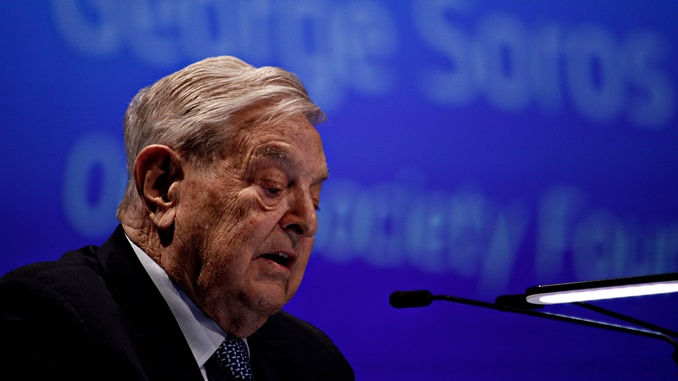
Most of the other funds come from sizable contributions by wealthy out-of-state Democrats. Jonathan Soros, heir to father George Soros’ $25 billion empire, has given $2 million to PAC for America’s Future this year and remains their single-highest donor.
Other top donors from last year to this year include:
- $500,000 from Lynn Schusterman, an Oklahoma billionaire and wife of the late oil and gas founder Charles Schusterman
- $1 million from Wendy and Barry Munger, Californians and children of former Berkshire Hathaway vice chair and late Charles Munger
- $400,000 from Indiana philanthropist Deborah Simon, daughter of billionaire shopping mall magnate Melvin Simon
- $400,000 from Steven Laufer, economist with the Federal Reserve Board
- $300,000 from Debra Ann Efroymson, a New Mexico descendant of the wealthy Efroymson dynasty
- $250,000 from New York property management tycoon Gideon Friedman
- $245,000 from billionaire California philanthropist John Pritzker, son of Hyatt Corporation founder Jay Pritzker
- $200,000 from David Karp, former CEO of major social media platform Tumblr
- $100,000 from a Paul Karp (Paul Haahr), a Google software engineer out of California
- $100,000 from Linda Schlein, the wife to venture capitalist Ted Schlein out of California
- $170,000 from multiple members of the billionaire Pigott family out of Seattle, Washington
- $75,000 from Juan Sebastian Scripps, an angel investor out of Kentucky
- $75,000 from Andrew Beck, a New York-based philanthropist
- $50,000 from Steven Spielberg, the acclaimed Hollywood director
- $50,000 from Kate Capshaw, a Hollywood actress
- $50,000 from Jacqueline Asplundh, the Asplundh Tree Expert Company scion out of Florida
- $50,000 from Brian Rosenthal, the engineering director for Facebook residing in New York
- $50,000 from Lorin Silverman, the New York descendant of business tycoon Marty Silverman
PAC for America’s Future’s affiliates have also brought in millions for the cause. These affiliates serve as holding entities for transferring funds to the PAC.
PAC for America’s Future formerly went by the “Future Now Fund” up until 2021. It’s a repository for funds from major Democratic dark money donors like George Soros and funder to one of the state’s leading dark money nonprofits, Progress Arizona, the outfit led in part by Governor Katie Hobbs’ former press secretary Josselyn Berry. (She rejoined after resigning from the governor’s office due to her posted gun violence threat to “transphobes” last year within hours of the Nashville elementary school shooting.)
Given its most recent name, it should come as no surprise that PAC for America’s Future is listed as “related” on tax returns to two similarly named 501c4 nonprofit entities: Future Now Action and Future Forward USA Action. The two nonprofits also operate a super PAC, Future Forward PAC, which has received nearly $19 million so far this year from Future Forward USA Action ($12 million in 2022).
This network of millions is a critical resource for the Democratic Party during election years.
Jennifer O’Malley Dillon, White House deputy chief of staff and Biden’s 2020 campaign manager, told The New York Times that the Future Forward ecosystem was “critical” in the 2020 presidential election, and would be again this year.
The Biden team directed his 2020 campaign finance director and White House deputy assistant Katie Petrelius to join the Future Forward team.
The Soros family’s Open Societies Foundation gave $15 million to Future Forward USA Action in 2022 and $5.5 million in 2021. The Arabella Advisors dark money network has also given millions to PAC for America’s Future and the two related “Future” nonprofit entities.
Although few of this mega PAC’s funds come from Arizonans, the Arizona Democratic Party, its candidates, and close-knit organizations have benefitted. In this most recent quarterly campaign finance report, as well as the last, the Arizona Democratic Party received nearly $300,000.
In the last campaign finance report, PAC for America’s Future reported spending over $140,000 on Arizona’s Democratic candidates, with all candidates receiving $10,800 boosts each. AZ List PAC also received $27,000.
For the State House, these donations went to candidates Deborah Howard, Stephanie Simacek, Oscar De Los Santos, Brandy Reese, Nicholas Gonzales, Matias Rosales, Mariana Sandoval, Karen Gresham, and Kevin Volk. For the State Senate, these donations went to Christine Marsh, Analise Ortiz, John McLean, and Stacy Seaman.
PAC for America’s Future is technically a “hybrid” committee — or “Carey” committee — meaning it’s capable of making independent expenditures as well as direct contributions to candidates.
A donor’s first $5,000 goes to a contribution account per PAC for America’s Future’s donor site. All funds beyond that $5,000 cap go into a non-federal account. That latter account is for PAC for America’s Future’s 527 committee, a tax-exempt type of committee that allows for unlimited donations to support or defeat political candidates but requires disclosure of all donors and expenses.
PAC for America’s Future’s 527 Committee then funnels the donations in excess of $5,000 — estimated to amount to tens of millions — to PAC for America’s Future’s joint initiative with Future Now Action, “The States Project” (TSP).
TSP took credit for moves undertaken to flip the Arizona legislature blue, dating back to their initial claim of victory in 2018 with four seats flipped for Democrats in the state House; then two new seats in the House and one new seat in the Senate in 2020; and then defense of won seats in 2022.
“Flipping both chambers in Arizona is possible in 2024. In the Senate 1,500 voters changing their minds would have shifted the balance of power in 2022. And in the House, we see a clear path to governing power, as less than 1,000 voters shifting would have ended rightwing control. Investing in the districts where we see the opportunities to shift power now gives us the strongest shot at achieving our goals in the state.” – TSP
Based on the influx of funds through their various PAC for America’s future tributaries, it appears that wealthy out-of-state interests have a vested interest in ensuring Arizona goes from a swing state to a firmly blue stronghold.
AZ Free News is your #1 source for Arizona news and politics. You can send us news tips using this link.
by Staff Reporter | Jul 17, 2024 | News
By Staff Reporter |
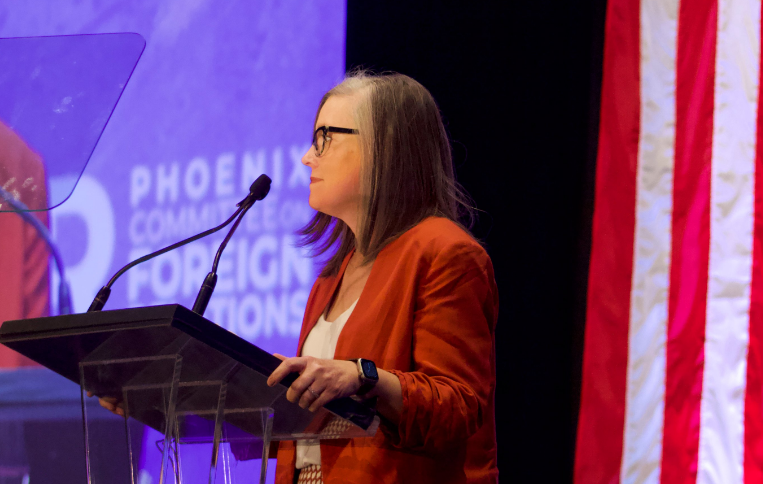
Governor Katie Hobbs said people need to pump the brakes on inflammatory rhetoric aimed at political opponents, but brushed off questions about whether she was guilty of using similar rhetoric.
Hobbs made the remarks in brief during her press conference Monday announcing an apprenticeship program partnership with Intel. The governor offered her opinion on what constitutes appropriate and safe political rhetoric as a response to the attempted assassination of former President Donald Trump over the weekend.
“Political violence has no place in this country, and voicing our political opinions peacefully is absolutely paramount to preserve the sanctity of our democracy,” said Hobbs. “We have to come together and we have to stop inflaming this kind of rhetoric, using this kind of rhetoric.”
Hobbs added that political discourse has become unhealthy and a hindrance to a healthy society.
“Too often our communities are being torn apart by politics,” said Hobbs. “We need to come together and remember that we are neighbors, friends, and American citizens all united by a love for our country.”
However, when pressed by reporters to address her past usage of inflammatory political rhetoric, Hobbs refused to justify her remarks. The governor dismissed concerns about her own actions as a different type of “politics” than what she was addressing.
“I’m not going to get into that,” said Hobbs. “I’m not thinking about politics right now.”
Hobbs has spent years framing Republicans as dangerous extremists, namely in reference to her gubernatorial opponent (now Senate candidate) Kari Lake and Trump.
“The extremist Republican majority had the chance to do the right thing for their constituents, and they failed. While extremists in the legislature refuse to protect our rights, I will do everything in my power to protect reproductive freedoms for Arizona women.”
“Hate speech and religious discrimination have absolutely no place in our state. Kari Lake and her extremist allies’ rhetoric is harmful, and to give them statewide platforms to spread it would be seriously dangerous for Arizona.”
“Kari Lake is too dangerous for Arizona.”
“Kari Lake has gone radical and is far too dangerous for Arizona.”
“Kari Lake’s campaign spends more time spreading conspiracy theories and inciting fear than providing real solutions to Arizona’s very real challenges. Her dangerous rhetoric and ideas pose a serious threat to our state and country.”
Several days before the 2022 election, Hobbs urged Republican voters in an opinion piece for Fox News to back her because Lake and other modern Republicans were “extremist, radical stone throwers” that represented an insanity and chaos that would override the Constitution and upend democracy.
Even before becoming governor, Hobbs engaged in inflammatory rhetoric against the former president. During the first year of Trump’s presidency, Hobbs accused Trump of pandering to Nazis.
“[Donald Trump] has made it abundantly clear he’s more interested in pandering to his neo-nazi base than being [President] for all Americans,” wrote Hobbs.
During Trump’s initial presidential campaign, Hobbs accused Trump of “promot[ing] rape culture” and “bragg[ing] about sexually assaulting women.” Hobbs also claimed that Trump posed a serious, existential threat to our country.
AZ Free News is your #1 source for Arizona news and politics. You can send us news tips using this link.