by Corinne Murdock | Oct 11, 2023 | News
By Corinne Murdock |
In a since-deleted article, “Three Women-Led Organizations That Helped Flip Arizona Blue,” principal actors behind several of the most powerful leftist dark money organizations in the state bragged about engineering Democratic voter turnout in the 2020 election.
Vianey Olivarria, then-communications director and current executive director for Chispa AZ, credited work done by her organization and others to turn out Democratic voters. Olivarria also served as a director of Activate 48, a coalition of Black, Indigenous, People of Color (BIPOC) organizations.
“Arizona turning blue is a victory a decade in the making and owed to the tireless work and dedication of Black, Brown, and Indigenous people who organize for justice and liberation,” stated Olivarria.
(Original article linked here; archived article linked here).
Chispa AZ is a 501(c)(4) project of the League of Conservation Voters (LCV), another 501(c)(4), and sponsored by Way to Win, a national donor network aimed at defeating Republican candidates. Way to Win served as the sponsor to Progress Arizona, formerly and once again led by Gov. Katie Hobbs’ ousted spokeswoman Josselyn Berry.
Per the IRS, a 501(c)(4) organization may engage in political campaigns on behalf of or in opposition to candidates so long as those activities aren’t the organization’s primary activity.
Discrepancies exist in various organizations’ tax returns disclosing contributions to Chispa AZ’s political arm, Chispa AZ PAC. Neither “Chispa AZ” or “Chispa AZ PAC” exist within the IRS database. Also, Chispa AZ has claimed the same EIN as LCV publicly; however, different organizations’ tax returns have cited multiple, nonexistent EINs for Chispa AZ.
In their 2018, 2019, and 2020 tax returns, LCV listed an EIN number for Chispa AZ PAC that yielded no results in the IRS Tax Exempt Organization database. In their 2019 tax return, LCV listed an organization called Fuerte Arts Movement for the Chispa AZ PAC’s address, and listed the same EIN number from 2018. They used the EIN again in their tax return.
In the 2019, 2020, and 2021 tax returns from the California-based Grove Action Fund, a different address and EIN number from that used by LCV were listed for Chispa AZ PAC. The listed address was the correct address for Chispa AZ; however, the EIN listed also doesn’t exist in the IRS database.
Planned Parenthood Advocates of Arizona’s 2020 tax return listed that same nonexistent EIN number as well, and offered the Fuerte Arts Movement address.
Tax returns from the Green Advocacy Project (2020) and the Wilderness Society Action Fund (2019) also listed the nonexistent EIN given by LCV, but listed the correct address.
Publicly collected data reflects that Chispa AZ PAC has managed at least around $8.5 million in contributions since 2017. Yet, Chispa AZ has claimed to have total revenues of nearly $26.9 million, net assets of over $18.4 million, and expenses of over $18.9 million.
Chispa AZ is also part of MiAZ, a coalition of nonprofits focused on turning out minority voters.
Other Chispa organizations exist in Colorado, Florida, Maryland, Nevada, and Texas.
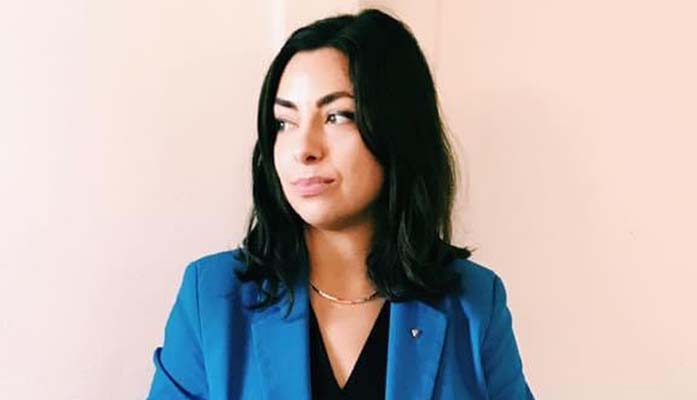
Chispa AZ isn’t the only dark money entity lacking a clear IRS status to have an outsized impact for Democrats in recent elections. There’s also the two Arizona Asian American Native Hawaiian and Pacific Islander (AZ AANHPI) related organizations: AZ AANHPI for Equity and AZ AANHPI Advocates. Although AZ AANHPI wasn’t featured in the deleted 2020 article, their communications director was: Alexa Rio-Osaki. She spoke on behalf of a different dark money nonprofit also part of MiAZ: Our Voice, Our Vote.
“We’re doing what we can to ensure everyone’s represented,” said Rio-Osaki.
Rio-Osaki has her hands in multiple leftist dark money organizations: in addition to AZ AANHPI and Our Voice, Our Vote, Rio-Osaki served as the director of Progress Arizona.
Recently, AZ AANHPI for Equity has engaged in lawfare against non-party conservative organizations, demanding transparency of private documents while operating in the dark itself.
AANHPI for Equity and AZ AANHPI Advocates have independent websites, social media pages, and staff, yet the pair are presented as one entity in multiple locations (for example, on the AZ AANHPI for Equity “about us” page). Both were founded in July 2020 by Jennifer Chau, who has served as the director for AZ AANHPI for Equity, an unspecified nonprofit, and executive director for AZ AANHPI Advocates, a 501(c)(4) nonprofit, since their inception according to her LinkedIn page.
According to the IRS, AZ AANHPI Advocates had its federal tax exempt status automatically revoked in mid-May for not filing any tax forms in the entire three years of its existence (EIN:85-2344934). The IRS issued its revocation posting earlier this month. No IRS records exist for AZ AANHPI for Equity.
Yet, both organizations’ websites continue to solicit donations and market themselves as nonprofits. The Arizona Corporation Commission (ACC) awarded AZ AANHPI Advocates good standing for its status as a nonprofit in mid-July as well. No ACC records exist for AZ AANHPI for Equity.
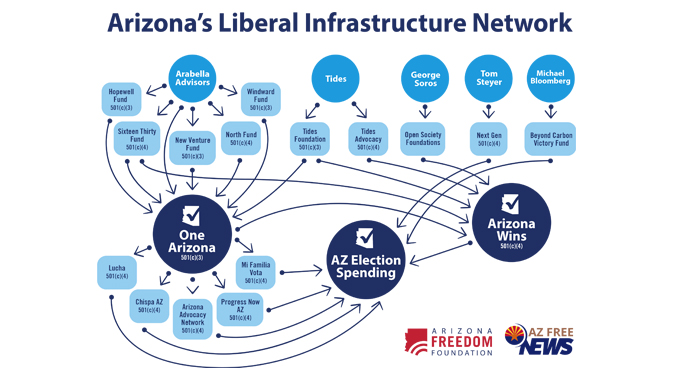
Like Chispa AZ, AZ AANHPI has used EIN numbers of another organization in receipt of funds. In 2021, AZ AANHPI for Equity received $25,000 from Solidago Foundation and gave the EIN belonging to One Arizona, the 30-nonprofit coalition to which all five Arabella Advisors nonprofit arms issued funds. Also that year, AZ AANHPI made its name synonymous with “One Arizona” and used its EIN in its receipt of $35,000 in funding from Asian Americans Advancing Justice.
On its website, AZ AANHPI Advocates discloses that it receives funding from top leftist dark money organizations The Future We Need and Arizona Wins!. The listed address for The Future We Need is the same address for the Arizona Education Association and Progress Now Arizona (now Progress Arizona); yet, no such organization as “The Future We Need” exists per ACC, the IRS, the Federal Election Commission (FEC), or the secretary of state’s campaign finance databases. There does exist a similarly-named dark left political action committee (PAC) entity, “The Future We Want.”
In their entire three years of advocacy and fundraising, only AZ AANHPI Advocates had any campaign finance records filed within the state: just one receipt of $10,000 from Invest in Arizona in August 2021, for “signature gathering.” According to the secretary of state’s campaign finance database, AZ AANHPI has never filed any reports on their contributions or expenditures.
The deleted article was published by Supermajority News: a project of Supermajority and the Supermajority Education Fund, the latter a project of the Arabella Advisors’ New Venture Fund. Arabella Advisors is behind one of the biggest dark money funding networks in the nation; their shadowy dealings prompted the District of Columbia attorney general to issue subpoenas to the organization last month.
Along with their Arizona-based compatriots, Supermajority will also be working to turn out more Democratic voters in the upcoming 2024 election.
Last year, Supermajority reported turning out over 959,000 voters: nearly 116,200 in Arizona. The organization had over 8,000 active members in Arizona. Supermajority reported that they ensured the turnout of 30 percent of women ages 18 to 35 years old, specifically to ensure the re-election of Sen. Mark Kelly and election of Gov. Katie Hobbs. The organization disclosed that their approach consisted of contacting female Democrat voters that sporadically voted in presidential elections but hadn’t voted in midterm elections.
“At the state level, we were able to help elect and support progressive governors who would protect and expand women’s freedoms in their states,” stated Supermajority.
Supermajority took credit for Kelly’s re-election and Hobbs’ election, declaring that 92 percent of Kelly’s margin of victory was made up of their voters and that their 116,200-voter turnout far surpassed Hobbs’ 17,100-vote margin.
The organization also noted its plans for the upcoming 2024 election: contacting 432,300 female Arizona voters who didn’t vote last year, overcoming the projected 10,500-vote victory margin, and electing a Democratic senator to take independent Sen. Kyrsten Sinema’s seat. The organization also plans to target Georgia and North Carolina.
“We need a Democratic senator in AZ who will work alongside Sen. Mark Kelley [sic],” stated Supermajority.
Corinne Murdock is a reporter for AZ Free News. Follow her latest on Twitter, or email tips to corinne@azfreenews.com.
by Corinne Murdock | Oct 10, 2023 | News
By Corinne Murdock |
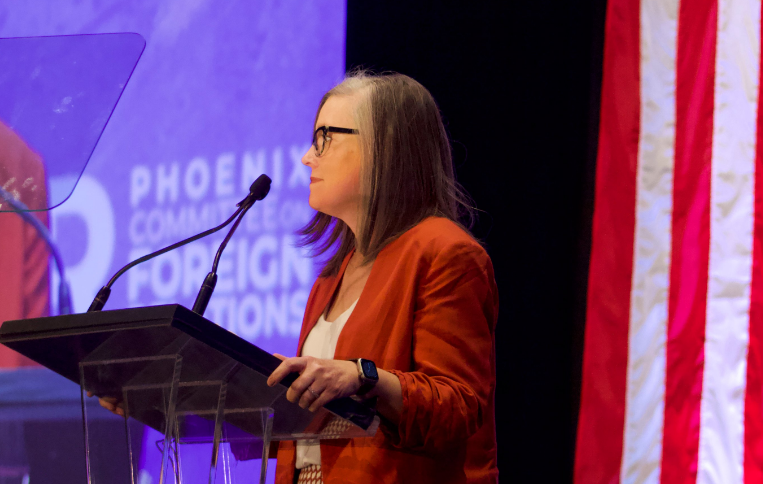
In the ongoing standoff over 13 agency appointments, Gov. Katie Hobbs took issue with the Senate’s vetting process; yet, she was forced in recent months to withdraw one of her nominees over his alliance with antisemitic extremism.
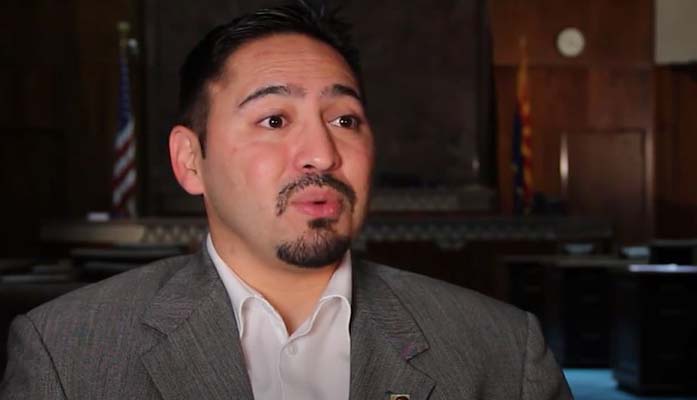
Former Democratic State Sen. Martín Quezada failed to be confirmed as the Arizona Registrar of Contractors (AROC) director following discovery of his support for the Boycott, Divestment, Sanctions (BDS) Movement.
Quezada purged his X timeline of several anti-Israel posts. In a deleted May 2021 post, Quezada urged his followers to listen to a speech by Rep. Rashida Tlaib (D-MI-12) and to “free Palestine.” In her speech, Tlaib called for the U.S. to cease funding to Israel over the alleged apartheid of Palestinians. Traditionally, apartheid concerns state-sanctioned racial segregation and discrimination such as the denial of voting rights.
Tlaib’s remarks came about a month after the Human Rights Watch (HRW) declared that Israeli policy in the West Bank amounted to apartheid, one of the first international organizations to do so. Tlaib, HRW, and other pro-Palestinian entities and actors have accused the Israeli government of apartheid for denying certain rights and privileges enjoyed by its citizens to Palestinians, as well as their engaging in a military conflict to maintain control over the disputed territory.
Two days after Quezada reposted Tlaib’s remarks, he appeared as a guest speaker for a Council on American-Islamic Relations of Arizona (CAIR-AZ) protest against the alleged Palestinian apartheid. CAIR-AZ has been identified as an entity of the Muslim Brotherhood and linked to activity with Hamas: the terrorist militant group behind this most recent attack on Israel.
As of this report, at least nine Americans were killed and an unknown number remain hostage. Authorities estimate that at least 150 individuals were taken hostage, if not more. Early estimates declared that 800 Israelis were killed, and over 2,500 were wounded in this most recent attack.
In his May 2021 speech for the CAIR-AZ protest, Quezada called the Israeli government a “Zionist state” enacting terrorism: invalid military occupation, human rights abuses, and ethnic cleansing. Quezada called for President Joe Biden to cease funding for the Israeli military.
“All of those billions of dollars, that is directing military aid that is going to occupation forces that are committing terrorism against the people of Palestine right now,” said Quezada. “This — what we are witnessing — is oppression and occupation in action right now. This is murder in action right now.”
After the protest, Quezada wrote in a since-deleted post that he was a proud ally to the Free Palestine movement.
“I was proud to be present today as a friend and an ally to the Palestinian people,” said Quezada.
The next month, Quezada voted against legislation enhancing school curriculum on the Holocaust and antisemitism. In a speech on the Arizona Senate floor, Quezada derided the legislation as a lobbyist push to root out any criticisms of Israel.
“There is a strong and a well-funded lobbying effort that’s underway right now to take advantage of this crisis, to redefine antisemitism to include any criticism of the nation-state of Israel,” said Quezada.
Despite these past remarks and actions, Hobbs nominated Quezada for the AROC directorship in January.
By May, the Senate Committee on Director Nominations rejected Quezada’s nomination, dubbing him “an unqualified extremist with [a] racist past.” The committee uncovered Quezada’s antisemitic sentiments through its vetting process.
Although Hobbs apparently conceded to the committee’s findings by withdrawing Quezada’s nomination, only several months later the governor accused the Senate of poor vetting techniques. Hobbs cited canceled hearings and failures to bring committee-approved nominees to the floor for a vote. The governor accused the committee of “slow walk[ing]” acceptable nominees.
“[I]t is clear the Senate’s vetting process is not functioning as intended by law or tradition,” said Hobbs. “I have fulfilled my responsibility of nominating eminently qualified directors who meet the requirements of law.”
Hobbs withdrew her 13 nominees and reappointed them as executive deputy directors in an attempt to bypass the Senate confirmation. The move prompted a feud between Treasurer Kimberly Yee and Hobbs after the former declined to recognize several Hobbs appointees as valid members at the last Board of Investment meeting, followed by the latter accusing Yee’s concern with the law of being “extremist” behavior and “partisan obstructionism.”
Corinne Murdock is a reporter for AZ Free News. Follow her latest on Twitter, or email tips to corinne@azfreenews.com.
by Daniel Stefanski | Oct 10, 2023 | News
By Daniel Stefanski |
Arizona elected officials stood with Israel after the American ally suffered a shocking and horrific terrorist attack late last week.
After Israel was attacked by Hamas terrorists on Friday night (Arizona time), state politicians offered their thoughts, prayers, and messages of unwavering support for the Middle Eastern democracy.
Governor Katie Hobbs wrote, “I condemn the horrific terrorist attack on Israel by Hamas. Arizona stands with the people of Israel and supports their right to self defense. My heart breaks for the families of those who have been killed, injured or captured.”
Attorney General Kris Mayes stated, “Deeply shocked and heartbroken by today’s terrible Hamas terrorist attacks in Israel. My heart goes out to the families mourning their lost loved ones. Arizona stands resolutely in support of Israel.”
Secretary of State Adrian Fontes added, “This has been a tough day for the world. I unequivocally condemn today’s terrorist attacks in Israel and am thinking of the victims and their loved ones. Every nation should have the right to defend itself. Democracy must be protected wherever it is in jeopardy.”
Treasurer Kimberly Yee also weighed in, saying, “I stand with Israel. The United States has enjoyed a longtime friendship and allied relationship with Israel, a shining light of democracy in the Middle East. As a former State Senate Majority Leader and now as Arizona Treasurer, I have fought against BDS efforts to boycott and harm Israel. Please join me in praying for protection over the people of Israel against these evil Hamas terrorist attacks. May God bless the United States and Israel.”
Many members of Arizona’s Legislature also shared their solidarity with Israel over the weekend.
Senate President Warren Petersen spoke for his Republican conference, stating, “Arizona Senate Republicans stand in support of Israel, one of our nation’s most important allies. We strongly condemn the horrific violence happening against innocent Israeli civilians and Americans. We send prayers for strength, courage and comfort as the Israeli people battle against pure evil.”
Representative Alma Hernandez wrote, “While I don’t post during Shabbat I must break that today. Israel is at war and my heart is breaking for what is happening and unfolding there. Innocent Israelis murdered, walking on the streets, elderly being murdered while waiting at bus stops, women and children being kidnapped, raped and murdered on video. All while Palestinian terrorist are celebrating on the streets. I can’t believe this is happening today. My heart is shattered.”
Arizona Senate Pro Tempore, T.J. Shope, expressed his prayers for the American ally.
Representative Consuelo Hernandez said, “Praying for the people of Israel who were infiltrated by Hamas terrorist. So many more Israelis will be killed for the simple reason of being Jewish and existing. You are not alone. The world is watching.”
Representative Jacqueline Parker praised Israeli leadership and response to the attacks, saying, “At least there’s one righteous super power left in the world with competent leadership. I pray for Israel’s safety & swift victory.”
Representative Seth Blattman added, “This is a horrifying surprise attack on the people of Israel. I stand with Israel as it defends itself against Hamas in this ongoing assault.”
Other municipal and county officials also issued their own statements in reaction to the events from the weekend.
Phoenix Mayor Kate Gallego posted, “I’m proud to stand with Israel and condemn Hamas’s attacks on innocent people in the strongest terms. Here in Phoenix, our police are stepping up patrols near synagogues – and our hearts are with our many friends throughout Israel.”
Representative Alexander Kolodin recognized the increased security provided by Phoenix law enforcement, stating, “Grateful to the Phoenix Police for this extra degree of vigilance. We American Jews are tremendously luck to live in a country where officers of every faith are willing to risk their lives to protect our ability to worship freely.”
Maricopa County Attorney Rachel Mitchell also shared her prayers for Israel.
Peoria Mayor Jason Beck told AZ Free News that “Israel is a home away from home for me and my family. It has a sacred history and is one of the few places in the region that respects the personal beliefs of their citizens. I’m both saddened and angry at what these acts of terrorism have done to the people of Israel. I am taking action by sending body armor to Israel for the protection of the brave soldiers who will defend their homeland and our Western values. The Biden administration should be ashamed of their recent actions that opened up funding to Iran. Iran is who has openly trained and funded Hamas and other affiliates that don’t recognize Israel’s right to exist. They seek to wipe Israel off the face of the earth. I stand with the men and women of Israel in this fight and pray that God will protect their homeland.”
Daniel Stefanski is a reporter for AZ Free News. You can send him news tips using this link.
by Corinne Murdock | Oct 8, 2023 | News
By Corinne Murdock |
Gov. Katie Hobbs’ ex-press secretary, Josselyn Berry, ousted for tweeting a death threat to “transphobes” hours after the Nashville school shooting, has returned to the dark money organization she worked for previously.
After laying low for several months and privatizing her social accounts, Berry reactivated her LinkedIn and publicly announced her hire by Progress Arizona. She began working with the organization in June.
“After a much-needed sabbatical I’m thrilled to announce I’ve returned home to my Progress Now family as their Senior Director of Campaigns,” said Berry. “I’ll be working with our battleground states to help them run winning programs for the 2024 election cycle.”
Although Berry has reactivated her LinkedIn account, her X page (formerly known as Twitter) remains private. At some point after inciting controversy and making her X page private, Berry updated her profile header image from a picture of Hobbs to the phrase “Trans Rights Are Human Rights.”
Those who reacted positively to Berry’s characterization of her departure from the Ninth Floor included Hobbs’ policy advisor, Molly Murphy; Hobbs’ deputy chief of staff, Will Gaona; Arizona House communications director, Robbie Sherwood; Arizona Senate Democratic Caucus communications director Calli Jones; Arizona House Democratic Caucus senior policy advisor Vicente Reyna; and Phoenix Vice Mayor Yassamin Ansari’s communications director, Emily O’Neil.
Berry resigned within days after issuing a general death threat to those opposed to transgender ideology. The morning after the Covenant School shooting, Berry posted a gif of a woman holding guns in each hand with the caption “Us when we see transphobes.”
Less than 24 hours before, a woman who identified as a transgender man shot and killed three elementary school-aged children and three teachers at the Covenant School in Nashville, Tennessee.
Prior to her communications gigs with Hobbs, the Arizona Democratic Party, and the Arizona Senate Democrats, Berry served as the Progress Arizona executive director and chairman.
The dark money nonprofit has received funding from One Arizona, which in turn received funding from the dark money behemoth Arabella Advisors’ five nonprofit arms.
The nonprofit has also received funding from George Soros directly, such as through his Democracy PAC, and indirectly, such as through the Future Now Fund (aka PAC For America’s Future).
The nonprofit then turns around and issues funding to a number of progressive nonprofits including the Arizona Advocacy Network, CASE, Civic Engagement Beyond, League of Women Voters AZ, LUCHA, Our Voice Our Vote, Poder Latinx, and Rural Arizona Action.
Berry also previously worked as the program manager for Arizona Wins and communications coordinator for the Arizona Advocacy Network, two key organizations within the state’s leftist dark money network.
Corinne Murdock is a reporter for AZ Free News. Follow her latest on Twitter, or email tips to corinne@azfreenews.com.
by Daniel Stefanski | Oct 4, 2023 | News
By Daniel Stefanski |
Arizona’s Governor and Treasurer continue to escalate their political feud over the constitutionality of executive agency nominees.
After Governor Katie Hobbs, a Democrat, announced her decision to withdraw her remaining agency nominees for Senate confirmation, Treasurer Kimberly Yee, a Republican, revealed that during last week’s State Board of Investment meeting, she “did not recognize employees from the Arizona Department of Administration or the Arizona Department of Insurance and Financial Institutions as legally participating members due to the recent actions of the Governor.”
Yee’s action led to political fireworks from the Governor’s Office with a press release calling out the State’s Treasurer for “falling in line with extremist Jake Hoffman’s decision to participate in partisan obstructionism.” The fiery communication from Hobbs’ Office asserted that Yee “broke the law and refused expert advice from professionals in order to play political games with taxpayer money, shirking her responsibilities as the State Treasurer.”
Hobbs’ Director of Operations and Interim Director of the Arizona Department of Administration (ADOA) said, “The taxpayers deserve to have their funds invested optimally to maximize ROI, and they have entrusted Treasurer Yee with that responsibility. By shutting out the voices of fellow agencies, you are failing to take into account all of the information that the law requires in order to do right by our taxpayers.”
Henderson sent a letter to Yee, accusing her of “illegally depriving ADOA of the power to participate in Tuesday’s Board meeting.” The interim agency director also noted, “Any matter covered in the meeting will need to be added to the agenda for the next meeting, at which you must recognize Assistant Director Restinas and allow her to participate as a member in accordance with the law.”
The Republican Treasurer quickly responded via letter to the governor, letting the State’s chief executive know that she took “exception to the unprofessional and juvenile rhetoric used throughout (Henderson’s) letter,” and that she was appalled by the “complete lack of respect from a member of your administration towards a duly statewide elected official.” Yee explained that her actions during the investment meeting last week were not done “for political reasons, as suggested by your staff, but rather out of an abundance of caution to ensure that the actions taken by the BOI during the September 26, 2023, meeting were legitimate and lawful.”
Treasurer Yee took several paragraphs to justify her actions in refusing to recognize the two agency leaders at her recent meeting. She asserted that, pursuant to state statutes, her Office required multiple pieces of documentation from the Governor’s team on the two appointments in addition to “legal authority supporting the appointments.” Yee stated that she “cannot in good conscience seat the ADOA and DIFI employees on the BOI moving forward” without receiving the aforementioned pieces from the Governor’s Office.
Yee also expressed her disagreement with Henderson’s allegation that her actions at the BOI meeting were “invalid and must be re-added to next month’s agenda.” She noted that one of the appointees, Retsinas, “attended the full meeting via WebEx as a member of the public and at no time informed the BOI, or Treasury staff, that she had been appointed by Mr. Henderson, as interim director of ADOA.”
In conclusion of her letter, Yee expressed hope that her letter “alleviates the concerns of (Hobbs) and (her) staff,” requesting the governor to “send us all documentation supporting (her) appointments as soon as practicable so that we may ensure that the appropriate designees are seated on the BOI moving forward.”
Daniel Stefanski is a reporter for AZ Free News. You can send him news tips using this link.