Two Arizona Republican Senators are calling for the state’s governor and attorney general to take action after a patient was recently released from the Arizona State Hospital (ASH).
Late last week, Senators Anthony Kern and T.J. Shope demanded that Attorney General Kris Mayes and Governor Katie Hobbs “protect the citizens of Arizona by immediately rescinding the release of a seriously mentally-ill patient who was housed at the ASH after being found incompetent to stand trial in the brutal murder of his own mother and seven-year-old niece.”
FOR IMMEDIATE RELEASE: Republican Senators Call on Attorney General Mayes, Governor Hobbs to Immediately Address Imminent Public Safety Threat ⬇️ @anthonykernAZ@TJShopepic.twitter.com/NyV96oMtau
Grigg tweeted that “the public is not informed where he (Rodney Aviles) was released to or what part of the city,” and that behavioral facilities had repeatedly “denied to accept him.” She reported that the family of his alleged victims “told ABC15 in 1999 that the murders happened just hours after he was released then from a psychiatric facility.”
The Senate Republicans’ release revealed that in February, “Maricopa County Attorney Rachel Mitchell sent a letter to Mayes saying she has serious community safety concerns and believes Aviles poses an ongoing threat to his family and the community at large. The report went on to mention a 2021 court filing objecting to Aviles’ release, citing a doctor’s statements that Aviles had no insight into the fact of his mental illness, Aviles has insisted he does not need medication, but that Aviles is expected to need inpatient care for the duration of his life.”
Kern released a statement about the news, saying, “We have a Governor issuing numerous unconstitutional executive orders left and right, allowing taxpayer-funded sex-change surgeries, stripping county attorneys of their prosecutorial powers, protecting a Death Row inmate from execution, acting as a travel agency in transporting illegal immigrants to their preferred destinations, and even focusing on hairstyles of state employees. Now, we have an individual who is clearly an imminent danger to society and being immersed back into the community because of the incompetence of the Hobbs’ Administration. Unfortunately, she and Mayes are nowhere to be found when public safety is at risk. When Mayes should be defending our laws and prosecuting the most vile criminals, she’s instead advocating for lawlessness. The citizens of this great state and the victims who have been through unthinkable suffering deserve immediate action from these so-called ‘elected officials.’ Their priorities are completely tone-deaf and out of touch with the needs of our state. Any fallout or further victimization from the release of Aviles will strictly be the result of inaction from Hobbs and Mayes.”
Protecting the family and the public at large should be a priority for Hobbs and Mayes….it isn't (see below): https://t.co/LpVz2pJBAW
Senator Shope added, “If this man is unfit for trial after murdering his family, he’s unfit to be on the streets with the general public and must stay under proper care and supervision. As chairman of the Senate Committee on Health & Human Services, I’ll be working with my colleagues to bring truly independent oversight of the Arizona State Hospital. This is clearly necessary to keep patients and citizens safe from the winds of politics.”
This is truly asinine. Where are @GovernorHobbs & @arizonaago@krismayes on this? If he’s unfit for trial after murdering his family, he’s unfit to be on the streets with the rest of us and must stay under proper care & supervision.
After the Senators issued their press release, Grigg reported that Governor Hobbs’ Office informed her that the governor “is fully committed to keeping Arizonans safe and is finding solutions to improve ASH operations and ensuring public safety. Additionally, she recognizes ASH’s legal obligations and expects the State Hospital to follow any applicable laws or court orders.”
Attorney General Mayes’ Office also told Grigg, “the Superior Court mandated the release of this individual. But given that our office serves as legal counsel for ADHS and ASH, we have no additional comments to make.”
Grigg wrote that she “tried to get the court records of his release but the filing is confidential.”
Daniel Stefanski is a reporter for AZ Free News. You can send him news tips using this link.
More of Arizona’s municipalities are increasing their water conservation efforts, leading taxpayers to pay more for less.
Preexisting sustainability goals and the burgeoning Colorado River drought have offered justification for these municipalities’ efforts, which have now resulted in lawn bans, increased water rates, and restricted water usage over the last few years.
Multiple cities recently traded in their Colorado River water rights in exchange for federal funding: Tucson, Phoenix, Peoria, Glendale, Scottsdale, Gilbert, Mesa, Surprise, Queen Creek, along with the state, Apache Junction Domestic Water Improvement District, Central Arizona Groundwater Replenishment District, Metropolitan Domestic Water Improvement District in Tucson, Salt River Project, and EPCOR.
Last month, Gov. Katie Hobbs announced the Arizona Department of Water Resources (ADWR) ban on the construction of new Phoenix homes that would rely on groundwater.
These progressive restrictions and charges also continue despite noted successes in conservation in comparison to past years with smaller populations.
The answer may lie with other developments in the state over the years. Big Tech’s data centers may be one of the major drains on water supply outweighing the net savings of residents’ water conservation efforts.
Mesa
In comparison to the other cities, Mesa doesn’t impose major water conservation restrictions. It does offer $1,000 in rebates for grass removal, with an additional $100 maximum for planting native trees.
However, the city may be contributing to the water burdens faced by its neighbors. In 2019, it approved the development of a data center for Google that could use one to four million gallons of water daily. Arizona residents average about 146 gallons daily currently.
Yet, as Time pointed out, Arizona Municipal Water Users Association (AMUA) — an organization that Mesa helped found — chastised Arizona residents several weeks after the deal between Mesa and Google for using 120 gallons on average daily.
Meta (formerly Facebook, which also owns Instagram) is now building a data center there as well. The year they broke ground in Arizona, they promised to be “water positive” — meaning, restoring more water than they consume — by 2030.
Like Google centers, data centers could use around one to five million gallons of water a day according to Texas Tech University’s Water Resources Center director, Venkatesh Uddameri.
Microsoft also operates data centers out of El Mirage and Goodyear. They made the same promise to be water positive by 2030.
Over 30 percent of the world’s data centers are located in the U.S.
Scottsdale
Scottsdale banned lawns on new builds earlier this month.
The city also offers to pay residents up to $5,000 for lawn removals, and up to $1 per square foot of water surface area plus $400 for pool or spa removals. For multifamily properties, homeowner associations (HOAs), and commercial businesses, the city offered up to $40,000 to remove their lawns, with an additional $10,000 bonus for grass strips adjacent to streets.
Since Scottsdale launched its rebate program in 1992, total rebates amounted to over $4.7 million; about half of which came from grass removals. The city has removed 94 acres of grass since the program’s launch. This fiscal year’s rebate budget sits at $450,000.
Last September, Scottsdale banned HOAs from requiring overseeding lawns.
Residents surpassed the city’s goal of 10 percent water conservation, achieving 12 percent over the last two years.
Tucson
Last month, Tucson banned lawns and reduced water flow in new constructions. The city also required all new residential dwelling units to include piping for a separate discharge of gray water for direct irrigation: the untreated, leftover water from washing machines, bathtubs, and sinks.
In 2008, Tucson required all commercial development and site plans to include a rainwater harvesting plan that provided for 50 percent of the annual landscape water supply.
In 2014, Tucson passed a water waste ordinance fining individuals $250 on the first offense and $500 on subsequent offenses up to $2,500 for allowing water to escape or pool onto public property; washing driveways, sidewalks, parking areas with a hose (unless a residential customer); operating a misting system in unoccupied non-residential areas; having an irrigation head or emitter that’s broken or spraying more than 10 percent onto a street, parking lot, or sidewalk; failing to control a leak; and failing to meet the 50 percent rainwater harvesting requirement for landscape irrigation.
Tucson also offers multiple rebates: $100 per residential, multi-family, or commercial premium high-efficiency toilet; $150 for a flushometer valve/bowl combination; $200 for high-efficiency or water-free urinal installation; $100 or $200 for a residential high-efficiency clothes washer; up to $2,000 for a residential rainwater harvesting system; and up to $1,000 for a gray water system. The city also offers special incentives for low-income residents: free high-efficiency toilets, grants up to $1,000 and loans up to $2,000 for a rainwater harvesting system, grants and loans up to $500 for a gray water harvesting system, discounted high-efficiency clothes washers, and free plumbing repairs.
Each year, Tucson makes available up to $250,000 in grant money to establish stormwater harvesting in neighborhoods.
Phoenix
Last month, the Phoenix City Council approved the Sustainable Desert Development Policy, requiring rezoning cases on new developments to satisfy city-approved standards on EPA WaterSense efficiency certifications; drought tolerant and/or native landscaping; restrictions on turf usage; outdoor irrigation efficiency standards; green infrastructure or low-impact development provisions for surface parking areas, streets, and sidewalks; participation in the city’s Efficiency Checkup program; new swimming pool standards; new wet-cooling system standards; and preservation of natural open spaces.
Additionally, the policy will require any entities that use over 250,000 gallons of water per day to submit a water conservation plan, approved by city staff. Any entities that use over 500,000 gallons of water per day must derive 30 percent of their water consumption from a recycled or conserved water source.
Entities dubbed “large water users,” may be denied operation even if their conservation plan is acceptable to the city. The policy stated that the city may reject the large water user if there’s inadequate water resource availability in their proposed location, inconsistency with the city’s planning documents; undesirable economic value and impact of their proposed water use; undesirable impact to water rates; or incompatibility with the city’s definition of a key industry beneficial to the economy.
The city doesn’t offer any rebate programs, though last December city officials expressed a desire to launch one to incentivize lawn removals. The city signed a joint pledge between locales in California and Nevada to remove ornamental turf.
The city also imposes an ordinance onto new developers, the Water Resources Acquisition Fee (WRAF) ordinance, which may be mitigated via credit if the developer provides a permanent reduction in annual water demand on the city.
The city has promised that it won’t institute mandatory water use restrictions in the near future, though it warned that severe or worsening drought conditions within the next 10-15 years may warrant such restrictions. Policy changes could include water waste punishments similar to Tucson’s, requiring child safe pool covers to reduce evaporation, banning turf irrigation, and banning car washing.
Flagstaff
Flagstaff has stricter water use requirements than some of the other Arizona cities.
The city has a watering allowance schedule during which residents may water their landscape: even-numbered addresses on Sundays, Wednesdays, and Fridays, and odd-numbered addresses on Tuesdays, Thursdays, and Saturdays. Nobody may water on Mondays, and the city prohibits watering between 9 am and 5 pm. Gardeners wishing to water by hand — “incidental hand watering” — may do so on any day, except from 9 am to 5 pm. However, vehicle washing is not subject to the water schedule restrictions.
The schedule is only permitted to be used when the city is at the first stages of burdened water demand. At level two, the city bans irrigation; car washing at home; driveway, sidewalk, and tennis court washing; filling of fountains, ponds, streams, or pools over 100 gallons. The city also increases water rates for those using over 6,400 gallons, and potable standpipe rates increase by 130 percent. At level three, potable water use is banned outside.
Those who violate the rules within any of the three levels are subject to fines starting at $25, doubling with each violation.
The city implements a diverse set of rebate programs. Commercial properties may receive free high-efficiency sink aerators, free high-efficiency shower heads, free pre-rinse spray valves, $86 rebate or 50 percent of project cost for commercial toilets, $158 or 50 percent of project cost for hotel toilets; and $157 or 50 percent of the project cost for commercial urinals.
Both residential and commercial properties may receive a rebate at 25 cents per square foot for converting to low-water landscaping. They may also receive a $100 rebate on installation of a rainwater harvesting system with 1000-gallon minimum capacity, and free 55-gallon rainwater harvesting barrels.
The city reported that their conservation efforts, beginning in 1988, have yielded a 50 percent water use reduction.
Gilbert
The town of Gilbert is offering up to $800 to residents and up to $3,000 to non-residential customers who swap their lawns for desert landscaping that uses less water. The city set aside $60,000 for the residential program, and $15,000 for the non-residential program.
A Gilbert spokesperson told AZ Free News that they have a total of $120,000 per year to issue on their rebate programs, and that the allocated funding within that budget may change from year to year based on the popularity of each program.
Anyone who receives $600 or more in water bill credits must complete a W9 for the Gilbert Water Conservation, as per the Biden administration IRS reporting requirement enacted last year.
Those aren’t the only water conservation financial incentives that Gilbert has offered. The town introduced rebates up to $250 for residential, $400 for non-residential properties to install smart irrigation controllers.
In May, the town applied for a $3 million grant from the Water Conservation Fund to replace grass on government property with desert-tolerant landscaping. The grant money ultimately comes from federal COVID-19 relief funds.
Gilbert announced that it saved 254 million gallons due to its conservation efforts in 2019, and 375 million in 2018.
Corinne Murdock is a reporter for AZ Free News. Follow her latest on Twitter, or email tips to corinne@azfreenews.com.
Have you heard the outrageous story of what happened recently in Harrisburg, Pennsylvania’s capital? Gov. Josh Shapiro (D-Pa.), elected in 2022, had campaigned on school choice for tens of thousands of children, mostly minorities, who are forced to attend failing public schools in places like Philadelphia.
“It’s what I believe,” Shapiro, then state attorney general, assured voters as he ran for governor. Last month on a national Fox News broadcast, Shapiro was unequivocal in his support for school choice because “every child of God” deserves “a quality education.”
But there’s a force far more powerful in politics than Shapiro’s convictions, such as they are. And that force is the teachers unions. They put on a full-court press to stop the roughly 10,000 vouchers for the poorest kids in Pennsylvania’s worst school districts even though the state budget bill gave billions more for the public schools. It didn’t matter that this voucher program comprised less than 0.5% of state spending. The union brass commanded Democrats to vote no on even a single penny going to schools that work.
In the end, Shapiro did a full flip-flop. He vetoed his own promise. He might as well have declared that black lives don’t matter.
Shapiro has presidential ambitions — so he figures he needs the teachers unions behind him. But if he can’t face down Randi Weingarten, how is he ever going to stand up to bullies like China’s President Xi Jinping or Russia’s President Vladimir Putin?
This story isn’t just about Josh Shapiro in Pennsylvania. In North Carolina, Democratic Gov. Roy Cooper declared a state of emergency in the Tar Heel State because the legislature wanted to fund vouchers for kids to go to the best schools possible. Egads!
In Arizona, Democratic Gov. Katie Hobbs wants to defund a school choice program that is already serving tens of thousands of kids, most of whom are Hispanic, with proven results of better performance and higher test scores. Why would she kill a program that is working? The teachers unions want the money and the kids under their control.
In New York City’s Harlem neighborhood, charter schools are flourishing. They are alternatives to public schools but are still regulated by the state. They are oversubscribed because parents want to choose the best school for their kids. Now, the Democrats want to put a cap on the charter schools because the teachers unions want to warehouse the kids in public schools where a majority of the kids can’t read or do math at grade-level proficiency. In other words, many of the public schools are worse than mediocre. And it’s not for lack of money. New York spends more than $20,000 per child in public schools.
Did I mention that in nearly every one of these cases across the country, the Democrats blocking private and Catholic school options went to private schools themselves? Or they send their kids to private schools. But poor black kids aren’t allowed that same opportunity? These are hypocrites with a capital H.
There’s a cruel historic irony here. Sixty years ago this summer, Alabama Gov. George Wallace stood before the doors of schools to prevent black children from attending the schools with white children. He was trying to preserve the stain of segregation.
Today, Democrats are employing the same tactic to keep minority kids from attending excellent schools. Why? They say that school choice will hurt public schools or cause more segregation.
Wrong on both counts. Monopolies are always bad for consumers and competition improves service. Education choice requires public schools to compete. Would you get good and friendly service if there were only one restaurant in town?
Instead of draining public schools of money, studies show that per-pupil funding rises when some kids take advantage of vouchers to attend alternative schools. Charter and Catholic schools tend to be, in most cases, more racially diverse than inner-city public schools.
I’m a parent of five boys, so I know that each of my kids has different skills, interests, behavior issues and attention spans. To warehouse them all in the same schoolroom is madness. Schools should be tailored toward the kids and serve their interests — not those of the $1 trillion a year public-school-industrial complex.
More importantly, as an economist, my biggest worry about America’s future is what happens when kids are graduating without being able to read their diplomas and with no useful skills. There are hundreds of schools around the country where not a single child can pass a basic math or reading test.
That’s an economic, civil rights and national security tragedy. Shame on Democratic leaders, and some Republicans, too, for putting their own political ambitions ahead of our nation’s children.
Stephen Moore is a contributor to The Daily Caller News Foundation, senior fellow at the Heritage Foundation, and a co-founder of the Committee to Unleash Prosperity. His latest book is “Govzilla: How the Relentless Growth of Government Is Devouring Our Economy.”
Last Tuesday, Gov. Katie Hobbs announced that she signed the state onto the U.S. Climate Alliance: a Democrat-led initiative advancing the progressive energy reforms within the Paris Agreement and the Green New Deal.
Hobbs characterized the alliance — a project of the private nonprofit United Nations Foundation — as bipartisan. The only state in the alliance with a Republican governor is Vermont.
I'm excited to announce Arizona is joining the bipartisan Climate Alliance. Together, we are creating green jobs and businesses, ensuring clean air and water for Arizonans, lowering energy costs, and preparing more effectively for a changing climate.
— Governor Katie Hobbs (@GovernorHobbs) July 11, 2023
According to their 2021 tax filing, the United Nations Foundation pulled in $86.7 million according to ProPublica, with over $281 million the previous year. It spent nearly $23.1 million on climate initiatives in that 2021 filing, and around $25.2 million in the 2020 filling.
The alliance was founded in 2017 by the governors of California, New York, and Washington after the Trump administration withdrew from the Paris Agreement. California raised the initial funds to kickstart the alliance.
The current executive committee, elected in May, consists of all Democrats: Govs. Gavin Newsom (California), Janet Mills (Maine), Michelle Lujan Grisham (New Mexico), Kathy Hochul (New York), and Jay Inslee (Washington).
Other Democrat-led states in the alliance are Colorado, Connecticut, Delaware, Hawai’i, Illinois, Louisiana, Maryland, Massachusetts, Michigan, Minnesota, New Jersey, North Carolina, Oregon, Pennsylvania, Rhode Island, and Wisconsin.
The territories of Guam and Puerto Rico are also in the alliance.
Express goals of the alliance concern fulfillment of the U.S. pledge to the Paris Agreement and proposals outlined by the Green New Deal. The alliance was behind recent joint efforts with the White House to decarbonize government buildings and purchase of low-carbon, American-made construction materials. In February, the alliance convened in Washington, D.C. to deliver 21 specific federal climate actions to accomplish a “net-zero future” — aka, zero carbon.
A zero carbon future includes replacement of coal, gas, and oil-based power sources with total electrification. The World Economic Forum (WEF), a globalist activist organization, defined a net zero carbon future as including decarbonized buildings, wind and solar energy reliance, and electric vehicles.
Collectively, alliance goals include reducing collective greenhouse gas emissions (GHG) by 26-28 percent by 2025, 50-52 percent by 2030, and 100 percent by 2050; centering equity, environmental justice, and a “just economic transition” in all initiatives; and building a globalist accountability network between states and “the global community.”
California leads on all fronts except one: statewide building performance standards for efficiency. Carbon dioxide (CO2) is the primary form of GHG. The secondary GHGs are methane (CH4), nitrous oxide (N2O), and the industrial gasses: hydrofluorocarbons (HFCs), perfluorocarbons (PFCs), sulfur hexafluoride (SF6), and nitrogen trifluoride (NF3).
Alliance staff hail from a variety of high-profile progressive backgrounds within state or federal government, or climate advocacy organizations.
Casey Katims, the executive director, formerly worked as the deputy associate administrator for intergovernmental relations at the EPA, director of federal and inter-state affairs for Washington Gov. Jay Inslee, senior legislative assistant for Washington Rep. Suzan DelBene, and executive assistant for Inslee when he was a congressman.
Taryn Finnessey, managing director, formerly worked as the senior climate change specialist for Colorado and water policy analyst for Western Resource Advocates.
Andrew Sand, the policy director and formerly the senior policy advisor, formerly worked as the deputy director, assistant director, legislative liaison, and policy advisor for the Colorado Energy Office; chaired the Colorado New Energy Improvement District’s board of directors; served as chief of staff for former Colorado Sen. Gail Schwartz.
Marwa Kamel, senior policy advisor, also works as a freelance climate consultant; she formerly worked as a policy advisor to the New Jersey Department of Environmental Protection, and a consultant for the World Bank.
Mark Teschauer, senior policy advisor, formerly worked as a senior consultant for the WSP environmental consulting firm and program manager for the American Public Transportation Association.
Kareem Hammoud, senior policy analyst, formerly worked sporadically as a Yale University teaching fellow and research assistant, contractor with the Rocky Mountain Institute, and analyst for Parnassus Investments.
Kristin Igusky, programs and analysis director, formerly worked as an associate for the World Resources Institute and climate change analyst for SAIC.
Evan Westrup, communications director and founder of Sempervirent Strategies consulting firm, formerly worked as a fellow for the German Marshall Fund, press secretary and communications director for former California Gov. Jerry Brown, and deputy press secretary for the California Department of Justice. Last year it was reported that Westrup’s consulting firm would receive $10,000 a month from a committee formed by his former boss, Brown, using the millions in leftover campaign funds. Westrup formed the firm nine months after Brown termed out, according to his LinkedIn profile; the California secretary of state’s office reflects an LLC registration for his firm occurring in January 2021.
Nikki Burnett, senior communications associate, formerly worked as a communications officer for C40 Cities, communications fellow for the Pacific Council on International Policy, and associate with CLS Strategies. That last company is known for its manipulation and influence of foreign politics using a coordinated network of fake social media profiles and pages.
Corinne Murdock is a reporter for AZ Free News. Follow her latest on Twitter, or email tips to corinne@azfreenews.com.
Unwilling to work with the Arizona State Legislature, Governor Katie Hobbs has again chosen to exercise unilateral power in the pursuit of her progressive plans.
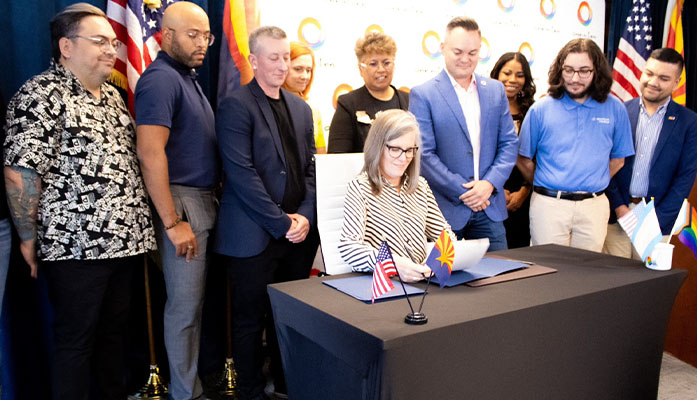
On Tuesday, Governor Katie Hobbs announced that she signed two Executive Orders to “restore rights and protect LGBTQ+ Arizonans.” According to Hobbs’ Office, the Orders “ensure the state employee health care plan covers medically-necessary gender-affirming surgery” and bar “state agencies from funding, promoting, or supporting conversion therapy against LGBTQ+ Arizonans.”
In a press release, the governor said, “Our LGBTQ+ community should never have to face hate and discrimination, and I will do everything in my power to fight for full equality. The State is leading by example on this issue, and we will continue working until Arizona is a place where every individual can participate equally in our economy and our workforce without fear of discrimination or exclusion.”
Today, I signed two Executive Orders restoring rights and protecting LGBTQ+ Arizonans. I'm proud the State is leading by example on this issue, and we will continue working until Arizona is a place where every individual can participate equally in our economy and our workforce… pic.twitter.com/q9CuemjV2F
— Governor Katie Hobbs (@GovernorHobbs) June 28, 2023
Legislative Republicans, already working through their options for addressing Hobbs’ recent Executive Order on abortion, were quick to react. Arizona Senate President Warren Petersen did not mince his words in response to the state’s chief executive’s latest action, tweeting, “Instead of helping struggling AZ families plagued by inflation, the governor just issued an order for taxpayers to cover the cost of elective, sex reassignment surgeries. This illegal, out of touch, unprecedented overreach did not receive proper JLBC review as required by law.”
Instead of helping struggling AZ families plagued by inflation, the governor just issued an order for taxpayers to cover the cost of elective, sex reassignment surgeries. This illegal, out of touch, unprecedented over reach did not receive proper JLBC review as required by law.
The Arizona Senate Republicans Caucus echoed its leader, writing, “Hobbs continues to show just how tone deaf she is with the majority of hard-working Arizonans. Her weak leadership abilities are on full display with every executive order and ignorant veto she drops.”
Hobbs continues to show just how tone deaf she is with the majority of hard-working Arizonans. Her weak leadership abilities are on full display with every executive order and ignorant veto she drops. https://t.co/GiD3tBJUhd
The Center for Arizona Policy immediately issued a statement to call Hobbs’ action a “dangerous power grab,” stating, “Governor Katie Hobbs should have run for the Arizona Legislature if she wanted to make law. Arizona lawmakers who represent Arizonans throughout the state are tasked with passing new laws, not the Governor. This power grab is not only partisan, but it is unwise and dangerous. What she calls “conversion therapy” amounts to basic counseling for those struggling with their gender. It is likely unconstitutional to tell therapists what they can say and citizens what therapy they can seek. It is also unconscionable to block coverage for counseling and health services sought by state employees and their dependents.”
The pro-life, pro-family organization added, “Hobbs also appears to be encouraging irreversible and experimental sex-change surgeries and drug therapies at a time when European countries are increasingly pulling back because of the damage done to so many. We also continue to see more and more people detransition after regretting the permanent effects of such drug therapies and surgeries.”
Many Democrats around the state cheered on the governor’s move, including Representative Nancy Gutierrez, who tweeted, “I was happy to be there today and witness these Executive Orders by Governor Hobbs! Our community will get the care they desire and be able to use their health insurance. I’m also grateful that no other child will subjected to harmful conversion therapy.”
I was happy to be there today and witness these Executive Orders by @GovernorHobbs ! Our community will get the care they desire and be able to use their health insurance. I’m also grateful that no other child will subjected to harmful conversion therapy. https://t.co/7pZljFUtdS
— Representative Nancy Gutierrez (@nancygforAZ) June 28, 2023
Arizona Republicans now find themselves facing a Democrat governor who is growing increasingly bolder about pushing the bounds of her constitutionally stipulated authority. Just two months ago, Hobbs went through what some might consider as the lowest moments of her fledgling administration, vetoing a wildly popular (and overwhelmingly) bipartisan “Tamale Bill,” signing a state budget that allowed Republicans to protect key priorities (such as the ESA program), and losing her chief of staff.
However, the events of the past calendar week have seemed to buoy the governor’s previously diminishing political capital, starting with her Executive Order to “centralize all abortion-related prosecutions under the Attorney General.” On Monday, after taking the weekend to contemplate a plan of response, Senator Jake Hoffman, the Chairman of the Committee on Director Nominations, announced that he was cancelling Tuesday’s hearing and requested a meeting with the Hobbs’ administration “to discuss any additional overreach (her) office intends to take requiring complicity from Executive Directors.”
After a report circulated that this meeting was “not likely” to occur, Senator T.J. Shope tweeted, “Oh…so much for that Open Door Policy we’ve heard about over and over again. I guess Governor Hobbs would rather fight it out in an adversarial court setting as opposed to an adult conversation in an office setting.”
Not to be forgotten – legislative Republicans and Governor Hobbs recently were battling over a Prop 400 solution – a fight that has been pushed to the rear-view mirror with her calculated Executive Orders at the end of this month.
Daniel Stefanski is a reporter for AZ Free News. You can send him news tips using this link.