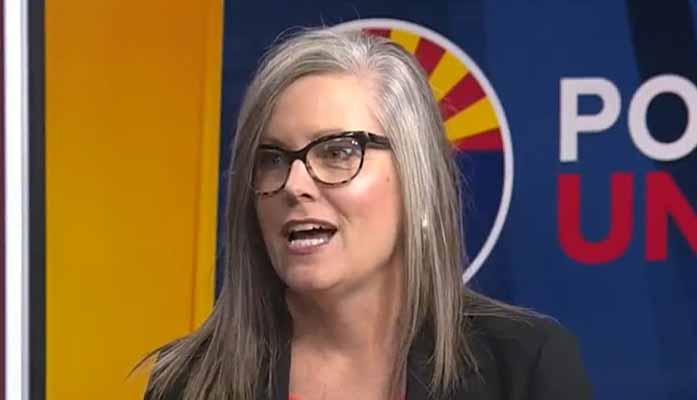
by Daniel Stefanski | Jun 27, 2023 | News
By Daniel Stefanski |
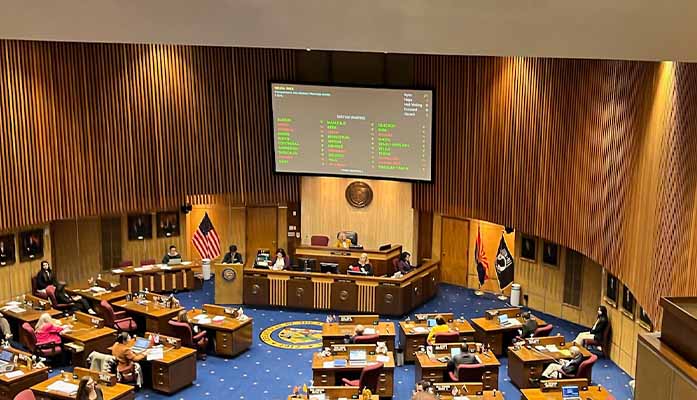
Arizona’s Republican-led Legislature is taking action after the state’s Democrat governor’s attempt to legislate by executive order when it comes to abortion.
On Monday, Senator Jake Hoffman, the Chairman of the Committee on Director Nominations, announced that he was canceling the next hearing “with support of the Republican Majority serving on the committee to determine Hobbs’ future intentions to further act beyond her authority.”
The Committee had been formed in February by Arizona Senate President Warren Petersen, who tasked the members with “gathering information and evaluating qualifications on the governor’s executive appointments in order to recommend a course of action for the Senate to take on each individual.” This committee had been created alongside the governor’s reticence to send many of her nominations to the Senate as required by state law.
The three Republican members of the committee – Hoffman, Sine Kerr, and T.J. Shope – sent a letter to Hobbs on Monday, informing her that she holds “the office of Governor in Arizona, not of monarch.” They wrote that her Friday executive order shows “a blatant disregard for constitutional separation of powers” by attempting “to seize lawmaking duties from the Legislature and law interpretation authority from the United States Supreme Court.”
These Republicans requested a meeting with the Hobbs’ administration “to discuss any additional unlawful overreach (her) office intends to take requiring complicity from Executive Directors,” telling the governor that they have “grave concern that the direction (she) intends to provide to (her) nominees will not allow them to fulfill this obligation (of thoroughly and objectively evaluating nominees for their commitment to execute Arizona laws, rather than create new public policies that conflict with the constitutionally established separation of powers).”
A Senate Republican Caucus spokesperson told AZ Free News that the chamber has received 21 director nominations from Hobbs, with 12 awaiting their confirmation hearings.
Hoffman released the following statement in conjunction with the release, saying, “Katie Hobbs’ reckless abuse of power and willful disregard for the separation of powers established by the Arizona Constitution sets a dangerous precedent that will not be tolerated by the Republican Majority within the Legislature. The Senate Committee on Director Nominations was created to honestly, accurately and thoroughly vet directors appointed by the Governor to critical state agencies so that only highly qualified, non-partisan individuals seeking only to serve the best interests of our citizens within the confines of these roles are confirmed. Their duty is to follow statute as prescribed by the Legislature. We are now forced to redirect our attention, from confirming directors and creating good policy for the people of Arizona, to examining the fallout of Hobbs’ unconstitutional maneuver, as well as the likelihood of future overreaches of her authority.”
Shope also issued a comment on the action from the Committee’s Republicans, stating, “Hobbs undermining our democracy by ordering these state agency Directors to act illegally is a clear violation of the constitutional separation of powers. Instead of working with Republican lawmakers on the issues that matter to our citizens, like crippling inflation, gas prices, housing costs, public safety and water security, Hobbs is gleefully attempting to circumvent the Legislature. We can’t in good faith be an accomplice to her radical and unlawful agenda.”
The third Republican on the Committee, Kerr, wrote, “We have serious concerns this Governor will put her Directors in the difficult position of choosing to follow the law or choosing to follow her unconstitutional directives. The important work of the Committee on Director Nominations cannot continue until we have assurances from the Governor that she will cease her attempts to circumvent the laws of this state and the rulings of the United States Supreme Court.”
Arizona Senate Democrats quickly pushed back on Hoffman’s revelation. Senate Democratic Caucus Chair Lela Alston issued a statement, writing, “Senator Jake Hoffman has once again shown his disregard for government and everyday Arizonans. By failing to schedule the confirmation hearings for the Governor’s nominees, he shows how ineffective and partisan the Republican party in Arizona truly is. I am disgusted by this move of extremism and call on his leadership to rectify his foolish actions.”
Another Senate Democrat leader, Caucus Whip Eva Burch, also weighed in on the Republicans’ action, saying, “Our job as elected officials is to serve the people of Arizona, not to engage in political sport to try to sabotage politicians we disagree with. The move to cancel all nominating committees is a disservice to the people who elected us to get these things done. Leaving our departments with uncertainty and without established leadership is irresponsible. It’s time to do our jobs and work together effectively and responsibly.”
Hobbs’ Friday news dump caught most Republicans by surprise but didn’t limit the outrage and resolve from pro-life officials and advocates over the weekend. Arizona House Speaker Ben Toma told AZ Free News that “the Governor cannot unilaterally divert statutory authority to prosecute criminal cases from Arizona’s 15 county attorneys to the Attorney General.” President Petersen opined that “this is another do-nothing executive order meant to pander to her liberal base and create unnecessary division on polarizing topics.” Center for Arizona Policy President, Cathi Herrod, asserted, “The law does not allow her to strip county attorneys of their clear enforcement authority as granted in various Arizona laws.”
Earlier this year, Republican leaders at the Arizona Legislature celebrated their “successful intervention(s) in cases to defend state laws and fight against federal overreach.” One of those cases was the SB 1457 (or Isaacson) litigation, where “a federal court granted Speaker Toma’s and President Petersen’s motion to intervene to defend a law that prohibits abortions based solely on a child’s genetic abnormality after Arizona Attorney General Mayes stated she would not defend the law.”
Hoffman’s decision to cancel Tuesday’s hearing will likely not be the last of the actions legislative Republicans could take to stand against Hobbs’ executive order.
Daniel Stefanski is a reporter for AZ Free News. You can send him news tips using this link.
by Corinne Murdock | Jun 24, 2023 | News
By Corinne Murdock |
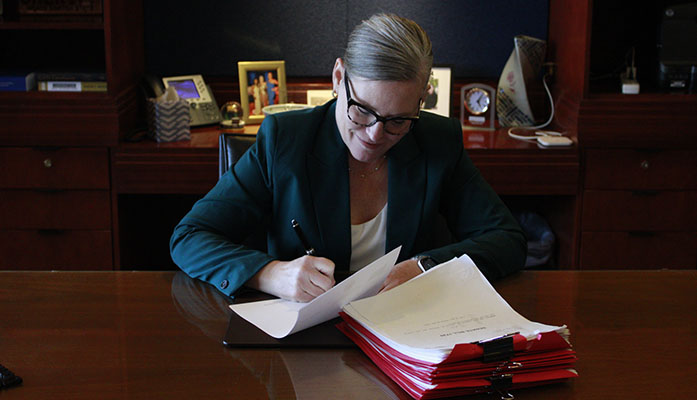
Gov. Katie Hobbs exercised her executive authority to take the enforcement of abortion law into her own hands.
On Friday — almost one year to the day that the Supreme Court overturned Roe v. Wade via Dobbs v. Jackson Women’s Health Organization — Hobbs issued an executive order rescinding county attorneys’ authority to prosecute in abortion-related cases, instead granting sole authority to Attorney General Kris Mayes. In a statement, Hobbs characterized abortion as a “fundamental right.”
“I signed an Executive Order protecting Arizonans’ reproductive freedom,” said Hobbs. “I will not allow extreme and out of touch politicians to get in the way of the fundamental rights of Arizonans.”
In addition to strengthening control over abortion prosecutions, Hobbs’ executive order directed state agencies to not assist in investigations relating to those who provide, assist, seek, or obtain abortions; banned compliance with other states’ extradition requests for those who provided, assisted, sought, or received an abortion where illegal; and established an advisory council to formulate strategy on expanding abortion access.
The executive order declared that abortion restrictions and bans were inimical to equity for those who get the most abortions: non-white, disabled, and poor individuals. The order also declared abortion as a form of freedom.
“[L]imitations on access to reproductive healthcare disproportionately impact people of color, people who live in rural and tribal communities, people with low incomes, and people with disabilities,” stated the order.
READ THE EXECUTIVE ORDER HERE
In addition to abortions, the Governor’s Advisory Council on Protecting Reproductive Freedom will be charged with expanding access and implementing equitable solutions concerning sexual and reproductive health care resources. Hobbs will appoint the council chair and members. The executive order noted that the council would “reflect the diversity” of Arizona to include indigenous, rural, and LGBTQ+ members.
Planned Parenthood, an abortion provider which also offers sexual and reproductive health care items, expanded their resources over the past year to include gender transition drugs like puberty blockers and hormone replacement therapy.
Pro-life groups challenged Hobbs’ statutory authority behind the executive order immediately.
In a press release, Center for Arizona Policy claimed that state law only allows for the attorney general to aid county attorneys in their duties — not replace them.
“Arizona law, A.R.S. 41-101, Section 8 states that the governor ‘may require the attorney general to aid a county attorney in the discharge of his duties.’ Aid does not mean supplant or replace. In her zeal for abortion, Gov. Hobs has exceeded her authority as governor,” stated Herrod. “The law does not allow her to strip county attorneys of their clear enforcement authority as granted in various Arizona laws.”
Hobbs preceded the executive order with an announcement of support for the Arizona Right to Contraception Act on Thursday.
Arizona law currently bans abortion after 15 weeks’ gestation.
Corinne Murdock is a reporter for AZ Free News. Follow her latest on Twitter, or email tips to corinne@azfreenews.com.
by Daniel Stefanski | Jun 24, 2023 | News
By Daniel Stefanski |
An Arizona state lawmaker is expressing outrage over the governor’s decision to veto one of her public safety bills.
On Thursday, Senator Sine Kerr issued a press release to highlight Democrat Governor Katie Hobbs’ “harmful veto of a bill requiring sex offenders convicted of dangerous crimes against children to register on the state’s sex offender website.”
The bill that elicited Kerr’s attention was SB 1583, which added “that a level one sex offender who commits specified sexual offenses is required to register on the internet sex offender website if the offender was sentenced for a dangerous crime against children (DCAC).”
Senator Kerr’s release revealed that there was “loophole in state law, which currently only requires some offenders who have been convicted of sex crimes against children to be listed on the sex offender website if they are considered at high risk of reoffending,” and that “those who are considered least likely to reoffend (level one offenders) may not be required to be listed on this website” – estimated in the thousands by the Arizona Department of Public Safety.
Hobbs, in her customary veto letter to the Senate President, explained her decision, writing, “State law already requires offenders that are deemed the most dangerous to be published on the Arizona Department of Public Safety Sex Offender Information website. DPS will continue to ensure this information is readily available to the public.”
The governor added that she looks forward “to continuing to work on legislative solutions to keep Arizona families and communities safe.”
Kerr vehemently disagreed with Hobbs’ justification and accused the state’s chief executive of being clueless when it comes to this issue, stating, “The lack of understanding from Governor Hobbs is a serious threat to the safety and wellbeing of all Arizona families with children. My bill would have armed parents, schools, churches and community centers with a digital tool of notification, transparency and awareness in order to prevent these offenders currently not listed on the website from further victimizing our kids. Hobbs’ veto letter, which she erroneously wrote to the wrong Senator, shows she doesn’t have a clue what’s going on with sex offender tracking in our state.”
In her statement, the senator also discussed the safety ramifications of this loophole and bemoaned the partisan nature of this bill, saying, “Right now, if a parent signs their child up for a sports team, and that coach was convicted of committing a dangerous sex crime against a minor but is not considered likely to reoffend, that coach may not be listed on the website. When the parent searches the site and doesn’t see the coach’s name pop up, they are given a false sense of security that their child will be in good hands. Protecting our children from sexual victimization should not be a partisan issue, yet all Democrats in the Legislature voted against the bill and our Democrat Governor vetoed it.”
Senator Kerr vowed to bring back this effort next session “so that we stop protecting sex offenders and start protecting children.”
Daniel Stefanski is a reporter for AZ Free News. You can send him news tips using this link.
by Daniel Stefanski | Jun 23, 2023 | News
By Daniel Stefanski |
If it wasn’t already apparent, the Republican-led Arizona Legislature and the state’s Democrat chief executive will not be coming together anytime soon on measures pertaining to election integrity.
On Wednesday, Senator J.D. Mesnard issued a press release to announce that Governor Katie Hobbs had vetoed a number of his bills “aimed at increasing voter confidence, convenience, transparency and timeliness of election results.”
The bills Mesnard was referring to were SB 1595, SB 1596, and SB 1598. SB 1595 would have “prescribed additional requirements for an early ballot to be counted and valid, required a voter to present valid identification by the prescribed days after an election for a ballot that was delivered by a voter’s agents or a voter who does not provide sufficient identification, removed the requirement that the period of early voting must end at 5:00pm on the Friday preceding the election, and deemed the early ballot of a voter who is issued an early ballot during the early voting period after confirming identification and stamped as ready for tabulating.”
SB 1596 would have “required a state, county, city, town or school district office to provide sufficient space for use as a polling place for an election when requested by the officer in charge of elections.”
SB 1598 would have “allowed a candidate for federal office to designate a representative who may act as an observer at a counting center and prescribed requirements relating to the conduct of party representatives, challengers and observers.”
Senator Mesnard released a statement in conjunction with his release, saying, “To say I’m disappointed is an understatement. Elections are becoming more chaotic and more controversial in Arizona with each passing cycle. We’ve seen it take weeks, sometimes more than a month, to count ballots and determine the winners of races. Following the last election, I heard more complaints across the political spectrum about the length of time it takes Arizona to finish counting than I did any other issue, and it’s a problem we can easily solve. Ignoring these problems is a complete disservice to our voters who are taking their precious time to exercise their civic duty. We can’t just kick the can down the road every year. My proposals were commonsense, practical to implement and would have made a real difference in tackling some of the issues voters continue to complain about. I look forward to trying again to provide impactful election reform next session.”
The governor didn’t have much to add in her veto letters for the three bills. For SB 1595, she wrote, “This bill fails to meaningfully address the real challenges facing Arizona voters.” For SB 1596, Hobbs explained: “This bill creates an unfunded and untenable mandate for schools and communities. This bill once had an appropriation, demonstrating that it needs funding to be viable. However, it was not included in the budget, and as such, I cannot support it.” And for SB 1598, Hobbs stated, “As it is not clear what problem this bill is attempting to address or if any such problem exists, I cannot support it.”
Daniel Stefanski is a reporter for AZ Free News. You can send him news tips using this link.
by Daniel Stefanski | Jun 22, 2023 | News
By Daniel Stefanski |
On Tuesday, Governor Katie Hobbs vetoed the Republican-led Prop 400 legislation, which was transmitted to her office last week.
Hobbs provided a statement on Twitter, justifying her decision, writing, “I just vetoed the partisan Prop 400 bill that fails to adequately support Arizona’s economic growth and does nothing to attract new business or create good-paying jobs. I strongly encourage the Legislature to vote on the compromise supported by a bipartisan majority in the House and Senate, business and labor leaders, and Maricopa County Mayors.”
Mesa Mayor John Giles, a Republican, praised the governor for her decision. Giles stated, “Thank you, Governor Hobbs, for your veto. We hope the Legislature will reconsider the cities’ Prop 400 compromise bill, to deliver quality-of-life benefits for all residents and strengthen our economy. Cities are committed to getting a balanced, multi-modal plan to the voters.”
On the other side of the political aisle, Democrat Mayor Kate Gallego also expressed her gratitude for Hobbs’ veto, tweeting, “Thank you, Governor Hobbs. We need a transportation plan that will support economic growth for years to come, and that’s not what this bill would have delivered. It’s time for the legislature to pass the plan that’s been endorsed by all our region’s mayors and tribal leaders.”
A spokesperson for the Arizona Senate Republican caucus told AZ Free News, “We put a good bill on her desk that passed with Majority support. Her and MAG’s proposal doesn’t have the votes she claims it does. We’re willing to come back to the table to negotiate in good faith, and we will consider all reasonable requests, but we won’t vote on a plan that doesn’t focus the majority of taxpayer dollars towards freeways and roads, which are the transportation options our citizens rely on to get to and from on a daily basis.”
SB 1246, as amended, passed the state house with a 31-26 vote (three members not voting) and the state senate with a 16-12 tally (two members not voting).
After the Legislature passed its proposal, the Arizona Freedom Caucus released a statement, touting the plan and calling on the governor to sign the bill on her desk. The Caucus wrote, “The passage of the conservative Prop 400 plan is a major victory for Valley commuters and taxpayers by fully funding highways and arterial roadway projects, eliminating any opportunity for the expansion of the utterly failed light rail system, and providing a guaranteed tax cut of $241 million. Additionally, the conservative Prop 400 plan provides voters the opportunity to cut their sales tax at the ballot box by more than $3.37 billion. Unlike the MAG and Hobbs’ plans, the conservative Prop 400 plan properly prioritizes building better freeways and roadways while simultaneously reducing commute times, traffic congestion, and taxes – a true win-win.”
A bipartisan group of Valley mayors, however – including Gallego and Giles – issued a statement last week to denounce the Republican legislators’ plan for Prop 400 and to threaten to circumvent the House and Senate. The six mayors stated that the Republican lawmakers’ “priorities involving transportation just don’t mesh with the realities of where we are as the fastest-growing county in the U.S. We are unalterably opposed to their plan, and if no solution is reached, we will have no choice but to get this before voters in 2024.”
House Speaker Ben Toma has taken exception to Hobbs’ public comments and negotiating abilities over Prop 400, telling reporters previously, “The Governor has chosen to be an uncompromising conduit for an inefficient MAG proposal that does not have sufficient votes to succeed in the House. I remain willing to negotiate, but their take-or-leave-it attitude is decidedly unproductive.”
Last month, the governor created unrest over ongoing negotiations, allegedly sending out a tweet that highlighted her fight with Republicans at the Legislature at the same time she was meeting with Senate President Warren Petersen.
Daniel Stefanski is a reporter for AZ Free News. You can send him news tips using this link.