by Matthew Holloway | May 16, 2026 | News
By Matthew Holloway |
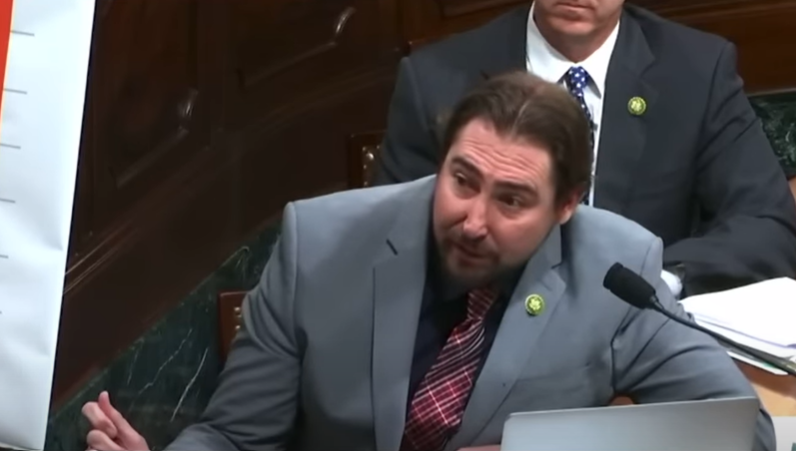
Congressman Eli Crane (R-AZ02) welcomed a Federal Emergency Management Agency (FEMA) announcement Tuesday that multiple Arizona health care providers, tribal entities, and state agencies are receiving federal funding through grants released by the agency.
The grants were awarded to the Arizona Department of Emergency & Military Affairs, the Arizona Department of Health Services, Dignity Community Care, Dignity Health, the Havasupai Tribe, HonorHealth, and Valleywise Health.
More than $5.5 million of the funding is designated for the Havasupai Tribe to repair damage caused by flash flooding in 2024. The project includes replacing four damaged bridges with structures designed to withstand major flood events, including 100-year flood events. The funding will also support fencing and erosion-control systems intended to protect ancestral burial grounds and culturally significant tribal sites.
In a statement released by his office, Crane said, “On behalf of rural Arizonans, I’m grateful to President Trump, Secretary Mullin, Associate Administrator Phillips, and agency personnel for delivering this reimbursement. This funding will strengthen health care across our state, as well as provide meaningful assistance for the Havasupai Tribe.”
“I also appreciate the work of Chairman Garbarino and Arizona’s congressional delegation,” he added, specifically highlighting the efforts of Rep. Andy Biggs (R-AZ05), whom he said, “demonstrated considerable leadership behind the scenes to resolve these long overdue needs.”
“We will continue to partner with the Trump administration to deliver wins for all Arizonans,” Crane said.
The Havasupai Tribe, located within Arizona’s Second Congressional District, was among the entities identified in the release. Crane’s district includes a significant number of tribal communities throughout northern and eastern Arizona.
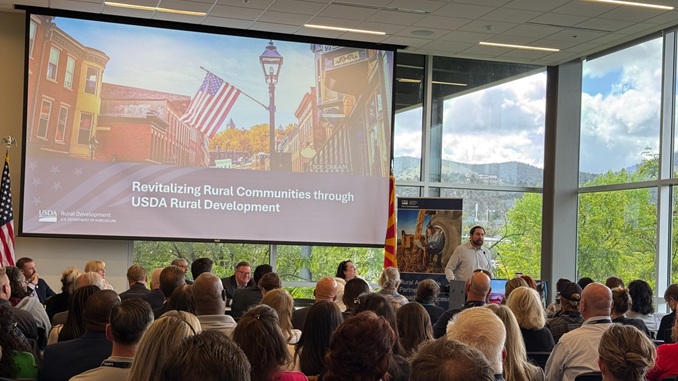
The announcement follows a series of recent federal and congressional discussions surrounding rural infrastructure, tribal services, and health care access in Arizona communities. Last week, Crane participated in a Federal Partners Forum in Prescott focused on rural Arizona infrastructure and coordination between federal, state, and local agencies.
Matthew Holloway is a senior reporter for AZ Free News. Follow him on X for his latest stories, or email tips to Matthew@azfreenews.com.
by Ethan Faverino | May 8, 2026 | News
By Ethan Faverino |
Congressman Eli Crane (R-AZ-02) participated in a Federal Partners Forum focused on addressing the distinct needs of Arizona’s rural communities, joining representatives from the U.S. Department of Agriculture (USDA) Rural Development and other federal agencies.
The event, held on May 5 at Yavapai College’s Center for Learning and Innovation in Prescott, convened more than 120 local and regional leaders alongside state and federal officials.
Senior Representatives from multiple federal agencies attended, including the National Park Service, U.S. Department of Health and Human Services (HHS), U.S. Department of Housing and Urban Development (HUD), U.S. Department of Veterans Affairs (VA), and the U.S. Small Business Administration (SBA).
During the forum, agency officials presented information on available federal resources and programs designed to support rural Arizona. Discussion topics included expanding access to healthcare, boosting small business growth, modernizing infrastructure, increasing affordable housing options, and enhancing broadband connectivity.
Participants were able to engage directly with federal partners to foster relationships, explore partnership opportunities, and identify practical solutions for long-term community development in rural areas.
“While our state faces many unique challenges, including Washington’s longstanding tendency to prioritize urban and coastal areas, we’re grateful to the Trump administration for putting rural interests at the forefront,” stated Rep. Crane. “Yesterday’s forum served as a catalyst for new opportunities and partnerships across local, state, and federal levels. I appreciate Yavapai College for hosting, and I’m thankful to Lori Urban, Lori Corbin, and everyone who helped make this event a success.”
The Federal Partners Forum is part of ongoing efforts to bridge gaps between rural communities and federal resources, ensuring Arizona’s rural priorities receive targeted attention and support.
Ethan Faverino is a reporter for AZ Free News. You can send him news tips using this link.
by Ethan Faverino | May 6, 2026 | News
By Ethan Faverino |
The U.S. House of Representatives unanimously approved an amendment presented by Congressman Eli Crane (R-AZ-02) to accelerate recovery efforts in the Kaibab National Forest following the devastating White Sage Fire.
The amendment, included in the 2026 Farm Bill, grants the U.S. Forest Service critical emergency contracting flexibilities to bypass unnecessary bureaucratic delays and speed up restoration work in the fire-affected areas.
Modeled after the North Rim Restoration Act of 2025, the measure targets nearly 60,000 acres impacted by the wildfire in Northern Arizona.
“Page, Fredonia, the Kaibab Band of Paiute Indians, and other impacted communities were dealt a setback due to the devastating White Sage Fire,” stated Rep. Crane. “In response, I’m honored to have introduced and passed an amendment to help pave the way to a full and timely recovery.”
Key provisions of Rep. Crane’s Amendment (Sec. 8409 – Kaibab National Forest Restoration):
- Authorizes the use of emergency acquisition flexibility under federal regulations to contract for forest management restoration activities, rebuilding, planning, design of structures, ground improvements, and other recovery efforts.
- Removes the need for a Presidential emergency or disaster declaration, allowing immediate action to support local communities.
- Requires robust transparency through detailed reports to Congress every 180 days on expenditures, expected costs, cost overruns, contractor performance, potential conflicts of interest, waste/fraud/abuse, and project timelines.
- Includes a 12-month extension option if new wildfires impact ongoing recovery, subject to congressional approval.
- Sunsets the authority five years after enactment or upon completion of recovery efforts, whichever comes first.
In addition to his own amendment, Rep Crane signed on as the sole cosponsor of an amendment led by Rep. Anna Paulina Luna (R-FL) to eliminate provisions that shielded pesticide companies from accountability while preserving critical public health protections. The measure restores Americans’ right to hold these companies accountable in court when their products cause harm.
He also cosponsored an amendment introduced by Rep. Paul Gosar (R-AZ-09) to reform evidence standards for compensating ranchers for livestock losses caused by Mexican wolves.
“I’m also grateful for the leadership of Representatives Gosar and Luna, who successfully passed provisions that assist our ranchers and help protect our food supply,” added Crane. “These results advance critical priorities for rural Arizonans, and I’m thankful for the positive outcomes.”
The amendments now move forward as part of the broader Farm Bill package.
Ethan Faverino is a reporter for AZ Free News. You can send him news tips using this link.
by Ethan Faverino | May 1, 2026 | News
By Ethan Faverino |
Congressman Abraham Hamadeh (R-AZ-08) introduced Kayleigh’s Law, a landmark federal legislation designed to provide survivors of dangerous crimes with permanent, lifelong protection from their convicted abusers by requiring courts to issue no-contact injunctions that remain in effect for the rest of the offender’s life.
Named after Kayleigh Kozak, an Arizona mother and prominent victim advocate who was sexually abused as a child by her teacher, the bill aims to end the repeated “legal tug-of-war” that forces survivors to return to court multiple times to maintain basic safety protections against their predators.
Kayleigh’s Law would mandate that federal courts impose lifetime no-contact injunctions against individuals convicted of federal sex crimes and violent felonies when requested by the victim or the government at sentencing.
The legislation builds directly on successful state-level reforms. Kayleigh’s Law has been enacted in Arizona and Wisconsin since 2022, where it has provided critical relief to survivors. In its first year alone in Arizona, the law enabled over 1,000 victims to secure lifetime protective orders against their abusers.
“As a former prosecutor, I know how vulnerable victims can be, how determined their predators often are, and how judges can frequently fail victims of crime. That is why we must require federal courts to impose these lifetime injunctions when requested by the government or the victim during sentencing,” stated Congressman Hamadeh. “I have seen what victims go through as the predator’s adjudication process plays out, and I know how important it is for the victim’s healing process to begin. That process cannot be interrupted by their predators simply because our courts fail to take crime seriously and fail to impose lifetime injunctions.”
Kayleigh Kozak, whose personal experience drove the creation of the original state law, emphasized the lifelong impact of sexual violence.
“The harm caused by sexual assault is not temporary. It is lifelong,” stated Kayleigh. “The protections for those who have been sexually violated should be lifelong too. No survivor should have to repeatedly return to court just to request the continuation of a protective order from the person who was convicted of sexually violating them. Kayleigh’s Law ensures no victim ever has to endure the nightmare of continuously justifying their need for safety. When I was a little girl, I could not protect myself from the teacher who sexually abused me at school – but I can fight now to protect myself, other innocent children, and every victim.”
Under the federal proposal, the lifetime injunction would prohibit all forms of direct or indirect contact with the victim and would remain enforceable even after the offender completes prison, probation, or supervised release.
Original cosponsors of Kayleigh’s Law include Representatives Brian Babin (TX-36), Andy Biggs (AZ-05), Tim Burchett (TN-02), Juan Ciscomani (AZ-06), Eli Crane (AZ-02), Troy Downing (MT-02), Mike Ezell (MS-04), Brandon Gill (TX-26), Paul Gosar (AZ-09), David Joyce (OH-14), Nancy Mace (SC-01), Dan Meuser (PA-09), Barry Moore (AL-01), Gary Palmer (AL-06), Chris Smith (NJ-04), David Schweikert (AZ-01), Greg Steube (FL-17), Marlin Stutzman (IN-03), David Taylor (OH-02), and Delegate Kimberly King-Hinds (MP).
Congressman Juan Ciscomani (AZ-06) stated, “Kayleigh’s Law originated in Arizona and will uplift thousands of victims of unspeakable crimes. I’m proud to join my colleagues in supporting this commonsense legislation to ensure victims of dangerous crimes can obtain lifetime protections against their abusers. Survivors should not be faced with uncertainty about those who have harmed them. Kayleigh’s Law will close critical gaps in federal law by strengthening protections, enhancing enforcement, and ensuring lasting safety for victims.”
Congressman Marlin Stutzman (IN-03) added, “Victims of violent crime and sexual assault deserve to have permanent, basic safety protections without having to repeatedly face their attacker in court. The emotional and psychological toll of these legal proceedings is high. Kayleigh’s Law gives victims one less thing to worry about by removing the fear and dread of reliving these experiences. I am proud to cosponsor Congressman Hamadeh’s bill to ensure these criminals hold no power over their victims.”
The bill mirrors key elements of Arizona Statute (A.R.S. 13-719), which applies to dangerous offenses, serious/violent felonies, and specific sex offenses under Chapters 14 and 35.1. Injunctions issued under the law are effective immediately upon sentencing and do not expire for the predator’s natural lifetime.
Kayleigh’s Law is being introduced during Sexual Assault Awareness Month, underscoring its focus on empowering survivors and closing critical gaps in federal protections for victims of sexual assault and violent crimes.
Ethan Faverino is a reporter for AZ Free News. You can send him news tips using this link.
by Matthew Holloway | Apr 28, 2026 | Education, News
By Matthew Holloway |
U.S. Representative Eli Crane (R-AZ02) announced the winners of the 2026 Congressional Art Competition for Arizona’s 2nd Congressional District following an awards ceremony held in Prescott.
The event took place at the Phippen Museum, where students, families, and educators gathered to recognize outstanding artwork submitted by high school students from across the district.
“The Congressional Art Competition offers our talented high school artists the opportunity to showcase their skills, and it’s an honor to play a role in the process,” Crane said in a statement. “On behalf of my team, I am deeply grateful to the Phippen Museum, our partners in higher education, and our professional judges for collaborating on this great tradition. We also appreciate the teachers who encouraged their students to participate, as well as everyone who came out to celebrate this occasion.”
The annual Congressional Art Competition is a nationwide program sponsored by the U.S. House of Representatives to encourage and recognize artistic talent among high school students.
Crane presented scholarship awards to selected student artists during the ceremony, from Embry-Riddle Aeronautical University, Grand Canyon University, Northern Arizona University, Northern Pioneer College, and Yavapai College, honoring their work and participation in the competition.
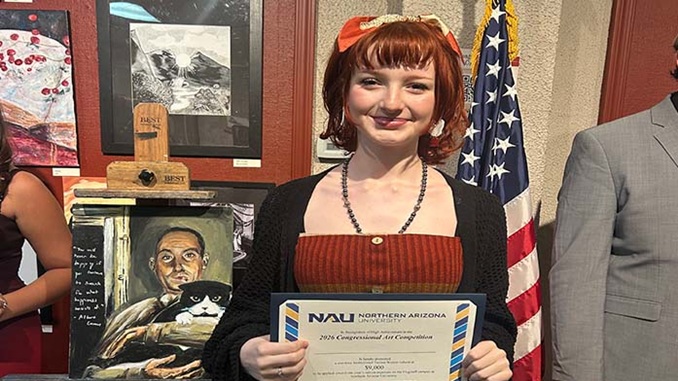
Winslow High School student Lindsey Cox earned first place and was awarded a scholarship to Northern Arizona University for her piece “Albert Camus and His Cat.” Her painting will be displayed in the U.S. Capitol for one year, and she will be honored at an awards banquet in Washington, D.C.
Jazmin Hunt, a Mingus Union High School student, won second-place honors with her piece, “Cat Eye,” and was awarded a scholarship to Embry-Riddle Aeronautical University.
Sarah Meyer, a Prescott High School student, was awarded third place for her piece “Desert Nightlife,” along with a scholarship to Yavapai College.
Honorable mention went to Prescott High School student McKenzee Stapleton, who earned a scholarship to Grand Canyon University, and the People’s Choice Award, voted on by the public, went to Mingus Union High School student Isabel McKean.
The event was supported by staff and volunteers at the Phippen Museum, as well as local artists who assisted in reviewing submissions and selecting winning pieces.
The Congressional Art Competition is held each spring in congressional districts nationwide, with winning artwork typically displayed in the U.S. Capitol for one year as part of a national exhibition.
Matthew Holloway is a senior reporter for AZ Free News. Follow him on X for his latest stories, or email tips to Matthew@azfreenews.com.