The U.S. House of Representatives has unanimously passed H.R. 7396, the Native American Entrepreneurial Opportunity Act, a bipartisan measure aimed at strengthening Small Business Administration (SBA) outreach and support for Tribal entrepreneurs across the United States.
The legislation, led by a bipartisan coalition in Congress, seeks to formally establish and codify the Office of Native American Affairs (ONAA) within the SBA by amending the Small Business Act.
The goal is to improve coordination, accountability, and targeted support for Native American and native Hawaiian business owners who often face structural barriers in accessing federal resources.
The bill was introduced by a bipartisan group of lawmakers including Rep. Eli Crane (R-AZ-02), alongside Rep. Shanice Davids (D-KS-03), Rep. Jake Ellzey (R-TX-06), and Rep. Kelly Morrison (D-MN-03). The measure passed the House with unanimous support after previously clearing the chamber in the last Congress with strong bipartisan backing before stalling in the Senate.
If enacted, the legislation would formally embed the ONAA within the Small Business Administration and assign its responsibility for expanding access to entrepreneurial development programs, contracting opportunities, and capital resources for Tribal communities.
This evening, the House unanimously passed the Native American Entrepreneurial Opportunity Act to strengthen @SBAgov outreach to Tribal entrepreneurs.
The office would also be tasked with improving coordination with other federal agencies and increasing education about available programs for Native entrepreneurs.
Tribal business owners, particularly those operating on reservations, often face unique challenges including complex tax structures, regulatory barriers, lending difficulties, and questions surrounding property rights.
Supporters of the legislation argue that these issues have been compounded by inconsistent outreach and limited access to federal small business programs.
By codifying the Office of Native America Affairs into federal law, the bill also strengthens congressional oversight by requiring annual reports to Congress detailing outreach efforts, consultations with Tribal governments, training initiatives, and the number of entrepreneurs served.
“I’m proud to be part of the bipartisan coalition working to improve and expand SBA outreach to Tribal communities. As the representative of over half of Arizona’s tribes, I’m focused on solutions to help expand economic growth throughout rural Arizona,” stated Rep. Crane. “I’m grateful to Rep. Davids for her leadership, as well as Reps. Ellzey and Morrison for their support of this important bill. I urge my colleagues in the Senate to quickly take up and pass this measure.”
Ethan Faverino is a reporter for AZ Free News. You can send him news tips using this link.
Rep. Eli Crane’s bill to expand the U.S. Capitol Police’s authority to respond to drone threats near the Capitol complex advanced through the House Administration Committee on Wednesday.
The U.S. Capitol Police Empowerment Act, sponsored by Crane (R-AZ-02), would authorize the Capitol Police Board and designated U.S. Capitol Police personnel to take action against unmanned aircraft systems that pose a credible threat to covered Capitol Police facilities or assets. The House Administration Committee unanimously advanced the measure during its June 24 markup.
Crane introduced the bill on May 13, 2025, with Reps. Scott Perry (R-PA) and Barry Moore (R-AL), as original cosponsors. Rep. Abe Hamadeh (R-AZ-08) later joined the measure as a cosponsor.
In a post to X, Crane wrote, “After meeting with the U.S. Capitol Police, I learned they lacked explicit authority to intercept drones on the complex.”
After meeting with the U.S. Capitol Police, I learned they lacked explicit authority to intercept drones on the complex.
My bill would allow the USCP to take decisive action to protect Members of Congress, staff, and constituents on Capitol Hill:https://t.co/IldB8bmEma
Under the bill text, the Capitol Police Board could authorize Capitol Police personnel assigned to protect people, facilities, or assets to mitigate a credible threat posed by an unmanned aircraft system. The bill would allow Capitol Police to detect, identify, monitor, and track a drone; warn its operator; disrupt control of the aircraft; seize or exercise control of it; confiscate it; or use reasonable force, if necessary, to disable, damage, or destroy it.
“The evolution of drone warfare has drastically changed both the battlefield and the threats to our national security,” Crane said. “My bill would grant the USCP the ability to take decisive action to protect Members of Congress, staff, and constituents on Capitol Hill.”
The legislation would require the Capitol Police Board to coordinate with the Secretary of Transportation and with the Federal Aviation Administration when an action could affect aviation safety, civilian aviation or aerospace operations, aircraft airworthiness, or the use of airspace.
The bill also includes privacy provisions. Regulations or guidance issued under the measure would have to ensure that interception or use of communications to or from a drone is conducted in a manner consistent with the First and Fourth Amendments and applicable federal law. The bill would limit the acquisition of communications to what is necessary to support authorized action and would generally bar retention of those records for more than 180 days unless one of several exceptions applies.
The measure would also require the chief of the Capitol Police, or another individual designated by the Capitol Police Board, to submit reports to Congress within six months of enactment and every six months thereafter. Those reports would have to cover actions taken under the authority, effects on the National Airspace System, privacy and civil liberties procedures, communications retained or shared outside Capitol Police, and any new technology or equipment deployed under the program.
The proposal comes as federal rules already restrict drone activity in Washington, D.C. The FAA says the National Capital Region is governed by a Special Flight Rules Area within a 30-mile radius of Ronald Reagan Washington National Airport, with unmanned aircraft flights prohibited inside the 15-mile inner ring without specific FAA authorization.
The U.S. Capitol Police also identifies Washington, D.C., and the U.S. Capitol Grounds as a “No Drone Zone.” Capitol Police regulations prohibit unmanned aircraft on Capitol Grounds, and violations can carry arrest, a $300 fine, 90 days imprisonment, and additional federal civil or criminal penalties.
Crane’s office said he drafted the bill with input from committees of jurisdiction, including House Administration, Transportation and Infrastructure, Judiciary, and Homeland Security. The bill was referred to the House Administration, Transportation and Infrastructure, and Judiciary committees after introduction.
Crane has also introduced the DEFEND Act, a separate piece of legislation aimed at broader civilian drone threats, and, alongside Rep. Ciscomani, targeted drone interference with wildfire response efforts with the Wildfire Aerial Response Safety Act of 2025.
Ranchers in Arizona and across the nation secured a step toward a potentially major grazing rights victory from the federal government following the intervention of a coalition of Arizona’s Republican congressmen.
Republican Reps. Andy Biggs (AZ-05), Juan Ciscomani (AZ-06), Eli Crane (AZ-02), and Paul Gosar (AZ-09) successfully petitioned the Department of the Interior (DOI) to issue a newly proposed grazing rule that purports to give ranchers greater flexibility and security for their work.
Biggs offered his support for this proposed rule, announced by the DOI on Monday. Biggs promised to Arizonans in a press release that the rule would prioritize American ranchers and food security.
“Under the previous administration, cattle ranchers were forced to reduce their herd counts because of federal mandates and orders cutting public grazing land use. This administration knows how critical it is to protect our great ranchers and allow these families to provide abundant food to the American people.”
DOI Secretary Doug Burgum issued a similar commitment to ranchers about the impact of the rule.
“For too long, ranchers and land managers have been forced to work under outdated rules that do not match today’s challenges,” said Burgum. “President Trump has made it clear that we must cut red tape, support the people who feed our nation and ensure our public lands remain healthy for future generations. These updates will help us do exactly that.”
The proposed rule promises to streamline grazing administration and expand rangeland health standards. As part of this approach, the Bureau of Land Management was directed to update definitions, simplify processes, and clarify regulatory language.
Last December, Biggs sent a letter requesting actionable support on expanding and rebuilding American cattle to Burgum, Department of Agriculture (USDA) Secretary Brooke Rollins, Forest Service Chief Tim Schultz, and Fish and Wildlife Service Director Brian Nesvik.
Ciscomani, Crane, and Gosar signed onto Biggs’ letter, which asked the agency heads to resist influencing from “extreme environmental causes.” Certain environmental advocates — most in progressive circles — believe cattle grazing to be environmentally devastating.
“Ranchers are not the problem. They are the solution,” said Biggs. “Yet outdated regulations and false claims continue to punish them, while predators such as the Mexican wolf devastate herds under the shield of a misapplied endangered species designation.”
Biggs claimed that he’d received reports of cattle ranchers forced to reduce herd counts due to government mandates and orders impacting the use of public grazing lands, and asked the agencies to review their processes, rules, and regulations for adverse impacts on American ranchers.
“At a time when rebuilding the domestic cattle herd is vital to our food security and rural livelihoods, these mandates are unacceptable,” wrote Biggs.
U.S. cattle operations have been on the decline for nearly a decade despite increased demand — the lowest in over 70 years. USDA reporting from last year reflected that cattle operations dropped by 17% while demand grew by 10%.
Biggs echoed the sentiments of blame regularly expressed by the average American rancher: increasing pressures from bureaucratic red tape magnifying other issues like the rising costs of supplies, namely feed, and environmental pressures, namely drought.
The DOI will continue to gather public input for the proposed rule affecting grazing management on public lands until July 13. The BLM is scheduled to host a virtual information session about the proposed rule on June 11 from 5 to 7 p.m. MT.
AZ Free News is your #1 source for Arizona news and politics. You can send us news tips using this link.
The White House Office of National Drug Control Policy (ONDCP) paid a visit to Arizona last week.
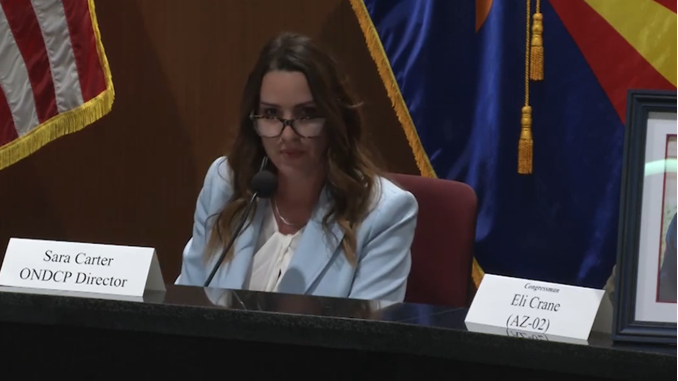
Sara Carter, director of the ONDCP, came to address Arizona’s unique situation with its ongoing drug crisis. Arizona was one of few states to experience an increase in drug overdose deaths rather than a decrease in 2025. Not only that: Arizona had the most drug overdose deaths last year.
While drug overdose deaths decreased 31% nationwide, Arizona experienced a 30% increase in drug overdose deaths.
Republican Rep. Andy Biggs (AZ-05) hosted Carter’s visit to Arizona, and Republican Rep. Eli Crane (AZ-02) joined the pair for meetings according to a press release from Biggs. These meetings were also attended by Drug Enforcement Administration officials, tribal partners, local law enforcement, and Angel Families.
Angel Families include all family members of individuals victimized or killed by criminal illegal aliens. Nearly all of the Angel Families in attendance last week were those whose loved ones fell victim to the crimes and violence resulting from drug cartel activity.
Eight of those families testified at a roundtable hosted at the Arizona State Capitol on Friday. These families claimed that the deaths of their loved ones were preventable through stricter immigration enforcement policies.
Among those to testify were Mary Ann Mendoza, who recounted how her son, Mesa police officer Brandon Mendoza, was killed in 2014 by an illegal alien drunk driver who had a criminal record dating back to 1994 and was living as a fugitive at the time of the crash.
Doug and Patricia Quets shared how their adult son Nicholas Quets, a Marine veteran, was murdered by Sinaloa cartel members in 2024.
Fernando Basurto explained that his grandson, Fernando Jose Basurto Jr., was about to graduate high school and had plans to enter the Air Force when he was murdered by a criminal illegal alien in 2016, who had been released shortly prior to the murder. Basurto said that former Sen. Martha McSally initially soured him on Congress because she refused to see their family to discuss Fernando Jose’s murder.
Patti Fox testified alongside her adult daughter, Carissa Aspnes, who was struck and severely disabled by an illegal alien running a stop sign in 2025. Carissa — a second-generation American on her grandmother’s side, a legal immigrant from Thailand — suffered a traumatic brain injury and now requires full-time care. Fox said local investigators initially covered up the fact that Carissa’s assailants were illegal aliens who entered the country under the Biden administration.
Karen Griffin explained that her teen son, Tyler Griffin, passed away in 2020 after taking a pill he believed to be Tylenol, but was actually laced with fentanyl.
Similarly, Anne Fundner shared that her 15-year-old son, Weston Fundner, passed away in 2022 after taking pills laced with fentanyl.
Carter promised to incorporate those suggestions from Friday’s roundtable into legislative proposals and policies put forth by the Trump administration.
Attendees included Reps. Quang Nguyen (R-LD-1), Nick Kupper (R-LD-25), and Lisa Fink (RLD-27); Sen. Carine Wrner (RLD-4); Maricopa County Supervisor Debbie Lesko; Queen Creek Mayor Julia Wheatley; and Art Del Cueto, formerly president of the National Border Patrol Council.
As part of its mission to address the drug crisis, ONDCP has taken a special focus on Arizona’s increase in drug overdose deaths, especially those involving fentanyl. It is the belief of the Trump administration, and Biggs and Crane, that the border policies of former President Joe Biden are to blame for Arizona’s ongoing drug crisis.
Carter commended Arizona as taking steps to fight back against the drug crisis.
“These communities know firsthand the devastating impact of illicit drugs,” said Carter. “President Trump and his administration will continue to fight for our citizens until every American is free to live a safe and healthy life, free from the scourge of illicit drugs.”
Earlier this month, ONDCP released a 200-page National Drug Control Strategy for 2026.
Under this administration, Trump has signed legislation classifying fentanyl-related compounds as Schedule I drugs; designated cartels as foreign terrorist organizations; designated illicit fentanyl and its core precursor chemicals as weapons of mass destruction; and signed legislation expanding the border wall and increasing deportations.
AZ Free News is your #1 source for Arizona news and politics. You can send us news tips using this link.
Rep. Eli Crane (R-AZ02) announced this week that language from his legislation aimed at restoring veterans’ Second Amendment rights has been incorporated into a bipartisan bill advancing through Congress.
According to a statement from Crane’s office, language from H.R. 496 was added to H.R. 1041, the Veterans 2nd Amendment Protection Act, which passed the U.S. House of Representatives this week and now heads to the Senate.
The legislation would prohibit the Department of Veterans Affairs (VA) from reporting veterans to the Federal Bureau of Investigation’s National Instant Criminal Background Check System (NICS) solely because they receive assistance managing their VA benefits through a fiduciary program.
Crane’s provision incorporated into H.R. 1041 would restore Second Amendment rights to veterans previously reported to NICS solely due to fiduciary participation.
The measure would require a judicial determination that a veteran poses a danger to themselves or others before Second Amendment rights could be restricted through NICS reporting.
Crane said the addition of his bill language strengthens the legislation by addressing veterans already affected by the prior reporting policy.
“I’m pleased to see the House Committee on Veterans’ Affairs add my language from H.R. 496 to the Veterans 2nd Amendment Protection Act,” Crane said. “This addition strengthens the bill, ensuring the retroactive removal of veterans who were wrongly added to the FBI’s NICS list.”
House Veterans’ Affairs Committee Chairman Rep. Mike Bost (R-IL) said the legislation is intended to protect veterans receiving financial assistance services from losing constitutional rights without court involvement.
“The men and women who have served and defended Constitutional rights for generations of Americans should not have to worry that they will be reported to NICS and lose their rights simply because they need help managing their books,” Bost said. “Veterans should never be treated like second-class citizens.”
Rep. Morgan Luttrell (R-TX), chairman of the Disability Assistance and Memorial Affairs Subcommittee, also supported the measure, stating that only courts—not agency officials—should determine whether constitutional rights are restricted.
The legislation follows policy changes announced earlier this year by the Department of Veterans Affairs. In February, the VA announced it would stop reporting veterans enrolled in the fiduciary program to NICS solely because they receive assistance managing benefits. The department stated it was also working with the FBI to remove prior VA-related NICS submissions connected only to fiduciary participation.
VA Secretary Doug Collins said at the time that veterans had been deprived of Second Amendment rights without sufficient due process protections.
Today, the House passed the bipartisan Veterans 2nd Amendment Protection Act.
This bill codifies @POTUS’ directive stopping the VA from reporting veterans to the FBI’s NICS list for using a fiduciary.
Following House passage, Crane praised the legislation and urged Senate approval.
“If the federal government is willing to strip the God‑given, unalienable rights of those who served in uniform, there is no telling where they will draw the line. H.R. 1041 codifies the termination of this un‑American practice and prevents future administrations from unilaterally reversing this wise decision.”
He added, “I’m grateful to President Trump for protecting the rights of our nation’s heroes, and I appreciate Chairman Bost for adopting my language into his bill. I urge my colleagues in the Senate to quickly pass these necessary reforms.”