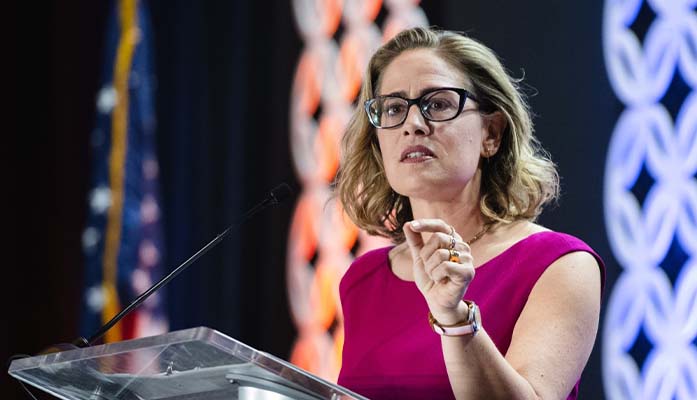
Former U.S. Sen. Kyrsten Sinema told Arizona business and political leaders she voted for Republican congressional candidate Jay Feely in the primary.
Citing two people present for the conversations, Axios reported that Sinema described Feely as “commonsense” and a “fiscal conservative.” The outlet said the discussions occurred during informal meetings over the preceding month and that Sinema indicated she was likely to support him in November.
According to one source cited by Axios, Sinema indicated that she viewed Feely as the best person to help address Arizona’s water crisis, including cutbacks to the state’s share of the Colorado River.
Feely, a former NFL kicker backed by President Donald Trump, faces Democrat Amish Shah in Arizona’s First Congressional District. The seat is open following Republican Rep. David Schweikert’s unsuccessful bid for governor. Shah, an emergency physician, defeated Marlene Galán-Woods for the Democratic nomination.
The National Republican Congressional Committee (NRCC) highlighted the Sinema report, arguing that her reported support strengthens Feely’s appeal to voters who split their tickets. The committee also noted that former Republican Gov. Doug Ducey had endorsed Feely.
“Arizonans of all parties trust Jay Feely to fight for lower taxes, a stronger Valley economy and protecting our water,” NRCC spokesman Ben Petersen said. “In stark contrast, Socialist Amish Shah vowed to raise taxes an average of over $4,000 and impose socialized government health care while reopening the border and going easy on sex offenders.”
Sinema announced her departure from the Democratic Party on Dec. 9, 2022. She subsequently received her seniority and committee assignments through the Democratic Conference for purposes of organizing the Senate, while declining to participate in either party’s caucus.
Scoop: Sinema quietly boosting Republican Jay Feely for Arizona House seat https://t.co/mgTLdZM6Hs
Arizona permits voters registered as independent or without a party designation to select a recognized political party’s ballot in state primary elections. Participating in the Republican primary therefore does not, by itself, establish that a voter has registered as a Republican.
The congressional contest has included disagreements over water use and economic development. Shah criticized Feely’s support for data centers while citing Arizona’s drought and potential Colorado River reductions. His campaign said he opposes building the facilities within the First Congressional District because of water shortages and utility costs.
During his legislative service, Shah supported a 2021 measure extending Arizona’s data center tax incentive application deadline and a 2023 measure addressing the program’s refund provisions. Feely has defended data center development as important to American competitiveness in artificial intelligence, while calling for developers to address water and electricity demands through measures including recirculated water and off-grid operation.
The Arizona Corporation Commission (ACC) revoked a Scottsdale investment advisory business’s license and imposed a $2,500 administrative penalty after finding that its owner misled clients about a yearlong jail sentence and made false statements in regulatory filings about his felony conviction.
The commission approved the consent agreement involving Paul Marascalco and his sole proprietorship, Paul Marascalco Registered Investment Advisor, during its Oct. 7 open meeting, according to an Oct. 13 Securities Division filing. The ACC announced the enforcement action that same day.
The consent agreement states that the business had been licensed as an investment adviser since May 2015 and operated from Scottsdale. It provided investment advisory services to approximately 20 clients around December 2020, charging fees based on assets under management.
According to the agreement’s findings, Marascalco drove while intoxicated in Chandler on Dec. 25, 2020, failed to stop at a stop sign, and collided with another vehicle around 8:15 p.m. All five passengers in the other vehicle were injured and taken to a hospital, including a child who suffered a compound fracture to her arm.
Police tested Marascalco’s blood, with the lowest of three results showing a blood-alcohol concentration of approximately 0.202%.
Marascalco pleaded guilty to aggravated assault, a Class 3 felony, on Sept. 10, 2021. The court accepted his plea on Nov. 10, 2021, and sentenced him to three years of supervised probation. The sentencing terms included substance-abuse treatment and a 12-month jail term, with two days of credit for time served and no eligibility for early-release credits.
A week before sentencing, Marascalco emailed clients to announce that another investment adviser would oversee his practice during his absence. He described personal issues requiring his attention and called the planned leave a “sabbatical in some ways,” according to the email excerpt reproduced in the agreement.
Marascalco told clients he expected to be away for approximately one year and assured them he was neither retiring nor closing the practice. He also said he would remain involved in all decisions and trades associated with their accounts.
The agreement’s findings state that he did not tell clients the absence resulted from his felony conviction and jail sentence or explain that continued involvement in all account decisions and trades would be extremely unlikely during incarceration.
One client independently learned of the arrest and conviction and left the firm, rejecting the substitute adviser’s services largely because the client believed Marascalco had been dishonest about his forthcoming absence.
On Nov. 10, 2022, Marascalco emailed clients to say he had returned to the office. The findings state that he again omitted the reason for his absence and did not disclose that he had been unable to remain involved in all account decisions and trades while incarcerated.
The regulatory filings described in the agreement contained inconsistent disclosures about the conviction.
In Form ADV filings dated June 21 and July 30, 2025, and Jan. 19, 2026, Marascalco denied a felony conviction or guilty plea within the preceding 10 years. The agreement states that the filings were certified under penalty of perjury. In the January filing, he acknowledged a felony charge while denying a conviction or guilty plea.
A July 31, 2025, Form ADV Part 2B characterized the incident as a traffic violation involving a minor accident. An Aug. 11, 2025, version disclosed the aggravated assault conviction, supervised probation, and a 12-month jail condition. A subsequent version also asserted that no clients had been lost, despite the agreement’s account of the client who left after learning about the conviction.
The ACC announcement said Marascalco’s conduct constituted dishonest and unethical practices in the securities industry. Under the consent terms, the respondents admitted the findings and legal conclusions for purposes of the commission proceeding and specified related proceedings, and waived their rights to a hearing and appeal.
The agreement assigns the $2,500 administrative penalty to the sole proprietorship, with payment due within five months of the order. It also revokes the business’s investment adviser license and permanently orders the respondents and their agents, employees, successors, and assigns to cease and desist from violating Arizona’s Investment Management Act.
Marascalco agreed not to apply or reapply in Arizona for registration as a securities dealer or salesman, or for licensure as an investment adviser or investment adviser representative. The respondents also agreed not to offer investment adviser or representative services within or from Arizona at any time.
U.S. Rep. Andy Biggs (R-AZ-05) is backing legislation that would require states to conduct annual Medicaid fraud risk assessments and implement corrective plans to address weaknesses in their programs.
Amid his campaign for Arizona Governor, Biggs announced his support for the Medicaid Fraud Prevention Act on Oct. 13, citing federal concerns about Arizona’s Medicaid oversight and repeated delays in submitting required financial audits.
H.R. 10636 was introduced Sept. 28 by Rep. Michael Rulli (R-OH), with Biggs among its original cosponsors. The legislation was referred to the House Committee on Energy and Commerce.
“I’m pleased to co-sponsor the Medicaid Fraud Prevention Act to establish a clear baseline for states to identify fraud, recover improper payments, and correct deficiencies in their Medicaid programs,” Biggs said. “Arizona officials must take these responsibilities seriously. Taxpayers deserve accountability, and continued failures in oversight risk both federal funding and the public’s trust.”
Under the bill’s provisions, states would complete their first assessment within one year of enactment and repeat the review at least annually. The assessments would cover fee-for-service payments, managed care, and eligibility and enrollment systems.
States would rank vulnerabilities, estimate potential improper expenditures, evaluate existing safeguards, and identify gaps in data sharing and enforcement. Within 90 days of completing an assessment, they would have to implement a corrective action plan with measurable outcomes and deadlines.
The legislation would also require annual state reports to the Secretary of Health and Human Services (HHS) describing identified risks, corrective actions, and progress. HHS would report to Congress on national trends and states’ implementation of corrective plans.
Biggs’ office cited a recent warning from the administrator of the Centers for Medicare & Medicaid Services (CMS) identifying Arizona among eight states reporting “zero fraud referrals and overpayments recovered in Medicaid managed care.” According to the announcement, the states were given 30 days to review their figures and verify that oversight was occurring.
The warning concerns Medicaid managed-care reporting. It does not establish that Arizona had no Medicaid fraud investigations or recoveries across all programs.
Biggs also criticized the state administration’s oversight approach.
“For far too long, governments at every level have allowed a festering culture of fraud and waste of monumental proportions across the United States,” he said. “Government officials have a responsibility to be good stewards of taxpayer dollars and ensure that Americans’ hard-earned money is spent appropriately and protected from fraud.”
Separately, Arizona’s delayed federal audit submissions were the subject of a September hearing before the Joint Legislative Audit Committee.
HHS Assistant Secretary for Financial Resources Gustav Chiarello testified about Arizona missing the federal Single Audit deadline for four consecutive fiscal years.
The fiscal year 2025 audit, due March 31, 2026, remained outstanding at the time of the hearing. Auditor General Lindsey Perry projected that it might not be issued until March 5, 2027.
A Single Audit examines financial reporting and compliance with federal award requirements. The legislative statement said HHS had warned that continued noncompliance could result in additional funding conditions, withheld payments, disallowed costs, or suspension or termination of federal awards.
The audit delays prompted questions from Arizona lawmakers about the administration’s corrective plans and potential consequences for federally supported programs.
Biggs’ announcement also cited an estimated Arizona Medicaid improper-payment rate above 6%, without identifying the measurement year. CMS explains that improper payment estimates measure compliance with payment requirements and can include documentation deficiencies. They do not measure the percentage of spending attributable to fraud.
A resurfaced 2009 interview in which Kris Mayes suggested water prices might need to rise has drawn criticism from Republican attorney general candidate Warren Petersen. Public relations consultant Stacey Champion responded by highlighting Mayes’ recent efforts to challenge utility rate increases.
During the 2009 Arizona PBS “Horizon” discussion, Mayes, then chairman of the Arizona Corporation Commission, said higher water prices could reduce consumption and the energy needed to pump water. She appeared alongside Arizona Investment Council President Gary Yaquinto and Arizona State University professor Mike Pasqualetti.
Public records researcher Brian Anderson circulated an excerpt on X, accusing Mayes of admitting that she deliberately increased water bills to combat global warming. The exchange does not identify a specific rate increase approved by Mayes or establish that stated motive.
INSANE VIDEO: @KrisMayes admits to hiking your water bills on purpose to stop global warming
"When it increases in price—the water—and people use less of it … that's a good thing … I think we can all come together around this idea that maybe the price needs to go up." #AZAGpic.twitter.com/0hytB0e1kV
Petersen shared the clip, writing, “I disagree with Mayes. I think your utility prices should go down, not up.”
In the recorded interview, Mayes explained the relationship between water prices, consumption, and the energy needed to deliver water.
“As it increases in price, what happens to energy? Well, what happens to energy is, well, when it increases in price, the water, and people use less of it, then we use less energy to pump that water. And so that’s a good thing,” Mayes said.
She then called for changing how Arizonans value water and for utilities to participate in that effort.
“But to Gary’s point, you know, we do need to value water differently. And I think Arizonans are ready to do that. I think Arizonans are ready to step up. But our utilities, and, you know, water companies, electric companies, natural gas companies, they need to step up too,” she said.
Mayes proposed a statewide discussion about resource consumption and prices.
“We need a statewide effort on both of these issues. And I think we need a statewide, frankly, marketing campaign around this to generate a dialogue, you know, about how we use our energy and how we use our water. And then I think we can all come together around this idea that maybe the price needs to go up.”
Champion responded on X, accusing Petersen and his allies of misrepresenting Mayes’ record.
“The lying & spinning from Weasley Warren & his team of misfits is just gross,” Champion wrote. “Want to pay exorbitant utility bills? Vote R. Lower bills? Vote D.”
Champion attached screenshots of six announcements from Mayes’ office concerning utility rates and data centers. The headlines included efforts to reduce proposed APS and Tucson Electric Power rate increases, challenges involving two water utilities, a proposed statewide pause on data center development, and a request to investigate whether APS customers subsidized large energy users.
Champion’s post highlighted Mayes’ subsequent positions on utility costs. However, it did not dispute the words Mayes used in the 2009 interview.
The original pricing discussion followed host Ted Simons’ question about whether Arizona’s era of inexpensive water was ending.
Yaquinto said water had been undervalued and argued that higher prices could encourage more efficient consumption. He also emphasized affordable access for families.
“I think it’s important that because it is an essential commodity for life, and everybody needs water to live and survive, there has to be some water made available to families on a low-cost basis,” Yaquinto said. “But if you’re a high user, I think that it’s now time for us to begin valuing and pricing the water properly.”
Later in the discussion, Mayes pointed to differences in water costs across Arizona. “We see places in Arizona where the cost of water is $10 a month. Crazy low,” she said.
Mayes also called for utilities to provide customers with conservation and energy-efficiency measures.
“What I would say is, if we give the tools to people that allow them to conserve, I think people do conserve,” she said.
The broader interview examined the water requirements of electricity generation and the implications of building power plants in an arid state. Mayes said the commission was considering water consumption as part of utilities’ long-term resource planning.
The Arizona Republican Party has asked Maricopa County Attorney Rachel Mitchell to investigate whether Democratic legislative candidate and former Scottsdale Councilwoman Tammy Caputi misrepresented her residence in voter registration and candidate filings.
AZGOP Chairman Sergio Arellano alleged that Caputi used a Scottsdale condominium address to establish residency in Legislative District 4 without actually living there. The party requested an investigation into possible election law violations, forgery, and perjury.
“These allegations warrant a thorough investigation. I have asked County Attorney Mitchell to review the evidence and determine whether any laws were violated,” Arellano said. “I have confidence that her office will take these concerns seriously and ensure that Arizona’s election laws are enforced.”
The party’s announcement describes a request for an investigation but does not indicate that prosecutors have decided to file charges or opened an investigation.
Caputi has previously defended her residency. In statements reported by KJZZ, she said she moved into the condominium in July 2025 and has lived there since. She described the owner as a longtime friend who offered her an opportunity to rent during changing family circumstances.
“I understand that running for public office comes with scrutiny, and I welcome legitimate questions about my residency,” Caputi said. She also asked that her family’s circumstances remain private and criticized Republicans for using them politically.
The Arizona Republicreported that photographs it obtained showed the condominium with little furniture and few indications of occupancy. The party also questioned whether utility accounts were in Caputi’s name.
Arellano contended that the circumstances warranted scrutiny of the residence Caputi reported on official documents.
KJZZ reported that the condominium belongs to Nestor and Suzanne Guzman, who each contributed $5,500 to Caputi’s campaign. The outlet said the property’s sale listing was removed Oct. 2, the day the Republic published its reporting.
KJZZ also reported that Caputi still owns the north Scottsdale home she listed during her 2024 City Council campaign. That property falls within Legislative District 3.
Arizona’s voter qualification statute, defines residency as actual physical presence combined with an intent to remain. For a political subdivision, the physical presence must be within that subdivision. The statute also provides that a temporary absence does not end residency when the person intends to return and that an individual has only one residence for election law purposes.
Under A.R.S. § 16-311, candidates for state legislative office must be qualified electors and reside in the district they seek to represent when filing. Nomination papers must provide the candidate’s actual residence address, subject to specified exceptions.
Caputi and Democrat Karen Gresham are challenging Republican Reps. Matt Gress and Pamela Carter for the district’s two House seats.