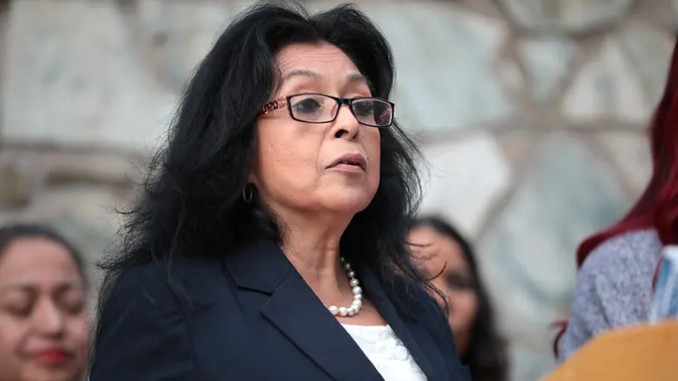
The Arizona Republican Party is targeting Democratic state House candidate Hollace “Holly” Lyon over school choice, circulating a graphic accusing the Legislative District 17 candidate of seeking to take educational options away from families.
In a post to X, the party wrote, “#LD17 voters shouldn’t let the sweet little grandma look fool them….” The accompanying graphic depicts Lyon carrying a bag of money in front of children and a school, with the message, “She Wants To Rob Your Family Of School Choice.”
The graphic’s disclaimer identifies the Republican Party of Arizona, LLC, as its sponsor and states that it was not authorized by any candidate or candidate’s agent. It does not cite a specific proposal or statement from Lyon supporting its characterization.
Lyon’s campaign website lists a pledge to “Strengthen public education and hold ESA vouchers accountable” among her legislative priorities. Her published platform does not specify whether she would seek to repeal universal eligibility for Arizona’s Empowerment Scholarship Account (ESA) program.
In an interview with Blog for Arizona, Lyon criticized the Republican-led Legislature’s adoption of “universal vouchers” for families whose children already attended private schools. She also accused lawmakers of failing to address fraud, waste, and abuse in the program.
Asked about other campaign priorities, Lyon said, “Fully funding our public schools (regardless of the ESA program) is a primary responsibility for the Legislature.” Her interview emphasized greater accountability and public school funding.
In a separate report in the Tucson Spotlight, Lyon said she supports increasing the base-level school-funding formula, improving teacher recruitment and retention through more competitive compensation, and restoring fiscal transparency to the ESA program.
“While funding alone will not solve every challenge in education, we cannot expect schools to succeed without making serious investments in students, teachers, and classrooms,” Lyon said.
The Arizona Department of Education administers the ESA program, which allows participating families to pay for private school tuition, curriculum, home education, tutoring, and other eligible educational expenses.
Under A.R.S. § 15-2402, parents participating in the program must agree to provide instruction in required subjects and use account funds for authorized expenses. The law also generally bars participating students from simultaneous enrollment in a school district or charter school and prohibits accepting a school tuition organization scholarship concurrently with an ESA in the same agreement year.
Arizona voters will decide in November whether to amend the state Constitution to require an Election Day ballot tabulation option at voting locations and government issued identification for every voter, including those voting by mail.
Proposition 144, referred to voters through House Concurrent Resolution 2001, also addresses citizenship requirements, foreign contributions, and the legal standard governing election laws.
Known as the Fast Accurate Secure Transparent Election Results Act (Fast Election Results Act), the proposal would apply to elections taking place on or after Jan. 1, 2028.
Under the final text, all voters would have the option on Election Day to have their ballots tabulated at their voting locations, with procedures prescribed by law. The provision states that its purpose is to prevent administrative delays and ensure timely, accurate results.
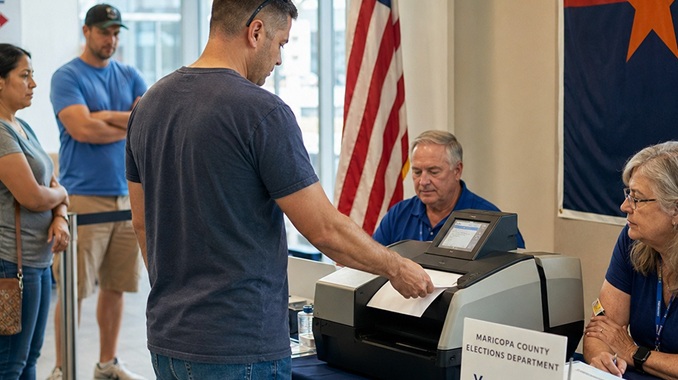
The Arizona Free Enterprise Club (AZFEC), which supports the measure, highlighted Maricopa County’s use of on-site early-ballot tabulation during the 2026 primary in an Aug. 13 commentary. The organization argued that making the option available statewide would reduce the backlog of early ballots requiring processing after Election Day and allow voters to see their ballots counted.
HOW DID PROP 144 GET ON THE BALLOT?
It took a last-minute fight at the Legislature to give Arizona voters the final say on the FAST Elections Act.
Prop 144 would put major election requirements into the Arizona Constitution, including government-issued voter ID, citizenship… pic.twitter.com/z7FeRfX4FG
In a discussion with AZFEC, Rep. Alex Kolodin (R-LD3) described GOP efforts to get the Proposition on the ballot, saying, “So what we hear from people, that they’re frustrated. They voted for Republicans to deliver things like common-sense election security, but then Republicans don’t give it to them. They just ask for money so that they can do it next time. And I was so sick and tired and embarrassed that we hadn’t done that. And so that’s why I put in all the effort that was required, and it was an enormous amount. But at the end of the day, we got it done.”
Maricopa County reported that 23,400 voters tabulated early ballots at vote centers on Election Day. County officials credited that option, along with improvements in removing ballots from envelopes and sending them to tabulation, with enabling the county to report 99% of results the following day.
Under the county’s 2026 procedures, voters bringing early ballots to vote centers on Election Day can check in, show identification, and use a tabulator programmed for early ballots. The county says ballots tabulated at vote centers are included in election-night results.
Proposition 144 would separately require valid government-issued proof of identity before casting a ballot in each election, whether voting in person or through another method. The amendment leaves implementation to law and does not specify a detailed process for presenting identification when voting by mail.
The official ballot language describes this provision as limiting acceptable identification documents to government-issued ID and extending the requirement to mail voters.
The measure would also reaffirm that only U.S. citizens may register and vote in Arizona elections and that elections must be decided solely by eligible citizen voters. It would prohibit foreign nationals from spending or contributing money or anything of value to influence an Arizona election and prohibit anyone from knowingly accepting such contributions.
Another provision would allow the people and Legislature to enact election laws, including those governing early and mail voting, when rationally connected to a legitimate state interest. Listed interests include election security, efficient administration, timely and accurate results, and public confidence.
The official ballot description says that provision would create a new standard for judicial review under the Arizona Constitution that could make election laws harder to challenge.
The Legislature would be required to appropriate money necessary to implement the measure. Its statement of intent also specifies that it does not change federal law governing the overseas military voting process.
A yes vote would approve the constitutional amendment. A no vote would retain the current constitutional provisions governing elections.
Democratic state Rep. Lydia Hernandez (D-LD24) has accused DJ Quinlan, a political consultant identified in state filings as Attorney General Kris Mayes’ campaign treasurer, of contacting her personal cellphone to pressure her over her endorsement of Republican Warren Petersen for attorney general.
Hernandez described the contact in a statement on Facebook accompanied by screenshots of the exchange. She said Quinlan texted her to criticize her decision to support Petersen and characterized the contact as harassment.
“This morning, DJ Quinlan, a political consultant associated with Kris Mayes’ campaign, texted me directly on my personal cell phone to criticize me over my endorsement of Warren Petersen for Arizona Attorney General. There is a difference between political disagreement and crossing the line,” Hernandez wrote. “We are not friends. We are not colleagues. I have never worked with him.”
The screenshots display the contact name “DJ” and the initials “DQ.” Hernandez identified the sender as Quinlan. The first incoming message reads, “Wow, you endorse the guy who told dreamers to be prepared to be deported. Gross. Selfish politician.”
Hernandez’s replies read, “Who is this?” followed by, “A text to insult me? Please refrain from contacting me again.”
The next incoming message reads, “To shame you. But you have no shame.”
A second screenshot shows Hernandez responding with a personal criticism, part of which is redacted. The sender then replies, “Oh, you remembered that we have talked” and “Good for you.”
“Mayes campaign harassing one of my endorsers. Mayes should condemn this unacceptable behavior,” Petersen wrote in a post to X. “This is par for the course for Mayes and her unprofessional team. I will restore respect and professionalism to the office.”
Mayes campaign harassing one of my endorsers. Mayes should condemn this unacceptable behavior. This is par for the course for Mayes and her unprofessional team. I will restore respect and professionalism to the office. pic.twitter.com/PGIZGwBCkx
A campaign finance report for Kris Mayes for Arizona, covering the second quarter of 2025, lists “Quinlan, DJ” as treasurer. Petersen identified the person accused of sending the messages as Mayes’ treasurer in a second post to X.
In his follow-up, Petersen called on Mayes to remove the treasurer, writing, “Mayes should drop him and condemn his unprofessional behavior.”
Kris Mayes treasurer, who didn't notice that Mayes accepted an illegal contribution last quarter, sent harassing text messages to one of my endorsers yesterday. Mayes should drop him and condemn his unprofessional behavior. https://t.co/DEY6ZzhVdD
The accusation follows Hernandez’s endorsement of Petersen over Mayes. Hernandez represents Legislative District 24 and cited public safety and schools in explaining her support for the Republican Senate president.
In a statement to AZ Free News, Mayes Campaign Manager Delaney Corcoran wrote:
“Informing someone who represents Maryvale and Arizona’s Latino community that they have endorsed an extremist who has promised family separations and the mass deportation of 70,000 Dreamers is not a threat. Intimidation is what we’ve seen from Jake Hoffman, TPUSA and other Warren supporters: aggressively attacking and calling for retribution against the 50 Republicans who bravely endorsed Attorney General Kris Mayes. Those are two very different things.”
In the statement shared by Petersen, Hernandez again pointed to school safety and said Petersen had committed to working with state education officials, the Auditor General’s Office, and the Legislature on school oversight and accountability.
“My political endorsements are my decision,” Hernandez wrote. “You can disagree with me politically all you want, but respect my boundaries.”
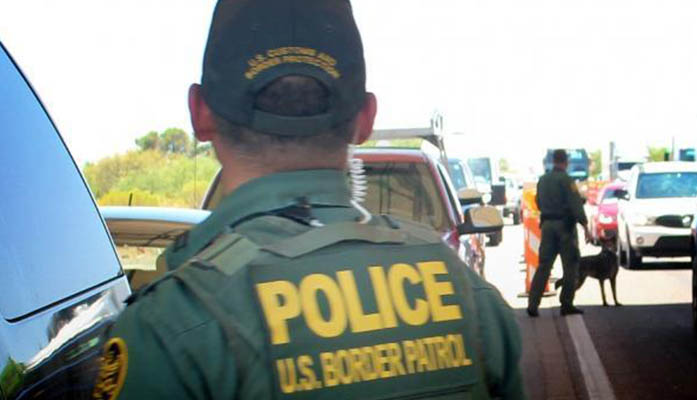
Federal officials are planning new Border Patrol station projects in Three Points, Casa Grande, and Sonoita-Elgin. U.S. Customs and Border Protection (CBP) is also preparing to build checkpoints in southern and southwestern Arizona using funding from the 2025 federal reconciliation law.
The three station proposals would accommodate a combined 1,000 agents, with each estimated to cost more than $100 million. CBP told the outlet the projects remain in early planning.
CBP said the projects would be funded through the 2025 reconciliation law commonly known as the One Big Beautiful Bill Act. Section 90002(a)(4) appropriated $5 billion nationally for expenses related to leasing, acquiring, constructing, designing, or improving CBP facilities and checkpoints.
At Three Points, a Sept. 11 forecast called for designing and building a station sized for 500 agents. The project was estimated to cost more than $100 million, with Sept. 25 listed as the projected solicitation date.
That forecast projected a contract award between October and December 2026, the first quarter of federal fiscal year 2027, and listed Sept. 1, 2029, as the anticipated contract completion date.
In an Aug. 21 letter to Pima County, CBP described a proposed site of approximately 87 acres about four miles east of the existing Three Points station and requested input for an environmental assessment.
In the letter, CBP specialist John Petrilla wrote, “The purpose of the new BPS is to accommodate the addition of new agents and personnel intended to enhance border security within the U.S. Border Patrol Tucson Area of Responsibility, with an ultimate objective of increasing the probability of apprehension of those that have entered into the U.S. illegally.”
The Casa Grande forecast describes a station for 300 agents and personnel, along with support space and other infrastructure. Its estimated cost also exceeds $100 million, with the same anticipated award quarter and September 2029 completion date. The listing identifies Casa Grande as the project location without specifying a street address.
The Sonoita-Elgin proposal would accommodate 200 agents and also exceed $100 million. The projected capacities describe the size of the facilities, rather than a confirmed increase of 1,000 agents assigned to Arizona.
CBP’s letter also identifies an alternative site along State Routes 82 and 83. The preferred Sonoita-area alternative involves an undeveloped 40-acre parcel approximately four miles southeast of the Sonoita crossroads. County officials said the location appeared to be near Elgin Elementary School.
Santa Cruz County Board of Supervisors Chairman John Fanning said that the county had requested details about site selection and the proposal’s economic, social, and environmental effects. CBP said it would seek community input as it evaluates potential locations.
CBP has not clarified whether the proposed facility would supplement or replace the existing station.
Separate federal forecasts outline two checkpoint projects, each estimated at $50 million to $100 million. The Nogales I-19 checkpoint proposal calls for a new checkpoint and supporting facilities at a preferred location adjacent to the existing checkpoint in Amado. The Wellton I-8 checkpoint proposal describes a new checkpoint and supporting facilities just west of the Dateland offramp in Yuma County. Both forecasts list anticipated contract completion on Sept. 30, 2029.
CBP said that the broader station and checkpoint investments are intended to replace aging facilities, strengthen operations, and support agents confronting human and drug smuggling. In a statement, the agency noted, “As potential locations are evaluated, CBP will seek input from local communities before projects move forward.”
Democratic congressional nominee Amish Shah did not participate in a second candidate appearance in less than a month, leaving Republican nominee Jay Feely to address voters at AMAC Action’s September 22 forum. The host said Shah did not respond to the AMAC invitation. His absence followed his decision to decline an August 26 Arizona PBS appearance.
“Please note that Democrat candidate Amish Shah was invited to participate but did not respond to our request,” the host said in the forum introduction, before introducing Feely.
“Arizonans deserve to hear from the candidates running to represent them. I’m disappointed that my opponent continues to hide from the public. But when you align yourself with Democratic Socialists, dodging questions is easier than answering for your policies,” Feely wrote.
Arizonans deserve to hear from the candidates running to represent them.
I’m disappointed that my opponent continues to hide from the public.
But when you align yourself with Democratic Socialists, dodging questions is easier than answering for your policies. https://t.co/oDv6gWLu8n
AMAC Action’s announcement listed both First Congressional District candidates as invitees to the virtual event. The organization described the forum as a nonpartisan educational program offering participating candidates equal opportunities to discuss their priorities and answer questions.
The appearance followed Arizona PBS’ August 26 “Candidates in Conversation” program, during which Feely answered questions without Shah participating. Arizona PBS confirmed that Shah declined its invitation.
At the AMAC forum, Feely discussed immigration enforcement, economic policy, and congressional stock trading.
“This election comes down to two choices. On one side you have myself who believes in free market principles, that believes in capitalism…on the other side, the Democrat party has embraced this big government, socialist belief,” Feely said.
.@JayFeely: “This election comes down to two choices. On one side you have myself who believes in free market principles, that believes in capitalism…on the other side, the Democrat party has embraced this big government, socialist belief.” pic.twitter.com/SEVjoqxfHg
“I believe the border should be completely secure, that no one should come across those borders illegally…If you come into this country illegally, you should not participate in any of our welfare programs.”
Feely also advocated for people who entered illegally to leave the country and pursue legal entry. And he endorsed restrictions on lawmakers’ financial activities.
“We should have a congressional ban on stock trading,” he said.
.@JayFeely calls to ban insider trading – something which 198 Democrats voted against:
“We should have a congressional ban on stock trading. Like Jeff, you and I shouldn't get arrested for the very things that if I'm in office I can do legally. That's not right.” pic.twitter.com/YFPioxXJ34
The National Republican Congressional Committee (NRCC) said Feely also addressed lowering costs for seniors, protecting Social Security and Medicare, and combating fraud. The committee criticized Shah’s absence and his health care positions.
“For seniors wanting answers about his socialist healthcare record, socialist Amish Shah was nowhere to be found. Socialist Shah would rather hide than defend the Bernie Sanders-AOC policies he praised,” NRCC spokesman Ben Petersen said.
Republican National Committee spokesman Nick Poche also criticized Shah in a statement provided to AZ Free News.
“Shah won’t debate because the second he opens his mouth, everyone in Arizona will know he’s an extremely far-left socialist who supports transgender surgeries for minors, soft-on-crime policies, and opening the border,” Poche said.
The Republican statements attributed Shah’s absence to his policy positions. The AMAC host’s introduction said Shah had not responded to the invitation but provided no explanation for his nonparticipation.
Health care has been a recurring subject in Republican criticism of Shah. Shah spoke in support of Sen. Bernie Sanders (I-VT) and a universal, single-payer Medicare for All system during an April 2019 Arizona for Bernie town hall.
Shah’s current campaign platform describes him as a supporter of universal health care and calls for expanding coverage, protecting Medicare, reducing premiums, and lowering prescription drug prices. His public safety platform calls for fully funding police and stopping fentanyl trafficking across the border.
Both candidates are listed for a separate First Congressional District debate scheduled for October 7 at 6 p.m. That event is part of the debate series organized by the Arizona Citizens Clean Elections Commission and the Arizona Media Association.
Feely, a former NFL kicker and broadcaster, and Shah, an emergency physician and former state lawmaker, are competing for the seat being vacated by Rep. David Schweikert (R-AZ-01). The district includes northeast Phoenix, Scottsdale, Fountain Hills, and Paradise Valley.